

My Dear Reader,
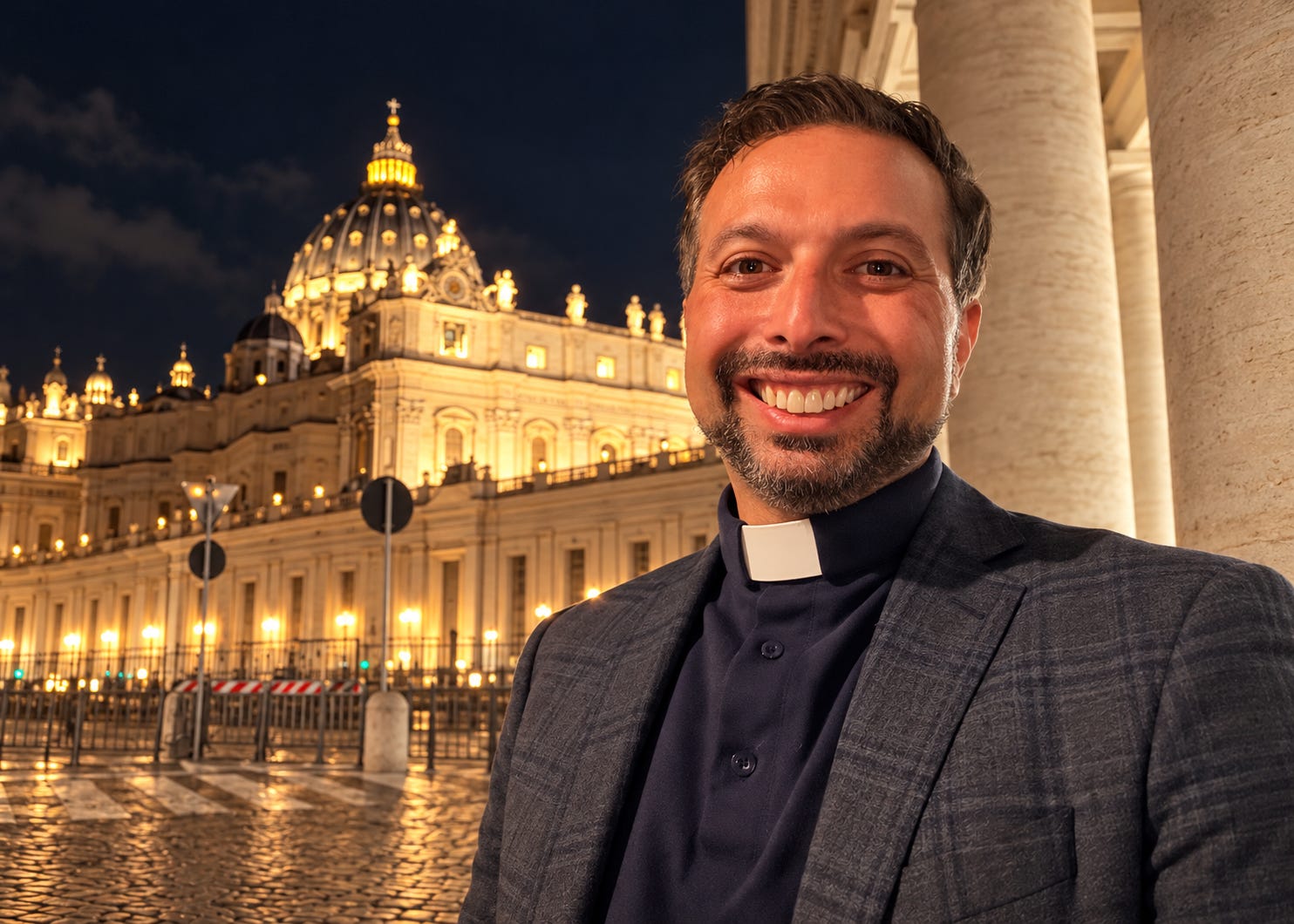
Before I left for Rome, you entrusted me with prayers for people you love, for burdens you have been carrying, and for hopes you may not have shared with many others. I carried those intentions with me and prayed with them there. This week’s essay is about what happened when our attention turned toward someone else who needed our prayers, and how a community formed across distance around that simple act of care.
This work is made possible by readers who choose to become paid subscribers. If you have room in your budget, I hope you’ll consider joining them. Your support helps keep our writing, prayer, and pastoral work available to everyone. If money is tight, please receive this essay freely and without guilt. Your presence here, your prayers, and your willingness to share the work are gifts to this community.
Your Brother in Christ,

We Came Seeking Care for Ourselves. We Ended Up Caring for The Pope.
What Rome taught us about vulnerability, prayer, and finding one another
I came to Rome looking to find out how the Church planned to accompany us. We ended up figuring out how we could accompany the Pope.
That certainly wasn’t on the itinerary.
I had come with questions about Amoris Laetitia, the Church’s teaching on love in the family, and what accompaniment might mean for people whose lives don’t fit neatly into the categories (And I have a lot to write about that still, never you worry). Behind those questions were people I know, including many of you: people who love God, long for community, and have been made to feel that something about their lives disqualifies them from belonging. I wanted to know what we could reasonably hope for, and whether the promise of accompaniment was becoming something people could actually experience.
Then concern for Pope Leo’s health entered the week, and the question became immediate. The man we were looking to for care and guidance needed our prayers himself. People across religious inclinations and circumstances began offering them, joining countless others around the world who were doing the same.
We sensed he needed us, and we were present to be there.
Over the course of the week, our invitations to prayer were viewed roughly five million times. About a thousand new people joined this Substack community along the way. Those numbers are difficult for me to take in, but reading the responses gave me something more human and very important to hold onto: people pausing in the middle of their own lives to express concern for another person. If you found your way here during those days, welcome. I’m very glad you’re here.
I should admit that I approached the nearly 50,000 social media comments with a bit of apprehension. I had been scanning for anyone saying harsh things about Leo in his illness. A great many people have been hurt by the Church, and as its most visible leader, he can become the recipient of anger that began long before his papacy. I don’t rush to judge that pain. I know something of what it feels like to love a Church that has wounded you.
Still, I was worried about what I might find, the internet being the internet. In the comments I read, I didn’t see the cruelty I had braced myself for. I saw people offering prayers and expressing concern, gathering around a man whose vulnerability they recognized. Whatever disagreements they brought with them, they wanted him to be well. And as they came together to pray for him, they found themselves among other people who cared.
I have been thinking about how much trust it takes to let ourselves be seen that way.
There was a time when cancer was so steeped in fear and stigma that people often concealed a diagnosis from friends and family. Sometimes doctors even withheld it from the patient. The word itself was avoided, adding silence to an already frightening experience. That stigma has not disappeared everywhere, but its history reminds us how illness can bring another fear with it: what will happen when other people know? The American Cancer Society describes this earlier culture of fear and denial, and the National Cancer Institute notes that stigma can still lead to isolation and avoidance.[1]
Will people look at us differently? Will they become uncomfortable and gradually stop calling? We may need company desperately and still hesitate to ask for it, because asking means giving someone the opportunity to turn away. If you’re in a position as the Holy Father is, you wonder if it creates opportunities your opponents might seek to exploit.
There is something of that risk in the simple request, “Would you pray for me?”
We say it so often in Christian life that we can overlook what someone has entrusted to us. They are allowing us into their vulnerability, admitting that something scares them, that they have a weakness, or that they cannot carry a particular burden alone. Sometimes those few words are as much as they can manage. They may be waiting to see how we receive the request before telling us anything more.
Over these past weeks, you have shared some of the most intimate things in your lives with me. You put concerns into words that I know were difficult to write, and you asked me to carry them to Rome. I want to thank you for that trust. I brought your prayers before the Lord, and I asked for the intercession of many, many saints along the way.
Some of them, I must confess, I barely knew. I would see them interred in a church and essentially say, “Hey, you. I have this book of really important prayers with me. You don’t seem too busy. Could you please pray for all of them with me?”
And so we did.
If you are suddenly contacted by Blessed Giovanni da Fiesole, better known as Fra Angelico, you’ll know what happened.
I love the familiarity of being able to ask a saint for help like that. We believe that our belonging to one another in Christ continues beyond death. I could stand in a church thousands of miles from your home, beside the resting place of someone who lived centuries before either of us, and ask him to pray with me for you. Your concern belonged in that church as surely as any of the prayers offered there over the centuries.
Carrying that book gave me a particular way of experiencing the places I visited. I had people to remember and intentions to bring before God. Although most of you were far away, you were part of what I was doing there. And when we prayed for Leo, our circle of concern widened to include someone whose responsibilities can make it easy to forget that he needs care, too.
Those of us who spend our lives trying to accompany others do not outgrow that need. There are times when we need someone to ask how we are and stay long enough to hear the answer. A collar does not spare us fear, and neither does the white cassock of a pope.
In Gethsemane, Jesus brought His friends with Him into His sorrow and asked them to remain nearby and keep watch. I return to that scene when we Christians become embarrassed about needing other people. Our Lord was willing to ask for company during His anguish. We can allow ourselves to ask for it in ours.
Of course, we cannot always be physically present. Most of us could offer Leo no practical help at all. Many of you live far beyond any distance I could travel for a visit. Yet prayer allows us to bring one another before God wherever we are, asking for healing, strength, and help with a love that distance does not make meaningless.
It can also change what we notice afterward. Once we have prayed for someone, we may remember to ask how the appointment went. We may make the call we had been putting off, or recognize that the person who always seems capable is struggling. Their life has entered our attention, and we begin to consider what being there for them might require.
That is where the messy work of being a family becomes real. We learn to ask for help, to receive confidences with care, and to stay in touch when a difficulty lasts longer than anyone expected. We also have to learn how to love people with whom we may have unfinished arguments.
Your willingness to care gave me hope, particularly because I had come to Rome wondering what welcome might be possible for people who have spent so long at the margins. Here were people already reaching toward one another, offering the very accompaniment I had come to ask about.
I went with a hunch that folks might be better welcomed, if incompletely, back into the Church. I came home more convinced of how desperately we need each other, and how much we want to be with each other when we can trust that our presence will be received with love.
For those of us who are Christian, this mutual care belongs to our life as one people in Christ. It also draws us toward people who do not share our faith, but whose needs and hopes do have a claim on our compassion. There is room in our prayers for people who are unsure what they believe, who are angry with God, or who cannot bring themselves to pray at all. We can remember them by name and ask God to be near them.
Now that I am home, I keep thinking about the lives represented in that book you blessed me with. My trip has ended, but you still have the appointments ahead of you, the person you are worried about, the difficulty you trusted me enough to share. I will continue bringing those intentions before the Lord every day throughout the day. Jesus is just as present in the Chapel here as He is in St. Peter’s.
I came to Rome hoping to learn how the Church might better welcome people who have found themselves at its margins. I came home with something I did not expect: a glimpse of us caring for one another. You entrusted me with your prayers; together, we prayed for Leo; and in the doing, people who may never meet found common ground in wanting another person to be well. We need one another, and we want to be with one another.
The trip has ended, but the lives represented in that prayer book continue. I will keep carrying your intentions before the Lord. I hope we will keep receiving one another’s requests with love, and remembering one another long after the conversation has ended.
I am still praying for you. Please keep praying for the Pope, for one another, and for everyone who needs someone to stay close in a hard time.
Oh,
and if you could,
pray for me too, please.
And Let Us Pray…
God of mercy,
Receive the prayers entrusted to us
and hold close everyone who is frightened,
ill, lonely, or carrying more than they can bear.
Give strength and healing to Pope Leo.
Bless those who have asked us to pray,
and teach us to remember them with patience and love.
Help us become a community
in which no one has to hide their need
or fear being turned away.
Keep us near to one another,
and near to You.
Amen.
And now it’s your turn
Has someone ever invited you into their vulnerability by asking you to pray for them? What did that trust mean to you? If you feel comfortable, tell us about it in the comments. Please share only what you are ready to share.
If this reflection brought someone to mind, consider sending it to them. Sometimes a simple “I’m praying for you” is a way of letting someone know they do not have to carry everything alone.
Thank you for the prayers you sent to Rome, and for the care you offered to one another here. The community grew by about a thousand people during this week, and I hope each person who has joined will find a place to think, pray, ask questions, and be treated as a soul rather than an argument.
Message From the Margins depends on readers who are able to support it. If this ministry has become a meaningful part of your life and you have room to help, a paid subscription is one practical way to keep this work going and accessible to everyone. If you cannot contribute financially, you belong here just as fully. Thank you for reading, praying, commenting, and sharing.