

Before We Begin…
First, thank you.
This community just crossed 7,000 community members here on Substack, and I wanted to take a moment to say how grateful I am that you’re here.
Whether you’ve been reading since the beginning or just stumbled into this little corner of the internet last week, thank you for spending part of your day with us. Every comment, every prayer, every email, every share, every subscription, and every thoughtful conversation has helped build something I never could have created alone.
June 10th marks the first anniversary of Message From the Margins. One year.
Honestly, that feels a little surreal.
If you have ideas for how we should celebrate turning one year old, I’d love to hear them in the comments.
A second update: I am actively working on the very first Message From the Margins podcast episode as we speak, and if all goes according to plan, I hope to launch it sometime this week.
Part of the podcast will include a segment called Questions From the Margins, where I’ll answer reader questions about faith, spirituality, Scripture, theology, psychology, prayer, current events, Church history, or just life in general.
We already have a few excellent questions waiting in the queue, but I’d love to receive more. You can truly ask me anything.
For now, Questions From the Margins is available as a small thank-you to those helping support the material aspects of this ministry through paid subscriptions.
And finally, thank you to every paid subscriber who helps make this work possible.
One of the things I love most about this community is that we have chosen a different path. No outrage farming. No clickbait. No treating people like products. No trying to keep everyone angry enough to boost engagement.
Just thoughtful conversation, spiritual reflection, prayer, and a shared commitment to remaining human in a world that often rewards the opposite.
Your Brother in Christ,

Now, on to today’s reflection.
A Cage Does Not Need a Lock
Poverty, sin, crime, and the Christian duty to build open doors
Every church seems to have one.
Sometimes it’s a folding table tucked against a wall in the vestibule. Sometimes it’s a bulletin board crowded with flyers no one has straightened in months. Sometimes it’s a wicker basket near the entrance with a handwritten sign asking for canned goods. Sometimes it’s a corner of the parish hall where bags of rice, jars of peanut butter, diapers, and toiletries slowly accumulate throughout the week.
The details change from church to church, but the message is always the same:
Someone nearby is hungry.
Someone’s electric bill is overdue.
Someone’s child needs diapers.
Someone is trying to decide whether this week’s money goes toward groceries, medication, rent, or gas.
Most of us know exactly what to do when we see that table. We drop off a few items. We write a check or in more recent days, a parishioner asks if they can Venmo or Zelle Me. We feel glad the church is helping. We may even whisper a prayer for the people who will receive whatever we’ve brought.
Then we continue on to coffee hour, choir rehearsal, Bible study, or Mass.
We rarely stop and ask a more unsettling question:
Why does Jesus keep talking about the poor?
Not why it is nice. Not why it is admirable. Not why decent people should be compassionate. I mean the deeper question.
Why does Christ return to the poor, the hungry, the prisoner, the stranger, the sick, the indebted, the outcast, and the publicly shamed over and over and over again?
Afterall, he came to redeem the world, not start a non-profit, right?
We often treat care for the poor as if it were a kindness project. Be generous. Be decent. Try not to look away. Volunteer when possible, and pray for them each day.
That is good, as far as it goes. But Jesus rarely commands us to do things merely because they are nice.
The deeper reason, I think, is that poverty is one of the clearest places where our captivity becomes visible.
Poverty does not only empty a bank account. It narrows a life. It limits options. It delays medical treatment. It exhausts the body. It humiliates the spirit. It teaches people what doors are for other people. It can make gangs look like family, drugs look like peace, violence look like power, and crime look like the only open door.
A cage does not need a lock if the person inside has been taught the door will never open.
That sentence has been nagging me because I think it explains more than we usually want to admit.
A person may technically have choices. Of course. Human agency matters. Christian faith cannot make sense of repentance, holiness, forgiveness, or judgment if we pretend human beings are machines merely reacting to circumstances past and present.
But agency can be wounded
diminished.
It can be starved.
It can be shaped by trauma, addiction, untreated mental illness, violence, neglect, bad schools, predatory economies, unstable housing, family systems that never learned tenderness, and neighborhoods where hope is treated like a luxury item.
This is where our ordinary language about sin often becomes too thin.
We tend to imagine sin as an isolated act of personal rebellion. A person knew the good, had every reasonable opportunity to choose it, and defiantly chose evil instead. Sometimes that is exactly what sin is.
But sometimes sin is captivity.
Sometimes sin is the survival strategy that became a prison. Sometimes it is rage learned early and practiced often. Sometimes it is the self-medication of a soul that has never known safety. Sometimes it is a desperate reach for belonging in a gang because every healthier form of belonging failed to show up. Sometimes it is the lie a person tells after growing up in a world where honesty only made them more vulnerable.
None of this makes harm harmless.
If someone steals, someone else loses. If someone becomes violent, someone else is wounded. If addiction takes over a home, children suffer. Christian mercy does not require moral blindness.
But moral clarity becomes cruel when it notices the wound only after it has become someone else’s problem.
The relationship between poverty, inequality, and crime is complicated, and we should say that plainly. A recent meta-analysis of 43 economic studies found that the effect of income inequality on crime is, at best, small and difficult to isolate. Poverty does not automatically create crime. Wealth does not automatically create virtue. Human beings are more complicated than that.
In fact, wealth often creates opportunities for entirely different forms of wrongdoing. We need only glance at the headlines to see fraud, corruption, exploitation, insider dealing, wage theft, predatory lending, and financial misconduct committed by people with impressive résumés and corner offices.
The difference is that society tends to view these crimes differently. The crimes of the poor are often visible, disruptive, and frightening. Sometimes cinematic. The crimes of the powerful are frequently buried in paperwork, contracts, boardrooms, and balance sheets.
One creates a viral TikTok.
The other creates a quarterly earnings report.
We have a moral vocabulary fluent in the sins of the poor and strangely inarticulate about the sins of the comfortable.
Still, the evidence is more than strong enough to tell us that incarceration, untreated illness, addiction, and poverty keep showing up in the same neighborhoods, the same families, and often the same bodies.
The Prison Policy Initiative, using Bureau of Justice Statistics data, found that people in prison had a median annual income of $19,185 before incarceration, in 2014 dollars, which was 41 percent less than non-incarcerated people of similar ages. SAMHSA (Substance Abuse and Mental Health Services Administration) reports that people with mental and substance use disorders are overrepresented in the justice system; it estimates that 44 percent of people in jail and 37 percent of people in prison have a mental illness, while 63 percent of people in jail and 58 percent of people in prison have a substance use disorder.
Read those numbers slowly.
We are not only looking at “bad choices.” We are looking at untreated suffering, disordered belonging, economic exclusion, trauma, and despair passing through the machinery of punishment.
The CDC has also found that adverse childhood experiences, including trauma before the age of eighteen, are associated with increased risks of substance use, violence-related behaviors, poor mental health, and other long-term harms. A broad review on the social determinants of mental health points in the same direction: poverty, inequality, discrimination, and social exclusion are not background scenery. They are part of the architecture that shapes mental health and disorder.
Christians should not be surprised by this.
We believe the human person is embodied. We believe the soul is formed in families, neighborhoods, economies, habits, wounds, rituals, and loves. We believe sin can be personal, social, structural, inherited, chosen, endured, resisted, and repeated. We believe grace does not erase reality. Grace enters reality and begins the work of healing it.
So here is the framework I would offer:
When we see destructive behavior, Christians should ask three questions.
First, what harm was done?
Second, what captivity made this harm more likely?
Third, what would freedom require from the person, the Church, and the wider community?
Most public debates stop at the first question. Someone did wrong. Someone broke the law. Someone used drugs. Someone joined a gang. Someone lied. Someone lashed out. Someone failed their children. Someone created chaos.
The first question matters.
The second question is where Christian maturity begins.
The third question is where discipleship becomes costly.
Because if sin is captivity, the Church cannot limit itself to shouting instructions through the bars.
Jesus begins His public ministry in Luke’s Gospel by reading from Isaiah: good news to the poor, freedom for the prisoners, recovery of sight for the blind, freedom for the oppressed. That is Luke 4. It is not a decorative mission statement. It is the shape of the Kingdom.
Christ does not announce a freedom that leaves the cages intact.
A Quick Pause
A strange thing has happened over the last year.
Thousands of people have gathered here looking for something that feels increasingly rare online: thoughtful faith without manipulation, compassion without naivety, and Christian reflection that takes both the Gospel and the real world seriously.
This community recently crossed 7,000 members, and I still find that remarkable.
Many of these reflections remain free because I genuinely believe the Gospel should be accessible. The people who choose to become paid subscribers help make that possible. They help keep this space independent, free from ads, outrage farming, and all the other incentives that reward keeping people angry and exhausted.
If these reflections have helped you think more clearly, pray more deeply, or remain a little more hopeful in difficult times, I hope you’ll consider supporting the work.
And to every paid subscriber already here: thank you. You are helping create a different kind of Christian community online.
That is deeply important.
He does not say, “I have come to tell captives to pull themselves up by their bootstraps.” He does not say, “I have come so the poor can just do better while nothing changes.” He proclaims release. He announces liberation. He confronts the powers, visible and invisible, that keep human beings bound.
And then He gives that work to His people.
That is the part we often prefer to spiritualize.
We like a Gospel that forgives sin. We become less enthusiastic when the Gospel starts asking why so many people are trapped in conditions where sin feels like survival.
The Church’s tradition has never understood care for the poor as optional sentiment. The United States Conference of Catholic Bishops, the American Governing Body of the Roman Church, summarizes the Catholic social teaching tradition by saying that the deprivation and powerlessness of the poor wounds the whole community, and that the preferential option for the poor is meant to help all persons share in and contribute to the common good. The Catechism teaches that the goods of creation are destined for the whole human race, and that ownership carries a responsibility to use goods in ways that benefit others, especially the sick and the poor.
This is not Marxism wearing a chasuble.
This is the Deposit of Faith refusing to let private comfort become the measure of moral order.
The Christian tradition understands that poverty is not merely unfortunate. It is dangerous to the soul, to the body, to families, to communities, and to the moral imagination of everyone who learns to tolerate it.
And yes, the poor may be difficult to love.
That sentence may make some people flinch, but every serious pastor, social worker, teacher, parent, nurse, chaplain, and recovery sponsor knows what it means.
Poverty does not automatically make people noble. Suffering does not always refine. Sometimes suffering curdles. Sometimes it makes people suspicious, reactive, manipulative, exhausted, angry, numb, or hard to reach. Sometimes people who have been abandoned learn to test every act of love until they can make it break first.
The poor rarely look like Oliver Twist.
Jesus knew that.
Do we really think Christ told us to love the poor because poverty makes people tidy, grateful, sober, polite, employable, charming, and easy to welcome into respectable rooms?
It is easy enough to love the polished middle-class woman in horn-rimmed glasses, the J. Crew shirt dress, and the kind of witty humor that makes brunch feel nearly sacramental. She may be delightful. I might enjoy her immensely.
But she is not the test case Jesus keeps placing in front of the Church.
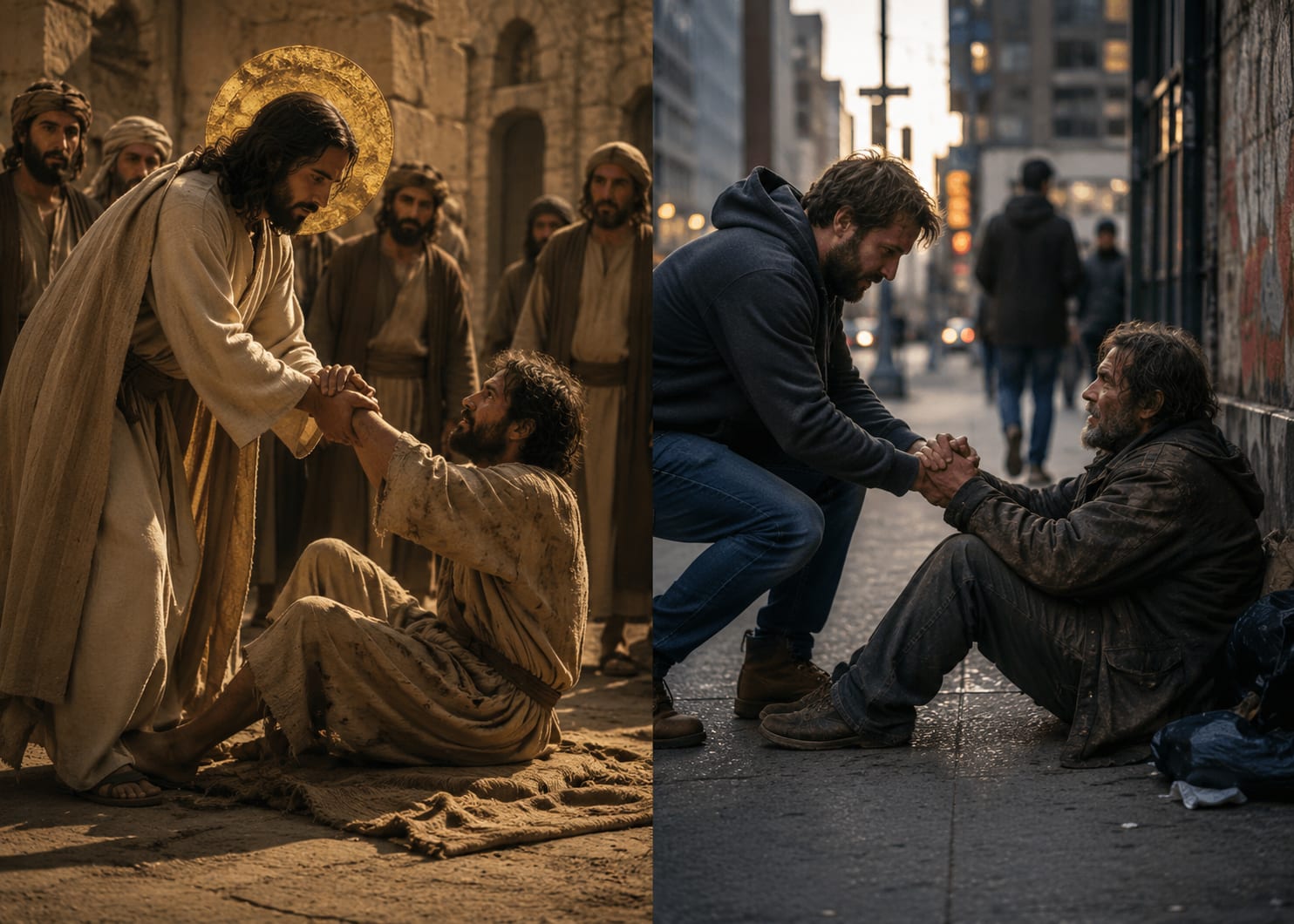
Christ sends us toward the wounded man on the road. Toward the prisoner. Toward the hungry. Toward the one who smells bad. Toward the one who has made a mess. Toward the woman dragged into public shame. Toward the tax collector everyone hates. Toward the leper whose body frightens the crowd. Toward the possessed man living among the tombs.
And He does not send us there so we can admire their resilience from a safe distance.
He sends us there because love is the beginning of liberation.
This is why “go and sin no more” has to be read with the whole scene still intact.
People love to quote that line from John 8 as if Jesus used it to win an argument on the internet. The woman caught in adultery stands before Him. The crowd has stones in-hand ready to attack. The religiously respectable have Scripture, or at least the parts of Scripture that serve their purpose. They are ready to turn her sin into a stage for their righteousness.
Jesus interrupts the execution.
He dismantles the mob.
He refuses to let her be reduced to the worst thing she has done.
Only after the stones have dropped, only after shame has lost its audience, only after her immediate death has been taken off the table, does He say, “Go now and leave your life of sin.”
Maybe that command sounds different when we remember the mercy that came first.
Maybe holiness begins to look possible only after someone has been given a future.
Maybe the systems that perpetuate the cycle have to be dismantled before better outcomes can be expected.
John 11 gives us another piece of the same pattern. Jesus calls Lazarus out of the tomb. Lazarus comes out alive, but still wrapped in grave clothes. Then Jesus turns to the people around Him and tells them to take off the grave clothes and let him go.
That is a remarkable image of the Church’s work, often lost in the spectacle of the story.
Christ raises the dead. The community still has to help remove what binds them.
There are freedoms God announces that the community must help make livable.
This is the point our public life keeps missing.
We know how to condemn theft at the convenience store. We become strangely sophisticated when discussing wage theft.
We know how to condemn the addict on the sidewalk. We become patient philosophers when the pharmaceutical industry, predatory treatment centers, or liquor stores clustered in poor neighborhoods profit from despair.
We know how to condemn the gang member. We become terribly realistic about school funding, housing segregation, employment discrimination, and the absence of safe adult belonging.
We know how to condemn disorder when it makes us uncomfortable. We struggle to condemn the kind of order that keeps people trapped.
And then we call ourselves morally serious.
This is where wealth inequality becomes more than an economic issue. It becomes a spiritual formation issue.
Extreme inequality teaches some people that they are entitled to endless insulation from consequences. It teaches others that no legitimate door was built for them. The wealthy may have lawyers, therapists, tutors, safe neighborhoods, family money, flexible time, reputation repair, second chances, and rooms where their failures are interpreted generously.
The poor often get a criminal record before their 18th birthday.
Then we ask why their lives do not display the same polish.
A cage does not need a lock if the person inside has been taught the door will never open.
This is also where the fierce reaction against DEI deserves a calmer, deeper reading than the culture war usually allows.
I know the acronym has been beaten like a piñata. Some programs were clumsy. Some were performative. Some probably deserved criticism. Institutions have a genius for taking a morally serious idea, burying it under training modules, and making everyone in the room resentful by slide three.
Fine. Say that.
But at their best, diversity, equity, and inclusion efforts tried to do something profoundly human: make the open door visible.
The American Psychological Association describes equity, diversity, and inclusion as a framework that promotes fair treatment and full participation, especially for people historically underrepresented or subjected to discrimination because of identity, background, disability, or other factors.
In plain English, at their best, these efforts told people who had inherited generations of closed doors: there is an open door here.
Not a guaranteed outcome.
Not a lowered standard.
Not a prize for existing.
A door.
And for people whose grandparents were barred from certain schools, whose parents were denied mortgages, whose neighborhoods were starved of investment, whose names were treated as suspicious on résumés, whose disabilities were ignored, whose accents were mocked, or whose bodies were over-policed, the visible presence of an open door is not symbolic fluff.
It is a direct contradiction of captivity.
That does not mean every policy carrying the DEI label is wise. Christians should be able to critique methods without sneering at the wounded. We should be able to ask whether a program actually helps people flourish without pretending exclusion never happened.
But when a society becomes enraged by the mere sight of an open door, we should pay attention.
Open doors threaten people who have confused inherited advantage with virtue.
They also threaten people who have built their moral identity on the belief that everyone already had the same chances they did.
This is the public theology point: mercy is not sentiment. Justice is not revenge. Freedom is not a slogan. The Gospel asks us to build conditions where holiness is more possible.
That means food.
Housing.
Treatment.
Safe schools.
Mentorship.
Reentry support.
Addiction recovery.
Mental health care.
Employment pathways.
Legal aid.
Belonging strong enough to compete with the street.
Because if the gang offers family, protection, status, money, and identity, while the Church offers judgment and a folding chair in a basement, we should not be shocked when the streets wins.
That sentence bothers me because I think it may be true.
The Church cannot preach freedom to captives while leaving the cages intact.
The Church cannot meaningfully serve the poor while embracing public narratives that reduce vulnerable people to threats, burdens, criminals, statistics, or inconveniences.
The Gospel consistently moves in the opposite direction. Jesus refuses to reduce people to the worst thing they have done, the poorest quality they possess, or the category society has assigned them.
He insists on seeing a person where everyone else sees a problem.
We also cannot pretend that accountability and abandonment are the same thing. People who harm others need to be stopped. Victims need protection. Children need safety. Communities need order. Mercy without protection becomes another way to sacrifice the vulnerable.
But accountability worthy of the Gospel must ask what kind of freedom comes next.
Do we want a person merely punished, or do we want them restored?
Do we want addiction merely shamed, or do we want treatment available?
Do we want the teenager out of the gang, or do we have somewhere for him to belong?
Do we want the woman leaving survival sex, or do we have housing, trauma care, employment, protection, and friendship ready for her?
Do we want the man coming home from prison to “turn his life around,” or do we have any door open that would allow him to do so?
“Go and sin no more” is not serious when there is nowhere to go.
This is where Christians have to recover our nerve.
We cannot out-punish captivity into freedom. We cannot shame despair into hope. We cannot sermonize addiction into healing while treatment remains unaffordable or easily revoked. We cannot tell people to choose life while every livable path remains blocked, hidden, or guarded.
The Gospel calls for more than pity.
It calls for open doors.
Some doors are personal: forgiveness, friendship, presence, mentorship, prayer.
Some doors are institutional: housing, education, healthcare, employment, fair wages, restorative justice.
Some doors are spiritual: confession, repentance, healing, worship, belonging, the slow discovery that God does not despise the person the world has already thrown away.
Some doors are political, and yes, that makes people nervous. It should. Politics is one of the ways societies decide whose suffering will remain normal.
But the command of Christ is not nervous.
Care for the poor. Feed the hungry. Visit the prisoner. Welcome the stranger. Tend the sick. Bind the wounds. Remove the grave clothes. Proclaim freedom to captives.
And then live as though the proclamation requires work.
The poor are not a charitable category. They are not a seasonal project. They are not props in the spiritual formation of the comfortable.
They are human beings in whom Christ has promised to meet us.
And when we meet Christ there, we may discover that the cage was never only around them.
Some of us are captive to comfort.
Some of us are captive to the need to feel innocent.
Some of us are captive to a religion that loves mercy as a word but fears what mercy requires.
Some of us are captive to a version of holiness that has more patience for respectable cruelty than visible desperation.
The poor reveal captivity because their wounds are harder to hide. The comfortable often have better wallpaper.
So perhaps the question is not only why Jesus tells us to care for the poor.
Perhaps the question is what He knows we will become if we refuse.
Practical Integration
Here are five practices for the week.
First, read Luke 4:16-21 slowly.
Do not rush to apply it. Notice the people Jesus names: the poor, the prisoners, the blind, the oppressed. Ask what kind of Church would make that proclamation believable.
Second, notice one place where you usually jump straight to judgment.
It may be addiction, homelessness, incarceration, debt, anger, family instability, or someone’s public failure. Ask three questions: What harm was done? What captivity may be present? What would freedom require?
Third, make one open door visible.
This can be practical and small. Share a job lead. Offer a ride. Contribute to a bail fund or reentry ministry. Help someone navigate paperwork. Invite someone into a room they assumed was closed to them.
Fourth, examine one respectable sin.
Look at your own life, church, workplace, or politics. Where have comfort, reputation, efficiency, profit, or safety become excuses for ignoring the suffering of others?
Fifth, pray for the difficult poor, not only the grateful poor.
Pray for the person whose wounds come out sideways. Pray without romanticizing them. Ask God for mercy with a backbone.
A Community-Oriented Closing
This is the kind of conversation Message From the Margins exists to have: not outrage, not easy answers, not religious varnish over social cruelty, but serious Christian interpretation of the world we are actually living in.
I would love to hear where this lands for you. Where have you seen poverty become captivity? Where have you seen an open door change a life? And where do you think the Church still has grave clothes to remove?
If this helped you think more clearly about sin, poverty, mercy, and freedom, share it with someone who still believes the Gospel has something serious to say about public life.
Closing Prayer
Lord Jesus Christ,
You came to proclaim good news to the poor and freedom to captives. Give us the courage to hear those words without softening them into sentiment.
Teach us to see the cages we have ignored: poverty, addiction, untreated illness, trauma, violence, loneliness, and the despair that teaches Your children no door will ever open for them.
Forgive us for the times we have confused condemnation with holiness. Forgive us for quoting “go and sin no more” while refusing to help make freedom possible. Forgive us for caring more about respectable order than human dignity.
Make Your Church a place of open doors. Give us mercy that protects the wounded, justice that restores the broken, and courage that does not disappear when love becomes difficult.
Help us feed, heal, welcome, advocate, accompany, and unbind. Help us recognize You in the poor, the prisoner, the stranger, the sick, the addicted, the ashamed, and the ones we are tempted to avoid.
Free us, Lord, from every captivity that keeps us from love.
Amen.
Before You Go…
The internet keeps insisting that the best way to build an audience is to make people angry.
I’m happy to report that we continue to ignore this advice.
Message From the Margins has now grown to more than 7,000 community members because thousands of people decided they wanted something different: thoughtful conversation, honest faith, meaningful prayer, and a place where compassion and moral seriousness can still belong together.
If you’re already a paid subscriber, thank you. Truly. You help keep most of this work available to everyone, support future projects, and make this ministry possible.
If you’re considering becoming a paid subscriber, I’d be honored to have you join us. Paid members help support everything we’re building, including the upcoming Message From the Margins podcast, future courses and resources, community gatherings, and our new Questions From the Margins segment.
We’re currently gathering questions for the podcast, and we’ve already received some wonderful ones. Questions From the Margins is available as a thank-you to those helping support the material aspects of this ministry. You can ask about faith, Scripture, prayer, theology, psychology, current events, Church history, or simply the struggles of ordinary life.
And one more thing…
On June 10th, Message From the Margins turns one year old.
If you have ideas for how we should celebrate, I’d love to hear them.
Thank you for reading, for sharing these reflections, for praying with us, and for helping build a community that refuses to surrender either its compassion or its common sense.
We’re just getting started.