

Yesterday, I mentioned that we were donating 50% of new subscription revenue to the Wounded Warrior Project as a small way of trying to live Matthew 25 together as a community.
Well… after tallying everything up, that came to $218.15.
Which is honestly amazing.
Also, apparently one blessed soul subscribed in Euros, which both delighted me greatly and explains the oddly specific number.
A few people emailed afterward asking if we could continue this another day.
My answer was very simple:
Absolutely.
So today, 50% of all new subscription revenue will again be donated to the Wounded Warrior Project.
This is not an official partnership or sponsorship or anything formal like that. I’m literally just taking the subscription revenue, dividing it in half, and making a donation in our community’s name. I’ll show the receipt once we complete our drive today.
Because I really do believe communities of faith should strive to live the words of Matthew 25 in both big ways and small:
“I was hungry and you gave me something to eat… I was sick and you visited me…”
That kind of Christianity matters now more than ever.
And honestly, I’d love to see if together we can reach a nice round $500.
Thank you for helping make Message From the Margins not merely a publication, but a genuinely compassionate community.
The new essay drops below.
With Tremendous Gratitude,

The Pope’s Warning About Becoming Less Human
Pope Leo XIV’s new encyclical is not really about artificial intelligence. It is about what happens when a civilization forgets how to recognize the sacredness of human beings.
A few nights ago, I caught myself doing something I suspect a lot of people do now without even thinking about it.
I had already finished working for the night. The chapel lights were off. Figgy was asleep beside me. And yet there I was, still sitting in front of my laptop, refreshing email, scanning headlines, half-reading three articles at once while my phone vibrated every few minutes with notifications I did not actually need to see.
At some point I realized I was no longer even absorbing information. I was just… processing.
Input.
Output.
Stimulus.
Response.
And honestly, that frightened me a little.
Not because technology is evil. I use technology constantly. My ministry would not exist without it. Most of us carry supercomputers in our pockets now and barely think about it anymore.
But there is a growing feeling many people cannot quite articulate, the feeling that modern life increasingly treats human beings less like souls and more like systems to optimize.
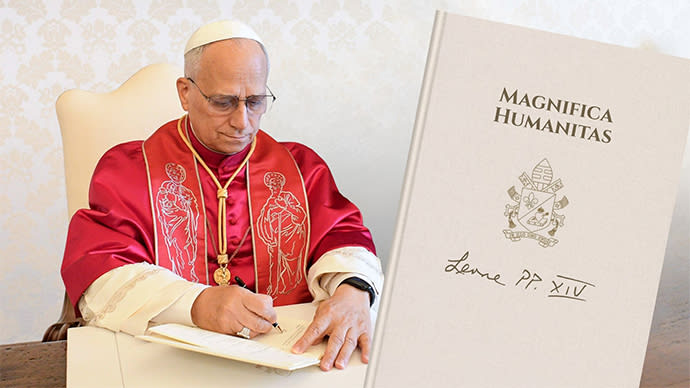
That is why Pope Leo XIV’s new encyclical Magnifica Humanitas struck me so deeply this week.
Most headlines are calling it “the AI encyclical.” That is technically true. The document spends considerable time discussing artificial intelligence, automation, data systems, labor, and technological power.
But after reading it carefully, I do not think AI is actually the central concern of the document.
The real concern is much older and much deeper.
What happens when efficiency becomes the highest moral value in a civilization?
Because once that happens, human beings slowly start getting evaluated the same way machines are.
Useful or not useful.
Efficient or inefficient.
Profitable or unprofitable.
Productive or unproductive.
And after enough years living inside systems like that, people begin doing it to themselves.
You can hear it in how exhausted people speak now.
“I’m falling behind.”
“I haven’t done enough.”
“I need to be more productive.”
“I can’t afford to slow down.”
“I feel guilty resting.”
After a while, the human soul starts sounding like middle management.
Pope Leo repeatedly warns against what he calls a “technocratic mentality,” the idea that human beings are primarily problems to manage, data to organize, or resources to maximize.
And honestly, once you see it, you cannot unsee it.
Social media platforms train people to think of themselves as brands.
Workers are increasingly managed by algorithms.
Artists become “content creators.”
Friendship gets quantified through engagement metrics.
Even rest now gets marketed as performance optimization.
Sleep better so you can produce more.
Meditate so you can focus harder.
Exercise so you remain competitive.
Everything becomes instrumentalized.
The encyclical becomes especially powerful when Pope Leo turns toward the hidden labor beneath artificial intelligence itself.
He reminds readers that AI is not magic. It is built on physical systems and human labor most people never see.
Miners extracting rare earth minerals.
Workers labeling data for pennies.
Content moderators absorbing psychological trauma hour after hour.
Factories.
Server farms.
Invisible labor markets.
At one point, he warns that technologies promising liberation can easily create “new forms of slavery” when profit and efficiency become detached from human dignity.
That line stayed with me.
Because many modern people already feel strangely disposable.
Companies report record profits while eliminating thousands of workers.
People train systems that may eventually replace them.
Entire careers become unstable overnight.
Young adults increasingly wonder whether they will ever own homes, retire securely, or experience the kind of stability previous generations assumed was normal.
And into this already anxious world comes AI.
Again, Pope Leo is not panicking about robots becoming conscious. The document is much more intelligent than that.
His fear is spiritual.
He is asking whether a civilization built entirely around optimization eventually loses the ability to recognize the sacredness of persons.
That is a very Christian question.
Genesis says human beings are made in the image of God.
Not in the image of productivity.
Jesus consistently treated people as more important than systems.
He stopped for interruptions.
He noticed the overlooked.
He spoke to people society considered economically, morally, or socially inconvenient.
Children.
Foreigners.
The sick.
The grieving.
The poor.
He never reduced human worth to usefulness.
And that matters enormously right now because modern life increasingly pressures people to justify their existence through performance.
Many people are exhausted not simply because they work too much, but because they feel they must constantly prove they deserve rest, security, attention, or dignity in the first place.
That is spiritual erosion.
One of the most surprising parts of Magnifica Humanitas is where Pope Leo turns toward the Eucharist near the end of the document.
At first it almost feels strange. The encyclical has spent so much time discussing algorithms, economics, labor systems, and technological power that the shift catches you off guard.
But then the deeper point becomes clear.
The Eucharist is the exact opposite of a technocratic worldview.
Modern systems increasingly train us to categorize, optimize, monetize, accelerate, and control.
The Eucharist teaches communion.
Presence.
Relationship.
Memory.
Shared dignity.
Human beings gathered together not because they are profitable, but because they belong to one another before God.
That is not nostalgia. It is resistance.
The Church cannot out-algorithm Silicon Valley. It should not try.
But Christianity still has something the modern world desperately needs, a vision of the human person that insists people possess dignity beyond usefulness.
I suspect that is part of why so many people responded emotionally to this encyclical so quickly.
Deep down, many people already know something in modern life feels increasingly inhuman.
Pope Leo simply said it out loud.
And perhaps that is the real warning of Magnifica Humanitas:
The greatest danger of artificial intelligence is not that machines become more like human beings.
It is that human beings increasingly accept being treated like machines.
An Encyclical Letter is a letter written by the Pope to “All People of Good Will.” Which means, it’s not an edict, or a proclamation, it’s not even explicitly reserved for Roman Catholics. It is a letter to you and to me. If you’d like to read Pope Leo’s words yourself, you can find them at the button below. I highly encourage you to make the time to read it, it is nourishment for the soul.
Did you read the Encylical Letter? I’d love to hear your thoughts!
And if someone you know is anxious about Artificial Intelligence, share this newsletter.
Closing Prayer
Lord Jesus Christ,
You saw people clearly in a world that often reduced them to status, usefulness, or shame. You stopped for the suffering, the overlooked, and the exhausted. You reminded people again and again that human life carries sacred dignity.
Protect us from becoming numb inside systems that train us to value efficiency more than compassion.
Protect us from believing our worth depends entirely on productivity, performance, or success.
Give wisdom to those shaping powerful technologies. Give courage to leaders making economic decisions that affect millions of lives. Give rest to people carrying exhaustion they can no longer explain.
Help us remember that we are human beings before we are workers, consumers, or metrics.
And teach us again how to recognize Your image in one another.
Amen.
And one friendly reminder before you go:
Today is the final day that 50% of all new subscription revenue will be donated to the Wounded Warrior Project.
Yesterday, this community raised $218.15 together, which honestly moved me deeply. So many of you reached out asking if we could continue for one more day, and the answer was an immediate yes.
This is not an official partnership or sponsorship. We are simply trying, in our own small way, to live the words of Matthew 25 together.
So if you subscribe today, you will not only support Message From the Margins and this ministry, you will also help support veterans through the Wounded Warrior Project.
I would genuinely love to see if together we can reach a nice round $500 before the day ends.