

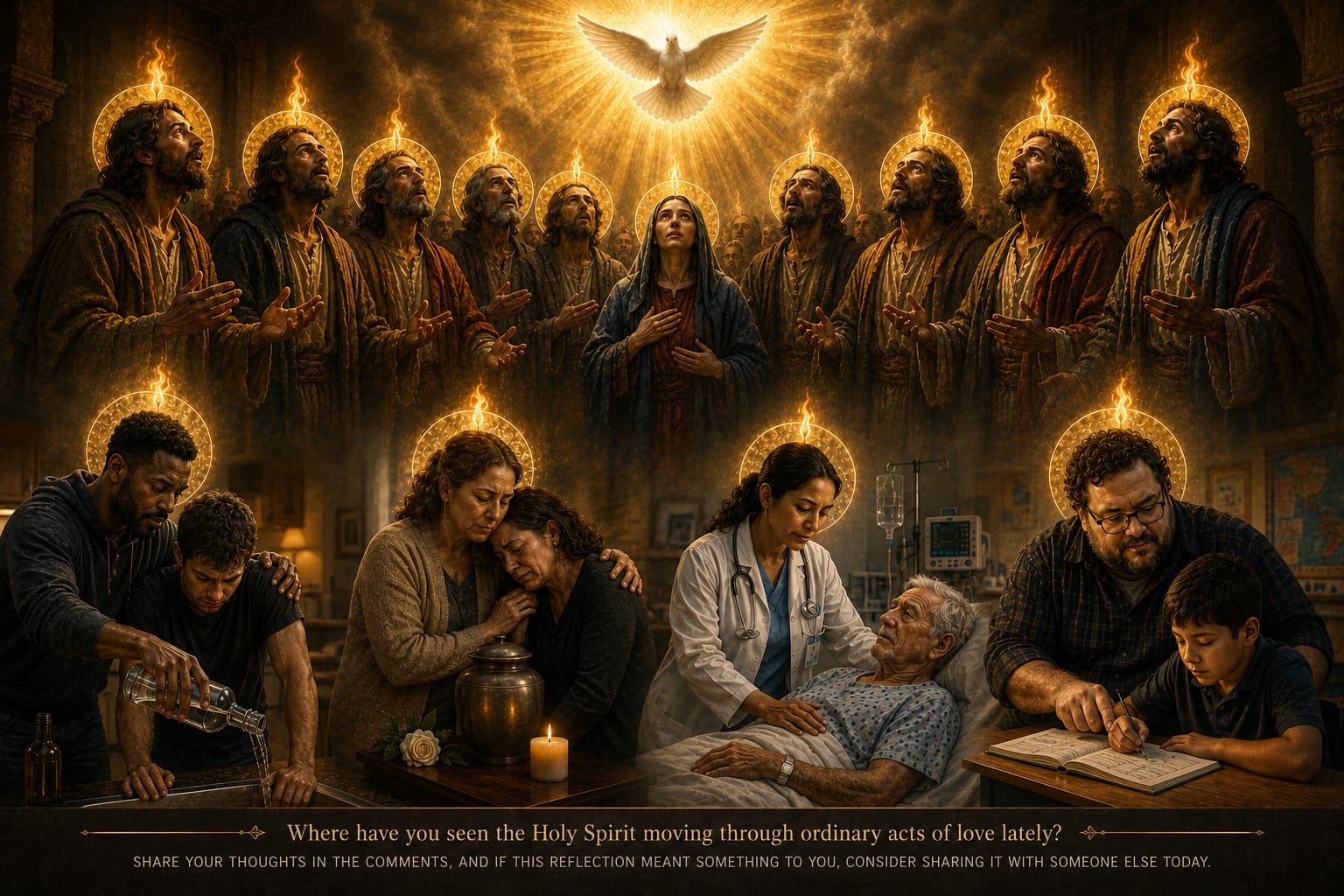
Pentecost Sunday and the Lie That You Have Nothing to Offer
Pentecost is one of the few moments in Scripture that feels almost impossible to domesticate.
A violent rushing wind. Fire resting over human heads. Ordinary people suddenly speaking in languages they never learned. Crowds gathering in confusion while frightened disciples step into the street with a kind of courage they did not possess a few hours earlier.
The Church does not give us Pentecost as poetry.
The Church presents Pentecost as an eruption.
And maybe that matters because many people have spent years reducing faith into something small, private, manageable, and emotionally safe. A personal belief system. A moral framework. A comforting ritual squeezed somewhere between work stress, grocery shopping, and doomscrolling.
Pentecost interrupts that version of religion completely.
Because Pentecost is what happens when the Spirit of God refuses to remain an idea.
Fifty days after Easter, the apostles are gathered together in Jerusalem. The resurrection has happened. Christ has ascended. But the disciples are still in that strange in-between place where grief, hope, fear, confusion, and responsibility are all tangled together.
And then the Holy Spirit descends.
Acts 2 describes wind, fire, and speech. The imagery is dramatic because the event itself is dramatic. Christianity makes a bold claim here: God does not merely inspire the apostles psychologically. God truly fills them with divine life and sends them outward into the world.
The timid become courageous.
The hidden become visible.
The silent begin proclaiming.
And perhaps most importantly, people from many nations suddenly hear the Gospel in their own languages.
That detail matters more than we sometimes realize.
The miracle of Pentecost is not merely that the apostles speak. It is that people hear.
Parthians, Medes, Egyptians, Romans, Arabs, people from all over the known world suddenly recognize something sacred being spoken in words they can understand. Pentecost becomes the undoing of division. Not by erasing difference, but by creating communion across it.
The Spirit does not flatten humanity into sameness.
The Spirit makes connection possible.
From the earliest centuries, Christians understood Pentecost as the birth of the Church’s public mission. St. Augustine described the Holy Spirit as the bond of divine love poured into human hearts. The fire resting over the apostles was never meant to stay locked in that room. The Spirit descends so the Gospel can move through human lives into the world.
And that means Pentecost was never only about the apostles.
It is also about us.
I think many people quietly carry the assumption that God works through other people.
The holy people.
The educated people.
The clergy.
The fearless people.
The people who know Scripture better.
The people who seem spiritually confident and emotionally composed.
Meanwhile countless ordinary people move through life convinced they have nothing spiritually meaningful to offer anyone. They bury their gifts before they ever use them. They dismiss their compassion as weakness. Their intuition as foolishness. Their longing as impractical. Their tenderness as naïve.
Some have spent so long surviving that they no longer recognize the movements of grace inside themselves.
But Pentecost tells a very different story.
The Spirit descended upon ordinary people first.
Not celebrities. Not religious elites. Not polished spiritual professionals.
Fishermen. Laborers. Imperfect disciples. People who had doubted, fled, panicked, argued, and failed.
People hiding in a locked room.
That is deeply important because many modern Christians suffer from a kind of spiritual imposter syndrome. They assume they are disqualified from meaningful participation in the life of God.
“I would not know what to say.”
“I am not wise enough.”
“I am not holy enough.”
“I could never help someone spiritually.”
And yet Pentecost stands in direct contradiction to that fear.
You may think you never have the right words. But I assure you, there are people you can reach whom I cannot. There are wounds you understand from the inside. There are lives shaped by experiences I have never lived. There are people who may hear grace more clearly through your voice than through mine.
Some people will never walk into a church long enough to hear a homily.
But they may hear Christ in the way you stay beside them when everybody else leaves.
In the way you forgive.
In the way you refuse cruelty.
In the way you encourage someone who has almost given up.
In the way you quietly remain faithful while carrying burdens nobody else sees.
That too is proclamation.
Not everybody is called to preach publicly. But every Christian is called to become a living witness that love, mercy, hope, and reconciliation are still possible in this world.
We are, all of us, sent out.
Some in dramatic ways, yes.
But many through the ordinary holiness of shared human life.
A parent comforting a frightened child at two in the morning.
A nurse sitting beside someone who is dying.
A recovering addict helping another person survive one more day sober.
A friend answering the phone instead of letting someone disappear into despair.
A teacher who notices the lonely student everybody else overlooks.
These moments rarely look spectacular.
Neither did Bethlehem.
Christianity has always insisted that God enters the world incarnationally, through actual human lives, actual human voices, actual human bodies. The Holy Spirit is not distributed according to status, popularity, charisma, or institutional importance. The same Spirit poured out at Pentecost has been given to the Church.
Which means your life is not spiritually empty.
You are not forgotten.
You are not disqualified.
And maybe one of the great tragedies of modern life is how many people have buried the very gifts God entrusted to them because they quietly decided those gifts “couldn’t possibly matter.”
Pentecost pushes against that lie.
The fire of Pentecost did not descend on people who already believed they were extraordinary.
It descended on people finally learning that God could work through them too.
And perhaps that is the invitation of this feast.
Not to become louder.
Not to become performative.
Not to turn spirituality into spectacle.
But to become available.
Available to love.
Available to courage.
Available to compassion.
Available to the quiet movements of the Spirit that most of the world has trained itself to ignore.
The Church year teaches us to remember what the world keeps trying to make us forget.
God still moves through ordinary people.
Practical Takeaways
-
Read Acts 2 slowly this week. Pay attention not only to the miracle itself, but to the kinds of people God chose to work through.
-
Ask yourself honestly where you may have buried gifts, compassion, wisdom, creativity, or courage because you assumed they “did not count.”
-
Pray each morning this week: “Holy Spirit, help me notice where I am being called to love today.”
-
Reach out intentionally to one person who may need encouragement, companionship, or hope.
-
Spend time reflecting on where your own lived experiences may uniquely equip you to connect with people others cannot reach.
Did You Know?
-
The word “Pentecost” comes from the Greek word meaning “fiftieth,” since the feast occurs fifty days after Easter.
-
Pentecost originally coincided with the Jewish feast of Shavuot, which celebrated both harvest and God giving the Law to Moses at Sinai.
-
Red vestments are traditionally worn on Pentecost to symbolize the fire of the Holy Spirit.
-
Many theologians describe Pentecost as the “birthday of the Church” because it marks the beginning of the Church’s public mission.
Closing Prayer
Come, Holy Spirit.
So many of us move through life quietly believing we have little to offer. We compare ourselves to others, doubt our worth, bury our gifts, and convince ourselves that courage, holiness, wisdom, or spiritual purpose belong to someone else.
But You chose ordinary people at Pentecost.
You filled frightened disciples with life and sent them into the world carrying hope they did not think they possessed.
Breathe into us again.
Awaken what we have neglected. Strengthen what fear has weakened. Teach us to recognize the ways You still move through ordinary acts of mercy, compassion, truth, forgiveness, and love.
Give us the courage to speak when someone needs hope. Give us tenderness in a world growing hard and cruel. Help us trust that our lives, however ordinary they may seem, can still become places where Christ is encountered.
And where we have forgotten our purpose, remind us that we too are sent.
Amen.
Pentecost did not end in the Upper Room.
If this reflection resonated with you, share it with someone carrying more spiritual weight than they let people see.
And tell me in the comments:
Where have you seen ordinary people become carriers of grace?