

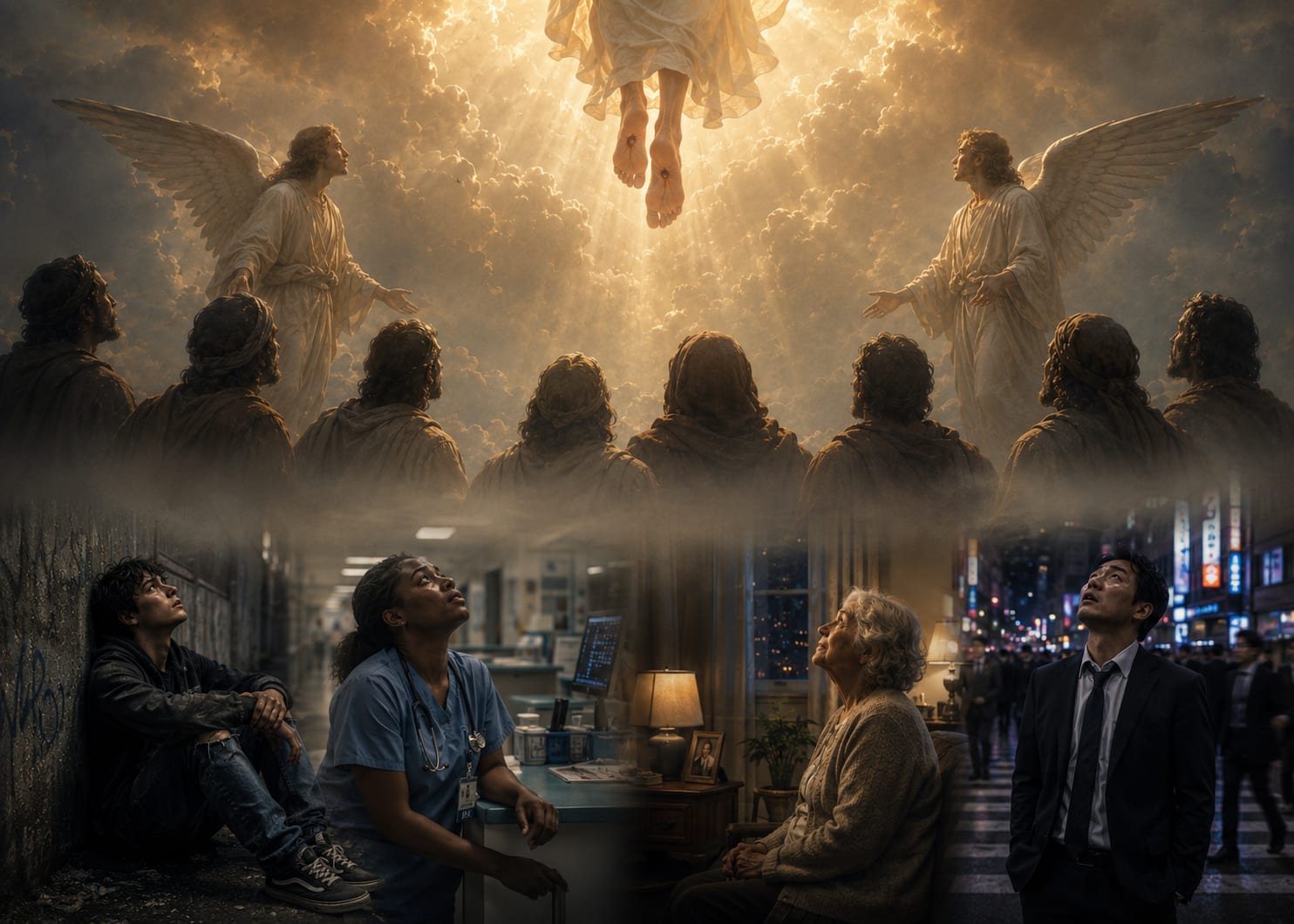
The Ascension Is Not About Jesus Leaving Us
Why this ancient feast still speaks to exhausted modern people
Most people imagine the Ascension as a departure scene.
Jesus says goodbye. The disciples stare upward. Clouds swallow Him from sight. End of story.
A surprising number of Christians quietly carry that interpretation around without realizing it. The Ascension becomes a kind of holy disappearance, Christ withdrawing from the world while humanity remains below trying to survive history until heaven finally arrives.
But the Church has never understood the Ascension as abandonment.
The Ascension is not Jesus leaving humanity behind. It is Jesus carrying human nature into the life of God.
That is the scandalous claim at the center of this feast.
Forty days after Easter, the Church celebrates the risen Christ ascending to the Father. In many dioceses the feast is transferred to the Seventh Sunday of Easter, but the mystery remains the same. The disciples witness the risen Jesus blessing them, commissioning them, and being taken from their sight.
Ancient Christians understood something modern people often miss: heaven is not “up there” somewhere beyond the clouds. The Ascension is not cosmic travel. Scripture speaks symbolically because human language strains under mysteries this large.
What the feast proclaims is far stranger and more beautiful.
The humanity of Christ, wounded, resurrected, still bearing scars, now dwells forever in the life of God.
St. Leo the Great preached that in the Ascension, “our lowly human nature was carried up in Christ above all the hosts of heaven.” Early Christians clung to that hope because they lived in brutal times. They buried children. Survived plagues. Watched violence swallow entire cities. The Ascension was never sentimental theology to them. It was a declaration that human life was not disposable to God.
That still matters.
Because many people today move through life feeling emotionally overclocked and spiritually numb at the same time. They wake up already bracing themselves before they even check their phones. Exhaustion has become so normalized that people describe themselves as “fine” while quietly unraveling underneath the machinery of modern life.
And somewhere beneath all that noise sits an old fear:
Does human life actually matter beyond productivity, visibility, or usefulness?
The Ascension answers that question with breathtaking force.
Christ ascends with humanity.
Not an idealized humanity. Not polished humanity. Actual humanity.
The Gospels are careful to show that the wounds remain visible after the Resurrection. Christianity does not teach that suffering simply vanishes or never happened. The wounds are transfigured, not erased.
That may be one of the hardest truths for modern people to trust.
We live inside cultures that reward polished surfaces and concealment. Most people learn quickly that exposed pain attracts discomfort at best and cruelty at worst. So we curate ourselves. Manage ourselves. Edit ourselves into something more acceptable, more efficient, more marketable.
Yet the risen Christ ascends still bearing scars.
The Church preserved that image because it reveals something essential about God. Divine love does not require pretending we were never wounded.
And the Ascension refuses another temptation too, the fantasy that salvation means escaping ordinary life altogether.
Some people secretly want religion to function as anesthesia. Just enough spirituality to dull the panic. Just enough heaven-talk to survive the week.
But the angels in Acts interrupt the disciples while they stand staring into the sky: “Why do you stand looking up toward heaven?”
In other words: stop waiting around for escape.
The mission is here.
Christian hope is not withdrawal from the world. It is fidelity within it.
That changes how we understand holiness itself.
Holiness is not becoming less human. Less emotional. Less embodied. Christianity has never taught that salvation means dissolving into abstraction. The destiny of humanity is communion with God, not erasure.
St. Irenaeus wrote, “The glory of God is the human person fully alive.”
Fully alive.
Not flattened into an algorithm. Not reduced to political tribes or consumer categories. Not valued only for efficiency or output.
The Ascension quietly declares that human dignity cannot be negotiated away by empires, markets, governments, or cultural trends. Christ has carried humanity itself into the heart of God.
No empire can outvote that.
That is why this feast speaks so powerfully into modern exhaustion. Many people are starving for a reason to believe their lives possess meaning deeper than performance. They are tired of becoming products. Tired of outrage masquerading as identity. Tired of endless noise hollowing out their interior lives.
The Ascension answers none of that with escapism.
It answers with presence.
Christ does not abandon the world. The disciples are sent back into it. Back to ordinary streets, ordinary people, ordinary responsibilities. Feed people. Tell the truth. Care for the vulnerable. Pray even when prayer feels dry. Remain human in an age trying to strip humanity down to appetite and anger.
A feast day is not religious nostalgia.
It is the Church teaching us how to see reality again.
And maybe that is what the Ascension ultimately restores: not fantasy, not certainty, but perspective.
Humanity is not forgotten.
Not the grieving father sitting alone in his car after the funeral. Not the addict trying once more after relapse. Not the exhausted nurse driving home in silence before dawn. Not the person who feels spiritually numb but still whispers a prayer anyway because some stubborn part of them refuses to give up entirely.
Christ carries humanity into God.
Scars included.
Practical Takeaways
-
Read Acts 1:1–11 slowly this week. Pay attention to the disciples standing there looking upward. Ask yourself where you may be waiting passively instead of living faithfully.
-
Carry this line into prayer: “Humanity is not disposable to God.”
-
Resist one form of escapism this week, digital, emotional, spiritual, or otherwise. Stay present to your actual life.
-
Spend five quiet minutes noticing where you feel exhausted, hidden, or emotionally fragmented. Bring that honestly into prayer instead of trying to sound spiritually impressive.
-
If possible, attend Mass for the Ascension or pray the Glorious Mysteries of the Rosary, especially the Second Glorious Mystery.
Closing Prayer
Ascended Christ,
You did not abandon the world in Your glory.
You carried our humanity into the heart of God.
When we feel exhausted, forgotten, or afraid, remind us that human life remains sacred in Your sight. Teach us to resist the temptation to numb ourselves, distract ourselves, or despair.
Give courage to those carrying grief, hidden wounds, loneliness, or shame. Let them know they are not beyond Your love.
Teach Your Church to stop staring passively at the sky while neglecting the work of mercy before us. Make us faithful in ordinary life, truthful in a culture of noise, and compassionate in a world that often rewards cruelty.
And when our faith feels thin, hold us close in the mystery of Your risen life.
Amen.
I’d love to know if this resonated with you! Let me know here in the comments!
And if you know someone who needs to hear this message right now, maybe share this reflection with them.
As always, thank you for being here. Blessed Ascension Day to each of you!