

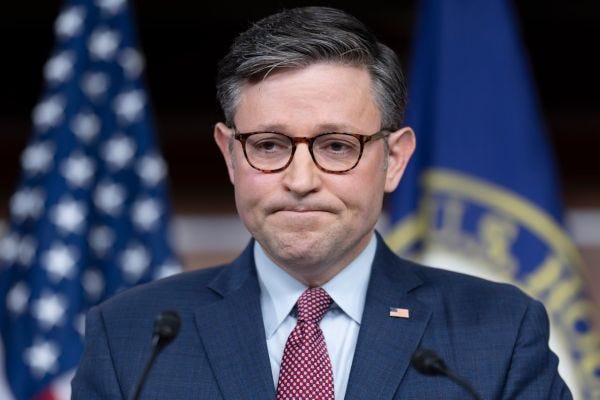
Dear Speaker Johnson,
I read your recent defense of “biblical border security” with great interest, not because it was persuasive, but because it was familiar. I have heard this argument before. I have heard it preached from corrupt pulpits, broadcast on cable news, and offered with great confidence by people who quote Scripture fluently while somehow never holding their own behavior and words to its standards.
You assure us that Christians must support harsh immigration enforcement, that borders are biblical, that mercy is personal but law enforcement is godly, and that anyone who suggests otherwise is either naïve or dishonest. You even took the time to correct the Pope, which is… bold
… and foolish.
So let’s talk.
Not in soundbites. Not in slogans. Not in the selective proof-texting you accuse others of while practicing it with Olympic discipline. Let’s talk about the Gospel you are invoking, and the one you are very carefully avoiding.
The Convenient Invention of “Spheres”
Your entire argument rests on a tidy framework, individuals show mercy, governments enforce law, churches disciple, families raise children. It sounds orderly. It sounds reasonable. It also is not a biblical doctrine in the way you are using it.
Scripture does not present “spheres of authority” as sealed moral containers, where compassion stops at the water’s edge of government responsibility. God repeatedly holds rulers, lawmakers, and nations accountable for how they structure public life.
When prophets confronted kings, they did not say, “Well, mercy is a personal virtue, but policy is none of God’s concern.” They accused rulers directly. They denounced unjust laws. They condemned systems that crushed the vulnerable while congratulating themselves for being orderly.
Isaiah does not rebuke individuals for being unkind. He rebukes those who legislate injustice:
“Woe to those who make unjust laws and issue oppressive decrees, depriving the poor of their rights and withholding justice from the oppressed…” Isaiah 10:1–2
Likewise, Amos does not scold private citizens for insufficient generosity. He condemns a nation for trampling the poor while maintaining religious respectability:
“You trample on the poor… you afflict the righteous, take bribes, and deprive the needy of justice in the courts.” Amos 5:11–12
The Bible never lets power off the hook the way you do.
Romans 13 Is Not a Free Pass
You lean heavily on Romans 13, as though “submit to governing authorities” ends the conversation (Romans 13:1–4). That passage has been used before, to defend slavery, to sanctify segregation, and even to silence Christians who opposed authoritarian regimes.
Paul is describing the purpose of government, not blessing every policy a government enacts. Scripture is clear that rulers are accountable to God when they cease to be servants of the good and instead become agents of harm (cf. Psalm 72; Proverbs 29:4).
“Endow the king with your justice, O God, the royal son with your righteousness. May he judge your people in righteousness, your afflicted ones with justice. May the mountains bring prosperity to the people, the hills the fruit of righteousness. May he defend the afflicted among the people and save the children of the needy; may he crush the oppressor.” Psalm 72:1–4
“By justice a king gives a country stability, but those who are greedy for bribes tear it down.” Proverbs 29:4
A government that terrorizes the vulnerable while calling itself righteous is failing its divine mandate, not fulfilling it… Especially if its officials are lining their pockets with cash and favors while doing so.
When laws produce chaos, family separation, mass detention, and death in the desert, the Christian question is not “Are the laws enforced?” but “Are these laws just?” (cf. Micah 6:8).
“What does the Lord require of you? To act justly, to love mercy, and to walk humbly with your God.” Micah 6:8
Justice is not defined by enforcement alone. Pharaoh enforced the law very efficiently (Exodus 1).
Borders Exist, Yes. So Does Moral Responsibility.
You are correct about one thing, Scripture recognizes nations and peoples (Acts 17:26). It also recognizes something you rarely mention, God’s repeated identification with the foreigner, the refugee, and the displaced.
Israel is commanded, again and again, not merely to tolerate the stranger, but to structure its common life around their protection, as a matter of covenant faithfulness (Exodus 22:21; Deuteronomy 10:18–19).
“Do not mistreat or oppress a foreigner, for you were foreigners in Egypt.”
Exodus 22:21“He defends the cause of the fatherless and the widow, and loves the foreigner residing among you, giving them food and clothing. And you are to love those who are foreigners, for you yourselves were foreigners in Egypt.”
Deuteronomy 10:18–19
This is not framed as optional charity. It is embedded in law.
The stranger is not protected because Israel is feeling generous that day. The stranger is protected because God remembers Egypt, remembers vulnerability, remembers what it is like to be powerless in the face of state violence (Deuteronomy 24:17–18).
Do not deprive the foreigner or the fatherless of justice, or take the cloak of the widow as a pledge. Remember that you were slaves in Egypt and the Lord your God redeemed you from there. That is why I command you to do this.
Deuteronomy 24:17–18
That memory is supposed to shape policy.
Nehemiah rebuilt walls, yes (Nehemiah 1–6). He also canceled debts, confronted economic exploitation, and refused to profit from his position (Nehemiah 5). Walls in Scripture are never the whole story. They are always paired with responsibility for those outside them.
Jesus Does Not Share Your Boundaries
You insist that Matthew 25 applies only to individual disciples, not governments. That distinction collapses the moment Christians hold power.
When Christians govern, they do not get to leave the Sermon on the Mount at the church door (Matthew 5–7). When Christians write laws, they do not suddenly stop being disciples.
Jesus never once tells His followers to love personally while supporting cruelty structurally. That is a modern invention, and a morally convenient one.
The hollowness of your argument is laid especially bare by its selectivity.
You are more than willing to invoke biblical authority when it authorizes punishment, exclusion, or control, particularly when those outcomes fall upon people your political coalition already views with suspicion or disdain. For you and your tribe, scripture is suddenly urgent when it can be used to justify harm toward same-sex couples, to cut transgender people off from medical care, to threaten women’s healthcare providers with the harshest penalties, or to turn the Ten Commandments into a political prop on a schoolhouse wall.
In those moments, the government is not merely permitted to act. It is required to act. Scripture becomes law, and law becomes weapon.
And yet, when Scripture calls for forgiveness, mercy, love of enemy, hospitality to the stranger, care for the poor, and compassion for the vulnerable, we are told that these commands are private virtues only, best left to individual conscience and never allowed to trouble public policy.
That contradiction should trouble any honest reader of the Gospel.
Why does Scripture suddenly demand government enforcement when it excuses cruelty, but retreat into personal discretion when it calls for mercy?
Why is the state an appropriate instrument for moral judgment in matters of sexuality, gender, and punishment, but an inappropriate instrument for care, protection, welcome, charity, and forgiveness?
If the government is only ever permitted to act as an agent of God’s wrath and never as an expression of God’s mercy, compassion, and sustaining love, then what you are describing is not a Christian vision of governance at all. It is a selective theology of vengeance, one that clothes personal grievance in biblical language. And yes, I suspect you enjoy it.
Jesus does not grant His followers permission to outsource love while centralizing punishment.
A government shaped by Christian conviction cannot claim moral authority while consistently choosing coercion over care, exclusion over protection, punishment over restoration, and violence over understanding. That is not fidelity to the Gospel. It is the misuse of Scripture to baptize resentment.
And the Gospel, inconveniently, refuses to cooperate with that project.
And here is the part you never address. Jesus does not ask whether the hungry are documented. He does not ask whether the naked followed proper procedure. He does not ask whether the imprisoned crossed a border legally (Matthew 25:31–46).
He identifies Himself with them.
Not symbolically. Personally.
For I was hungry and you gave me something to eat, I was thirsty and you gave me something to drink, I was a stranger and you invited me in, I needed clothes and you clothed me, I was sick and you looked after me, I was in prison and you came to visit me.’
“Then the righteous will answer him, ‘Lord, when did we see you hungry and feed you, or thirsty and give you something to drink? When did we see you a stranger and invite you in, or needing clothes and clothe you? When did we see you sick or in prison and go to visit you?’
“The King will reply, ‘Truly I tell you, whatever you did for one of the least of these brothers and sisters of mine, you did for me.’
The Pope Is Not the Problem
When Pope Leo XIV speaks about migrants, he is not engaging in leftist politics. He is doing what popes, prophets, and pastors have always done, reminding Christians that moral clarity matters more than national comfort.
You accuse him, and others like him, of confusing mercy with lawlessness. What you are really upset about is that he refuses to let fear masquerade as faith.
The Gospel does not promise safety at the expense of compassion. It promises salvation to those who are willing to let go of self-righteousness (Luke 18:9–14).
To some who were confident of their own righteousness and looked down on everyone else, Jesus told this parable: “Two men went up to the temple to pray, one a Pharisee and the other a tax collector. The Pharisee stood by himself and prayed: ‘God, I thank you that I am not like other people—robbers, evildoers, adulterers—or even like this tax collector. I fast twice a week and give a tenth of all I get.’
“But the tax collector stood at a distance. He would not even look up to heaven, but beat his breast and said, ‘God, have mercy on me, a sinner.’
“I tell you that this man, rather than the other, went home justified before God. For all those who exalt themselves will be humbled, and those who humble themselves will be exalted.” Luke 18:9–14
What No One Is Actually Arguing For
Let us be clear about something that keeps being distorted on purpose.
No one serious is arguing for a world with no borders, where anyone may come and go without process or accountability. Any assertion to the contrary is a mischaracterization, and at this point, an intentional one.
Even Pope Leo XIV has acknowledged what most reasonable people already understand: every nation has the right, and the responsibility, to establish and enforce fair, clear, and life-affirming immigration policy. Borders, in themselves, are not the issue.
Justice is not the issue.
Here is the issue.
Your party has repeatedly insisted that the intended targets of immigration enforcement are violent criminals, gang members, drug traffickers, abusers, and those who genuinely make communities less safe. If that were what we were seeing, there would be far less objection. The removal of people who commit serious crimes is a matter of justice, and justice has broad moral support.
But that is not what we are seeing.
What we are seeing, and what you continue to tell us is not happening, are children, women, teachers, caregivers, farm workers, and nannies being violently apprehended. Not carefully processed. Not humanely escorted. Rounded up in ways that traumatize families and communities.
We are seeing people who have lived here for decades, who built lives, raised families, paid taxes, and helped build this country, suddenly treated as disposable. We are seeing individuals with Temporary Protected Status have that protection abruptly revoked, then be reclassified as criminals and sent back to countries that are demonstrably unsafe.
We are seeing immigration policies that claim to reject lawlessness, while in practice reject the poor and the vulnerable outright, but offer glaring exceptions for the wealthy, the powerful, and those whose skin color is more palatable to bigots.
We are seeing the erosion of due process, a right guaranteed by the Constitution to all persons, not only citizens. We are seeing warrantless incursions into homes, anonymous and masked agents with little accountability, unmarked vehicles, and people taken from streets and workplaces without transparency or recourse.
We are seeing the rapid establishment of detention facilities with little to no congressional oversight, hastily constructed, minimally transparent, and operating with an obvious disregard for the well-being of those detained and for the dignity of human life itself. Facilities designed not for safety or care, but for speed, volume, and deterrence, where suffering is not a failure of the system, but part of its design.
And we are seeing violence used against peaceful protesters, including instances where people exercising their constitutional rights have been met with extreme force rather than protection.
This is not a debate about abstract policy. This is about what is happening in front of us, in real time, to real people.
And here the Ninth Commandment becomes unavoidable.
“Thou shall not bear false witness against your neighbor” (Exodus 20:16) is not a minor ethical suggestion. It is a foundational prohibition against the distortion of truth in ways that cause harm.
When immigrants are broadly characterized as criminals, invaders, or threats by virtue of their presence alone, false witness is being borne against them. When peaceful protesters are dismissed wholesale as paid agitators or terrorists in order to discredit their grievances, that false witness is compounded.
These are not harmless exaggerations. They are moral violations. They deform public conscience, justify cruelty, and license violence by first stripping people of their credibility and humanity.
Scripture does not permit the deliberate misrepresentation of one’s neighbor for political convenience. A society that routinely bears false witness against the vulnerable cannot then claim biblical authority for what follows.
If these actions represented justice, they would not require denial to defend them.
And if this is what is being justified in the name of Christianity, then Christians have an obligation to say, clearly and without apology, that this is not the Gospel at work.
What This Is Really About
This is not about borders. It is about who bears the burden of our fear.
It is about whether Christianity exists to sanctify power or to challenge it (Luke 4:18–19).
The Spirit of the Lord is on me,
because he has anointed me
to proclaim good news to the poor.
He has sent me to proclaim freedom for the prisoners
and recovery of sight for the blind,
to set the oppressed free,
to proclaim the year of the Lord’s favor. (Luke 4:18–19).
It is about whether the Bible is a living word that confronts us, or a toolbox we raid to defend what we already want (Hebrews 4:12).
“The word of God is living and active… it judges the thoughts and attitudes of the heart.” Hebrews 4:12
You say justice and mercy are not opposed. On that, we agree. But justice without mercy becomes politicized cruelty with paperwork. Mercy without justice becomes sentimentality. The biblical vision is harder than either.
It requires humility. It requires repentance. It requires admitting that legality is not the same thing as righteousness (Matthew 23:23).
Woe to you, teachers of the law and Pharisees, you hypocrites! You give a tenth of your spices—mint, dill and cumin. But you have neglected the more important matters of the law—justice, mercy and faithfulness. You should have practiced the latter, without neglecting the former. Matthew 23:23
And it requires listening, especially when the voices speaking are not convenient.
A Final Word
You are an intelligent man. You know Scripture well enough to know that what you offered was not the whole counsel of God (Acts 20:27). It was a carefully curated selection, designed to reassure the powerful and quiet the conscience.
The Gospel is not quiet.
It disrupts. It unsettles. It refuses to let us feel holy while others suffer in our name.
You can defend borders if you like. But do not claim the Bible demands policies that break families, endanger lives, and harden hearts.
That is not Christianity.
That is fear and lies dressed up in biblical verses. You may be able to fool some, but you cannot fool the one who’s name you call upon as your savior.
I hope you take these words to heart, remember that the Kingdom is bigger than anything in this world, bigger than political games, bigger than the speakership.
I will be praying for you, as I always do, and I hope for all the best things for you.
Grace and peace,
Father Rich
A Closing Invitation
This is among the most important pieces I have ever written.
Not because it is provocative, but because it names a moment when Scripture itself is being misused to justify harm, and silence would be a failure of pastoral responsibility.
If you believe this conversation matters, I ask you to help it reach others.
Restacking this piece with a note is the single most effective way to extend its reach. Your words become part of the witness, and they invite others to engage thoughtfully rather than reactively.
I also welcome your comments. Tell me how this landed for you, where you agree, where you struggle, or what questions it raised. I read every response and engage when I can.
And if this reflection resonated, a like helps ensure it is seen by those who need it.
Thank you for taking Scripture seriously enough to wrestle with it, and for being part of a community that refuses easy answers when the Gospel demands more.