
Introduction
A number of years ago, I met a man in his late 20’s who had come here with his mother and younger brother to escape the cartels in Mexico. In his hometown, young men had only three options in life: join, flee, or die. The cartels didn’t just run drugs; they ran everything. They controlled the schools, the police, the jobs, the futures of every boy in town. And they produced those drugs for one primary customer… the United States. We love to talk about the countries that produce and ship drugs north, but we rarely look at the demand that ruins our neighbors to the south.
I had known the oldest son for a few years, but when I met his mother, she told me the full story of how quickly things fell apart. When her oldest son, my friend, refused to work for the cartels, the threats started. First came the “warnings,” then the men with guns. You can’t file a visa application when someone’s knocking on your door. The immigration process might take years, but the cartel gives you days… or your head.
So they did what any parent would do when the lives of their children are on the line, they packed what they could, got on a plane, and came to the U.S. the way most people do. They didn’t cross a river or climb a fence. They arrived legally, then stayed past their limit because they had no choice. If they went back, they’d be dead.
Though we’ve lost touch, I’ve never forgotten that family. They weren’t looking for handouts or pity. As a matter of fact, all three of them worked and built productive lives here. They were looking for life. For safety. For a chance to raise their boys somewhere they wouldn’t be forced to kill or be killed. They lived a life of service here in the US.
Resurrection Always Begins in the Ashes
If life has left you broken or burned, Faith in the Fire will show you that hope is never gone. God does His best work not by sparing us from suffering, but by redeeming it.
➡ Begin again with Faith in the Fire.
Reflection
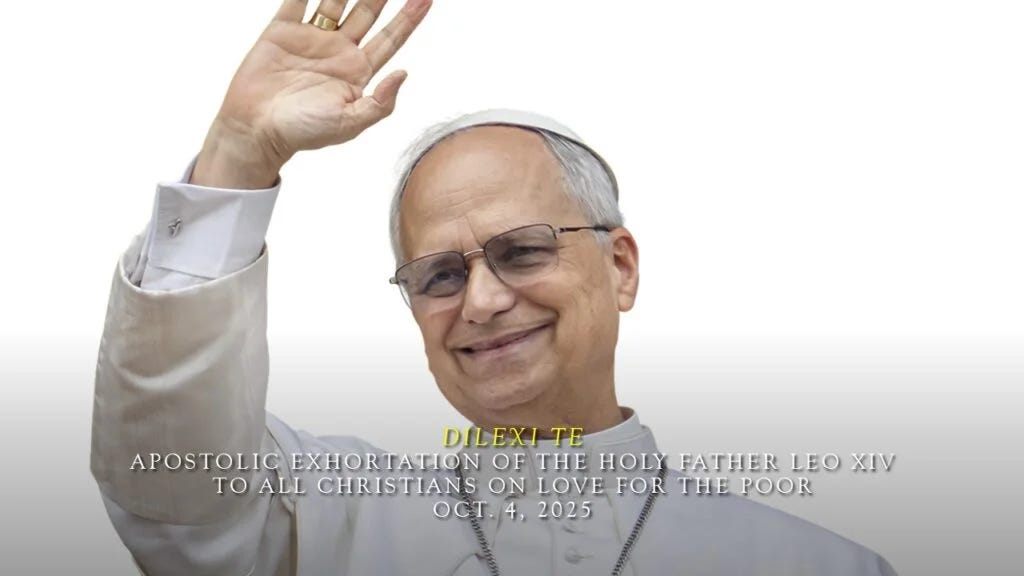
When I read Pope Leo’s new apostolic exhortation, Dilexi Te—“I Have Loved You”—I thought of them immediately. Because that’s what this document is really about. Love that doesn’t stay theoretical. Love that steps in when bureaucracy or politics fail. Love that moves from the head to the heart, and from the heart to the hands.
The Scriptures are not vague about this. God has never left us guessing about how we are to treat the stranger. From Genesis onward, the message is clear: “You shall not wrong or oppress the foreigner, for you yourselves were foreigners in the land of Egypt.” (Exodus 22:21) And later, “The alien who resides with you shall be to you as the citizen among you; you shall love the alien as yourself.” (Leviticus 19:34)
There’s no footnote that says “unless it’s politically inconvenient.” There’s no clause about “after a background check” or “once they’ve earned it.” God doesn’t give us that out. He simply says love them, because you know what it feels like to be vulnerable, to be unwanted, to depend on mercy.
When Jesus spoke of welcoming the stranger, He wasn’t giving us a metaphor. He was identifying Himself with the migrant, the refugee, the one who shows up with no papers and no power. “I was a stranger,” He said, “and you welcomed me.” (Matthew 25:35) The mystery of the Gospel is that Christ hides Himself in the ones the world rejects. Every time we draw a line, He steps over it. Every time we build a wall, He stands on the other side.
That’s what makes Dilexi Te such a holy document. It’s not a policy paper—it’s a spiritual alarm clock. It’s the Church shaking off the dust of political fear and remembering who we are. Pope Leo reminds us that the measure of our faith isn’t how tightly we guard our borders, but how freely we open our hearts.
The poor, the migrant, the single mother, the forgotten—they are not side projects for a church that has time to spare. They are our family. They are the beating heart of the Gospel. The Kingdom of God has always begun at the margins. The Savior of the world was born in a borrowed stable because there was no room for Him. He became what we now fear: displaced, unwelcome, poor.
And yet—He still comes. Every generation has to decide whether we will recognize Him when He arrives. He won’t come wearing a crown or carrying a passport. He will come hungry, tired, and afraid. He will come in the faces of people like Miguel and his family, still hoping someone will see them as human, still trusting that love means something in this world.
When we welcome them, we welcome Him.
Pope Leo begins Dilexi Te with the words of Christ from Revelation: “I have loved you.” A revelation of God’s heart for humankind. He is writing to a bruised Church, one that has been pushed to the margins by indifference and pride, and he reminds us of something we too easily forget: we are loved, and because of that love, we are called to love in return.
He writes that Jesus “assumed the poverty of human existence,” that He “experienced the same exclusion that is the lot of the poor.” In other words, Christ did not visit the margins, He lived there. He became what the world discards so that no one would ever again be beyond His reach. This is the among the deepest truths of our faith.
One of the most powerful lines in Dilexi Te says, “Christian love breaks down every barrier, brings close those who were distant, unites strangers, and reconciles enemies.” That line tells the story of the Gospel in miniature. If we take it seriously, the wall between us and them must crumble. There is only us.
Pope Leo brings back what he calls a “decisive and radical choice in favor of the poor.” The “preferential option for the poor” is at the heart of the Kingdom of God. God’s preference for the poor does not mean He loves others less; it means He meets us where love is needed most. If you want to find Christ, go where people are hurting, where people are hungry, where people are forgotten.
He also makes it painfully clear that poverty is not a natural condition. It is a human-made wound. He writes that it becomes “normal to ignore the poor, to live as if they do not exist, to organize the economy so that sacrifices are demanded of the many to serve the needs of the powerful.” These are prophetic words.
What moves me most is that Pope Leo refuses to separate spiritual life from daily life. He says that works of mercy, feeding the hungry, visiting the sick, welcoming the stranger, are “signs of authentic worship.” A Church that prays without serving does not yet understand what it means to pray.
And this brings me back to Miguel and his family. When Pope Leo writes that “in every rejected migrant, it is Christ himself who knocks at the door of the community,” I see their faces. Christ is not waiting at the gate for our approval. He is already here, sitting in the pew beside us, speaking in another language, wondering if anyone will look up and recognize Him.
The poor are not God’s charity cases. They are His chosen ones. They are not a cause. They are our kin. Dilexi Te is God’s love letter to them and a wake-up call to us.
Pope Leo reminds the Church to rediscover her heart, the one that beats in rhythm with the wounded and the weary. When we begin to love as Christ loves, with no condition, no fear, no borders, the Kingdom of God stops being an idea and starts to become real.
Christianity was never meant to be cruel. The Message From the Margins shows how to reclaim Jesus’ radical compassion. Free with 5 bonus e-books to deepen your faith.
Call to Faithful Action
So where do we go from here?
Pope Leo reminds us that love cannot remain an idea. It must become visible. If Dilexi Te is the Church remembering who she is, then the rest of us must remember too. We cannot pray “Thy Kingdom come” and then live as though it is someone else’s responsibility to build it.
The first step is to look with new eyes. See the poor not as a burden but as a blessing. Look at the migrant not as an issue but as a neighbor. See Christ where the world sees a problem.
Then, act. Act in quiet ways that no one applauds. Share your table. Give from what you have. Speak up when others are silent. Vote and volunteer with compassion in mind. Use your voice to lift up those who are not heard.
And above all, pray. Prayer is not an escape from the world but the place where love begins to take shape within us. It teaches us to see as God sees. It strengthens the heart to keep showing up when the world has grown tired of mercy.
Every generation of believers must decide whether the Gospel will remain words on a page or become flesh again in our lives. Dilexi Te is an invitation to live the Gospel not only in church pews but at the border, in the soup kitchen, in the classroom, and in the places where people feel unseen. Love, if it is to be holy, must be embodied.
Closing Prayer
Loving and merciful God,
You who said, “I have loved you with an everlasting love,” help us to remember what that means. Teach us to see You in every person who arrives with fear in their eyes and hope in their hands. Let us never forget that You were once the refugee child, the laborer without pay, the teacher without a home.
Break open our hearts until compassion becomes our instinct. Loosen our grip on comfort and control, and fill us instead with courage and tenderness. Where others build walls, give us the grace to build tables. Where the world grows cold, make us flames of Your love.
Forgive us for the times we looked away. Forgive our fear, our indifference, and our excuses. Renew Your Church, Lord, until she looks again like You—poor in spirit, rich in mercy, and wide open to the world.
Let the words I have loved you echo in us until they shape every action and silence every prejudice. Let them lead us back to the margins where You still dwell, waiting for Your people to remember who they are.
In the name of Christ, who loved us to the end,
Amen.
The Message from the Margins
Rediscovering the Gospel Where Christ Still Dwells
When Pope Leo wrote Dilexi Te (I Have Loved You), he reminded the Church of something the world keeps trying to forget: that love is not abstract, and holiness is not comfortable. The Kingdom of God begins where compassion meets courage… in the faces of the poor, the displaced, and the forgotten.
The Message from the Margins was born from that same conviction. It is a book about finding Christ where He has always been—among the people the world overlooks. Through stories, Scripture, and reflection, it invites readers to step beyond politics and pride, to see that the Gospel still speaks most clearly from the edges.
Each chapter explores what happens when faith moves from theory to embodiment: when the Church feeds instead of fears, when prayer becomes participation, and when mercy becomes the measure of our discipleship.
If Dilexi Te is the Church remembering who she is, The Message from the Margins is a guide for how we live that memory out. It calls us to a spirituality that is both contemplative and active—a love that prays with its hands as well as its heart.
This is not a book for those content with easy answers. It is a companion for those who believe that faith still has power to heal, reconcile, and begin again.
Discover how the Gospel sounds when it’s spoken from the margins… and how it can transform your life from the inside out.