

My dear friends,
Today I wanted to give you something a little more personal: a trip to the Feast of San Gennaro with your favorite New York Italian-American priest (Assuming I’m probably your only New York Italian-American priest). There will be pastries, there will be questionable pronunciation, and somewhere along the way I intend to teach you something. You knew that last part was coming.
This one is especially for you, with my gratitude for the way you carry Message From the Margins. Your support helps keep our wider pastoral work open to people who couldn’t otherwise afford it, and I wanted to share some of the faith and family feeling behind the fellow writing to you. Pull up a chair. Today, everybody’s Italian.
With love and gratitude,

San Gennaro, Save Us a Seat
On the day everyone gets to be Italian-American, a little about the bishop behind the feast, the miracle Naples treasures, and the faith we carry home.
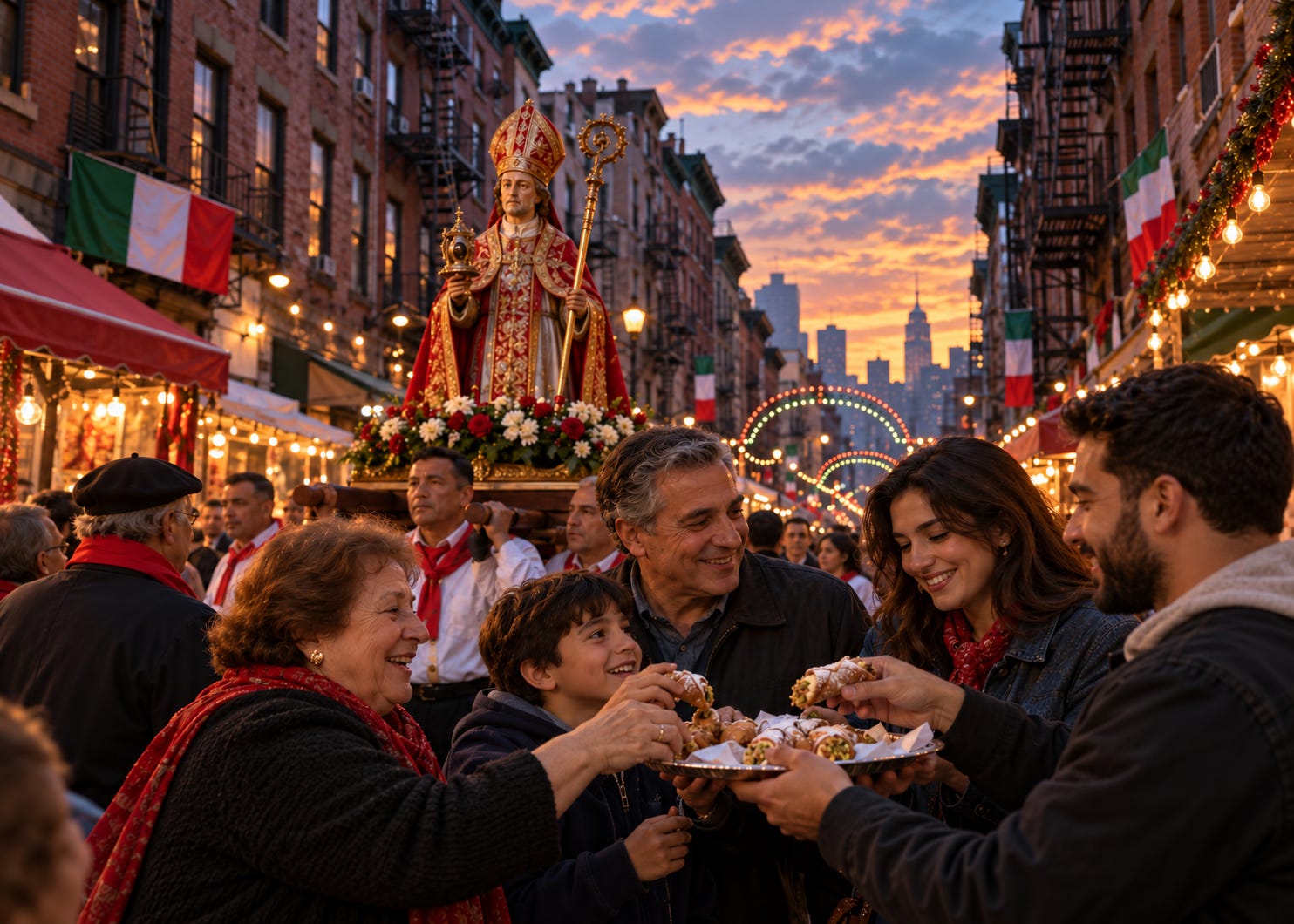
There are days when being Italian-American requires a certain amount of explanation. The Feast of San Gennaro is wonderfully efficient about this: we hand you something to eat, and you’re in.
For those few days in September, everybody gets to be Italian-American. You can say “muzzadel” and “brozoot” with whatever confidence you can muster, work “stunad” into a sentence, and enjoy the sudden expansion of your vocabulary. I would recommend a little discretion with that last one. Calling someone a stunad is best attempted after you’ve established that they like you.
What I love is the way people let their guard down. There are pastries to consider, people to enjoy, and very little reason to spend the afternoon proving anything about yourself. You can simply be there, part of the crowd, sharing in something that belongs to a neighborhood and somehow makes room for you, too.
For a New York Italian, that is a very particular kind of happiness.
The neighborhood has changed considerably since I was a kid. But when the feast comes around, Little Italy comes roaring back to life. This year brings a special anniversary: the New York celebration began in 1926, when Neapolitan immigrants organized a feast for their patron saint. A hundred years later, we are still gathering in his honor. The feast’s history
Among my own memories is the old Franciscan Church of the Most Precious Blood and the religious articles for sale there. As a teenager, I bought a St. Benedict crucifix and had it blessed.
I still wear it today.
I think about that now as a priest. Something I brought home from the feast has accompanied me into a life I had yet to live. The neighborhood has changed, and so have I, but that cross is still with me.
Of course, if I took to the streets with a microphone and asked people about San Gennaro himself, I suspect many would know considerably more about the pastry they had just eaten than about the saint whose name is on the celebration.
An entirely understandable situation. Let’s fix it before the next cannoli.
The bishop who went to the prison
San Gennaro, known in English as Saint Januarius, was bishop of Benevento, in southern Italy. His life belongs to the world of the third and early fourth centuries, and his martyrdom is traditionally dated to around AD 305, during the persecution associated with the emperor Diocletian.
The ancient account of his martyrdom tells of a deacon named Sossio who had been imprisoned. Gennaro went with two companions to comfort him, and they, too, were arrested. Other Christians became caught up in the persecution alongside them. The story ends with Gennaro and his companions being beheaded near Pozzuoli.
What catches my attention is the visit.
Before there is a statue or a procession, there is a man in prison and a bishop who goes to visit him. I can understand that act without knowing every detail of the ancient world. Someone is frightened and cut off from his community. Someone else decides he should have company.
The Letter to the Hebrews tells Christians to remember prisoners as though imprisoned with them (Hebrews 13:3). That is a demanding way to remember another person. It asks us to imagine the locked door from the inside, and to let that recognition influence what we do next.
Of course, in Matthew 25, Jesus tells us, “I was in prison and you visited me.” Visiting the prisoner is visiting Christ Himself. San Gennaro took that to heart.
He went to comfort an imprisoned member of his community, and in doing so, he served the Lord he had given his life to follow. That visit would cost him his freedom and, eventually, his life.
There is something worth carrying into our own understanding of community. We enjoy the gathering, and we also notice who cannot get there. We remember the person in the hospital, the friend who has withdrawn, the neighbor whose absence has become so familiar that we have stopped asking about it. The feast gives us the pleasure of being together; the bishop behind it asks us to go looking for those who need us.
The blood Naples treasures
In Naples, San Gennaro’s relationship with his people has an extraordinary expression. His blood is preserved in glass ampoules, and for centuries the faithful have gathered in prayer to witness the miracle of its liquefaction: the dried blood becomes liquid again. The earliest documented occurrence dates to 1389. September 19 is the best-known celebration associated with the miracle.
Think about what the Church is holding before the people. This is the blood of a man who remained faithful to Christ unto death. The violence that ended his life did not end his belonging to the Church, or his care for the people who would come to call on him. Christians gather around that relic in the confidence that, in Christ, our communion reaches beyond the grave.
That is part of what I love about devotion to the saints. We speak to them with the familiarity of people who expect to be heard. We ask for their prayers, bring them our troubles, and celebrate their feast days. In Naples, that affection for Gennaro has endured through generations of families, each bringing its own needs and gratitude.
The miracle invites wonder. I think of the prayers entrusted to this saint across the centuries, and of each new generation coming before his relics with its own hopes. As a priest, I treasure that sense of being joined in prayer to people I will never meet in this life. I would hate to become so practiced at explaining my faith that I forgot how to marvel at it.
And the blood draws our attention back to the man. Gennaro gave his life in fidelity to Christ; the people who venerate him are called to live that fidelity in their own streets and homes. We can ask for his protection and also ask for something of his courage, particularly when loving someone requires more of us than we had planned to give.
A saint who crossed the ocean
When Neapolitan immigrants brought their devotion to New York, Gennaro came into another chapter of community life. In a city where so much was unfamiliar, they could still pray to a saint they knew. They could celebrate his day, gather their neighbors, and teach their children his name.
I find that deeply moving. Starting again in a new place asks a great deal of people. Familiar prayers and celebrations can help a family find its bearings. A feast gives memory somewhere to go, something to do, and someone to share it with.
The Church has room for this kind of joy. In John’s Gospel, Jesus’ first sign takes place at a wedding, where He turns water into wine after the supply runs out. The happiness of a gathering is allowed to enter the Gospel. So is the very practical concern of whether there is enough for the guests.
That gives me considerable theological confidence about feeding people. I will leave the appropriate number of cannoli to your own prayerful discernment.
The Church of the Most Precious Blood now also has a Vietnamese congregation. The Italian traditions remain, while another community has made a spiritual home there, too.
I can miss the neighborhood I remember and be glad that people are still coming through those church doors. Their prayers belong there. Their children’s memories are taking shape there. Years from now, someone may speak about that church with the same affection I feel when I remember buying my crucifix.
And for these few September days, Little Italy offers the rest of us a place in the celebration. You don’t need an Italian surname to enjoy it. You can arrive knowing very little about the saint and leave knowing a little more, having been welcomed along the way. That seems to me a very good beginning.
I hope today gives you some of that freedom to enjoy being alive among other people. Eat something wonderful. Laugh with someone. Pray for the people who gave you your first experience of belonging, and make a little room for somebody who could use one now.
As for me, I’m still wearing the cross I brought home from the feast as a teenager. Whenever I tell that story, I get to bring a little of that day with me: the church, the celebration, and the faith that has accompanied me through all the years since.
Happy Feast of San Gennaro, my friends. There’s room for you here. I hope you came hungry.
And Now It’s Your Turn
What feast, family food, neighborhood gathering, or beloved tradition gives you that feeling of being part of something? Italian ancestry is entirely optional. I’d love to hear what your community celebrates, and what you most enjoy about it.
Sharing invitation: If someone came to mind while you were reading, send them a greeting for the feast, or invite them to enjoy a pastry with you. I suspect San Gennaro would be pleased to have brought another couple of people together.
Closing prayer
Lord Jesus,
Thank You for the people who have made room for us, for the celebrations that have brought us together, and for the faith we have received through the love of others.
Bless our neighborhoods and the families making a new home within them. Remember those who are lonely, imprisoned, ill, or far from the people they love. Give us the courage to go to them and the patience to stay.
Through the prayers of Saint Januarius, strengthen our fidelity to You. Let the joy of this feast find expression in generous tables, open doors, and friendships that endure when the celebration is over.
Gather us, with all Your saints, into the life You have prepared for us.
Amen.
Saint Januarius, pray for us.
And Did You Know?
An English monk knew his story. The Venerable Bede included Januarius in his eighth-century martyrology, drawing on an earlier account of the martyrdom. His memory had traveled well beyond Italy long before the feast reached New York.
One of his earliest written witnesses was another priest. In a letter from around 432, Uranius identifies Gennaro as a bishop and martyr who honors the Church of Naples. A historical overview hosted by the Archdiocese of Naples identifies this as the earliest surviving literary notice of him.
Naples gave him quite a hat. The jeweled mitre made by Matteo Treglia to adorn the saint’s bust contains 3,326 diamonds, 198 emeralds, and 168 rubies. The gems represent faith, hope, and charity respectively. My own vestment budget remains considerably more modest.
John Paul II called him a light for his region. In 1980, the pope confirmed Januarius as patron of the ecclesiastical region of Campania, calling him “a most splendid light of Campania.” That phrase is translated here from the Latin.
Thank you for letting me share a little of home with you today. I enjoy being able to bring you into the histories, places, and traditions that have shaped my faith, especially when they come with this much affection and a reasonable prospect of dessert.
You help make this work possible, from the research behind a saint’s story to the wider teaching and pastoral care we share freely. I’m grateful for your company and for the very practical way you support this ministry. May this feast bring you some good company of your own. And if you’re celebrating with a cannoli, please consider it appropriate to remember your priest.