

Before we begin, a small favor to ask.
Articles like this are among the hardest things I write.
Not because the words are so difficult. That part I love. But questions like this deserve more than quick answers and hot takes. They require prayer, study, reflection, and the willingness to wrestle honestly with things many people have been carrying for years sometimes decades.
The truth is, if I depended entirely on algorithms, outrage, and attention-grabbing headlines, this article probably would never have been written. I can’t imagine you would have preferred another article about what Donald Trump did today any more than I would have wanted to write one.
So that crosses off outrage.
And honestly, as you read a reflection about Scripture, faith, and the character of God, it would be a little absurd if an ad for hair-growth medication interrupted us halfway through. I simply cannot pivot from the story of Abraham and Isaac to, “A lot of people have been asking about my skincare routine.”
You’ve seen my skin. Nobody wants skincare endorsements from me.
So Message From the Margins exists because readers choose a different path.
If these reflections have helped you think more deeply, ask better questions, or stay connected to faith in a complicated world, I hope you’ll consider becoming a paid subscriber.
More than anything, your support helps create space for conversations like this one.
Now let’s talk about a question many Christians have carried for far longer than they realize.
Your Brother in Christ,

Why Does the God of the Old Testament Seem So Cruel?
The question many Christians carry for years, often without feeling safe enough to ask.
One of the questions I get asked most often is how I manage to find something to write about every single day.
The answer is that I have help.
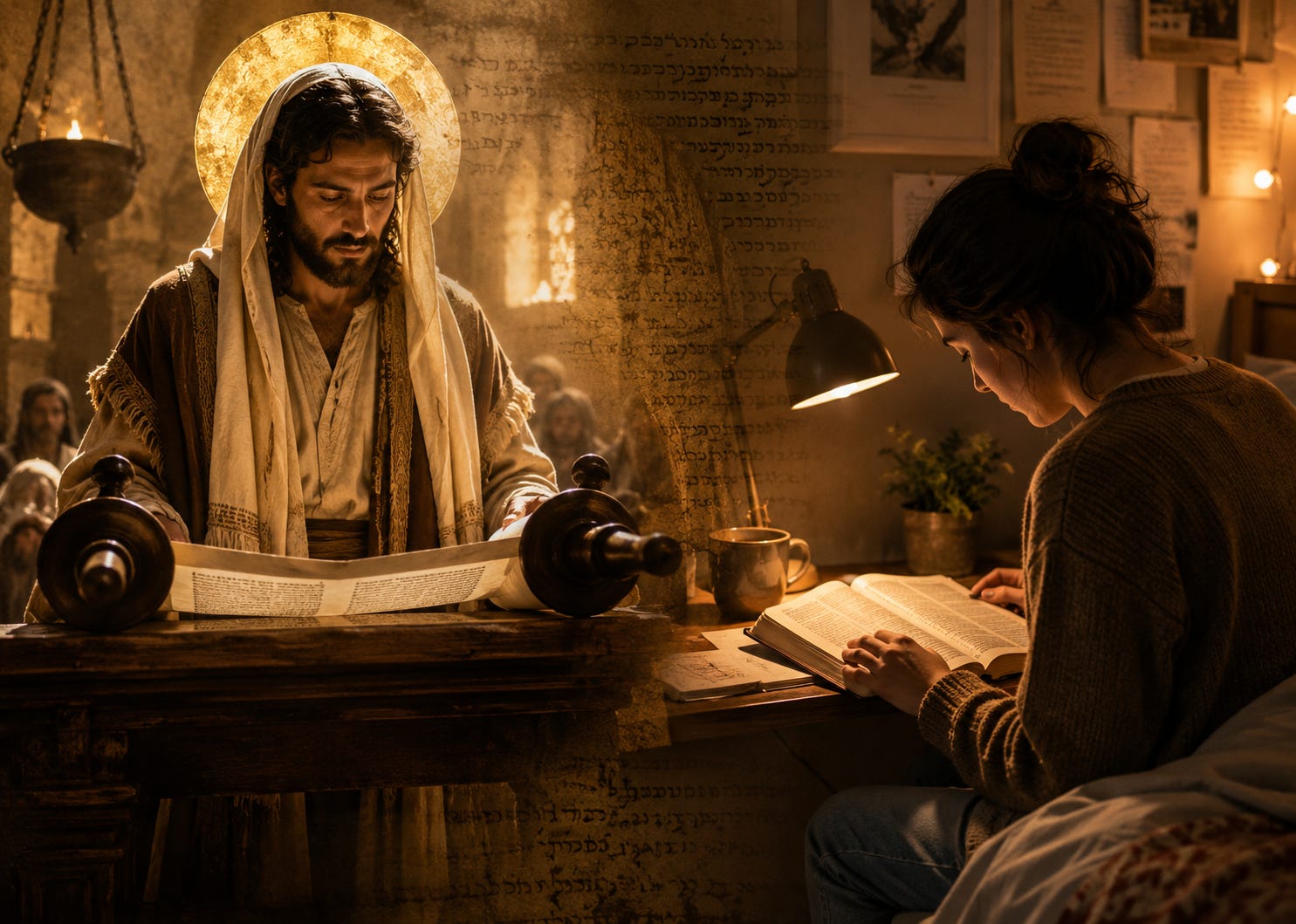
I have roughly four thousand years of predecessors who got there before me. I have Scripture. I have theologians, saints, mystics, scholars, and ordinary believers who spent centuries wrestling with life’s biggest questions.
And I have you.
Every day I read comments, messages, emails, and conversations from people all over the world. Some questions appear over and over. Others emerge only occasionally.
Then there are the questions that appear just often enough for me to recognize them.
Not often enough to become a overwhelming.
Just often enough for my pastors intuition to recognize that this question is sitting in a lot of hearts, but most are too afraid to ask.
I know this because this particular question once sat in mine.
I suspect many of you can guess what it is.
“If God is all-loving, why does the God we encounter in parts of the Old Testament sometimes seem anything but?”
There.
I said it.
For some readers, seeing that question written down may feel uncomfortable.
For others, it may feel like relief.
Maybe you’ve wondered about the Flood that destroyed the world.
Maybe you’ve struggled with the plagues of Egypt claiming the first born of every family.
Maybe you’ve read the story of Abraham and Isaac and felt your stomach tighten.
Maybe you’ve encountered stories of warfare, destruction, and judgment and wondered how any of it fits alongside Jesus telling us to love our enemies, forgive those who harm us, and pray for those who persecute us.
Many Christians have carried those questions for years, maybe your whole life.
The fact that these stories trouble you does not make you a bad Christian.
I would argue it may reveal something quite beautiful.
The reason these stories disturb us is often because we have been shaped by Jesus.
Why does the suffering of Isaac bother us?
Why does violence against enemies bother us?
Why does the death of children bother us?
Because Christ has taught us that children matter.
Because Christ has taught us that enemies remain human beings.
Because Christ has taught us that mercy is not weakness.
The moral instincts creating our discomfort are often Christian instincts.
That realization changed the way I approached these passages.
For a long time I assumed my questions were the problem.
Over time I began to wonder whether the questions themselves were pointing toward something important.
Not unbelief.
Not rebellion.
A deeper desire to understand.
One of the assumptions many Christians inherit is that the Bible arrived from heaven as a kind of divine documentary, dictated word-for-word while human authors functioned as little more than living pens.
Historically, Christians have understood inspiration in a much richer way.
The authors of Scripture were divinely inspired.
But inspiration is not possession.
God did not seize control of their bodies and write a book with their hands.
Catholic faith teaches something more mysterious and more beautiful: God is truly the author of Scripture, and the human authors are true authors as well.
They were not puppets. They were not passive instruments emptied of personality, culture, memory, fear, longing, or language.
They wrote as real human beings.
They carried the assumptions of their time, the limits of their world, the wounds of their experiences, and the questions they were trying to answer.
And through them, God revealed what He desired for our salvation.
That does not make Scripture unreliable.
It means God chose to speak through human words, within human history, through a relationship with human beings.
The stories have always been about our relationship, which means they must include our perspective.
If Scripture is the story of God’s interaction with humanity, it cannot be told from only one side.
It must contain the voices of real people trying to understand what they experienced, what they believed God was doing, and what those experiences meant.
That humanity is not a flaw in Scripture.
It is one of its greatest gifts.
When we read the Psalms, we encounter human joy, rage, gratitude, grief, confusion, doubt, and hope.
When we read Job, we encounter suffering and bewilderment.
When we read the prophets, we encounter people trying to understand national catastrophe and political upheaval.
Again and again, Scripture preserves the inspired witness of humanity’s encounter with God in the middle of real life.
That does not answer away every difficult question.
It does help explain why some passages feel difficult in the first place.
The Bible is not simply the story of God speaking.
It is also the story of humanity learning, often imperfectly, how to listen.
There is another challenge modern readers face.
Ancient people were often asking different questions than we are.
When many modern people open the Bible, their first question is:
“Did this happen exactly this way?”
Ancient readers were often asking:
“What does this mean?”
“What does this teach us about God?”
“What does this reveal about human nature?”
“What kind of people should we become?”
Stories, symbols, poetry, wisdom literature, and theological reflection were common ways of communicating truth.
Jesus used them constantly.
When Jesus tells the story of the Prodigal Son, nobody asks for the father’s birth certificate.
When Jesus tells the story of the Good Samaritan, nobody wonders whether the inn still exists.
We understand what Jesus is doing because the Gospel writers tell us He is telling a story.
We have the benefit of that perspective.
In other parts of Scripture, we often encounter ancient authors doing something similar without the same explanatory framework surrounding the text.
We are separated from them by thousands of years of culture, language, assumptions, and storytelling conventions.
As a result, modern readers sometimes become preoccupied with proving the story rather than understanding the truth it was intended to reveal.
The purpose of Scripture is not merely to tell us what happened.
It is to help us understand what it means.
Consider the story of Abraham and Isaac.
Modern readers often focus on the command and understandably recoil.
Parents especially feel the weight of that story.
If you’re unfamiliar with it, Genesis tells the story of God asking Abraham to take his beloved son Isaac to a mountain and offer him as a sacrifice.
Abraham obeys.
Father and son make the journey together.
Isaac even carries the wood for the sacrifice himself.
As the story reaches its terrible climax and Abraham prepares to carry out the command, God intervenes.
The sacrifice is stopped.
Isaac is spared.
A ram is provided instead.
For modern readers, the story can feel deeply disturbing.
Ancient listeners, however, may have heard something very different.
In a world where child sacrifice existed, the shocking part of the story was not that Abraham was asked to offer his son.
The shocking part was that God stopped him.
The child lived.
The story reveals a God fundamentally different from the gods many surrounding cultures imagined.
A God who provides rather than consumes.
For Christians, the story also points forward. The beloved son carries the wood for the sacrifice. A father faces the possibility of losing his son. God provides what is needed.
The Church has long seen in Isaac a foreshadowing of Christ.
Does that remove every difficulty from the story?
No.
I still understand why people struggle with it.
But understanding the deeper truths being communicated helps us move beyond the surface shock and toward the theological heart of the narrative.
One of my favorite biblical stories is Jacob wrestling with God.
Jacob wrestles all night.
He leaves wounded.
He leaves changed.
He leaves blessed.
The story is remarkable because Jacob is not condemned for wrestling.
His struggle becomes part of his transformation.
I think many Christians need permission to do the same.
Faith is not pretending difficult questions do not exist.
Faith is remaining in relationship with God while those questions exist.
That is where Jesus becomes essential.
For Christians, Jesus is not merely one voice among many.
Jesus is the fullest revelation of God’s character.
The Gospel of John tells us, “No one has ever seen God, but the one and only Son… has made him known” (John 1:18).
The Letter to the Hebrews calls Him “the exact representation of his being” (Hebrews 1:3).
If we want to know what God is like, we look at Jesus.
We look at the one who touched lepers nobody else would touch.
The one who forgave those who crucified him.
The one who welcomed outsiders.
The one who defended the vulnerable.
The one who chose a cross rather than violence.
The one who taught us to love our enemies.
Again, that does not erase the difficult passages of Scripture.
But it does tell us where to stand when reading them.
If a passage on its own leaves us wondering whether God is loving, Christians do not start with the passage.
We start with Jesus.
And this matters far beyond ancient history.
Every generation is tempted to create a God who hates the people we hate.
Every generation wants divine approval for its fears, grievances, tribal loyalties, and anger.
We see it in politics.
We see it in religion.
We see it online every day.
People still reach for Scripture to justify cruelty.
They still use it to justify exclusion.
They still use it to justify domination.
The reasoning is familiar.
If God blessed violence then, surely He blesses ours now.
If God judged enemies then, surely He judges ours now.
But Christians are called to measure those claims against Christ.
The question is not whether we can find a verse.
I could find you an isolated verse that would seem to justify almost any act of depravity.
The question is whether our understanding of God looks like Jesus of Nazareth.
I do not have perfect answers for every difficult passage in Scripture.
Neither have faithful readers across the centuries.
What I do know is this:
God was not afraid to leave the struggle in the text.
He preserved the questions.
He preserved the wrestling.
He preserved the humanity.
Which means that when you struggle with these stories, you are not failing at faith.
You are participating in one of faith’s oldest traditions.
The Bible is not the story of people who never questioned God.
It is the story of a God who never stopped pursuing people who did.
Five Practices for the Week
1. Read Genesis 32:22-32.
Read the story of Jacob wrestling with God. Notice that the blessing comes through the struggle, not around it.
2. Read one Gospel story each day.
Ask a simple question: “What does this reveal about the character of God?”
3. Write down one spiritual question you’ve been avoiding.
Don’t solve it. Just acknowledge it honestly before God.
4. Notice where mercy appears.
Pay attention to acts of forgiveness, compassion, patience, or kindness during your day.
5. Have one honest conversation.
Talk with someone you trust about a spiritual question you normally keep to yourself.
Join the Conversation
Was there a particular passage of Scripture that troubled you for years?
Did someone help you see it differently?
I’d love to hear your experience in the comments.
And if you know someone who has carried this question for a long time, consider sharing this reflection with them.
Prayer
Loving God,
You are greater than our understanding and closer than our fears.
We thank you for the gift of Scripture, for the stories of faith, struggle, courage, failure, hope, and redemption that have guided generations before us.
Some passages comfort us immediately. Others challenge us. Others leave us with questions we cannot easily answer.
Give us the courage to bring those questions to you rather than hiding them.
Protect us from mistaking certainty for faithfulness.
Teach us to trust that honest wrestling can be part of discipleship.
Help us keep our eyes fixed on Christ, whose life reveals your compassion, justice, mercy, and love.
When we are tempted to use faith as a weapon, remind us of the One who carried a cross.
When we are tempted to despair, remind us that you remain present even in our uncertainty.
Grant us humility, wisdom, patience, and peace as we continue learning what it means to follow you.
May our hearts become more like the heart of Christ.
Amen.
One final thought before you go.
Remember the note at the beginning of this article?
See what I meant?
I am reasonably certain reflections like this are necessary in today’s world. They take time to research, time to pray through, and time to write. More importantly, they require the freedom to explore difficult questions without chasing outrage, fear, or whatever happens to be driving clicks this week.
For better or worse, that means this work depends on people who believe thoughtful faith is worth supporting.
If you found value in this reflection, if it helped you make peace with a question you’ve carried for years, or if it simply reminded you that faith and honest inquiry belong together, I hope you’ll consider becoming a paid subscriber.
Your support doesn’t just help me keep writing.
It helps create and sustain a community where conversations like this can still happen.
And for that, I am deeply grateful.
Thank you for reading. Thank you for thinking. And thank you for being part of Message From the Margins.