

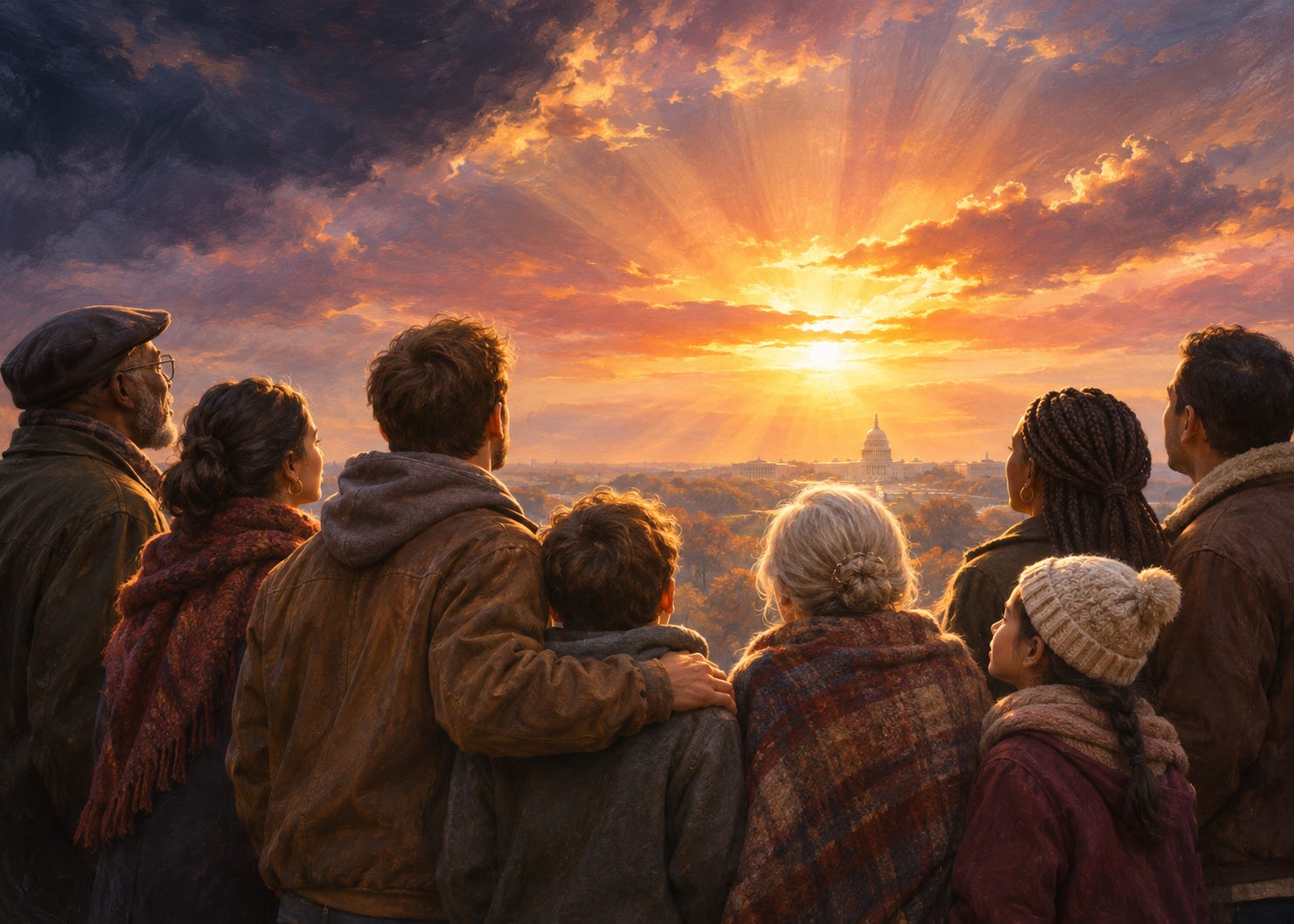
For the neighbors who have spent these years afraid.
Good morning, friends.
Thank you for reading, praying, sharing these reflections, and helping make this a place where we can speak honestly about faith and the country we share.
Keeping Message From the Margins going depends on financial support from readers. If you have room in your budget, please become a paid subscriber and help carry this work. Nearly everything remains free because I believe the Gospel cannot be placed behind a paywall. If money is tight, please set the request aside without guilt. You belong here.
Your Brother in Christ,
The Dawn From On High Shall Break Upon Them
The country we feared we had lost has given us a reason to hope again.
We #$%&-ing did it!
Last night, Americans took control of both houses of Congress away from Donald Trump’s party. After all the fear about what this election might bring, the country delivered a sweeping rejection of his administration. [11]
MAGA is dead!
I am ecstatic this morning. Grateful to the people who kept showing up when the races looked impossible, who kept insisting that their neighbors deserved better, and who refused to accept that this was simply what America had become. I suspect it will take a little while for the full relief of it to catch up with me.
Good Lord, we needed this.
There is a passage of Scripture I have loved for years, and today it feels so close that I hardly know what to do with myself. Which seems as good a time as any to tell you my one and only idea for a tattoo.
I would have these words written on my arm:
“In the tender compassion of our God the dawn from on high shall break upon us.
To shine on those who dwell in darkness and the shadow of death, and to guide our feet into the way of peace.”
As you can probably imagine, Father doesn’t have any tattoos, and probably won’t ever have one. But if I did, that would be it.
It is my favorite passage of Scripture. I love the tenderness of it, the promise that God sees the people who have been living in the dark and comes to them there. And this morning, it feels as though we are living it.
These words come from the Benedictus, the canticle of Zechariah in the first chapter of Luke’s Gospel, which Christians have carried into morning prayer for centuries. Zechariah is an elderly priest who has been told that he and his wife, Elizabeth, will have a son. He struggles to believe the angel’s announcement and loses his ability to speak. Months later, when the child is born and named John, his voice returns, and he begins praising God. [1] [2]
He sings of God remembering His promises to Israel, of deliverance from fear, and of the forgiveness his son will help announce as he prepares the Lord’s way. The dawn is Christ, whose coming will bring God’s mercy to people who have waited so long for it.
Zechariah is rejoicing while so much remains unfinished. His son is still a baby, with an entire life ahead of him. Yet God has begun something, and the old priest has found his voice.
I suspect quite a few of us are finding ours today.
The decency we feared we had lost
Compassion has been so conspicuously absent from the exercise of power that it has become difficult, at times, to imagine what its return might feel like.
We watched American aid get cut off and clinics close. In South Sudan, children with cholera died trying to reach the next clinic. Children dying of a treatable disease because the care that used to be there was gone. [3]
Detention camps on American soil. Reports of beatings and sick people left without care. Families searching for loved ones they could not reliably find through the government’s own detention systems. [5]
Americans putting off medical care they cannot afford, while lawmakers voted for cuts expected to leave millions more without insurance. Parents wondering whether their transgender child could keep receiving care or be safe at school. A presidential family collecting a fortune through cryptocurrency while foreign-linked investments raised grave conflicts of interest. Epstein survivors forced to fight for their privacy after the government exposed their names. [6] [7] [8] [9]
And through it all, the endless degradation of public life. A president behaving like a mad king, with candidates eager to prove they could be just as cruel. An opponent’s childhood abuse turned into campaign material, with the president encouraging the candidate to keep the ad running. No human humiliation too low to serve as an audition for his approval. [10]
I believe much of what we have watched this administration do deserves to be called evil. When people suffer because those with power have chosen to abandon them, or because hurting them has become politically useful, Christians ought to be able to say plainly what we are looking at.
What frightened me, though, was how easily people could be persuaded to excuse it. After a while, the grief extended beyond the conduct of the government. It reached into our understanding of the people around us. You could find yourself wondering whether a neighbor you had always considered decent would recognize any limit to what they were willing to defend.
We began to mourn American decency as though it were something we would have to describe to our children in the past tense. There had been a time, we would tell them, when this sort of behavior would have cost a person the trust of their community. When being caught in a lie was embarrassing. When anybody asking us for power was expected to care about somebody besides themselves.
Of course, America has never lived up to those expectations consistently. People pushed to its margins know that better than anyone. But we feared we were losing even the expectation, the shared understanding that cruelty and corruption were things a country ought to resist.
At times, many of us genuinely feared it would never stop.
The light breaking through
And then came last night, and enough Americans refused to continue handing this administration the power it wanted.
The people who believed we could be better kept working. They were there in states the rest of the country had already colored in and stopped thinking about. They were there when it would have been easier to stay home, or to decide that trying to persuade one more person was a waste of breath.
They deserve better than our surprise that they exist.
This morning, I can see a country full of people who refused to give up on one another. They came to the polls with different concerns, and we should resist the temptation to imagine that every ballot expressed our own convictions. But together they have given us a reason to believe that the decency we mourned still has a future here.
Part of MAGA’s power has rested on the insistence that it speaks for the real America. Everyone else is a lesser citizen, whose loyalty becomes suspect whenever they disagree with Donald Trump. For a movement so fond of accusing people of hating America, it has a remarkably difficult time liking Americans.
Yesterday, that claim to ownership suffered a decisive defeat. If we are seeing the beginning of the end of MAGA, this is where that ending starts: with Americans refusing to accept that the country belongs to it, and that the rest of us must learn to endure whatever it chooses to do.
Trump remains president. But the new Congress will have the power to investigate his administration and resist its agenda. For the people who have spent these years wondering who could protect them, that is a consequential change.
And for Christians who have watched our faith used to excuse so much suffering, there is another reason for hope in the people voters have chosen.
The Christian Left, and the work that begins today
Texas elected James Talarico, a Presbyterian seminarian who has made love of neighbor central to his public faith and explicitly rejected Christian nationalism. Kansas elected Adam Hamilton, a United Methodist pastor who campaigned on decency and appealed across party lines. These men spoke openly about Christianity as they challenged the politics of the religious right, and voters sent them to the United States Senate. [12]
Their victories give Christians who reject Christian nationalism a much larger public platform. I hope people who have come to dread the religious language of politics will hear something in their witness that helps them recognize the Jesus they have been struggling to find there.
This witness has been here all along, in Christians who have kept feeding people, welcoming strangers, and standing beside neighbors whose rights were threatened. What gives me hope today is the possibility that more of the country will hear them, and that their convictions will have greater influence over the decisions made in Washington.
I want a Christian Left that can speak confidently about the Gospel. The obligation to love our neighbors reaches into the laws and budgets that shape their lives. A Christian who asks what happens to the poor when a bill passes is bringing a necessary question into the room, and should be prepared to insist on an answer.
I also want us to be clear about the freedom we are defending. Talarico’s own account of his faith includes a commitment to the separation of church and state. Our neighbors should be free to practice another religion, or no religion, with the same rights and security we claim for ourselves. That is part of loving them. [13]
The test of this public Christianity will be what it does for people. It will be whether the person held in detention can reach a lawyer, whether the family keeps its health coverage, and whether a community whose clinic closed receives help in time. The people who have carried so much of the cost of these years deserve to be among the first considered when the incoming majority decides what to do with its power.
And we must remain capable of scrutinizing our allies. Where public authority has been abused, there needs to be an honest accounting. Evidence should be followed, responsibility should reach the people who made the decisions, and the law should be applied fairly. The party celebrating today has obligations to the public, including the people who voted against it.
Closer to home, we can make it easier for someone to leave this movement behind. Nobody who has been hurt owes another person instant trust or a convenient declaration that everything is forgiven. But when people begin to reconsider what they supported, I want them to be able to find a community that will help them take responsibility and live differently.
That is work a pastor can do. It is work this community can share. We have spent so much energy defending the elementary proposition that people deserve to be treated as human beings. Think what we might accomplish if more of that energy could go toward helping them flourish.
For today, I am grateful for the chance. Grateful that people kept going when they were frightened and tired. Grateful that we have something to celebrate together, and a reason to imagine a better country than the one we feared we were becoming.
I will probably remain a priest without a tattoo. But I want the words I would have written on my arm to describe what people experience because we are here.
May those who have lived in darkness find themselves less afraid. May they discover, through what we do next, that their neighbors meant it when they voted for a better country.
And may God guide our feet into the way of peace.
And Let Us Pray…
God of mercy,
give rest to those who have been afraid,
and comfort to those whose losses cannot be undone.
Protect the people still waiting for help.
Grant wisdom and courage to those entrusted with power,
and keep us honest when we would excuse our friends.
Thank You for every person who refused to give up on their neighbor.
Teach us to live at peace with one another,
through Jesus Christ our Lord.
Amen.
And Now It’s Your Turn…
Who are you thinking about as you take in the results this morning? What would you most like to see change for them?
If someone you love has been afraid for the future, please share this reflection with them.
A Word Before We Part…
What we have built here has given me hope for the future of this ministry. I want Message From the Margins to remain a dependable place for serious Scripture study, pastoral care, and a public Christian voice that refuses to excuse cruelty. Sustaining that work requires more readers who are able to support it financially.
If this ministry has become part of your life, please consider becoming a paid subscriber today. Your support helps fund the research, writing, Bible studies, and podcast work, while keeping the core of the ministry available to everyone. Thank you for helping us reach people through your reading, prayer, comments, and sharing, too.