

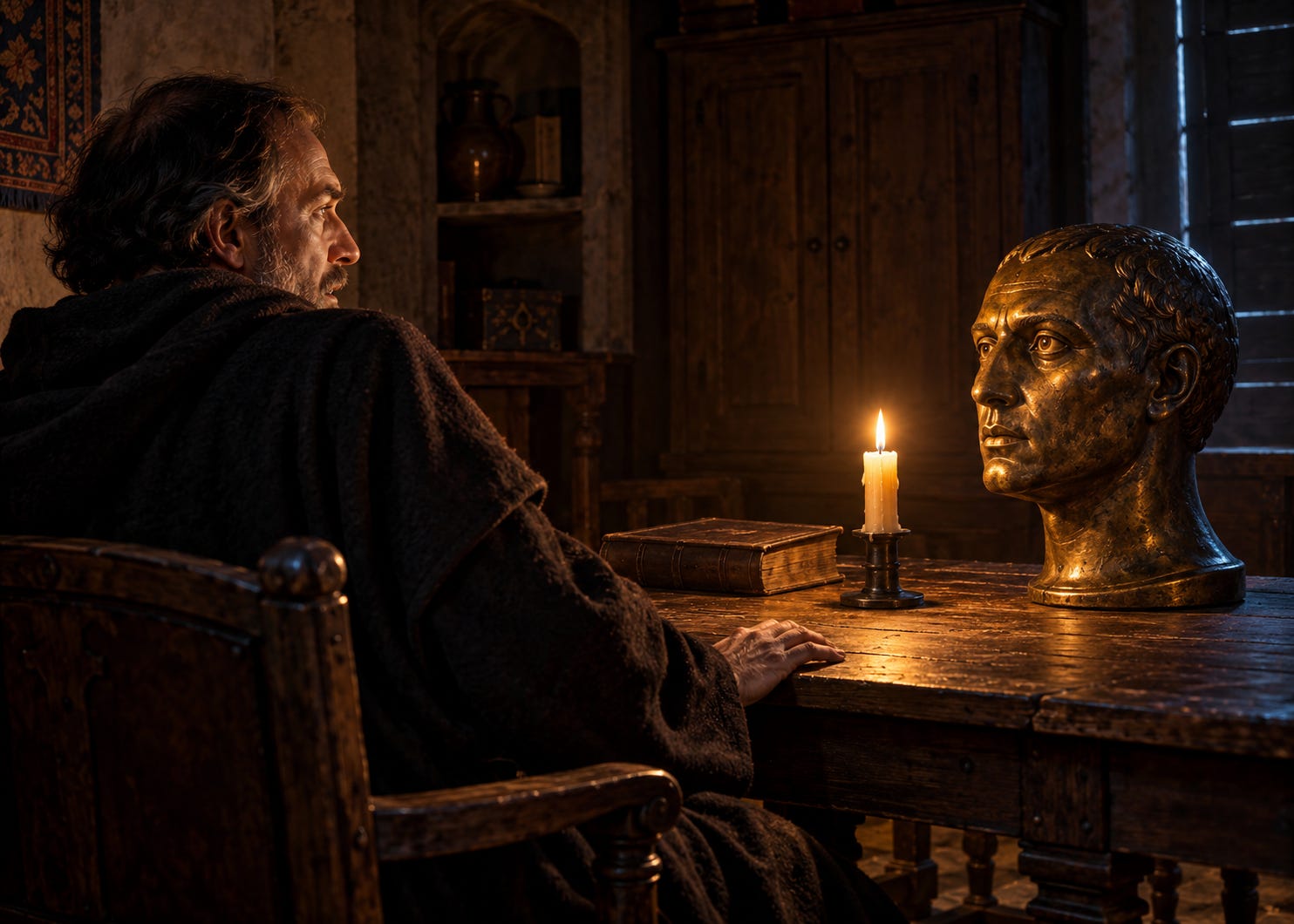
“The legend of Gerbert of Aurillac, later Pope Sylvester II”
Friends, I promised we would have some fun for our Unlucky 13K celebration, and I have been looking forward to telling you this one. Thank you for reading along and bringing your friends. Today’s guest is a pope with a very unusual item among his personal effects.
Paid subscriptions help cover the work and keep most of Message From the Margins free, so people can find pastoral care without having to find a credit card first. If you have room to support it, I’d be grateful. If money is tight, please enjoy the story with my love.
The Ooky Spooky Story of Pope Sylvester II
The pope, the bronze head, and the question he really ought to have asked.
Gather close, my dear friends, and let me tell you one of my absolute favorite legends, perfect for Halloween.
In an upstairs room, with the shutters closed against the night, a man is sitting across a table from a severed head.
He has been talking to it for some time. So far, the head has shown no interest in the conversation, which is beginning to irritate Gerbert.
(Side Note: It’s pronounced Zha-bear, not Ger-bert, like an off-brand baby food. ~Fr. Rich)
(Side Side Note: I tell you this, because when I first read this legend, I may or may not have called him “Ger-bert.” ~Fr. Rich)
(Side Side Side Note: Confession: I absolutely called him Gerbert, and then told the story to people much smarter than myself. ~Fr. Rich)
The point is, GERBERT, pronounced Zha-bear, which we all knew of course, has gone to considerable trouble to acquire this particular haunted head.
I should mention that it is made of bronze, for one thing. We can all relax a little on that point. Its new owner, however, has been assured that under the proper mystical conditions it will answer any question put to it.
And tonight is THE night.
The stars are in the proper alignment.
The necessary preparations have been made.
And Gerbert has sent everyone in the house away.
He clears his throat…
“Can you hear me?” he asks.
“Yes.”
The man knocks his chair over he startles so greatly.
He stares at the head. Its mouth has not moved. There has been no movement anywhere in the room, except for his own undignified departure from the chair. Nevertheless, he has heard a voice, quite distinctly, coming from the table.
This is Father Gerbert of Aurillac. Before we are finished, he will become Pope Sylvester II. At present, he is having tremendous difficulty figuring out what on earth is going on.
He waves a hand over the bust and under it, takes it away, then bends to look underneath the table. He examines the wall behind the head. He opens a cupboard. There must be a person somewhere, or a trick he has overlooked. He has spent years studying clever devices, and he refuses to be made a fool of by one.
He finds nothing. Returning to the table, he addresses the bronze face with a little less impatience.
“Is there anyone else in this room?”
“Yes.”
Gerbert turns toward the door. It is locked. He has the key in his pocket. He looks behind him, toward the cupboard he has just opened, and then back at the head.
Of course. The head has counted itself.
That must be what it means.
This particular haunted head is insufferably literal, it would seem.
I would like to tell you that were I in possession of a talking head that answers questions, I would have fetched a hammer, thrown it into the fire, or brought it to an exorcist.
But I also have people I worry about, and questions I would give a great deal to have answered. So, perhaps I might have stuck around for another question or three.
Afterall, what’s five or six revelations from a spurious source, after all?
No need to get a-head of ourselves.
Gerbert, being a brilliant Mathematician, continues his questioning, choosing queries with answers he can check. He asks about his own life, about people he has known, about something he has written in a book now lying closed beside him. The head answers correctly each time. Its replies are always brief: yes or no. He cannot persuade it to explain itself, but after a while he stops trying.
He picks up the chair and settles back in.
Gerbert is a scholar, and a very gifted one as it turns out. He has spent long nights following the movements of the heavens and teaching himself how things work. To discover a secret, understand it, and make use of it has been among the great pleasures of his life. Having something on his table that he cannot explain is almost unbearable.
And beneath his learning, he has a desire he has been rather more discreet about.
“Will I become pope?”
“Yes.”
He sits back. For several minutes he asks nothing else.
Gerbert has been obliged to listen to a good many men whose confidence exceeds their intelligence. Soon, those men will have to ask him for things. I imagine he allows himself a few happy thoughts about that.
Eventually, though, Gerbert begins doing what we do with good news. He worries about losing it. How much time will he have? Will he live to accomplish what he hopes? He has imagined himself making a pilgrimage to Jerusalem one day, when his duties permit it. Perhaps the head can tell him whether he will live long enough to go.
“Will I die before I celebrate Mass in Jerusalem?”
“No.”
Gerbert repeats the answer to himself. Then he repeats the question, testing how the two fit together. He will not die before he celebrates Mass in Jerusalem. Which means that, so long as he has not celebrated Mass there, he will still be alive.
And he is under no obligation to go.
He almost laughs. After all the difficult things he has learned, the thing that will keep him safe turns out to be wonderfully simple. He need only stay where he is.
Across the table, the head says nothing.
The head goes to Rome
In time, the first answer proves true. Gerbert becomes pope, takes the name Sylvester II, and prepares to move into his new residence.
The head presents a small practical problem. Someone must carry it. Unwilling and unable to trust the task to anyone else, Gerbert wraps it himself, places it in a chest, and remains in the room while the chest is moved. When an attendant offers to unpack it, he sends the man to attend to his books.
Thereafter, the pope keeps the head behind a locked door. He visits it alone. You may imagine the satisfaction of returning to that room after a tiresome day and finding at least one person in the papal palace who will give a concise answer to a straightforward question.
On the subject of Jerusalem, however, he needs no further advice. If anyone proposes a journey there, he simply declines. If someone praises the holiness of making such a pilgrimage, he agrees that it must be a very beautiful thing for other people to do.
He has work in Rome. Surely they understand.
The precaution becomes a habit. Eventually, he scarcely thinks of it as a precaution at all. The head has been right about so many things, including the most astonishing thing he ever asked it. His own hands have been anointed; people kneel when he enters a church. Every time someone calls him Holy Father, he has another reason to trust what he heard that night.
And when he finds himself growing tired, or wakes with some small pain he cannot account for, he remembers that he has never been to Jerusalem.
Somewhere else, a bell may be tolling for the dead. He has plenty of time.
A perfectly ordinary morning
The trouble comes on a morning when the pope is scheduled to celebrate Mass at a church in the city. There is no journey to arrange. His attendants know where he is expected, and everything has been made ready.
He arrives, puts on his vestments, and goes to the altar. Mass proceeds as it should. When he gives the final blessing, the congregation answers him, and he returns to the sacristy.
An attendant is helping him remove his vestments when the pope suddenly grips the man’s arm.
At first the attendant assumes that a fastening has caught. He apologizes and reaches to free it, but Sylvester’s grip tightens. The pope is bent forward, trying to draw a breath.
They get him into a chair. Someone runs for help. The attendant kneels beside him, asking where the pain is, but Sylvester is looking past him at the doorway.
He cannot understand it. He has been careful. All these years, he has been so careful.
“What is this church called?” he asks.
The attendant looks at him in bewilderment.
“Your Holiness?”
“Tell me its name.”
“The Holy Cross of Jerusalem, Your Holiness”
Sylvester lets go of the man’s arm.
He has been thinking of roads, ships, and a distant city. He has been guarding himself against a journey. And all the while, there has been a church in Rome whose name contains the very word he has refused to hear.
And he has just celebrated Mass there.
The head has kept its promise.
His last visitor
They carry him back to the palace. He is in bed when he asks for the chest, and at first nobody knows which chest he means. He becomes agitated. He wants the key, the little locked room, the thing that must be brought from it. Finally, someone understands.
An attendant carries the head to his bedside and begins unwrapping it. Sylvester watches the cloth come away from the face. How often he has looked at that mouth, waiting for the answer he wants.
“Is that the Jerusalem you meant?”
“Yes.”
The attendant drops the cloth.
Sylvester is hardly aware of him. He has one more question, and he asks it with the fear of a man who has only just understood what everybody else has always had to live with.
“Am I going to die?”
“Yes.”
He begins another question, then stops. Even now, he wants to find a way around the answer. Surely there is something he can offer, somewhere he can go, some arrangement he has failed to consider. The head has helped him before.
Beside the bed, the attendant is staring at the bronze mouth. The pope takes hold of his sleeve.
“Take it away.”
The man does not move.
“Please,” Sylvester says. “And bring me a priest.”
When the priest arrives, the pope makes his confession. He has spent years choosing his words so carefully, hoping to get the answer that will protect him. Now he must say what he has done, including the things he would rather leave out. The priest stays beside him and hears him through.
At the end, Sylvester bows his head to receive absolution.
I am glad to leave him there, with someone praying over him. Whatever foolishness has brought him to that bed, I would rather he spend his remaining breath asking God for mercy than asking the head for another favor.
The head, meanwhile, has been returned to its room. The attendant has covered it, locked the door, and gone to find the priest. In his haste, he has left the key in the lock.
Later, a servant passing through the corridor notices it. He opens the door and lifts his lamp. There are books on a shelf, a chest against the wall, and on a table, something covered with a cloth.
He is about to leave when he hears a chair scrape across the floor behind him.
“Who’s there?” he calls.
No answer.
He raises the lamp higher. The room is empty, except for the thing on the table. He ought to fetch someone, but it will look foolish if he has been frightened by an old bundle of cloth.
So he asks a different question.
“Am I alone?”
From beneath the cloth, the head answers.
“No.”
And Now It’s Your Turn…
What did you think of our spooky story?!
Have you ever heard this legend before?
Could it be… TRUE?!
I’d like to hear what you made of that first conversation with the head! Drop a comment and let us know!
Know somebody who enjoys a good spooky story? Send them this one. I would hate to think you were the only person checking the cupboard before bed.
And Let Us Pray…
Lord Jesus,
You know how frightened we can become about the future,
and how badly we want to be told that everything will go as we hope.
Help us tell You the truth about our fears.
Give us good judgment when reassurance comes too easily,
and courage to ask for help when we need it.
Watch over the people we love,
and teach us to trust Your mercy when we cannot see what comes next.
And also, remind us to leave room for fun in our lives and our faith,
and help us to accept the legends of the Church as a gift.
Amen.
If this is your first visit, welcome to Message From the Margins. There are Bible studies here, reflections on living our faith, and occasional expeditions into the stranger parts of Christian history. I hope you’ll stay and explore.
Father decided that we should have some fun this week because we crossed 13,000 readers on the approach to Halloween. Ghost stories aren’t part of our usual repertoire, but heck, if you guys enjoy this one, there are plenty of other Ooky Spooky Legends in the Church to tell.
And… we’re trying to speed past unlucky 13k as fast as possible, so if you haven’t subscribed yet, please join us. Those who can take a supporting subscription help keep the work going for everyone. However you join in, thank you for being here.