

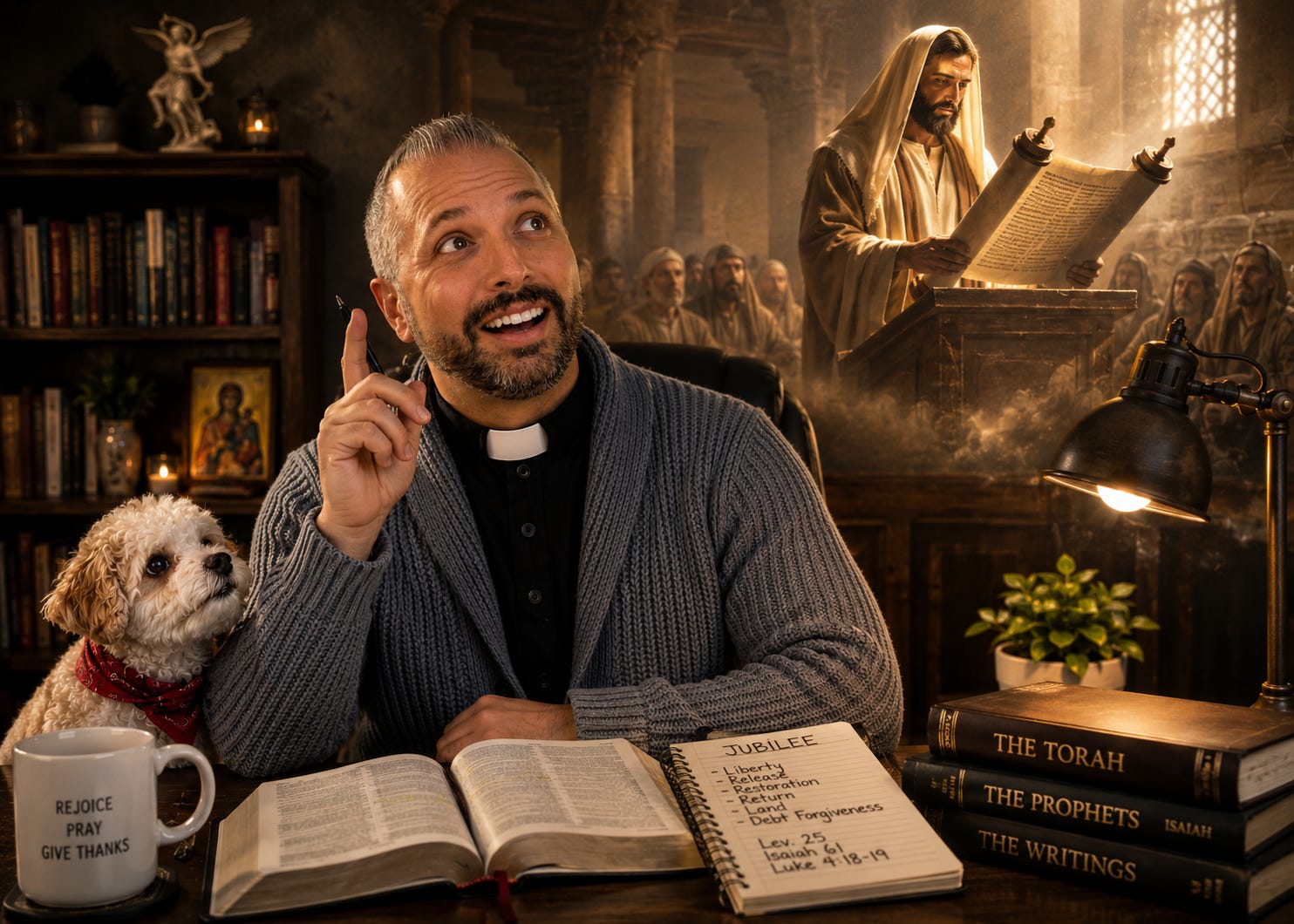
Before We Begin…
If you’ve been here for a while, you’ve probably noticed something about Message From the Margins.
I don’t treat you like children.
We may all be at different places in our spiritual journeys. Some readers have been studying Scripture for decades. Others are still figuring out whether they believe any of this at all.
But this will always be a place that invites you to think.
A place that asks difficult questions.
A place where disagreement is welcome, curiosity is encouraged, and honest conversation matters.
It is also not a place built around ego.
I have no interest in being the guy with all the answers.
My goal has never been to tell you what to think.
It’s to invite you into the conversation.
Yesterday’s news sent me down a rabbit hole.
As many of you know, economics was part of my undergraduate studies. Ralph Maynard Keynes I am not. Nobody is waiting for my call to advise the Federal Reserve.
But every now and then that background helps me notice a question worth exploring.
Yesterday was one of those days.
The announcement that Elon Musk had become the world’s first trillionaire got me thinking about wealth, power, economics, and what Christianity actually has to say about them.
What started as a quick article turned into several hours of research, note-taking, Bible study, and more than a few moments where I found myself saying:
“WHOAH… WHOAH… WHOAH… WHOAH?!!!!!!”
The result is today’s essay.
It’s longer than usual.
It’s more ambitious than usual.
And honestly, I think it’s one of the most fascinating things I’ve written in quite some time, if I might say so myself.
What follows is an exploration of a forgotten biblical economic idea called Jubilee, an idea that Jesus explicitly invoked at the beginning of his ministry, an idea that once shaped how God’s people thought about debt, poverty, wealth, restoration, and justice.
Most Christians have never heard a sermon about it.
After today, I suspect you’ll wonder why.
One final thing before we begin.
Pieces like this take a tremendous amount of time to research, write, and fact-check. If you’ve found value in the work we’re doing here, if these essays challenge you, encourage you, deepen your faith, or simply make you think, I hope you’ll consider becoming a paid subscriber.
Paid subscriptions make this ministry possible.
They allow me to spend less time chasing algorithms and more time doing what I love most: digging deeply into Scripture, asking difficult questions, and sharing what I find with all of you.
Now grab a fresh cup of coffee, put your phone on “Do not disturb,” put on Bluey for the kids.
We are going on quite a journey.
The Economic System Jesus Announced, and Why Most Christians Have Never Heard About It
Yesterday, Elon Musk became the world’s first trillionaire. Not billionaire.
Trillionaire.
The first human being in history whose wealth has crossed the threshold of one trillion dollars.
The human brain is not equipped to understand numbers that large.
A million sounds like a lot.
A billion sounds unimaginably larger.
A trillion barely registers as a meaningful concept at all.
So let me put it another way.
One million minutes ago, Pope Francis was still alive, Joe Biden was president, and most of us were complaining about the price of eggs.
One billion minutes ago, the Roman Empire still existed. The first apostles had died, but their students were still helping lead the early Church. Polycarp, a disciple of the Apostle John, was among the most respected Christian leaders in the world. Emperor Hadrian ruled the Roman Empire.
One trillion minutes ago, human beings did not exist.
Not civilizations.
Not nations.
Not Christianity.
Not Rome.
Not agriculture.
Not writing.
Not even Homo sapiens.
The world was in the middle of an Ice Age.
Early human ancestors were still discovering how to control fire.
That is the scale of a trillion.
And now one individual possesses wealth measured in those terms.
Whether you see that as an inspiring achievement, a warning sign, or some combination of both, it raises a question that is difficult to avoid:
What happens when wealth, power, and opportunity become concentrated on a scale previous generations could scarcely imagine?
Most modern people instinctively answer that question through the lens of capitalism, socialism, communism, free markets, taxation, regulation, or government spending.
The strange thing is that Jesus didn’t.
In fact, buried in the pages of Scripture is an economic vision so important that Jesus chose it as one of the defining themes of his first public sermon.
Yet most Christians have never heard a sermon about it.
Most Bible studies never discuss it.
Most churches never teach it.
And if you asked the average Christian to explain it, they probably couldn’t.
Not because it’s hidden.
Quite the opposite.
It’s hiding in plain sight.
Scattered throughout the Law.
Echoed by the prophets.
Embedded in the teachings of Jesus.
Reflected in the Lord’s Prayer.
Illustrated by Zacchaeus.
Practiced in the Book of Acts.
Defended by the Church Fathers.
And still present in Christian social teaching today.
It’s as though generations of Christians have been staring at the pieces of a puzzle without realizing they belong to the same picture.
The system was called Jubilee.
And the deeper I dug into it, the more convinced I became that we have not merely forgotten an obscure Old Testament law.
We have forgotten an entire way of thinking about wealth, debt, poverty, property, labor, restoration, justice, and human dignity.
More importantly, we have forgotten what that vision reveals about God.
Because the central question of Jubilee is not:
“How rich is too rich?”
Nor is it:
“How much should government do?”
The central question of Jubilee is far more profound:
What happens when people become trapped?
Trapped by debt.
Trapped by poverty.
Trapped by exploitation.
Trapped by injustice.
Trapped by systems that turn temporary hardship into permanent exclusion.
Again and again, the God of Scripture seems unwilling to accept that outcome as normal.
And nowhere is that more evident than in the first sermon Jesus ever preached.
I suspect you remember the scene.
Jesus walks into the synagogue in Nazareth.
The scroll of Isaiah is handed to him.
He stands to read…
The passage Jesus chose was familiar to everyone in the room.
It came from the prophet Isaiah.
Good news to the poor.
Freedom for captives.
Recovery of sight for the blind.
Release for the oppressed.
And then one final phrase:
“The year of the Lord’s favor.” (Luke 4)
Most Christians today hear that phrase and assume it means God’s blessing.
A spiritual season.
A time of grace.
The people sitting in that synagogue likely heard something much more specific.
Something economic.
Something social.
Something that reached all the way back into the Law of Moses.
But before we get there, notice something else.
Jesus finishes reading.
He rolls up the scroll.
He sits down.
And Luke tells us that every eye in the synagogue was fixed on him.
Every eye.
The room is silent.
People are waiting.
And then Jesus says something astonishing:
“Today this scripture is fulfilled in your hearing.” (Luke 4)
Think about what he’s claiming.
Not that Isaiah was interesting.
Not that Isaiah was wise.
Not that Isaiah had something important to teach.
Jesus is claiming that what Isaiah was talking about is happening right now.
In him.
This is not a side comment.
This is a mission statement.
The opening declaration of his public ministry.
Which raises an obvious question:
What exactly was Isaiah talking about?
Because if Jesus chose this passage as the banner under which he announced his ministry, we should probably understand what it meant.
This is where things get interesting.
The phrase “the year of the Lord’s favor” wasn’t simply religious language.
It pointed toward one of the strangest laws in the entire Bible.
A law so unusual that many Christians have never heard a sermon about it.
A law that dealt with debt.
Land.
Poverty.
Freedom.
Restoration.
And the possibility of beginning again.
The law was called Jubilee.
And once you understand Jubilee, it becomes very difficult to hear Jesus’ words the same way again.
The Law Most Christians Never Hear About
If you’re anything like me, you probably didn’t hear much about Jubilee growing up.
I heard sermons about David and Goliath.
I heard sermons about Jonah.
I heard sermons about the Prodigal Son.
I heard sermons about Heaven, Hell, prayer, forgiveness, and salvation.
I don’t remember hearing a single sermon devoted entirely to Jubilee.
Which is strange.
Because once you discover it, it seems to be everywhere.
Jubilee appears in Leviticus 25.
“‘Count off seven sabbath years—seven times seven years—so that the seven sabbath years amount to a period of forty-nine years. Then have the trumpet sounded everywhere on the tenth day of the seventh month; on the Day of Atonement sound the trumpet throughout your land. Consecrate the fiftieth year and proclaim liberty throughout the land to all its inhabitants. It shall be a jubilee for you; each of you is to return to your family property and to your own clan. The fiftieth year shall be a jubilee for you; do not sow and do not reap what grows of itself or harvest the untended vines. For it is a jubilee and is to be holy for you; eat only what is taken directly from the fields.
‘“In this Year of Jubilee everyone is to return to their own property.
“‘If you sell land to any of your own people or buy land from them, do not take advantage of each other. You are to buy from your own people on the basis of the number of years since the Jubilee. And they are to sell to you on the basis of the number of years left for harvesting crops. When the years are many, you are to increase the price, and when the years are few, you are to decrease the price, because what is really being sold to you is the number of crops. Do not take advantage of each other, but fear your God. I am the Lord your God.
At first glance it sounds bizarre.
Every fifty years, a trumpet would sound throughout the land.
Debts would be released.
People trapped in debt servitude would be freed.
Families would return to ancestral lands.
Property would revert back to its original households.
The land itself would rest.
Imagine trying to explain that to a modern economist.
Actually, imagine trying to explain it to a modern American.
We live in a culture built around accumulation.
Build more.
Own more.
Acquire more.
Scale more.
Grow more.
The underlying assumption is that what you accumulate today should remain accumulated forever.
Jubilee challenges that assumption.
Not because wealth is evil.
Not because success is evil.
Not because private property is evil.
The Bible never says any of those things.
Instead, Jubilee seems to be asking a very different question:
What happens when temporary hardship becomes permanent exclusion?
Imagine you’re a farmer in ancient Israel.
A drought hits.
Your crops fail.
You borrow money.
The next year isn’t much better.
The debt grows.
Eventually you sell part of your land.
A few years later you sell more.
Your children inherit less than you did.
Your grandchildren inherit less than they did.
A temporary setback becomes a permanent condition.
A bad year becomes a bad century.
God appears remarkably unwilling to allow that process to continue forever.
Which is why Jubilee wasn’t primarily about debt forgiveness.
That’s the part most people focus on.
The deeper concern was restoration.
Restoration of families.
Restoration of opportunity.
Restoration of dignity.
Restoration of community.
The goal wasn’t making everyone equal.
The goal wasn’t punishing success.
The goal wasn’t redistributing wealth for the sake of redistribution.
The goal was preventing permanent dispossession.
That phrase became the key that unlocked the entire concept for me.
Because once you see it, you start seeing it everywhere.
The God of Scripture repeatedly acts to prevent temporary hardship from becoming permanent exclusion.
That’s what Exodus is about.
That’s what the return from Exile is about.
That’s what many of the prophets are talking about.
And, as we’ll soon discover, that’s exactly what Jesus seems to be talking about too.
But before we go any further, there’s one sentence buried in the Jubilee laws that changes everything.
A sentence so radical that most of us read right past it without noticing.
God says:
“‘The land must not be sold permanently, because the land is mine and you reside in my land as foreigners and strangers.” ~Leviticus 25:23
Read that again.
The land is mine.
Not yours.
Mine.
Suddenly the entire conversation changes.
Because modern economics usually begins with ownership.
The biblical vision begins with stewardship.
The Difference Between Ownership and Stewardship
That single sentence from Leviticus changes everything.
“The land is mine.”
Not the king’s.
Not the wealthy landowner’s.
Not the person with the largest army.
God’s.
If you miss that, Jubilee makes no sense.
In fact, much of the Bible makes no sense.
Because most of us have been taught to think about possessions in a very particular way.
I worked for it.
I earned it.
I bought it.
It’s mine.
To be fair, there is truth in that.
The Bible does not condemn work.
The Bible does not condemn success.
The Bible does not condemn private property.
In fact, the commandment against stealing assumes private property exists.
But Scripture keeps insisting there is another truth that sits above all of those truths.
Everything ultimately belongs to God.
The land belongs to God.
The harvest belongs to God.
Our talents belong to God.
Our opportunities belong to God.
Even our lives belong to God.
We are not owners in the absolute sense.
We are stewards.
Caretakers.
Trustees.
People entrusted with something that ultimately belongs to someone else.
And that changes the questions we ask.
The ownership mindset asks:
“What am I allowed to do with what is mine?”
The stewardship mindset asks:
“What am I called to do with what has been entrusted to me?”
Those are not the same question.
One focuses on rights.
The other focuses on responsibility.
One asks what I can keep.
The other asks what I am supposed to do.
Suddenly, wealth isn’t merely a personal achievement.
It’s a trust.
Property isn’t merely an asset.
It’s a responsibility.
Success isn’t merely something to enjoy.
It’s something to steward.
This idea runs throughout Scripture.
It appears in the prophets.
It appears in the teachings of Jesus.
It appears in the early Church.
It appears again and again in Christian social teaching.
And it shows up in one of the most uncomfortable statements ever made by a Church Father.
St. Basil the Great, writing in the fourth century, looked at wealth and poverty and said:
“The bread which you do not use belongs to the hungry; the cloak in your closet belongs to the naked; the shoes you do not wear belong to the barefoot; the money you bury belongs to the poor.”
— St. Basil the Great
The first time I read that quote, I remember stopping.
Not because I immediately agreed with every implication.
Because it felt so foreign to the way most modern Christians talk about money.
Basil wasn’t asking whether something legally belonged to you.
He was asking what God intended it for.
That’s a very different conversation.
And before anyone starts accusing Basil of being a socialist, it’s worth remembering something important:
He lived roughly fourteen hundred years before Karl Marx.
This wasn’t socialism.
It wasn’t capitalism.
It wasn’t progressivism.
It wasn’t conservatism.
It was Christianity.
Or at least one influential Christian’s attempt to take Scripture seriously.
Which raises an uncomfortable possibility.
What if our modern political categories are actually getting in the way?
What if we’ve spent so much time arguing about capitalism versus socialism that we’ve overlooked the fact that the Bible is asking an entirely different set of questions?
Questions about dignity.
Questions about responsibility.
Questions about restoration.
Questions about what happens when people become trapped.
And once you start noticing those questions, something fascinating begins to happen.
You start finding them everywhere.
Even in places you’ve read a hundred times before.
Take the Lord’s Prayer, for example.
Because there is a word in that prayer that most Christians have been saying for years without really noticing.
The Puzzle Piece Hidden in the Lord’s Prayer
Here’s where things started getting weird for me.
Because once I began looking for Jubilee, I kept finding echoes of it in places I had read dozens, maybe hundreds, of times before.
Take the Lord’s Prayer.
Most Christians can recite it from memory.
Many of us learned it as children.
We’ve spoken it at baptisms.
Weddings.
Funerals.
Hospital bedsides.
Sunday worship.
It’s one of the most familiar prayers in human history.
Yet there is a word sitting right in the middle of it that many Christians never stop to think about.
Jesus teaches us to pray:
This, then, is how you should pray:
“‘Our Father in heaven,
hallowed be your name,
your kingdom come,
your will be done,
on earth as it is in heaven.
Give us today our daily bread.
And forgive us our debts,
as we also have forgiven our debtors.
And lead us not into temptation,
but deliver us from the evil one.”
Depending on your church tradition, you may have learned “trespasses.”
Others learned “sins.”
Still others learned “debts.”
The Greek word behind the passage is often translated literally as debts or obligations.
Now, before anyone panics, I’m not suggesting Jesus was secretly teaching a lesson on accounting.
He’s talking about something larger.
But it is worth noticing that the language Jesus chooses overlaps with the same world of obligation, forgiveness, release, and restoration that sits at the heart of Jubilee.
Think about that for a moment.
One of the most famous prayers in Christianity includes the idea that debts should be released.
Obligations should be forgiven.
People can be restored.
The God Jesus reveals is not a God who delights in keeping score forever.
The God Jesus reveals is a God who creates paths back.
Back into relationship.
Back into community.
Back into dignity.
Back into life.
Suddenly, the themes of Jubilee don’t seem quite so isolated anymore.
They’re beginning to appear throughout Jesus’ teaching.
And then we encounter a man named Zacchaeus.
Most of us remember him for one thing.
He was short.
Which is unfortunate.
Because that may be the least interesting thing about him.
Zacchaeus and the Difference Between Forgiveness and Repair
The story appears in Luke 19.
Jesus enters Jericho.
A crowd gathers.
A tax collector named Zacchaeus climbs a tree so he can see over everyone else.
It’s one of those stories that ends up in children’s Bibles because it’s easy to picture.
Short man.
Tree.
Crowd.
Jesus looks up.
Invites himself to dinner.
Everyone complains.
And that’s usually where our attention stops.
But the most important part of the story happens afterward.
Something changes in Zacchaeus.
Not just emotionally.
Practically.
Materially.
Economically.
Zacchaeus stands up and says:
But Zacchaeus stood up and said to the Lord, “Look, Lord! Here and now I give half of my possessions to the poor, and if I have cheated anybody out of anything, I will pay back four times the amount.”
Jesus said to him, “Today salvation has come to this house, because this man, too, is a son of Abraham. For the Son of Man came to seek and to save the lost.”
Read that carefully.
Zacchaeus doesn’t merely apologize.
He doesn’t merely confess.
He doesn’t merely feel bad.
He restores.
He repairs.
He makes restitution.
If he has harmed someone, he intends to make it right.
In fact, he intends to go beyond merely making it right.
And Jesus’ response is fascinating.
Jesus doesn’t say:
“Whoa, slow down. That’s unnecessary.”
He doesn’t say:
“None of that matters. Only your personal faith matters.”
Instead, Jesus declares:
“Today salvation has come to this house.”
Notice what happened.
The encounter with grace produced restoration.
The encounter with mercy produced repair.
The encounter with Christ produced a desire to make things right.
That is a deeply biblical pattern.
And it points to something modern Christians often miss.
The Bible’s vision of justice is bigger than punishment.
It is bigger than guilt.
It is even bigger than forgiveness.
Again and again, Scripture asks another question:
What would it look like to restore what was broken?
That question sits at the heart of Jubilee.
It sits at the heart of Zacchaeus.
And once you start looking for it, you begin finding it everywhere.
Even in the earliest days of the Church itself.
The Puzzle Pieces Keep Appearing
At this point, I started wondering whether I was connecting dots that weren’t really there.
Maybe Jubilee was important.
Maybe Jesus intentionally invoked it.
Maybe Zacchaeus reflects some of its themes.
But was I forcing a pattern?
Then I got to the Book of Acts.
And the pattern became much harder to ignore.
Acts describes the earliest Christian community in remarkable terms.
People shared resources.
They cared for one another.
They ensured that vulnerable members of the community were not abandoned.
Luke summarizes the result with a statement that should make every Christian stop and think:
All the believers were one in heart and mind. No one claimed that any of their possessions was their own, but they shared everything they had. With great power the apostles continued to testify to the resurrection of the Lord Jesus. And God’s grace was so powerfully at work in them all that there were no needy persons among them. For from time to time those who owned land or houses sold them, brought the money from the sales and put it at the apostles’ feet, and it was distributed to anyone who had need. ~Acts 4: 32-35
Read that again.
“There were no needy persons among them.”
Not because nobody had needs.
Not because everyone possessed equal wealth.
Not because the apostles had discovered a perfect economic system.
There were no needy persons among them because the community took responsibility for one another.
The Gospel had consequences.
Not just spiritual consequences.
Social consequences.
Economic consequences.
Communal consequences.
People’s relationship with money changed.
People’s relationship with possessions changed.
People’s relationship with one another changed.
The most fascinating thing about Acts is that Luke never presents this as an economic theory.
Nobody is arguing about capitalism.
Nobody is arguing about socialism.
Nobody is debating tax policy.
Those categories didn’t even exist.
Instead, something much simpler is happening.
People have encountered the risen Christ.
And that encounter has changed how they think about what belongs to them.
Or perhaps more accurately, it has changed how they think about what belongs to God.
Which brings us back to stewardship.
Back to Jubilee.
Back to that strange sentence in Leviticus.
“The land is mine.”
Once you believe that everything ultimately belongs to God, it becomes much harder to ignore the needs of your neighbor.
The early Church understood that.
The Church Fathers understood that too.
In fact, some of them expressed it in language so direct that it still makes modern Christians uncomfortable.
St. John Chrysostom warned that failing to share with the poor was not merely a lack of generosity, but a failure of justice.
St. Ambrose argued that creation itself was intended for the benefit of all.
Again and again, early Christian thinkers found themselves wrestling with the same questions raised by Jubilee:
What is wealth for?
What obligations accompany blessing?
What do we owe one another as members of the same human family?
The more I read Scripture, the more I realized that the Bible returns to those questions over and over again.
And the answers rarely fit neatly into our modern political tribes.
Which may explain why we don’t talk about Jubilee very much.
Because Jubilee has a habit of making everyone uncomfortable.
The political left likes some parts of it and dislikes others.
The political right likes some parts of it and dislikes others.
Jubilee stubbornly refuses to fit inside anyone’s ideological box.
And perhaps that is because it wasn’t designed to.
It wasn’t written by Democrats.
It wasn’t written by Republicans.
It wasn’t written by economists.
It wasn’t written by political theorists.
It emerged from a people trying to understand what life looks like when God is taken seriously.
Which raises a question I’ve found increasingly difficult to ignore:
If Jubilee is so important…
If Jesus deliberately invokes it…
If its themes keep appearing throughout Scripture…
Why do so few Christians know anything about it?
Why Did We Stop Talking About This?
At this point, I found myself unable to shake a very important question…
How did it disappear?
How did generations of Christians become so familiar with the Bible and yet so unfamiliar with one of its most fascinating ideas?
I don’t think there is a conspiracy.
I don’t think there was a secret meeting where Church leaders decided to erase Jubilee from the faith.
The answer is probably much simpler.
Over time, Christianity became increasingly focused on the individual.
Now before anyone gets angry, hear me out.
The individual matters.
Salvation matters.
Personal conversion matters.
Prayer matters.
Repentance matters.
Your relationship with God matters.
All of those things are deeply important.
But somewhere along the way, many Christians began acting as though those were the only things that mattered.
We became very good at talking about personal sin.
Less comfortable talking about social sin.
Very good at talking about what happens after we die.
Less comfortable talking about how we live together before we die.
Very good at talking about getting souls into heaven.
Less comfortable talking about what a community shaped by the Kingdom of God might actually look like.
The result is that many of us learned to read the Bible with blinders on.
When we encounter a passage about greed, we make it personal.
When we encounter a passage about generosity, we make it personal.
When we encounter a passage about forgiveness, we make it personal.
When we encounter a passage about wealth, poverty, labor, debt, land, oppression, exploitation, or restoration…
we somehow manage to make those personal too.
And to be clear, there is nothing wrong with personal application.
The problem comes when we stop there.
Because the biblical writers didn’t stop there.
The prophets certainly didn’t.
When Amos condemns injustice, he’s not talking only about individual behavior.
When Isaiah speaks about oppression, he’s not talking only about individual behavior.
When Micah talks about exploiting the vulnerable, he’s not talking only about individual behavior.
They are talking about communities.
Systems.
Nations.
Structures.
Ways of organizing life together.
The Bible consistently assumes that human beings do not merely sin as individuals.
We also create sinful patterns.
Sinful institutions.
Sinful habits.
Sinful ways of arranging society.
And those patterns can become so normal that nobody even notices them anymore.
Which brings us back to Jubilee.
Because at its heart, Jubilee is asking a question that remains surprisingly relevant:
What happens when an entire society begins treating permanent exclusion as normal?
What happens when poverty becomes hereditary?
What happens when opportunity becomes concentrated?
What happens when debt becomes a trap?
What happens when some communities never recover from the losses of the past?
What happens when the vulnerable become invisible?
Those are not Democratic questions.
They are not Republican questions.
They are not socialist questions.
They are not capitalist questions.
They are Jubilee questions.
And whether we like it or not, they are questions the Bible refuses to stop asking.
Which is why I think the most important thing Jubilee reveals isn’t actually about economics.
It’s about God.
And that, I suspect, is where the conversation becomes truly uncomfortable.
The Dangerous Question Jubilee Still Asks
At this point, some readers may be feeling a little uncomfortable.
Good.
Honestly, so am I.
Because Jubilee has a way of forcing us to confront questions we would often rather avoid.
Not questions about political parties.
Questions about reality.
For example:
What happens when the effects of injustice last longer than the injustice itself?
That’s a question modern society struggles to answer.
Imagine a family loses its land.
A generation passes.
Then another.
Then another.
Eventually the original injustice is gone.
The people responsible are gone.
The laws that allowed it are gone.
But the consequences remain.
The family still has no land.
The opportunities that land would have created are still missing.
The inheritance that might have been passed down never existed.
The damage continues long after the event itself has faded into history.
Jubilee seems to recognize something that many of us would rather not admit:
History leaves scars.
The Bible understands this instinctively.
Why else return land?
Why else release debts?
Why else restore households?
Why else proclaim liberty?
Because God appears to understand that the consequences of hardship often outlive the hardship itself.
A bad harvest can affect generations.
A crushing debt can affect generations.
An injustice can affect generations.
Which is why Jubilee isn’t merely concerned with stopping harm.
It is concerned with restoration.
Repair.
The possibility of beginning again.
And once you see that, some modern realities start looking a little different.
Take slavery.
Whenever Christians discuss justice, somebody eventually points out that the Bible contains references to slavery.
That’s true.
What is often left unsaid is that the slavery practiced in ancient Israel was not the same thing as the race-based chattel slavery that scarred American history.
Ancient debt servitude was often tied to poverty, debt, or economic collapse.
American slavery transformed human beings into inheritable property.
It tied bondage to race.
It made status hereditary.
It created systems whose effects continued long after slavery itself was abolished.
Those distinctions matter.
But so does another observation.
The trajectory of Scripture repeatedly moves toward freedom.
Toward restoration.
Toward release.
Toward dignity.
Not toward permanent bondage.
The same can be said for countless other examples.
The Trail of Tears ended.
Its consequences did not.
Redlining became illegal.
Its consequences did not instantly disappear.
Segregation ended.
Its consequences did not disappear overnight.
History leaves marks.
Again, this isn’t an argument for a particular political solution.
Reasonable Christians can disagree about solutions.
They often should.
The question comes before the solution.
The question is whether we are willing to acknowledge the wound.
Whether we are willing to acknowledge the mark history leaves behind.
And whether we believe restoration matters.
Because restoration sits at the center of Jubilee.
The same question emerges when we look at the modern world.
Millions of people remain trapped in forms of exploitation that most of us rarely see.
Human trafficking.
Forced labor.
Debt bondage.
Children working in dangerous conditions.
Workers whose entire lives are controlled by obligations they cannot escape.
The forms have changed.
The trap remains familiar.
Which brings us back to Jesus.
When he spoke of freedom for captives and release for the oppressed, who exactly was he talking about?
The answer, I suspect, is larger than any single group.
Larger than any single century.
Larger than any single political issue.
The God of Jubilee consistently seems drawn toward those who have become trapped.
The poor.
The oppressed.
The indebted.
The excluded.
The forgotten.
The people everyone else has learned to live without noticing.
And that observation leads to perhaps the most important discovery of all.
Because after all the discussion of debt, land, poverty, slavery, justice, and restoration, I eventually realized that Jubilee is not primarily revealing an economic system.
It is revealing the character of God.
What Jubilee Reveals About God
Somewhere in the middle of all this research, I realized I had been asking the wrong question.
I started by trying to understand a forgotten economic system.
I ended up discovering something about God.
Because the more I studied Jubilee, the less it looked like an economic policy and the more it looked like a window into the divine heart.
Think about the pattern we’ve seen.
A family falls into debt.
God creates a path back.
A household loses its land.
God creates a path back.
A nation goes into exile.
God creates a path back.
Zacchaeus has built his life on exploitation.
God creates a path back.
The early Church encounters poverty in its midst.
God creates a path back.
Again and again, the same pattern emerges.
Again and again, God seems unwilling to leave people trapped.
And suddenly I realized something.
That’s not just the story of Jubilee.
That’s the story of the entire Bible.
The Exodus is the story of people trapped in slavery and God creating a path back to freedom.
The Exile is the story of people trapped far from home and God creating a path back.
The prophets are constantly speaking to people who believe their future has been lost and reminding them that God is not finished with them.
And Christianity itself begins with the astonishing claim that human beings are trapped by sin and death, and that God has created a path back.
The same rhythm appears over and over and over again.
Which is why I no longer think Jubilee is primarily about economics.
Economics is simply one place where the pattern becomes visible.
The deeper truth is that the God of Scripture refuses to accept permanent dispossession as normal.
Think about how radical that actually is.
The world is full of systems that sort people into categories.
Successful and unsuccessful.
Winners and losers.
Deserving and undeserving.
Important and expendable.
The logic of the world often says:
“You made your bed. Lie in it.”
“That’s just how things are.”
“Some people get left behind.”
“Nothing can be done.”
The logic of Jubilee says something very different.
It insists that temporary hardship should not become permanent exclusion.
That failure should not become destiny.
That poverty should not become identity.
That oppression should not become normal.
That human beings should not be discarded.
And if that sounds familiar, it should.
Because that is also the logic of grace.
Grace says your worst mistake is not your final identity.
Jubilee says your worst economic moment is not your final identity.
Grace says restoration is possible.
Jubilee says restoration is possible.
Grace says God refuses to abandon people to what has happened to them.
Jubilee says communities should refuse to do the same.
For years I thought of grace primarily as something personal.
The forgiveness of sins.
The restoration of a relationship with God.
The promise of eternal life.
I still believe all of that.
But Jubilee suggests that grace has social consequences.
Not because society can save itself.
Not because government can create the Kingdom of God.
But because a people shaped by grace should begin to resemble the God who gives it.
And the God revealed in Scripture is relentlessly, stubbornly committed to restoration.
Not punishment alone.
Not judgment alone.
Restoration.
Again and again, God asks:
How do we bring people back?
Back into community.
Back into dignity.
Back into relationship.
Back into hope.
Back into life.
That is the heartbeat of Jubilee.
And once I saw it, I started noticing something else.
The people sitting in that synagogue in Nazareth may have understood exactly what Jesus was claiming.
When they heard “the year of the Lord’s favor,” they weren’t just hearing a spiritual metaphor.
They were hearing restoration.
Release.
Return.
Liberty.
The possibility of beginning again.
Which means Jesus wasn’t merely announcing a personal salvation plan.
He was announcing the arrival of a kingdom.
A kingdom shaped by the character of a God who refuses to leave people trapped.
And that realization brings us back to where we began.
Back to a world where one man can possess a trillion dollars.
Back to a world wrestling with debt, poverty, inequality, exploitation, and exclusion.
Back to a world still asking what human flourishing should look like.
Because before we ask what policies are wise…
Before we ask what economics should look like…
Before we ask who is right and who is wrong…
There is a more fundamental question.
What kind of God do we believe in?
Jubilee gives us an answer.
A God who keeps creating paths back.
Back to Nazareth
So let’s return to that synagogue.
Let’s return to the moment where this journey began.
Jesus stands.
The scroll of Isaiah is handed to him.
He reads about good news for the poor.
Freedom for captives.
Sight for the blind.
Release for the oppressed.
The year of the Lord’s favor.
Then he rolls up the scroll.
Sits down.
And Luke tells us that every eye in the room is fixed on him.
Imagine the silence.
Imagine the anticipation.
Imagine knowing these Scriptures your entire life and suddenly realizing someone is about to tell you what they mean.
Then Jesus speaks.
“Today this scripture is fulfilled in your hearing.”
I’ve heard those words countless times.
I’ve preached on them.
I’ve prayed with them.
I’ve reflected on them.
Yet after studying Jubilee, I hear them differently.
Because the people sitting in that synagogue were not merely hearing a promise of heaven.
They were hearing a vision of restoration.
They were hearing a God who sees those trapped by poverty.
Those trapped by debt.
Those trapped by oppression.
Those trapped by systems that deny human dignity.
They were hearing a God who refuses to leave people there.
A God who keeps creating paths back.
Back to community.
Back to freedom.
Back to dignity.
Back to hope.
Back to life.
Perhaps that’s why Jubilee keeps appearing throughout Scripture.
Perhaps that’s why its themes echo through the prophets.
Perhaps that’s why they emerge in the Lord’s Prayer.
Perhaps that’s why Zacchaeus doesn’t merely repent but restores.
Perhaps that’s why the early Church worked so hard to ensure there were no needy persons among them.
Perhaps that’s why generation after generation of Christians kept returning to questions of labor, wealth, poverty, and justice.
Not because Christianity is primarily an economic system.
It isn’t.
Not because Jesus came to endorse a political party.
He didn’t.
But because the Gospel has consequences.
The way we understand God eventually shapes the way we understand one another.
And if God refuses to abandon people to permanent exclusion, perhaps we should be cautious about accepting permanent exclusion as normal.
If God keeps creating paths back, perhaps we should be looking for them too.
Not because every problem has a simple solution.
It doesn’t.
Not because every political question has an obvious answer.
It doesn’t.
But because followers of Christ should at least be asking the same questions Christ asked.
What happens to the poor?
What happens to the oppressed?
What happens to the indebted?
What happens to those left behind?
What happens to those who have become trapped?
For a very long time, I assumed Jubilee was an obscure Old Testament law.
Something interesting.
Something historical.
Something largely irrelevant.
I don’t think that anymore.
I think Jubilee is one of the most important ideas most Christians have never been taught.
Not because it gives us all the answers.
But because it reminds us to ask the right questions.
And perhaps that is why Jesus chose it as the banner under which he announced his ministry.
Not with a discussion of power.
Not with a discussion of doctrine.
Not with a discussion of religious rules.
But with a proclamation.
Good news.
Freedom.
Release.
Restoration.
The year of the Lord’s favor.
The language of Jubilee.
The language of a God who refuses to leave people trapped.
Maybe the people in that synagogue understood more than we do.
They heard release.
They heard restoration.
They heard return.
They heard dignity.
They heard hope.
They heard Jubilee.
Maybe it’s time the rest of us heard it too.
A Final Thought Over Coffee
Before we rush off to debate economics, politics, taxes, wealth, debt, or government programs, I wonder if Jubilee invites us to begin somewhere smaller.
Closer to home.
Closer to the heart.
Where do you see people trapped?
Maybe it’s someone trapped by debt.
Maybe it’s someone trapped by addiction.
Maybe it’s someone trapped by loneliness.
Maybe it’s someone trapped by grief.
Maybe it’s someone trapped by a mistake they made years ago and still cannot forgive themselves for.
Maybe, if we’re honest, it’s us.
One of the reasons I find Jubilee so compelling is that it reminds me that God’s answer to human brokenness is rarely abandonment.
God does not seem particularly interested in writing people off.
Again and again throughout Scripture, God creates paths back.
Back to community.
Back to dignity.
Back to hope.
Back to life.
Perhaps that’s why Jesus chose Jubilee as the opening note of his public ministry.
Not because every economic question has a simple answer.
Not because every social problem can be solved by a government policy.
But because the Kingdom he announced is fundamentally a kingdom of restoration.
A kingdom where people are more than their failures.
A kingdom where hardship is not destiny.
A kingdom where exclusion does not get the final word.
A kingdom where grace keeps opening doors we thought were permanently closed.
And in a world where some people possess wealth measured in trillions while others struggle to make it through the week, perhaps the most important question is not whether we have all the answers.
Perhaps the most important question is whether we are asking the same questions Jesus asked.
Who is poor?
Who is oppressed?
Who is trapped?
And what would it look like to help create a path back?
That, I suspect, is a question worth carrying with us long after we’ve finished our coffee.
And Now It’s Your Turn…
I’d genuinely love to hear your thoughts on this one.
Not because I think I’ve discovered all the answers.
Quite the opposite.
The deeper I dug into Jubilee, the more questions I found myself asking.
Questions about debt.
Questions about poverty.
Questions about wealth.
Questions about restoration.
Questions about what it means to follow a God who seems remarkably unwilling to leave people trapped.
So let me ask you:
Before reading this article, had you ever heard a sermon or Bible study on Jubilee?
What surprised you most?
Do you think modern Christianity has largely forgotten this part of Scripture, or do you think I’m overstating the case?
And perhaps the biggest question of all:
If Jesus deliberately chose Jubilee as one of the defining themes of his first public sermon, what do you think he was trying to tell us?
Share your thoughts in the comments.
I read every one of them, even when we disagree.
In fact, some of the best conversations in this community happen when thoughtful people wrestle with difficult questions together.
And if this essay made you stop and think, if it challenged an assumption, connected some dots, or helped you see Scripture in a new way, please consider sharing it.
One of the goals of Message From the Margins has always been to recover treasures hiding in plain sight.
Jubilee may be one of the biggest treasures we’ve forgotten.
Let’s start the conversation.
Closing Prayer
Let us pray.
God of Jubilee,
You are the God who hears the cry of the oppressed,
the God who frees captives,
the God who restores what has been broken,
and the God who never abandons Your people to despair.
Forgive us for the times we have accepted as normal
what You never intended.
Forgive us when we have overlooked those who are struggling,
ignored those who are trapped,
or forgotten that everything we have ultimately comes from You.
Teach us to be faithful stewards of the gifts You have entrusted to us.
Give us eyes to see those who are burdened,
wisdom to recognize injustice,
courage to pursue restoration,
and hearts that reflect Your mercy.
Help us remember that no person is defined by their worst mistake,
their deepest wound,
their greatest failure,
or the hardships they have endured.
Remind us that You are always creating paths back:
Back to dignity.
Back to community.
Back to hope.
Back to life.
As we seek to follow Christ, may we become people who bring good news to the poor, freedom to the oppressed, and hope to those who feel forgotten.
And may Your Kingdom come, on earth as it is in heaven.
Through Jesus Christ our Lord.
Amen.
Well, Well, Well…
You made it all the way to the end.
First of all, congratulations.
Second, you may now officially annoy your pastor by asking about Jubilee after church tomorrow.
(If you do, please report back.)
Seriously though, thank you for spending part of your day with me.
One of the things I love most about this community is that you’re willing to wrestle with ideas that don’t fit neatly into sound bites, political tribes, or easy answers.
This article wasn’t really about economics.
At least not primarily.
It was about discovering a piece of Scripture that many of us somehow missed.
It was about asking why Jesus chose Jubilee as the banner under which he announced his ministry.
And it was about what that forgotten idea might reveal about the heart of God.
If you’ve made it this far, I’d love to hear from you.
Leave a comment and let me know:
What was your biggest “Wait… WHAT?” moment in the article?
Was it Jubilee itself?
The Lord’s Prayer?
Zacchaeus?
The Church Fathers?
The idea that Jesus may have been talking about something far bigger than we’ve been taught?
I genuinely read the comments, and some of the best insights in this community come from the conversations that happen below the article.
And one more thing…
If this piece made you think, challenged an assumption, connected some dots, or taught you something new, please consider sharing it.
Send it to a friend.
Post it on social media.
Forward it to that one Bible-study person in your life who is always sending you fascinating rabbit holes.
Word of mouth is still the single biggest way Message From the Margins grows.
And if you’d like to support this work and help me keep producing deep-dive essays like this one, consider becoming a paid subscriber.
Paid subscriptions help keep the lights on, the coffee flowing, and the rabbit holes thoroughly explored.
Thank you for being here.
Now go forth and casually ask people whether they’ve ever heard of Jubilee.
I suspect you’re going to get a lot of blank stares.