

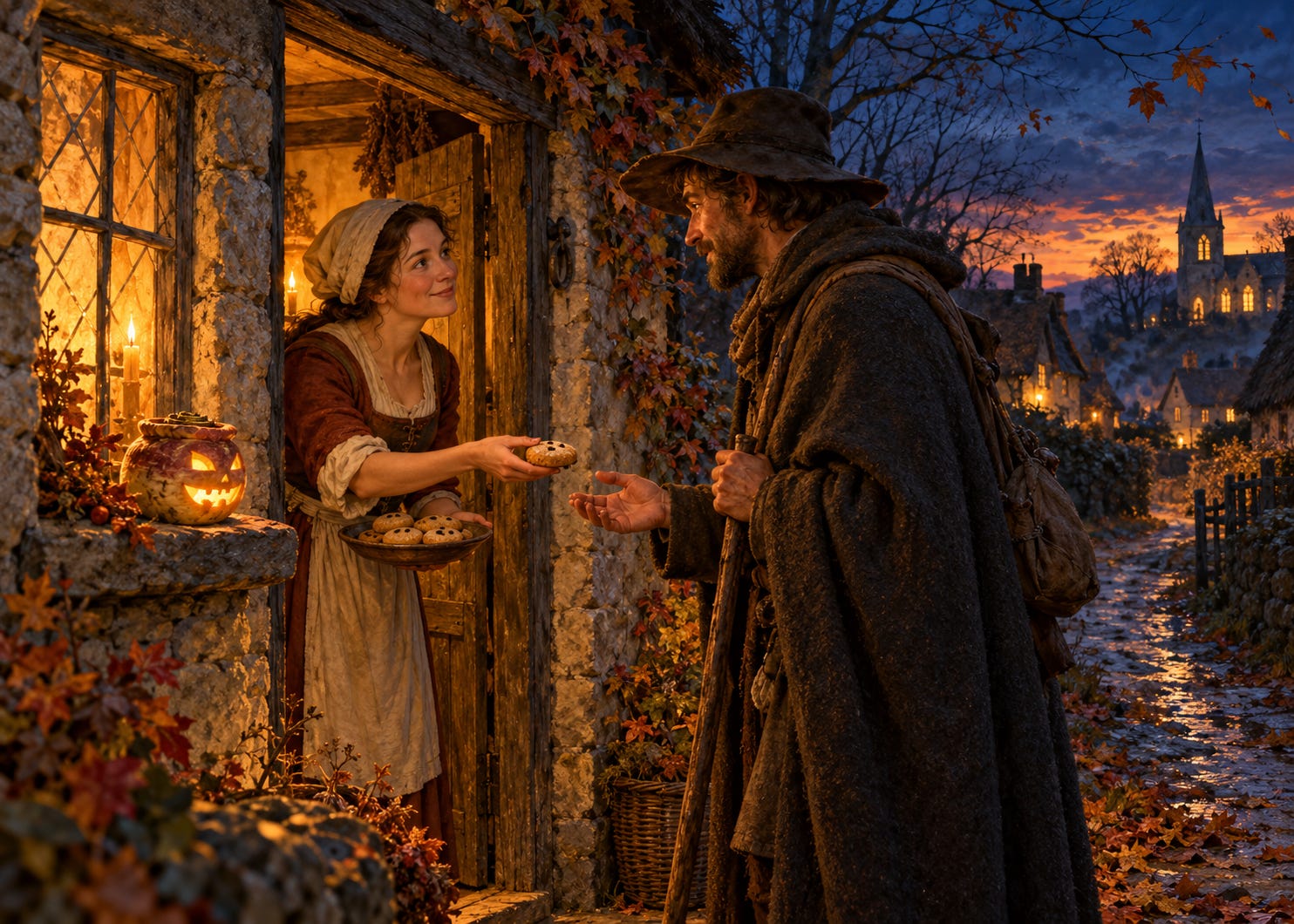
“The custom of souling: a cake offered at the door, with remembrance of the dead close at hand.”
Happy Halloween, my dear family. When I suggested a week of strange Christian stories, the main reason was that I thought we could use a little fun. We have since acquired a haunted bronze head, a talking dog, and a sorcerer still struggling to accept that his evening has gone badly. I have enjoyed this immensely, and I hope you have too. Today, we follow the evening that gave us our excuse, and tomorrow we’ll talk more about All Saints Day and the day after, All Souls.
Thank you for reading and helping this community grow. Paid subscriptions make the work possible and help keep nearly everything here freely available. If you have room to support the ministry, I would be grateful. If you are watching every dollar, please enjoy the writing without guilt. I am glad you are here.
The Incredible History of All Hallows’ Eve
A knock at the door, an offer concerning your dead relatives, and the long, strange journey to Halloween.
It is after dark, and somebody at the door would like to discuss your dead relatives.
Under ordinary circumstances, I would recommend leaving the latch on.
But picture an English household several centuries ago, at the beginning of November. There are fresh cakes in the house, and the person outside hopes you might spare one. In return, they will pray for the people you have lost.
They ask whom you would like them to remember. You give a name, perhaps two, and they repeat the names back to you before accepting the cake. Then they move on to the next house, leaving you to answer somebody in the kitchen who wants to know whether there are any cakes left.
This is souling, a custom that brought the household’s prayers for its dead into an exchange with the living at its door. The cakes were known as soul cakes, and the visitors might be poor neighbors or, in later accounts, children making their rounds with songs and prayers. A seventeenth-century dictionary describes Catholics in parts of England still giving these cakes to poor people on All Souls’ Day.
Now look down your own street tonight, where somebody is approaching a lighted door and hoping the people inside have something good to eat. The visitor may be a dinosaur, and the proposed bargain may involve a threat of mischief, but nobody is expecting a theological examination before receiving a miniature Snickers.
People have been knocking on doors around this season for a very long time, bringing prayers, songs, disguises, and occasionally intentions the householder would prefer they had left at home. How did an evening named for the saints acquire such a peculiar collection of visitors?
Gather close, my dear friends.
The saints had an evening first
If you asked Halloween to introduce itself properly, it would have to admit that its name is All Hallows’ Eve. “All Hallows” means All Saints; we still use a related word in the Lord’s Prayer when we say, “hallowed be thy name.” This is the evening before the feast, much as Christmas Eve is the evening before Christmas. The name grew shorter over time, while the saints kept their place on the other side of midnight.
Their feast grew out of a much older practice of remembrance. Christian communities kept the anniversaries of martyrs’ deaths, gathering to honor the people whose faith had cost them their lives. As common commemorations developed, more of those people were remembered together, including those whose names a particular community might never have known.
In Rome, that remembrance found a remarkable home beneath the dome of the Pantheon. Stand inside and look up through its opening to the sky: the building had already lived a Roman religious life when, in the early seventh century, Pope Boniface IV dedicated it to Mary and the martyrs. Within those ancient walls, Christians made a place of prayer for people who had died for Christ.
The anniversary of the dedication was May 13. Yes, May. The saints have not always conducted this business in pumpkin season.
November 1 eventually became established as the Western feast of All Saints. The traditional account links that development with Pope Gregory III’s dedication of a chapel to the saints and its wider extension under Gregory IV, though the observance grew across places and generations. Any explanation that makes a holiday this crowded the work of one man with a calendar and a clever idea deserves a little suspicion.
As the November feast took its place, the evening before it belonged to the saints too. The following day would become All Souls, devoted to prayer for the faithful departed. Around the beginning of the second millennium, Abbot Odilo of Cluny established that November commemoration among the monasteries under his authority, and it spread more widely in the centuries that followed.
Together, the observances gave communities days for remembering their dead. The customs that gathered around those days could become fiercely contested: during the Reformation, practices associated with purgatory, including Halloween bell-ringing, came under attack. Some were suppressed, while others survived or acquired new meanings. Whatever the church authorities permitted, the households beyond their doors still had people to remember and evenings to fill.
There may be somebody on the road
Those households stood in landscapes with stories of their own. Imagine the approach of winter in Ireland, with the harvest gathered and the light going earlier. The food you have put away matters in a way that is difficult to appreciate when a supermarket is ten minutes down the road. A journey after dark means passing, without streetlights, the places about which other people have told you stories.
Somebody has always told you a story about the place you must pass after dark.
Samhain marked the beginning of winter in the Irish year, and medieval accounts place gatherings and feasting around it. Stories associate such seasonal turning points with encounters beyond the ordinary human world; later recorded Irish Halloween traditions are full of returning souls, dangerous spirits, protective customs, and opportunities to frighten a neighbor.
In those later traditions, the dead might be expected at the family home, while travelers had reasons to be careful about whom they might meet on the way. Places associated with fairies were best given some distance. The National Museum of Ireland records beliefs about carrying a steel needle or a black-handled knife for protection. You might know every bend in the road by daylight and still find yourself rather grateful for the object in your pocket when you walked it at night.
Now, we cannot confidently trace each of these later beliefs back to an ancient Celtic ceremony. Historians question some of the familiar pictures of Samhain as a universal Celtic festival of the dead, and the evidence does not establish a simple papal scheme to replace it with All Saints. What we can follow is generations of people living with seasonal customs, Christian observances, and stories whose meanings changed in the telling.
A family could go to church, remember its departed, and still advise you to keep away from a particular place on the way home. It could also decide to contribute something alarming to the journey.
A face in the window
Before the pumpkin became the familiar lantern, people hollowed out turnips, cut faces into them, and put candles inside. A lantern could be carried along the road or set in a window, where it might give a passerby an experience they would later describe with considerable confidence.
One such object reached the National Museum of Ireland through a Donegal schoolteacher, who described it as the kind made in her locality around 1900. The museum preserves a painted plaster model, allowing a perishable bit of household mischief to survive for the rest of us to appreciate. I am grateful to them. History would be much poorer if we preserved only the things people were willing to admit they had been doing seriously.
The lanterns also gathered stories around them. One concerns Jack, who is welcome in neither Heaven nor Hell and must wander with a light. You can imagine how well that would go down if somebody told it just before you had to carry your own lantern outside.
On the road, you might also encounter people whose faces were less easy to identify. In the visiting tradition called guising, a song, recitation, or other performance could earn a reward at the door. A mask offered the additional advantage of allowing behavior one might have to explain more carefully if everybody could see one’s face. Between the prayers, the performances, and the pranks, a household had plenty of reasons to listen for a knock.
Of course, you could stay indoors and find other ways to frighten yourself. People hoping to discover whom they would marry had several options available, some of them involving the vegetables.
Jean would like a word with the fire
In Robert Burns’s “Halloween,” published in 1786, country people gather for an evening of games and charms. Burns supplies notes explaining the customs, so we can follow both what they are doing and why their friends are taking such an interest in the results.
One game names nuts for prospective couples and puts them into the fire. If they burn comfortably together, the courtship looks promising; if one jumps away, there may be difficulties ahead. Jean quietly puts in two. She does not announce whose names they bear, but the poem lets us in on her secret: one is Jock, and the other is herself.
For a while, the fire is most cooperative. The nuts burn together as though nothing will part them. Then Jock’s nut jumps up the chimney, and Jean must watch her little prophecy make an undignified departure.
I feel for Jean. There are disappointing romantic developments, and then there is having the fireplace deliver one.
Other customs offered a little more information about the person you were hoping to meet. Pulling a kale stalk with your eyes shut could reveal clues about a future spouse’s shape and size; dirt on the root suggested a fortune, while the taste of the stem supplied an assessment of temperament. I cannot imagine the person who pulled something crooked and bitter would be left to contemplate the result in peace.
For a more direct glimpse, there was the mirror. Take an apple and a candle to a looking glass, and perhaps you would see your future partner over your shoulder. Whether you expected a revelation or simply enjoyed frightening yourself, your friends had an excellent excuse to tease you afterward.
The darkness outside might be full of stories about the dead, but around this fire the living have matters of their own to attend to. The ghosts will have to wait. Jean is watching the chimney.
The neighbors join in
Families crossing the Atlantic carried customs and stories with them, and Irish and Scottish traditions became part of a developing North American Halloween, alongside other seasonal celebrations and local inventions. The old interest in romance traveled well: early twentieth-century Halloween images still show a holiday occupied with courtship, games, and sociable gatherings.
The pumpkin became the familiar lantern, parties and greeting cards flourished, and communities found their own ways of managing the mischief that could accompany the evening. Some of it was destructive enough to encourage organized alternatives. Over the twentieth century, children going door to door demanding “trick or treat” became a familiar sight, with the practice much more widely established around its middle.
A modern candy bag has several histories behind it. Souling and guising belong among its visiting relatives, though we should resist drawing one uninterrupted line from a medieval cake to every chocolate bar handed out tonight. What we can see, standing on our own doorsteps, is a neighborhood participating in an arrangement that requires a certain generosity of imagination.
A child arrives dressed as Spider-Man. Beside him is a dinosaur, and behind them is an adult carrying the coats. The person answering the door has bought something to give them and left a light on so they know they are welcome. For a little while, everyone participates in the children’s conviction that they are astonishing.
There is something rather good about a street full of adults making that arrangement on purpose. Christians should be able to enjoy it, particularly those of us whose religious inheritance already gives the imagination so much to work with.
We are allowed to be a little ooky spooky
Catholics inhabit a world more extraordinary than a tidy account of things we can measure. We profess the resurrection of the dead and believe that our communion with the saints reaches beyond the people we can see. We speak of angels and miracles, approach the altar expecting an encounter with Christ, and keep the company of people whose lives continue to teach us through their relics, shrines, and stories.
Around that life of worship has grown an immense treasury of legends, reported apparitions, local devotions, and accounts of experiences people could scarcely explain. Among them are stories of great tenderness and troubling claims that deserve careful examination. There are also tales so delightfully strange that Father has spent a considerable part of Halloween week looking forward to telling you about them.
We are allowed to enjoy that inheritance. The curiosity that makes us lean closer when a story grows strange can belong to a Christian imagination, along with a little pleasurable shiver and the wonder of discovering that reality might exceed our grasp.
Faith would lose something essential if we flattened it into propositions that could all be independently verified by a historian or a laboratory. Those disciplines deserve our respect and can correct our mistakes, but Christianity also asks about God, grace, and our ultimate destiny. Remove its mystery, and we would have lost much of what we were trying to understand.
That makes honesty about our stories especially important. The Resurrection stands at the heart of Christianity; an alleged apparition has a different place. The legend of St. Peter’s talking dog can be enjoyed as a myth, while my addition of a serpent made from wine belongs to the imagination of the priest who was having fun telling it. You are free to appreciate the dog without staking your salvation on him.
Catholic tradition recognizes both the value of popular devotion and the need to examine it. Even recognized private revelations add nothing to the revelation given in Christ, and a saint’s name attached to a story does not relieve us of the responsibility to ask sensible questions. The same discernment applies to the objects we use in prayer. A medal can recall God’s care and the life of a saint; treating it as something that mechanically guarantees protection turns devotion toward superstition. A candle may accompany our prayer, but it cannot oblige God to deliver a particular result.
There is good reason to ask questions when frightened people are being urged to surrender their money or their judgment. Our openness to mystery should make us attentive to their fear, and willing to challenge anyone exploiting it. We can enjoy a strange story, take an extraordinary experience seriously, and still keep our minds awake. I hope this week has given our imaginations some room to play while helping us remember the difference.
After the last knock
And the saints are still there, on the other side of midnight. Tomorrow is their feast, when we remember the breadth of holiness, including the lives known to God and a handful of grateful neighbors. On Monday, All Souls will give us a day to bring the names of our own beloved dead into prayer.
For tonight, admire the costumes. Give the dinosaur the entirely serious attention the dinosaur believes it deserves. Enjoy the company of your friends, and if somebody has a story worth telling, let them tell it properly. Then, when the visitors have gone and the street is quiet, perhaps light a candle for someone you miss. Say their name and entrust them to God.
Several centuries ago, a stranger might have knocked at your door and offered to remember that person with you. Tonight, I would be glad to do the same.
Leave their name below, if you wish. I will remember them in my prayers.
Oh, and one last thing before you go…
If you’re going out on the town tonight, please promise Father you’ll take care of yourself. If you’re drinking, drink responsibly and arrange a safe ride home. As you make merry, respect other people’s boundaries and your own. Bodily autonomy and consent deserve your attention, whatever the occasion.
Remember that everyone you encounter is a beloved child of God. That includes you, so extend yourself the same care you owe your neighbor.
And with all that said, for the love of God, please have fun.
The world has been terribly heavy lately. Take some time to enjoy the people and places you love. Laugh, dance, and give yourself an evening you’ll be glad to remember tomorrow.
And Let Us Pray…
God of the living and the dead,
Receive the people whose names are in our hearts tonight.
Grant them rest in your peace,
and comfort those who miss them.
As we remember your saints,
help us recognize the quiet holiness of lives spent caring for others.
Bless the neighbors who welcome one another this evening,
and give our children a safe and joyful night.
Keep our hearts open to your mystery and our judgment clear,
so that our faith may grow in love.
Amen.
And Now It’s Your Turn…
Several centuries ago, a stranger might have knocked at your door and offered to remember that person with you. Tonight, I would be glad to do the same.
Leave their name below, if you wish. I will remember them in my prayers.
Know someone who would enjoy a little Halloween history with their candy? Send them this story. There is a good chance they have never considered asking a cabbage about their romantic future.
If somebody shared this piece with you, welcome. I’m Father Rich, and Message From the Margins is where we explore faith with curiosity, a sense of humor, and particular care for people who have been made to feel they do not belong. You can subscribe for free and have the next piece delivered to your inbox.
We have been celebrating Unlucky 13K this week, and I would love your help getting this community to 14,000 readers. Every personal recommendation introduces the work to someone I might never reach on my own. Thank you for helping people find us.