

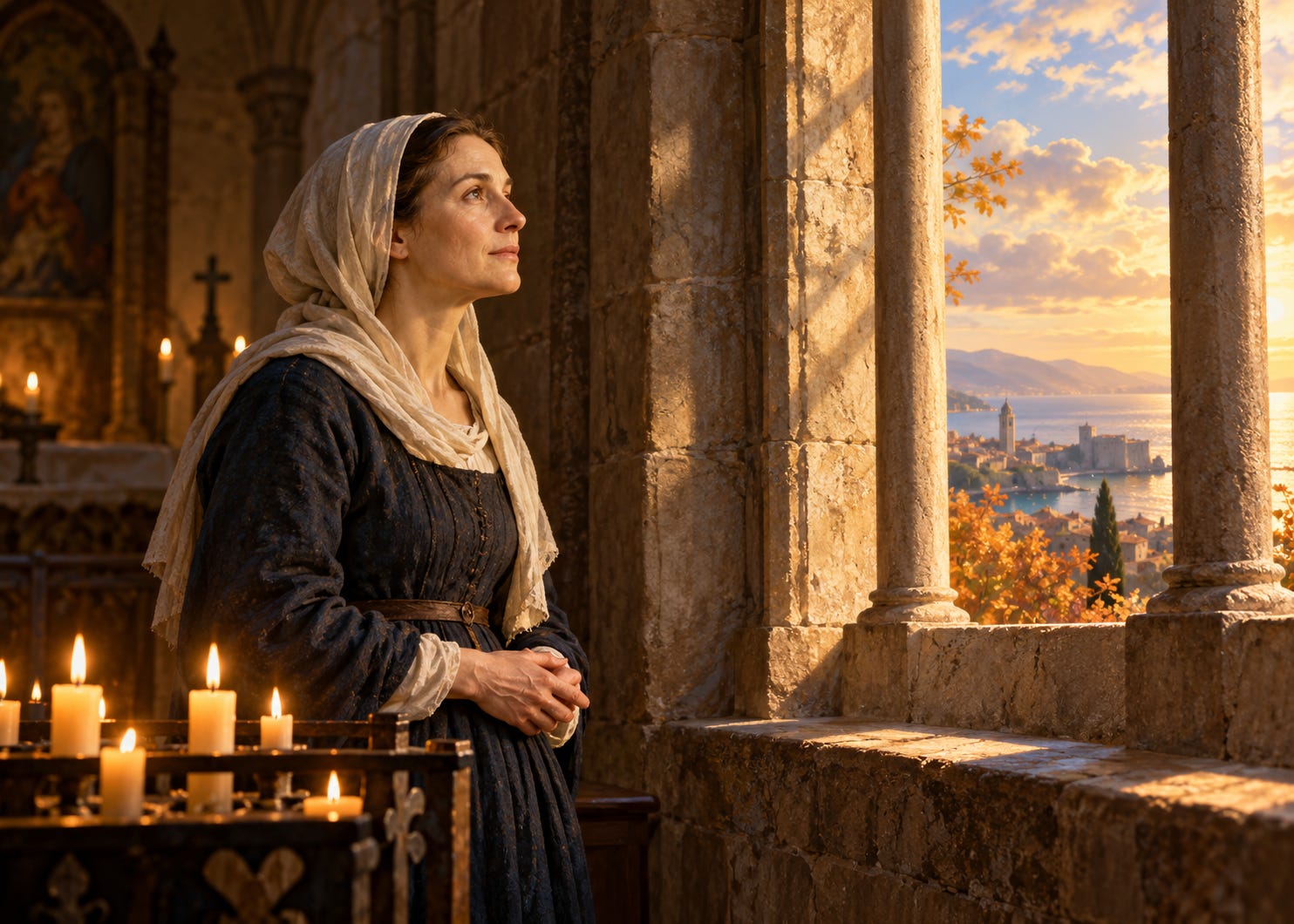
Catherine of Genoa in prayer.
My Dear Family,
After our All Saints’ reflection on Lois, today we turn toward the people we want to remember in prayer. I have been particularly drawn to Catherine of Genoa’s understanding of purgatory, and I hope you will enjoy exploring it with me. There is also a little of Father’s own theological speculation, for which I will accept responsibility.
Thank you for reading, praying, sharing these reflections, and helping build this community. I depend on reader support to keep doing the research, writing, and production behind Message From the Margins. If you have the financial room, please consider becoming a supporting subscriber. If money is tight, please remain with us freely and without guilt. New readers are welcome to subscribe for free.
With love and gratitude,

The Fire of God’s Love
Why we pray for the dead, and the hope Catherine of Genoa helps us discover in God’s purifying love.
Of all the things I might have expected a saint to say about purgatory, this would have been fairly low on the list:
“There is no peace to be compared with that of the souls in purgatory, save that of the saints in paradise.”
That is Catherine of Genoa, a fifteenth-century Italian mystic, describing a condition many Christians have imagined with rather less enthusiasm. She speaks of increasing contentment, of a soul becoming more receptive to God, and of a love so desirable that the soul welcomes being purified for it.
She also describes terrible suffering. For her, this suffering belongs within the soul’s desire for a God it already loves. It sees what still stands in the way of their communion and welcomes His work of removing it.
On All Souls’ Day, when we pray for people we have loved and lost, that is an understanding of purgatory worth spending time with. We may know a great deal about the weaknesses of the person whose name we bring to prayer. We also know why we loved them. To pray for them is to trust that God can love them fully and bring them to a wholeness we could never give them.
Why We Pray Today
Today’s full liturgical name is the Commemoration of All the Faithful Departed. Yesterday, on All Saints’ Day, we celebrated those who share the fullness of life with God. Today, our prayer is especially for the departed who are still being purified for that fullness. We ask that they may enjoy His presence in complete freedom and joy.
The two days belong together because the Church understands herself as one communion in Christ. We who are still living can pray for one another, seek the prayers of the saints, and offer our prayers for the dead. Death changes our relationship with people we love, but our belonging to Christ continues to unite us.
We rarely know the spiritual condition of a particular person after death. Offering prayer for someone expresses our desire for their good and our trust in God’s mercy. It does not require us to decide how much purification they need, or whether they have already entered the fullness of Heaven. That judgment belongs to God, whose knowledge of them is complete.
Our hope reaches toward the resurrection of the dead. In John’s Gospel, Jesus promises to raise up those who believe in Him on the last day. We entrust our loved ones to the One who has passed through death and risen, asking Him to bring them into the life He promises.
Catherine knew something of God’s purifying love from her own life.
What Happened at Confession
Born in Genoa in 1447, Catherine married Giuliano Adorno at sixteen. The marriage was unhappy, and his gambling contributed to its troubles. After about a decade, she had become deeply dissatisfied with her life.
In March 1473, she went to confession. According to the account preserved by those close to her, she was overwhelmed by an awareness of her sins and of God’s immense love. She left without completing her confession, went home, and wept. Several days later, she returned to the priest.
Her awareness of sin had arrived with the discovery of how greatly she was loved by the God she had offended. She wanted to return to Him, even while she could scarcely bear what she had seen about herself.
Her teaching, preserved in the Treatise on Purgatory, grew from that experience of love.
Many of us have learned to associate the discovery of our faults with humiliation, rejection, or the end of a relationship. We may be very good at hiding what we fear would make us unlovable. Catherine describes being known by God in a way that makes her want to come closer.
The Arms Are Already Open
When Catherine writes about God’s desire to receive us, she pictures His arms already extended. As far as He is concerned, “paradise has no gates.”
The soul, however, sees what remains within it that cannot bear the fullness of that encounter. It wants the purification God offers. Catherine regards that purification as a mercy the soul eagerly receives, even though her language about its suffering is severe.
For someone who has imagined purgatory as a place where God reluctantly processes applications for admission, this requires a fairly substantial revision of the picture.
In traditional Catholic teaching, those undergoing this purification are assured of salvation. They have died in God’s friendship. Their preparation for the fullness of Heaven takes place within that belonging to Him.
To understand the need for it, we might consider how much of ourselves we can withhold even from someone we love. We want closeness, provided certain subjects remain untouched. We want to be understood, while carefully managing what the other person is permitted to know. We can spend years defending something we would be freer and happier to surrender.
The difficulty is that surrender can feel like losing the person we have worked so hard to become. An apology may require us to give up our position as the injured party. Listening honestly may reveal that the account we have been telling for years omitted another person’s suffering. Even when we want to change, we can cling fiercely to what keeps us from changing.
Imagine that resistance finally giving way in the presence of a love we can trust completely. There would be pain in seeing the truth, and relief in being able to stop hiding from it. Catherine’s understanding gives us a way to approach both.
What the Fire Can Consume
She turns to gold to explain what she means. In the furnace, its impurities are consumed as it is refined. Once the gold is pure, the fire has nothing further to remove.
In her account, the purification ends when there is nothing left to prevent the soul from resting wholly in God. The soul’s fulfillment is the purpose of the fire.
Sin can become so familiar that we mistake it for part of our identity. A cruel temper becomes simply the way we are. Pride becomes a matter of principle. Resentment begins to seem indispensable to remembering what happened to us. If God frees us from these things, what sort of person might He reveal?
I would like to find out what love could become in me without the constant need to be right. I suspect the people around me would appreciate the discovery, too.
Catherine also compares the soul to a surface whose covering prevents it from reflecting sunlight. As the covering is removed, it receives and reflects more of the light. The sun has been shining all along.
As that covering disappears, the soul’s joy grows, even amid the suffering Catherine describes. It belongs to God and can receive Him more fully.
Now, Now… I Can Hear You
Before you think Father is completely aloof, yes, I can hear my Protestant friends, and a fair number of my Catholic friends, grumbling: “But purgatory isn’t in the Bible! It’s made-up nonsense!”
You would have found plenty of company among the reformers. The Church of England’s historic Articles of Religion rejected the Roman doctrine as lacking scriptural warrant. So if that is your objection, I owe you rather more than a quotation from an Italian mystic, however fond I am becoming of her.
The word purgatory does not appear in Scripture. Catholics came to the belief through a long history of reading Scripture and praying for the dead, with the teaching eventually receiving formal definition at councils including Florence and Trent. The passage from Second Maccabees in which people pray and offer sacrifice for fallen soldiers belongs to that history. It also brings us straight into one of our disagreements, since most Protestant traditions do not receive that book as Scripture.
Paul supplies another image in First Corinthians. He describes people building on the foundation of Christ, their work being tested by fire, and a person being saved even as the work is lost. He is addressing the building up of the Church, and Catholics later read his imagery as support for purification after death. Many Protestants believe that interpretation asks the passage to say more than Paul intended. Our disagreement includes how we understand the Church’s authority to develop her teaching.
And here I would like to offer a little of my own half-baked theology, which you are welcome to help me think through.
We experience life one thing after another. Anything unfinished needs more time, so when we imagine arriving at death with our holiness still very much a work in progress, we picture another stretch of time in which to finish it. Purgatory begins to resemble a prison sentence, complete with the question of how long we have left to serve.
But if God’s life is not divided into yesterday, today, and tomorrow as ours is, why should an earthly timetable govern our encounter with Him? I wonder whether the purification belongs to the encounter itself. We come before Him with everything our lives have made of us, and His love reaches every part that still resists Him.
I cannot tell you how the departed experience time. What I find persuasive is the possibility that being brought fully into God’s life involves a transformation our clocks cannot describe. All the frailties we struggled with, the temptations we kept surrendering to, and the failures we never managed to put right are known by Him. I can hope that He will free us from what has distorted our love and heal the wounds we bring to Him. Benedict XVI cautioned in Spe Salvi against calculating this purification by earthly measurements of time.
When I ask God to purify someone I love, I am asking Him to bring that person wholly into the joy Catherine describes. I trust that He knows how to do it.
When We Say Their Names
The person whose name we bring to prayer has a history we knew only in part. Even after years of loving someone, there are sorrows they never explained, choices we never understood, and things they may have wished they could put right.
We do not have to settle all of that before we pray. We can ask God to bring them fully into His love, trusting Him with what we admired and with what hurt us. If the relationship was difficult, our prayer can remain truthful about it. The person who caused harm needs God’s mercy; so do the people still living with its consequences.
But how can our prayers help, if the work belongs to God? The question is familiar from praying for people who are still alive. We ask Him to heal, strengthen, forgive, and accompany those we love. Our prayer participates in His care for them. In the communion of saints, we believe that relationship continues beyond death.
Benedict XVI explored this in Spe Salvi, writing about the ways our lives are bound together and our love can reach another person through prayer, even after death. We bring God our gratitude, our concern, and sometimes our own need to ask forgiveness. The person we can no longer reach by telephone can still be someone for whom we pray.
One early Christian mother asked her sons to keep praying for her. Monica was ill at Ostia, far from home. She told them not to worry about where she would be buried. Her request was to be remembered at the Lord’s altar, wherever they were.
Her son Augustine preserved those words in his Confessions. Later, he asked his readers to pray for Monica and his father, Patricius. His mother’s request passed into the care of people who had never met her.
A Day for All Our Dead
Christians were praying for their dead long before November 2 became the day for a collective commemoration. The observance we know spread from the abbey of Cluny in France about a thousand years ago. Its abbot, St. Odilo, directed his monks to commemorate all the faithful departed on the day after All Saints. As the custom spread, a practice already dear to Christian families received a shared place in the Church’s year.
The word all gives the day its generous reach. We pray for the dead whose families have themselves died, for those buried without a name, and for people whose passing scarcely interrupted the world around them.
We can say their names where we know them, and commend to God those we could never name. Our forgetting has not erased them from His knowledge.
Keeping All Souls’ Day
We can join that prayer very simply today. At Mass, the Church commends the departed to the Father through Christ’s saving death and Resurrection. You might ask that someone you love be remembered at the altar, or bring their name into your own prayer at home. A cemetery visit can become an occasion for intercession as well as remembrance.
The tradition also commends almsgiving on behalf of the dead. Feeding someone, helping with another person’s care, or giving to relieve suffering can accompany our prayer for a loved one. Through these acts, the love associated with their memory continues to serve a neighbor.
And there is the familiar prayer many of us have heard at a graveside: Eternal rest grant unto them, O Lord, and let perpetual light shine upon them. We ask for their rest in God and for the light of His presence to fill their lives completely.
Catherine’s account of peace gives me hope for these prayers. The person we miss is known by a God whose love exceeds ours, and whose healing can reach what we could never mend. We can entrust them to Him without pretending we understand everything that awaits them.
Remember the arms Catherine pictures, extended to receive us. Bring God the person you wish you could hold again, and ask Him to bring them into the fullness of His joy.
May they rest in peace, and rise in glory.
And Let Us Pray…
A Prayer for All Souls’ Day
God of mercy,
We bring You the people whose names we still speak with love, and those whose names have been lost to us. You know each of them completely.
Receive our departed loved ones into Your care. Forgive their sins, heal what remains wounded, and bring them into the fullness of Your joy. Remember those who died alone, those whose graves are unknown, and those for whom no one remains to pray.
Be close to the people grieving today. Hear the things we wish we could still say, the gratitude we never finished expressing, and the sorrow that has survived the passing years.
Give us grace to love one another while we have the opportunity, to seek forgiveness when we cause harm, and to receive Your mercy ourselves.
Through Jesus Christ, our risen Lord. Amen.
St. Catherine of Genoa, pray for us.
And Now It’s Your Turn…
Whom would you like us to remember this All Souls’ Day? Leave their name in the comments, and tell us a little about them if you would like. A name alone is enough.
As you read the names others leave, please include them in your prayers. We can help fulfill one another’s requests, as Augustine asked his readers to help him fulfill his mother’s.
If someone you love is remembering a person they miss today, you might send them this reflection and invite them to add a name to our prayers. New readers can subscribe for free and join us.
A Word Before We Part…
Thank you for adding your attention and prayers to this community. If this reflection helped you understand the day or pray for someone you miss, please share it. Free subscriptions help more people find the work. If you can help sustain it financially, please become a supporting subscriber; I still need that support to keep these reflections open to everyone. If you cannot, I am grateful you are here, and your participation is welcome.
And Did You Know?
Catherine’s mystical life included running a hospital.
She devoted herself to the sick at Genoa’s Pammatone Hospital and took responsibility for its running. Her husband eventually joined her in serving there. Her contemplation of divine love accompanied years of practical care for people in need.
C. S. Lewis believed in purgatory and prayed for the dead.
The Anglican author discusses both in Letters to Malcolm: Chiefly on Prayer, a book published after his death in 1964.
A dish of sweetened grain can express resurrection hope.
In Orthodox commemorations of the departed, koliva may be prepared with grain or rice, honey or sugar, and other ingredients. The grain evokes new life arising from what is buried; the sweetness expresses hope for the joy of the life to come.