

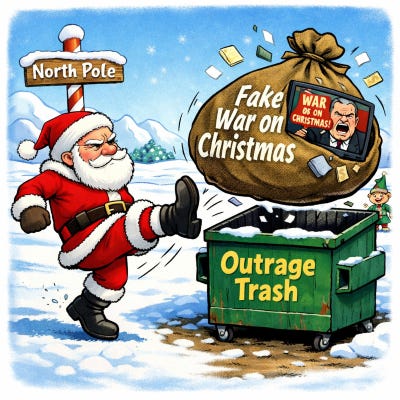
Every December, if you turn on Fox News or any of the culture-war echo chambers, you’ll eventually hear someone shrieking about the so-called “War on Christmas.” Politicians, especially the guy on top, solemnly declare that, thanks to them, you are once again allowed to say “Merry Christmas,” as if it had ever been forbidden in the first place.
The unintentionally ironically named American Family Association even publishes a yearly “naughty and nice list” of retailers, grading them on whether they sufficiently honor Christmas by their standards. In their telling, if you use a Christian greeting in today’s America the “PC Police” will rappel out of a helicopter to escort you to the December Re-Education Camp for Seasonal Greeting Offenders. And if you don’t say “Merry Christmas,” they’re happy to play the greeting police themselves.
Of course… none of this is real.
Walk into almost any store, office, home, or church in America and wish someone a Merry Christmas. Nine point nine times out of ten, you’ll receive the same warmth right back. No one is dragging people to a December re-education tribunal. The “War on Christmas” simply does not exist.
But here’s the twist: something is doing real damage to Christmas.
And it isn’t inclusive greetings. It isn’t neutral retail signage. It isn’t a coffee cup.
What weakens Christmas is poor Christian witness. (This free article continues below the following invitation…)
If this reflection is speaking to you, I’d love to invite you to become a subscriber. Your support helps me continue this ministry and create work that matters.
Hysterical outrage theater.
Correcting strangers because they said “Happy Holidays.”
Behaving as if Christianity is so fragile that a seasonal greeting might shatter it.
That doesn’t communicate faith or joy. It communicates fear, insecurity, and detachment from reality.
And honestly… it makes us look foolish.
Take the dreaded word “holiday.” Say it slowly with me… H…o…l…
Holy. Days.
The word comes from Old English, hāligdæg, meaning “holy day,” a term that originally referred to Christian feast days and sacred observances throughout the year. Over time, the meaning broadened and became shorthand for the whole stretch of seasonal observances around Christmas and New Year.
So when someone says “Happy Holidays,” they’re not rejecting faith… they’re literally using a word rooted in the language of holy time.
Often it’s nothing more dramatic than a polite way of saying, “I don’t know what you celebrate, but I hope it’s beautiful,” or simple shorthand for, “Merry Christmas and Happy New Year.”
And we should be honest about something else.
This phony “War on Christmas” didn’t just appear out of nowhere. It exists because outrage is profitable. It drives ratings, clicks, donations, and political loyalty. If you can convince people that their faith, their culture, and their very way of life are under attack, they will do almost anything in the name of self-protection.
Fear is a powerful fundraiser. Outrage is a powerful organizing tool.
But the cost is devastating.
More division.
More resentment.
More contempt for our neighbors and suspicion of “the other side.”
And here’s the danger. The voices shouting that Christianity is under attack claim they are defending your faith, but what they actually corrode is your heart, your compassion, your soul… and it might lead you into sin.
And there’s something else worth considering.
A lot of people get swept up in this as a kind of performative piety. It becomes a way of signaling devotion, of proving to like-minded Christians, pastors, and social media circles, “Look how holy and committed I am. Look how boldly I’m defending the faith.”
But the Gospel is pretty clear about acts of piety done for the sake of attention and approval.
Jesus tells us that when our religious displays exist primarily to be seen and celebrated by others, we have already received our reward in full. God is not impressed by public bravado. Heaven is not moved by culture-war pageantry.
And I’m afraid that loud, theatrical outrage over seasonal greetings does not store up treasure in heaven… it just collects applause from your hand-curated crowd.
How do we prepare our hearts to welcome the Prince of Peace while consuming media that constantly tells us to hate half the country… and to justify that hatred in the name of Christ?
That is not discipleship. That is spiritual corrosion dressed up as religious conviction.
Because there are things that genuinely threaten the spirit of Christmas.
Rampant consumerism that turns the season into a shopping frenzy instead of a spiritual one.
Cruelty disguised as “law and order,” especially toward immigrants and families living in fear during the holidays.
Celebration of excess, greed, and resentment while invoking the name of the Child laid in a manger.
Those things sound a lot closer to the Temple marketplace Jesus overturned… than to Bethlehem.
If we truly want to “keep Christ in Christmas,” it will never begin with a slogan on a banner or a cashier’s greeting. It starts with our behavior.
Buy groceries for someone who is struggling.
Let the elder in line go first.
Hold doors. Practice gentleness. Give quietly to those who cannot repay you.
Show up with hospitality. Bake cookies and share them with neighbors.
Be grateful. Be joyful. Be kind.
If Christ ever goes missing from Christmas, it won’t be because someone said “Happy Holidays.”
It will be because we forgot how to love.
And that… not inclusive language, not seasonal signage, not Starbucks cups… is the real threat to Christian witness.
I wish you a very Merry Christmas and Happy Holidays to all.
If you value this kind of pastoral writing — honest, compassionate, rooted in the Gospel and free from culture-war noise — I want to invite you to help sustain it.
This publication is reader-supported. Paid subscribers make it possible for me to keep producing thoughtful reflections, prayer resources, and spiritual guidance for people who are hungry for a faith rooted in mercy, truth, and love.
If this work matters to you, please consider upgrading today:
👉 Support This Work by Becoming a Paid Subscriber
It’s one small step… but it makes a real difference in keeping this ministry alive and growing.
And if you can’t right now — I’m still grateful you’re here.