

Before we dive in, a quick personal note.
Through a rather impressive confluence of events, I found myself yesterday completely without access to the internet for most of the day. No wifi, no cell service. In today’s world, that’s somewhere between mildly inconvenient and a survival reality show.
I missed all of you.
I’ve been reading your beautiful comments from yesterday’s article about my dog Figgy, Prayer, and God and I’m deeply grateful for the thoughtful conversations that continue to happen in this community. I loved watching you guys respond to each other! I’ll be responding to each of your remarks shortly.
One other thing before we begin.
I love writing these reflections. I love the conversations they spark. But a newsletter is ultimately a supplement to the life of faith, not a substitute for it.
I didn’t spend two thousand words reflecting on the beauty of the Eucharist so everyone could stay home and read an article about it.
So, If you’re able, get to Mass this weekend.
Gather with your local community.
Hear the Scriptures proclaimed.
Receive the Sacrament.
Be nourished by Word and Sacrament.
The Christian faith has always been something lived, not merely read about.
Now, let’s talk about the Eucharist.
The Solemnity of the Most Holy Body and Blood of Christ: What Kind of God Becomes Food?
People will risk their lives for a great many things.
Freedom.
Family.
Country.
Truth.
What people generally do not do is risk imprisonment, torture, and execution for a metaphor.
Which brings me to Corpus Christi.
The Solemnity of the Most Holy Body and Blood of Christ.
For those of us who worship in the Sacramental traditions, it arrives once a year. We hear familiar readings. We sing familiar hymns. We nod our heads at familiar theology.
Then we go home.
But the deeper I have studied the Eucharist, the more I find myself haunted by a simple question:
What exactly did the first Christians think was happening at that altar?
Because their behavior makes very little sense otherwise.
The Catholic and Orthodox Churches celebrates Corpus Christi to honor its belief that Jesus Christ is truly present in the Eucharist, Body, Blood, Soul, and Divinity.
The feast itself dates to the thirteenth century, but the mystery it celebrates reaches back to the Last Supper.
On the night before His death, Jesus took bread, blessed it, broke it, and gave it to His disciples.
“This is my body.”
Then He took the cup.
“This is my blood.”
Christians have repeated those words for nearly two thousand years.
Every Mass.
Every language.
Every continent.
Every generation.
And hanging on those words is one of the most astonishing claims Christianity has ever made:
God does not merely teach us.
God gives Himself to us.
One of the most interesting debates in Christian history revolves around a tiny Greek word.
When Jesus says, “This is my body,” the word recorded in the New Testament is estin.
Is.
Not represents.
Not symbolizes.
Not stands for.
Is.
Of course, language is complex. Jesus often spoke in images and metaphors.
But when we look at the Christians closest to the apostles, something fascinating emerges.
Ignatius of Antioch, writing around the year 107, described the Eucharist as the flesh of Christ.
Justin Martyr, writing in the second century, insisted Christians were not receiving ordinary bread and wine.
Long before medieval theologians developed technical language, ordinary Christians already believed something extraordinary was happening.
The doctrine did not emerge centuries later.
The doctrine emerged because Christians were trying to explain what they had already received.
But honestly?
The strongest argument may not be found in theology books.
It may be found in human behavior.
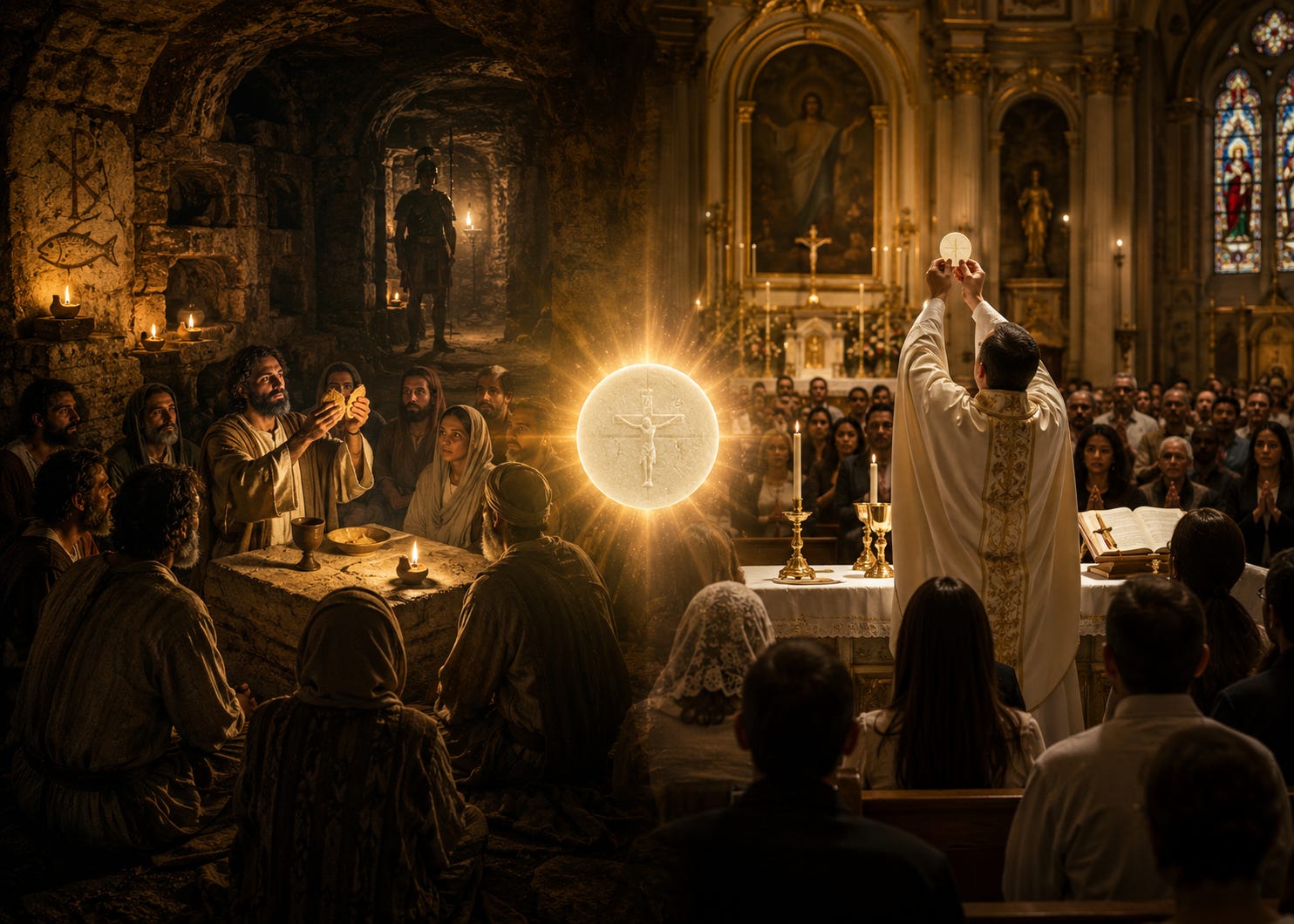
Imagine a small gathering in dank crypt beneath the streets of Rome.
Oil lamps flicker against damp stone walls.
The air smells of earth and smoke.
Above them, the empire carries on.
Soldiers patrol.
Merchants sell their goods.
Politicians give speeches.
Down below, hidden among tombs and catacombs, Christians gather to pray and break bread.
The room is as filled with fear as it is with reverence.
One informant, one Roman spy, could destroy everything.
One arrest could trigger a chain of executions… your family… your friends.
The Creed many of us recite absentmindedly today carried enormous weight in those years. Shared prayers and professions of faith helped identify fellow believers in a world where betrayal was a constant possibility.
To gather was dangerous.
To be identified as Christian was dangerous.
To celebrate the Eucharist was dangerous.
I consider myself a fairly brave person.
But gathering in an underground crypt knowing discovery could mean death?
For a symbol?
I’m sorry.
I suddenly have to wash my hair that evening.
To receive Christ truly present?
To encounter the living God?
To participate in a mystery that transcends death itself?
Okay.
I’m in.
People do not keep risking their lives generation after generation for a religious gesture.
Something much larger was happening.
Or at least they believed it was.
And that deserves our attention.
Yet the question that keeps drawing me back is not whether the Eucharist is difficult to understand.
Of course it is.
Even after two thousand years of some of the most brilliant minds the world has ever known praying over it, debating it, writing about it, and defending it, I’m fairly certain our understanding is but straw compared to the reality.
The deeper question is why God would choose this way of being present.
Why bread?
Why wine?
Why a meal?
Why not simply leave us a book?
Why not leave us a philosophy?
Why not just leave us a set of rules?
Because Jesus has been moving in one direction from the beginning.
Closer.
The burning bush.
Closer.
The covenant.
Closer.
The prophets.
Closer.
The Incarnation.
Closer.
The Cross.
Closer.
The Resurrection.
Closer.
And finally, the Eucharist.
As close as possible.
A God who enters a manger is exactly the kind of God who would enter a meal.
Speaking only for myself, if the Eucharist is merely symbolic, then it remains a beautiful gesture.
A sacred memory.
A meaningful reminder.
But if all we’re talking about is bread and wine representing something else, respectfully I can stop by Whole Foods on the way home and pick up a rustic olive loaf and a lovely mid-tier bottle of Cabernet.
Those things may nourish my body.
What they cannot do is unite me to Christ.
What they cannot do is communicate sacramental grace.
What they cannot do is draw a poor slob from New York into the mystery of divine life.
If the Eucharist is only a symbol, it is lovely.
If the Eucharist is what Christians have proclaimed for two thousand years, then we are standing before something so astonishing that language begins to break down.
God making Himself available to ordinary people.
God feeding His people with His own life.
God refusing to remain distant.
God choosing communion over separation.
And suddenly Corpus Christi is no longer a feast about a doctrine.
It becomes a feast about the character of God.
The kind of God who would rather be consumed than remain far away.
Many people move through life spiritually hungry.
Not because they lack information.
Most of us are drowning in information.
What we lack is communion.
We scroll.
We click.
We consume.
We absorb endless opinions, endless news, endless outrage.
Yet beneath all of it remains a hunger that none of those things can satisfy.
The Eucharist confronts that hunger.
It insists that the deepest longing of the human heart is not ultimately for success, distraction, certainty, or control.
It is for God.
And the astonishing Christian claim is that God wants that communion even more than we do.
The story of salvation is not humanity searching for God.
It is God searching for humanity.
The Good Shepherd searching for His beloved sheep.
The Eucharist is simply the latest chapter in that search.
Or perhaps the most intimate one.
The Church year teaches us to remember what the world keeps trying to make us forget.
Corpus Christi teaches us that God is not distant.
Not indifferent.
Not hiding.
He is closer than we dare imagine.
And sometimes He comes disguised as bread and wine.
Now It’s Your Turn
I’ll leave you with the question that kept following me while writing this piece:
What kind of God becomes a meal?
Not a king issuing orders from a distance.
Not a philosopher handing down ideas.
Not a deity demanding admiration from afar.
A God who wants to be close.
Close enough to share our humanity.
Close enough to suffer with us.
Close enough to feed us with His own life.
Have you always believed that?
Did you struggle with it?
Did something happen that changed your understanding of the Eucharist?
Or are you still trying to figure out what you think?
Tell me in the comments.
Some of the best conversations in this community begin with honest questions.
And if this reflection helped you see Corpus Christi through a different lens, share it with someone who may have spent years hearing about the Eucharist but never quite understood why Christians have treasured it for two thousand years.