
Disclaimer: The following is an attempt at humor to make an arcane and theologically complex topic interesting to the modern reader, explaining it in terms present-day young people will understand. In no way is any disrespect or cavalierness intended or implied.
Mary’s Irish Exit…
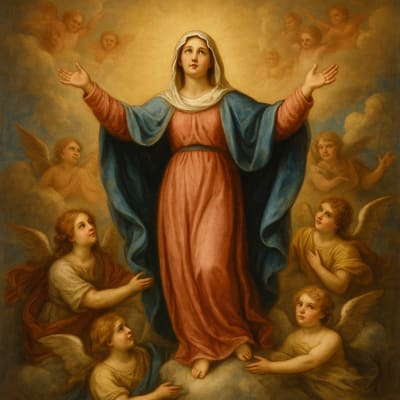
Every August 15, Catholics celebrate what I can only describe as Mary’s ultimate Irish exit1. One moment she’s here, the next ::poof:: gone. But this wasn’t just slipping out of a dinner party to avoid awkward goodbyes. The Church teaches that at the end of her earthly life, Mary skipped the whole “death” part and went straight to Heaven, body and soul. No funeral, no burial, just… gone. Up to Heaven.
The feast is called the Assumption, which might sound like we’re guessing about it, but comes from the Latin assumere, meaning “to take up.” Since death, the separation of body and soul, is the price of sin, and Mary is believed to have been free from sin from her conception, she wouldn’t experience it. Instead, she was taken directly into Heaven at the close of her earthly journey.
Where the Story Comes From
If you go flipping through your Bible looking for “The Assumption of Mary,” you won’t find it. This is one of those moments where Catholicism leans into something bigger than Sola Scriptura. The Catholic and Orthodox traditions both recognize that faith was handed down not just in the written Word, but in the oral tradition of the Church. Stories, teachings, and understandings were preserved in the life of the community before they were ever written down, and some never were if you can believe that.
By the 4th century, Christians were already preaching and singing about Mary’s passing and her being “taken up” into glory. Eastern Christians call it the Dormition, meaning “falling asleep.” For them, death didn’t claim Mary in the usual way. She simply closed her eyes here and opened them in Heaven.
Papal Infallibility in Action
This belief has been around since the earliest days of the Church, but it got a major spotlight moment in 1950 when Pope Pius XII declared the Assumption of Mary a dogma, one of the very few times a pope has exercised the doctrine of papal infallibility. In Catholic understanding, that means he was preserved from error in officially defining a truth of faith for the whole Church.
Of course, not all Christians accept papal infallibility. Old Catholics (of which I am one) don’t. Many Protestant communities, and even some Eastern Orthodox, honor Mary deeply without embracing belief in the Assumption. And that’s worth saying out loud.
Why This Matters Spiritually
Whether or not you accept the Assumption as literal history, it carries a powerful pastoral message.
For women, especially, it’s a reminder that God’s plan for salvation is not reserved for men alone. In a time and place where women’s bodies were often dismissed as secondary or seen as impure, the Church holds up Mary’s body as glorified, taken into Heaven without corruption. That’s a radical affirmation of dignity. The greatest Christian of all forever remains a woman… not an apostle, not a Pope, a woman.
For all of us, the Assumption is a vision of hope. It says that our bodies matter, that they are part of God’s good creation, and that redemption embraces the whole person, not just the soul. It’s also a reminder that death is not the end, and that God’s promises reach into every fiber of our being.
Finding Value Beyond the Disagreement
If you come from a tradition that doesn’t accept the Assumption as historical fact, or even as metaphor or allegory, there’s still something here for you. At its heart, this feast celebrates God’s faithfulness and the way Mary’s life points to Christ. She is the model disciple, one who says yes to God, carries Christ into the world, and remains faithful through every trial.
Her ending, whether you see it as physical, symbolic, or mythic, is a promise of the glory God intends for all who love Him. The story isn’t about something reserved only for Mary, it’s the destiny that awaits all the faithful at the Second Coming. She just earned a singular place in the Beta version.
A Prayer
Lord God,
You lifted the Blessed Virgin Mary into the joy of Heaven. In her, we see the fullness of your promise: that where Christ has gone, we may follow. Give us her courage to say yes, her humility to serve, and her faith to trust you with every part of our lives. May we see in her not just a distant figure, but a sister in the faith, walking with us toward the life you have prepared.
Amen.
An “Irish Exit” or “Irish Good-bye” is a tongue in cheek slang term for when someone leaves a party without saying making a fuss or saying goodbye to anyone.