

My Dear Family,
We have spent this week enjoying some wonderfully strange stories from Christian history and legend. For All Saints’ Day, I want to introduce you to someone from my own life. Her name was Lois, and she helped teach me what it means to follow Jesus. I hope her story brings to mind someone whose faith and goodness have stayed with you.
If you are new to Message From the Margins, you are welcome to subscribe for free and join the conversation. Reader support makes this work possible, and I need it to keep researching, writing, and sharing these reflections. If you have the financial room, please consider becoming a supporting subscriber. If money is tight, please stay with us freely. Your reading, prayers, stories, and willingness to share this work are gifts to this community.
With love and gratitude,
The Saint Who Lived Next Door
A story about Lois, the communion of saints, and the people whose love helps us find our way to God.
Want to hear about a time I believe I experienced a miracle?
First, I need you to meet Lois.
She lived next door to the house where I grew up, although “neighbor” hardly describes what she was to us. Lois was another grandmother, and one of those people whose faith became part of your life through the way she lived hers.
She gave selflessly of herself. She had set aside building a family of her own so she could care for her aging mother, and she spent decades as a catechist, helping shape the faith of hundreds maybe thousands of children. I could go on for hours about this woman. For now, suffice it to say that she was a profoundly good woman who helped teach me how to be a disciple.
And I am pretty sure that, a few years after she passed into eternal life, she helped save mine.
It was sometime in the late 1990s, before any of us had cell phones. My brothers were across the street playing Manhunt with the other neighborhood boys, and my mother sent me to tell them it was past curfew and time to come home.
I remember how dark it was that night. I don’t think there was a moon out.
As I crossed the road, a sudden urge came over me to run. Fast. I broke into a sprint, but the sensation was stranger than running. It felt almost as though my feet came up off the ground and I was being whisked to the other side.
At the same time, an all-black car came speeding over the hill with its headlights off. It was traveling far above the speed limit and missed me by perhaps a foot.
I stood on the other side of the road, shocked and winded, trying to take in what had just happened. Along with the shock, I felt an extraordinary lightness.
Then I caught a familiar scent.
Lois had a very distinct fragrance, one I knew well enough to recognize. Standing there in the darkness, a few years after her death, I could swear I smelled it.
You can call me crazy. I am pretty sure that through her intercession, and perhaps some behind-the-scenes collaboration with my guardian angel, Lois helped get me across that road alive.
When I tell you that I believe in the communion of saints, this is part of what I am telling you. I believe Lois is with God, and that the love she showed us during her life has continued beyond her death.
She has no feast day on the calendar. No pope has declared her Blessed. Most of you would never have heard her name if I had not told you this story. But I am convinced that she is a saint in Heaven, still loving us and interceding for us.
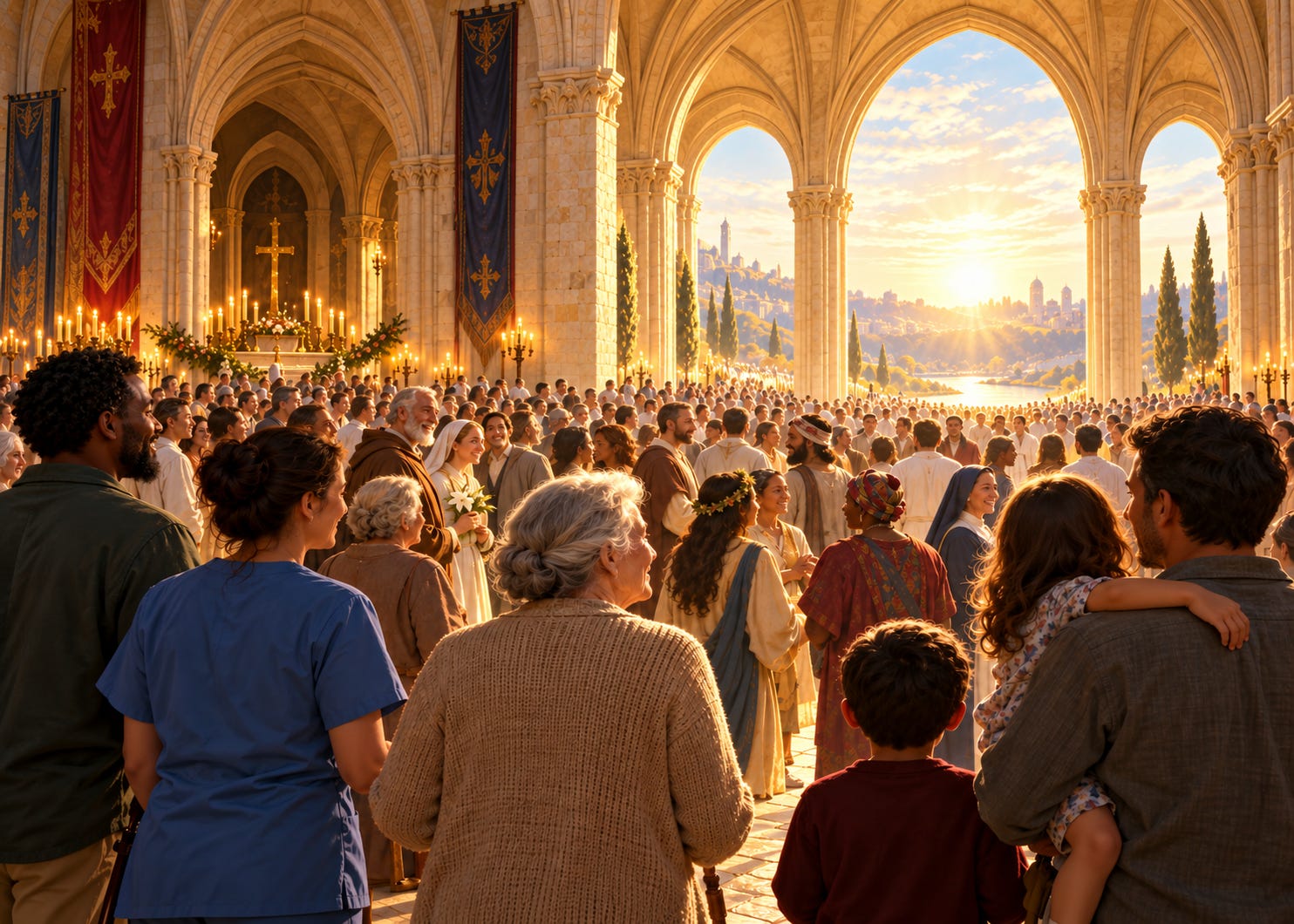
All Saints’ Day gives us room to remember people like her.
We know the names of some of the saints. We tell their stories, visit their shrines, and ask for their prayers. Beyond those familiar names is a company of holy people far larger than any calendar could contain.
When I think about that company, I think about the woman who lived next door.
What Is a Saint, Anyway?
Calling someone a saint can sound like an affectionate exaggeration. We say it about the person who has put up with us for forty years, or the teacher whose patience has survived an entire classroom of children. We know what we mean, more or less. But the Christian meaning deserves a closer look.
A saint is a holy person, someone whose life has been touched and transformed by God’s grace. When we speak of the saints in Heaven, we mean people who now share fully in His life and love. The selfishness and sin that wounded their relationships have been healed. They are with God.
Canonization is the Church’s formal recognition that a particular person belongs to that company and can be held up for public veneration. The paperwork does not admit anyone to Heaven. God has already attended to that.
And holiness begins before the funeral. Paul addresses the Christians in Corinth as people sanctified in Christ and called to be holy, then spends much of his letter dealing with the trouble they are causing. Within the opening chapter, he is already confronting their rivalries. Anyone who has ever belonged to a church should find the sequence familiar.
Their calling was real, even while they had a great deal of growing to do. So is ours. We receive God’s grace and learn to cooperate with it, sometimes painfully, through repentance and the daily practice of love.
One other clarification, before somebody starts fitting Lois for wings: human beings do not become angels when we die. Angels are a different order of God’s creation. Our hope is the resurrection of the body and the fulfillment of our humanity in Christ. A grandmother who is with God is still the person who loved you, now sharing in His glory. She has not been reassigned to another species.
That continuing identity is part of what makes the communion of saints so dear to us. The people who are with Christ remain joined to us in Him. We ask for their prayers much as we ask a friend to pray for us, trusting that their closeness to God has deepened their capacity to love.
All of that love, and every grace we receive, comes from God. The saints share in His generosity, and their prayers draw us toward Him.
The Saints You May Know
Peter has a basilica in Rome, countless statues, and a place in almost everyone’s idea of a saint. The Gospels also let us see him frightened enough to deny knowing Jesus three times.
We met Peter this week in the legend of his contest with Simon Magus. His Gospel story includes a more intimate encounter. After the Resurrection, John tells of Jesus preparing breakfast by the water, then asking Peter whether he loved Him. Peter is distressed when the question comes a third time. Yet Jesus entrusts His sheep to this man who knows how badly he has failed.
The Church has preserved the failure along with the calling. We get to see the mercy Peter needed before we ask him to pray for us.
Then there is Thérèse of Lisieux, the Carmelite nun whose desire to love reached far beyond the walls of her convent. As her own death approached, she was thinking about the good she hoped to continue doing afterward:
“I want to spend my heaven in doing good on earth.”
She expected her love for people to have a future after her death. I suspect Lois would have found plenty to discuss with her.
Pope Francis gave a name to the kind of holiness I knew in Lois. In Gaudete et Exsultate, he spoke of the “saints next door,” pointing to parents raising children with love, people working to support their families, and those persevering in illness. He also included mothers, grandmothers, and other loved ones among the witnesses who encourage our faith.
My example is admittedly literal. She was right next door.
But many of you will recognize someone of your own in that description. You knew their voice and their habits. You saw what it cost them to care for another person, and you learned something about God because they did.
The Book of Revelation gives us a vision large enough for this company: a multitude beyond counting, drawn from every nation and language, standing before God and the Lamb. Our familiar names belong within that immense gathering, alongside people whose names we have never heard.
A Brief History of the Feast
Our calendars preserve something Christian communities were doing long before printing existed: remembering the people whose faith had helped sustain their own. The martyrs held a special place in that remembrance.
One early account, the Martyrdom of Polycarp, describes a community gathering the bones of its murdered bishop. They regarded those remains as more precious than jewels or gold and placed them where they could gather to remember him. They hoped to assemble there with joy on the anniversary of his martyrdom, honoring his memory and preparing others to follow his example.
The word used for that anniversary means “birthday.” His death marked his birth into eternal life. Even with their bishop’s remains before them, these Christians expected to have something to celebrate.
Communities also began honoring martyrs together, and the feast we know took shape over centuries. In the early seventh century, Pope Boniface IV dedicated Rome’s Pantheon to Mary and all the martyrs, with a feast on May 13. By the ninth century, a November 1 celebration of all the saints was spreading through the Frankish Empire with the support of Gregory IV. That date became established across the Western Church.
The feast gives us a day to rejoice in the whole company, including the people whose holiness went largely unrecorded. Tomorrow, All Souls’ Day, our attention turns especially toward prayer for the departed who are still being purified for the fullness of life with God. Together, the days express our conviction that we continue to belong to one another in Christ.
How to Keep the Feast
That belonging can be difficult to feel when the person we miss has been absent for years. A feast gives us something to do with our gratitude and our longing. We can bring both to God in prayer, and, where we are able, join the Church at worship.
At Mass, our prayer joins the praise of Heaven. Listen for the angels and saints as the Eucharistic prayer unfolds. The people we cannot see are part of the company in which we worship.
At home, you might light a candle beside a photograph and thank God for the person in the picture. Tell their story to someone who never met them. Explain why you remember their generosity, or how their faith helped you through something you could scarcely manage on your own. Give a child more than a name on the back of an old picture.
You can ask the saints to pray for you, too. There need be no elaborate wording. If you believe someone you loved is with God, you can entrust your concern to their prayers.
Then consider something they taught you that you could practice today. Lois spent decades helping children come to know their faith. Other people have taught us how to visit the sick, apologize without excuses, or notice a neighbor who needs help. We honor those gifts by allowing them to shape what we do next.
The Beatitudes, proclaimed on this feast, give us a way to examine that response. Jesus blesses the merciful, the peacemakers, and those who hunger for righteousness. We have opportunities to become those people in the relationships we already have, especially when loving someone takes more patience than we had planned to give.
The Woman Next Door
Thinking about the people who formed us also leaves us wondering how much we never knew. We saw some of their sacrifices. Others may have been made so privately that we still cannot account for all the goodness we received.
Edith Stein, the philosopher and Carmelite nun also known as St. Teresa Benedicta of the Cross, wrote about people whose hidden lives help determine the course of history. She believed that only when what is hidden is revealed will we discover the people to whom we owe decisive turns in our own lives.
I think about that when I remember the road, the car without headlights, and the familiar scent that seemed to meet me on the other side. I believe Lois helped me that night. I also know that she had been helping me long before it, through years of love that taught a boy something about following Jesus.
All Saints’ Day lets me give thanks for her in the company of the whole Church. Somewhere in that multitude beyond counting, I believe there is a woman who cared for her mother, taught hundreds of children, and became another grandmother to the boy next door.
I hope to see her again. Until then, there is still much I can learn from the way she lived.
Lois, pray for us.
And Now It’s Your Turn
I’ve told you about Lois. Now I would love to hear about someone who helped teach you what holiness looks like.
Perhaps it was your grandmother, a neighbor, a teacher, or someone whose goodness carried you through a time when you badly needed their care. Tell us their name and a little of their story. Most of us never had the chance to meet them, but through your memories, we can come to know something of the love they gave.
And if you have experienced something you believe was a miracle, an answer to prayer, or a moment when the distance between Heaven and earth seemed unexpectedly small, you are welcome to share that, too.
I suspect there are quite a few saints whose stories we would never hear unless someone who loved them took the time to tell us.
If this reflection brought someone to mind, send it to a person who knew and loved them, or to someone who would enjoy hearing their story. You can invite them to subscribe for free and add their memories to the conversation.
And Let Us Pray…
God of the living,
Thank You for the people through whom we first came to recognize Your goodness. Receive our gratitude for the care they gave, for the faith they helped us find, and for the sacrifices we may never fully understand.
Be close to those who miss them today. When we wish we could hear a familiar voice again, help us bring that longing to You. We entrust our departed loved ones to Your mercy and rejoice in all who now share the fullness of Your life.
Give us grace to love those who depend on us with patience and courage. Help us receive the care we need, repent when we cause harm, and grow into the holiness to which You call us.
May the prayers of Your saints encourage us as we follow Jesus Christ, our Lord.
Amen.
All you holy men and women of God, pray for us.
And Did You Know?
All Saints has another place on the Orthodox calendar.
Orthodox Christians celebrate All Saints on the first Sunday after Pentecost. The placement connects the holiness of the saints with the gift and work of the Holy Spirit.
The repentant thief appears in an Orthodox All Saints icon.
The man crucified beside Jesus who asked to be remembered in His kingdom appears at the lower center of the icon described by the Greek Orthodox Archdiocese of America.
All Saints belongs to Anglican prayer, too.
The Book of Common Prayer keeps the feast on November 1. Its prayer for the day joins our fellowship in Christ with a request for grace to follow the saints in holy living.
Thank you for reading, and especially for helping us remember the people whose names might otherwise go unspoken. Please share this reflection with someone who would enjoy joining our conversation. Free subscriptions help this community grow, and every new reader is welcome.
If you can help sustain the work financially, please become a supporting subscriber. Your support helps keep these reflections available to everyone. If you cannot, I am grateful you are here. Keep reading, praying, and telling us your stories.