

A Word Before the Homily
Happy Sunday, friends.
I’m sorry today’s Homily is going out so late. Honestly, I wasn’t happy with what I’d written earlier in the week, and thought to myself “I’m not publishing this.” So, I started from scratch this morning. If you happen to be one of our readers who was with me in a previous parish, you know it’s not uncommon for me to walk up to the pulpit with one homily in mind, and leaving the pulpit having preached something entirely different.
Today, I want to talk to you about the role of women, I’m bound to ruffle a few feathers and probably lose a few subscribers, but I think it’ll be worth it. You’ll have to let me know at the end if it was.
Anywho, as I mention each Sunday, If you have a parish where you can worship freely and be treated with kindness, I hope you’ll spend some time with that community today. (I know I’m getting this to you late, so your Mass options may be fewer, but they are still out there, I promise!) Praying beside other people and receiving Communion involve our whole selves, and there is a great deal a screen cannot give us. If you’re looking for a suitable church, I’m happy to help you find one.
For those reading at home because getting out is difficult, or because church has become a painful place to be, I’m glad you’re here. Let’s begin with the readings, remembering the women who have helped us recognize Christ and those who are still waiting to be heard.
Today’s Readings
Thirty-third Sunday in Ordinary Time
Lectionary: 157
First Reading
Proverbs 31:10–13, 19–20, 30–31
When one finds a worthy wife,
her value is far beyond pearls.
Her husband, entrusting his heart to her,
has an unfailing prize.
She brings him good, and not evil,
all the days of her life.
She obtains wool and flax
and works with loving hands.
She puts her hands to the distaff,
and her fingers ply the spindle.
She reaches out her hands to the poor,
and extends her arms to the needy.
Charm is deceptive and beauty fleeting;
the woman who fears the LORD is to be praised.
Give her a reward for her labors,
and let her works praise her at the city gates.
Responsorial Psalm
R. (cf. 1a) Blessed are those who fear the Lord.
Blessed are you who fear the LORD,
who walk in his ways!
For you shall eat the fruit of your handiwork;
blessed shall you be, and favored.
R. Blessed are those who fear the Lord.
Your wife shall be like a fruitful vine
in the recesses of your home;
Your children like olive plants
around your table.
R. Blessed are those who fear the Lord.
Behold, thus is the man blessed
who fears the LORD.
The LORD bless you from Zion:
may you see the prosperity of Jerusalem
all the days of your life.
R. Blessed are those who fear the Lord.
Second Reading
Concerning times and seasons, brothers and sisters, you have no need for anything to be written to you. For you yourselves know very well that the day of the Lord will come like a thief at night. When people are saying, “Peace and security,” then sudden disaster comes upon them, like labor pains upon a pregnant woman, and they will not escape.
But you, brothers and sisters, are not in darkness, for that day to overtake you like a thief. For all of you are children of the light and children of the day. We are not of the night or of darkness. Therefore, let us not sleep as the rest do, but let us stay alert and sober.
Alleluia
R. Alleluia, alleluia.
Remain in me as I remain in you, says the Lord.
Whoever remains in me bears much fruit.
R. Alleluia, alleluia.
Gospel
Jesus told his disciples this parable:
“A man going on a journey called in his servants and entrusted his possessions to them. To one he gave five talents; to another, two; to a third, one, to each according to his ability. Then he went away. Immediately the one who received five talents went and traded with them, and made another five. Likewise, the one who received two made another two. But the man who received one went off and dug a hole in the ground and buried his master’s money.
“After a long time the master of those servants came back and settled accounts with them. The one who had received five talents came forward bringing the additional five. He said, ‘Master, you gave me five talents. See, I have made five more.’ His master said to him, ‘Well done, my good and faithful servant. Since you were faithful in small matters, I will give you great responsibilities. Come, share your master’s joy.’
“Then the one who had received two talents also came forward and said, ‘Master, you gave me two talents. See, I have made two more.’ His master said to him, ‘Well done, my good and faithful servant. Since you were faithful in small matters, I will give you great responsibilities. Come, share your master’s joy.’
“Then the one who had received the one talent came forward and said, ‘Master, I knew you were a demanding person, harvesting where you did not plant and gathering where you did not scatter; so out of fear I went off and buried your talent in the ground. Here it is back.’
“His master said to him in reply, ‘You wicked, lazy servant! So you knew that I harvest where I did not plant and gather where I did not scatter? Should you not then have put my money in the bank so that I could have got it back with interest on my return? Now then! Take the talent from him and give it to the one with ten. For to everyone who has, more will be given and he will grow rich; but from the one who has not, even what he has will be taken away. And throw this useless servant into the darkness outside, where there will be wailing and grinding of teeth.’”
How Much Wisdom Have We Buried?
As you guys know, I’m 42 years old, which is kind of a weird age. I’m young enough for there to be a tremendous amount of life still to experience and knowledge to acquire, but old enough to have assembled a rather nice smorgasbord of wisdom. I did choose to go into the wisdom business, and I’ve studied philosophy and theology in depth, with a wide array of teachers and mentors helping me see the world along the way. That accounts for much of it, but still, I didn’t fall off the turnip truck yesterday, as they say.
Anyway, you go around the block enough times, and if you don’t have blinders on, you begin to see how differently this world treats women. I’ve certainly seen it in the church, even amongst the more progressive parishes in which I have served. I’ve seen it in our educational systems and in politics, and it was there back when I worked in the secular world, too. There always seemed to be women holding everything and everyone together, dependable women who sacrificed themselves time and again, only to occupy that peculiar second-place position where they could be praised and revered while also being easily dismissed.
I remember the discussion around Kamala Harris when she was running for president, and I’m going to put policy aside for a moment because I don’t want us getting sidetracked. What stayed with me were the variations on “I just can’t take her seriously,” followed by complaints about her smile or the way she laughed, much as we had heard about Hillary Clinton’s supposedly unbearable, shrill voice. I’m not very good at keeping my own mouth closed, so of course I would have to ask, “And Donald Trump seems like a sober, serious, and capable statesman and orator?!” 1 2
And we know how those campaigns ended, with Harris and Clinton joining the part of our political history where we keep the shouldas, wouldas, and couldas. The incredible women from my old parish found someplace else to experience Christ, and the woman from my old secular job, with whom I’ve stayed friends, is still holding everything together, although her name isn’t on the door. I believe the company is all virtual now, so there may not actually be a door to put her name on, but the point remains.
I think of my friend when I read the whole poem in Proverbs 31, because the woman we meet there has a remarkably good head for business. She considers a field and buys it, plants a vineyard with her earnings, and trades with merchants, making decisions on which the people in her household depend. Before anyone adds a vineyard to your responsibilities this week, though, keep reading, because the poem is also going to let her speak. 3 4
One of the verses we don’t hear this morning says, “She opens her mouth in wisdom,” and describes her teaching as kind; a verse earlier, she is facing the future with laughter, which the biblical writer seems to take rather better than some of our political commentators. The final verse calls for her deeds to be acclaimed at the city gates, out where the community can hear about the woman whose work it has been benefiting from. And if we back up to the beginning of this same chapter, before the poem begins, we find a king named Lemuel passing on what his mother taught him about governing. She tells him to speak for people who cannot get a hearing and to defend the rights of the poor, which seems to me a very good use of a king. 4
We’ve talked a lot about highly accomplished women so far, but I’d assert that even a woman who has never done anything for us deserves our willingness to to hear her, and she ought to be able to disagree without first presenting a history of exceptional service. She is also allowed to get something wrong without being taken as evidence that women have been given rather too much say, a standard under which the men in charge would have had a difficult time keeping their jobs.
In today’s Gospel, Jesus tells a story about three servants entrusted with sums of money, the talents of the parable, while their master is away. Two put what they receive to work, while the third buries his portion because he is afraid of the man to whom he will have to answer. When the master returns, the money is still there, and I can understand why the servant might have thought that would count in his favor: he can hand back everything he was given, without having lost any of it. The master answers with a severity that makes this an uncomfortable parable, and the servant’s careful preservation fails to satisfy him. 5
As a priest, I have a responsibility toward a faith I received from others and cannot simply remake to suit myself. There is something reassuring about the thought of handing it on exactly as it came to me, with every familiar arrangement still in place, although that would also mean handing on any refusal we had mistaken for God’s will. How often have we buried the voice and witness of women because we were afraid, or because we were told that was how things had always been done?
The woman who tells us what a teaching has done to her life is bringing knowledge into the conversation that we ought to hear before preparing our explanation of what she has misunderstood. She may have spent years bringing a vocation to prayer, or trying to reconcile what she was taught about God with the way her own children have been treated. When we speak as though our refusal settles what God thinks of her, that judgment can follow her back into prayer. Our confidence that we meant well will be of limited comfort to her while she is trying to speak to God without hearing our refusal in His voice.
Paul is writing to people who already belong to Christ when he tells them to stay awake, which is a useful warning for those of us who can do all the familiar religious things while missing what another person is trying to show us. Some of you have been explaining for years, and there may be very little patience left for another invitation to share your experience with people who have settled the outcome before you sit down. If we seize upon the anger in your voice as a reason to postpone listening again, we can spend the whole afternoon discussing your tone and never get around to what happened to you. When you have shown us where we were wrong, the people who heard our earlier judgment need to hear us say so. 6
And there are losses here that an overdue change of mind cannot give back. If you once imagined a life in ministry, or put aside your studies because you were told they could lead nowhere, a welcome offered twenty years later arrives in a different life, with responsibilities and possibilities that have changed while you were waiting. You may be glad that another woman will have an opportunity you were denied and still grieve the years in which you wanted to begin; there is no reason your gratitude should make you forget how old you were when you first asked. Some of you have found a home for your ministry elsewhere and know the strange experience of loving the work you do now while still mourning what it took to get there. Others have no later ministry to point to, and I cannot ask you to produce a happier ending so that the rest of us can feel more comfortable with the story.
The women who left my old parish carried their faith into other places, and I keep wondering about all the things a community never gets to learn when people like them go. A parish can continue with its services and familiar routines without knowing what it has lost, because it cannot remember a sermon it never heard or know who might have found a way back to faith through a story that was never told. The work gets done by someone else, and after a while it can become easy to forget that another person might have helped us understand God differently.
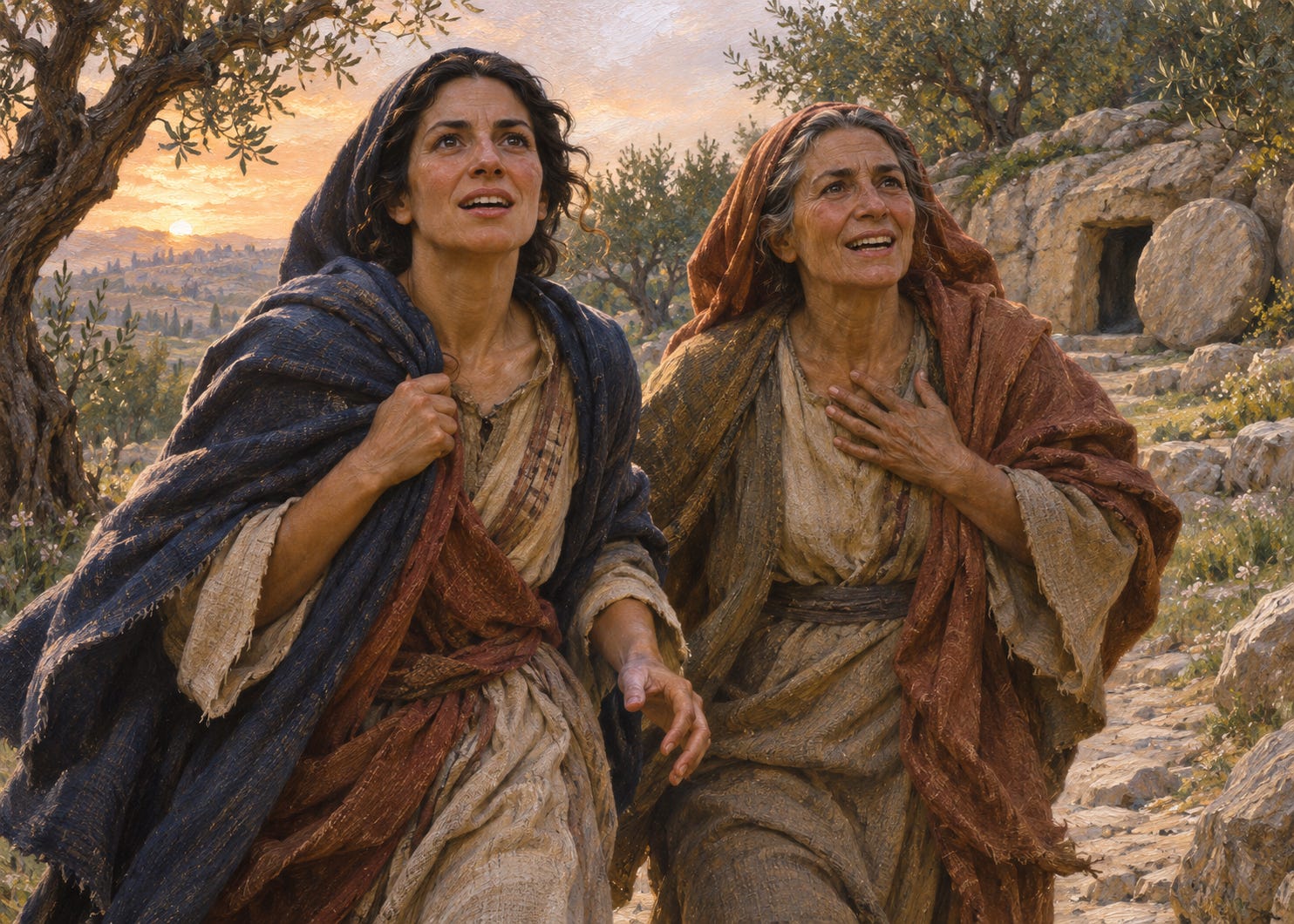
Our own Scriptures preserve an account of women speaking truth to men who could not receive it, and I am grateful that the embarrassment has survived in the telling. Mary Magdalene, Joanna, Mary the mother of James, and the other women in Luke’s account come back from the tomb with news the apostles need, having found it empty and heard that Jesus has risen. They remember what He told them in Galilee, and they bring His words along with the account of what they have encountered. The apostles dismiss their report as nonsense; Luke records their refusal without explaining all that lay behind it. The women’s testimony was true before the men believed them, and for a little while the apostles are the ones who need to catch up with what these women have come to understand. 7
In Matthew’s account, the women are hurrying from the tomb in fear and great joy when Jesus meets them, and they come to Him and take hold of His feet in worship. There is such tenderness in that encounter, with the women close enough to touch the One they had mourned, bringing their fear and joy with them as He speaks. He entrusts them with a message for the men He calls His brothers: they are to go to Galilee, where they will see Him. The women leave with words Christ has asked them to carry, and His brothers are being asked to let those women’s words direct their next steps toward Him. 8
And Now It’s Your Turn
Who is a woman who has helped you understand God differently, and what did you learn from her?
Can you remember a time when a community allowed a woman’s insight to change its direction? What made that possible?
If you know a woman who has been thanked for everything she does and seldom asked what she thinks, I hope you’ll send her this homily.
Let Us Pray
Lord Jesus, You entrusted the women at the tomb with news Your disciples needed to hear. Teach us to receive what You give us through another person, especially when her words unsettle a conviction we have defended for years.
Be near to women who have been made to doubt the wisdom You have given them. Where our voices have become confused with Yours, help them hear Your love again. Keep us from treating their patience as an excuse for our refusal to change, and give us the courage to repair what we can without demanding that they make us feel forgiven.
Bless the women who have taught us to recognize You. Let what we learn from them change the way we live together, for Your name’s sake.
Amen.
Keeping This Ministry Open
If you’d like to help sustain Message From the Margins and haven’t yet become a supporting subscriber, please consider doing so. Your support gives me the time to prepare these homilies and helps keep nearly everything we publish open to anyone who needs it. To those already supporting this work, thank you. And whether you can contribute financially or not, I’m grateful you’re here.
May the peace of Christ be with you and with those you love.