

Opening
I cannot tell you how many people have quietly said to me, “Father, I’m just not very holy.”
They say it after losing their temper.
After missing Mass.
After falling back into an old habit they thought they had conquered years ago.
After realizing that the life they imagined for themselves looks nothing like the life they are actually living.
Underneath that confession is almost always the same assumption: holiness must look clean. Composed. Impressive. Controlled.
We imagine saints as serene figures in stained glass windows, halos firmly in place, robes unwrinkled, hands folded, never flustered. We assume sanctity means having mastered ourselves to the point where the mess has disappeared.
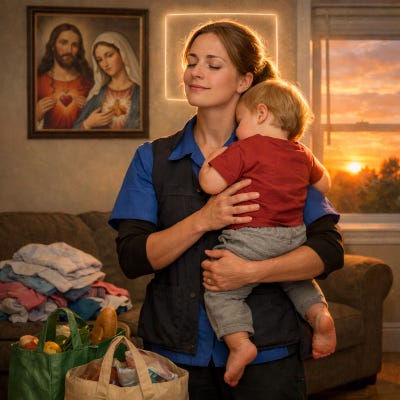
But most of us live in the middle of unpaid bills, strained relationships, aging parents, sick children, political turmoil, physical fatigue, presumptuous employers, online dating, and inboxes that never quite empty. Our prayer is distracted. Our patience is uneven. Our love is sincere, but imperfect.
So we quietly conclude: sainthood must be for someone else.
Yet the Gospel tells a different story.
Reflection
When Jesus calls His disciples, He does not recruit polished spiritual athletes. He calls fishermen who misunderstand Him repeatedly. He calls a tax collector. He calls Peter, who will swear loyalty one day and deny Him the next. He calls Mary Magdalene, known for her suffering.
And still, He says, “Follow me.”
Scripture does not hide the messiness of the saints. Peter weeps bitterly after his denial. Paul admits openly, “I do not do the good I want, but the evil I do not want is what I do” (Romans 7:19). The early Church was riddled with conflict, confusion, and growing pains. Read Acts carefully. It is not tidy.
Holiness in the New Testament is not presented as flawlessness. It is presented as faithfulness.
The Greek word often translated as “holy” is hagios, meaning set apart, consecrated. It does not mean “never struggling.” It means belonging to God.
Church history confirms this. Consider Augustine of Hippo, who wrestled publicly with ambition and desire before his conversion, and even afterward never stopped writing about grace because he knew how desperately he needed it. Consider Thérèse of Lisieux, who struggled with illness, scrupulosity, and spiritual dryness. Her “Little Way” was not about heroic perfection. It was about doing small things with great love in the middle of limitation.
Modern sainthood looks less like dramatic visions and more like showing up.
It looks like a parent choosing patience after a long day.
It looks like someone going to therapy because they want to break a cycle.
It looks like an exhausted nurse whispering a prayer between patients.
It looks like you deciding, again, to forgive.
I have had seasons where my prayer felt luminous, almost effortless. I have also had seasons where I have prayed through distraction, doubt, and emotional fatigue. If I am honest, the latter seasons formed me more deeply. Because in those moments, I was not sustained by religious feeling. I was sustained by fidelity.
Jesus does not say, “Be perfect before you come to me.” He says, “Abide in me” (John 15:4).
Abiding is ongoing. Relational. Patient. Sometimes quiet. Sometimes costly.
The saints are not the people who avoided the mess. They are the ones who kept turning toward Christ in the middle of it.
Gentle Practical Integration
If modern sainthood is about faithfulness in the mess, here are a few small ways to live that this week:
-
Choose one consistent prayer time, even if it is brief. Five steady minutes daily will shape you more than sporadic spiritual intensity.
-
Repair quickly. If you snap at someone, apologize within the day. Holiness grows in humble repair.
-
Practice hidden goodness. Do one act of kindness that no one sees and do not mention it to anyone.
-
Examine without condemning. At night, ask: Where did I turn toward God today? Where did I resist? Then place both in His hands without self-hatred.
-
Stay rooted in community. Holiness is never solitary. Attend Mass. Call a friend. Engage in real conversation.
These are not grand gestures. They are faithful ones.
A Word for Mardi Gras and Ash Wednesday
If you’re reading this on Mardi Gras, I hope you celebrate well.
Joy is not the enemy of holiness. The Church, in her wisdom, has always understood feast and fast. So if you are gathering with friends tonight, enjoy it. Laugh. Toast. Dance. Jesus himself loved to have fun with His friends and family.
But please… be wise.
Arrange a safe ride.
Be kind to strangers.
Do NOT text your ex.
Drink water before you go to bed.
Your future self will thank you.
And remember: if today is Mardi Gras, tomorrow is Ash Wednesday.
The ashes are not about shame. They are about truth. “Remember that you are dust, and to dust you shall return.” That is not a threat. It is clarity. It is freedom from pretending we are invincible.
Go receive ashes at your local parish. Let the Church mark you with humility and hope.
We will have Mass here at 8:00 PM, and you are welcome to join us online… but as you know, it is hard to impose ashes through a screen. Some things require embodiment. Show up somewhere in person if you can.
And if you have not yet downloaded your free Lenten Guide, A Centering Lent in a Chaotic World, this is the week to do it. Lent is not about spiritual heroics. It is about steadying your soul.
Let’s begin well.
Prayer
Lord Jesus Christ,
You did not call the flawless.
You called fishermen, doubters, zealots, and sinners.
You called people who were tired, confused, impulsive, and afraid.
We come to You as we are, not as we imagine we should be.
In the busyness of our days, when patience runs thin and our hearts feel divided, anchor us in Your steady presence. When we fail, teach us to return quickly without despair. When we are weary of trying, remind us that faithfulness, not perfection, is what You ask.
Heal the parts of us that believe we must earn Your love. Quiet the voice that says we are not enough. Give us courage to remain with You in dry seasons and joyful ones alike.
Make our ordinary lives holy by Your grace.
Consecrate our work, our relationships, our struggles.
Form us into saints who belong entirely to You.
We place our unfinished selves into Your merciful hands.
Amen.
Closing
If you have ever felt disqualified from holiness because your life feels complicated, know this: you are not behind. You are not uniquely broken. You are human.
And God has always built saints out of human beings.
I would love to hear in the comments: Where do you most struggle with the idea of holiness? What part of your life feels too messy to be sacred?
If this reflection strengthened you, consider becoming a supporting member so we can continue walking together.