

A Word Before the Homily
Good morning, my friends.
Before we turn to a Gospel about keeping watch through the night, I want to encourage you to let other people help sustain your faith. If you have a safe, loving parish and can worship there today, I hope you will go. Hear the readings aloud, add your voice to the singing, and share in the worship of your community. For those of us whose tradition gathers around the Eucharist, there is also the gift of receiving Christ at the table together. These words on a screen can accompany you; a parish can come to know you in person.
If church has wounded you, or you are homebound, caring for someone, or simply not ready to return, you are welcome here. You can pray with these readings from where you are. And if you want help finding a parish where you will be treated with dignity, let me know. I would be glad to help you look.
Your Brother in Christ,

Today’s Readings
Reading 1
Wisdom 6:12-16
Resplendent and unfading is wisdom,
and she is readily perceived by those who love her,
and found by those who seek her.
She hastens to make herself known in anticipation of their desire;
Whoever watches for her at dawn shall not be disappointed,
for he shall find her sitting by his gate.
For taking thought of wisdom is the perfection of prudence,
and whoever for her sake keeps vigil
shall quickly be free from care;
because she makes her own rounds, seeking those worthy of her,
and graciously appears to them in the ways,
and meets them with all solicitude.
Responsorial Psalm
Psalm 63:2, 3-4, 5-6, 7-8
R. (2b) My soul is thirsting for you, O Lord my God.
O God, you are my God whom I seek;
for you my flesh pines and my soul thirsts
like the earth, parched, lifeless and without water.
R. My soul is thirsting for you, O Lord my God.
Thus have I gazed toward you in the sanctuary
to see your power and your glory,
For your kindness is a greater good than life;
my lips shall glorify you.
R. My soul is thirsting for you, O Lord my God.
Thus will I bless you while I live;
lifting up my hands, I will call upon your name.
As with the riches of a banquet shall my soul be satisfied,
and with exultant lips my mouth shall praise you.
R. My soul is thirsting for you, O Lord my God.
I will remember you upon my couch,
and through the night-watches I will meditate on you:
You are my help,
and in the shadow of your wings I shout for joy.
R. My soul is thirsting for you, O Lord my God.
Reading 2
1 Thessalonians 4:13-18
We do not want you to be unaware, brothers and sisters,
about those who have fallen asleep,
so that you may not grieve like the rest, who have no hope.
For if we believe that Jesus died and rose,
so too will God, through Jesus,
bring with him those who have fallen asleep.
Indeed, we tell you this, on the word of the Lord,
that we who are alive,
who are left until the coming of the Lord,
will surely not precede those who have fallen asleep.
For the Lord himself, with a word of command,
with the voice of an archangel and with the trumpet of God,
will come down from heaven,
and the dead in Christ will rise first.
Then we who are alive, who are left,
will be caught up together with them in the clouds
to meet the Lord in the air.
Thus we shall always be with the Lord.
Therefore, console one another with these words.
Alleluia
Matthew 24:42a, 44
R. Alleluia, alleluia.
Stay awake and be ready!
For you do not know on what day your Lord will come.
R. Alleluia, alleluia.
Gospel
Matthew 25:1-13
Jesus told his disciples this parable:
“The kingdom of heaven will be like ten virgins who took their lamps and went out to meet the bridegroom.
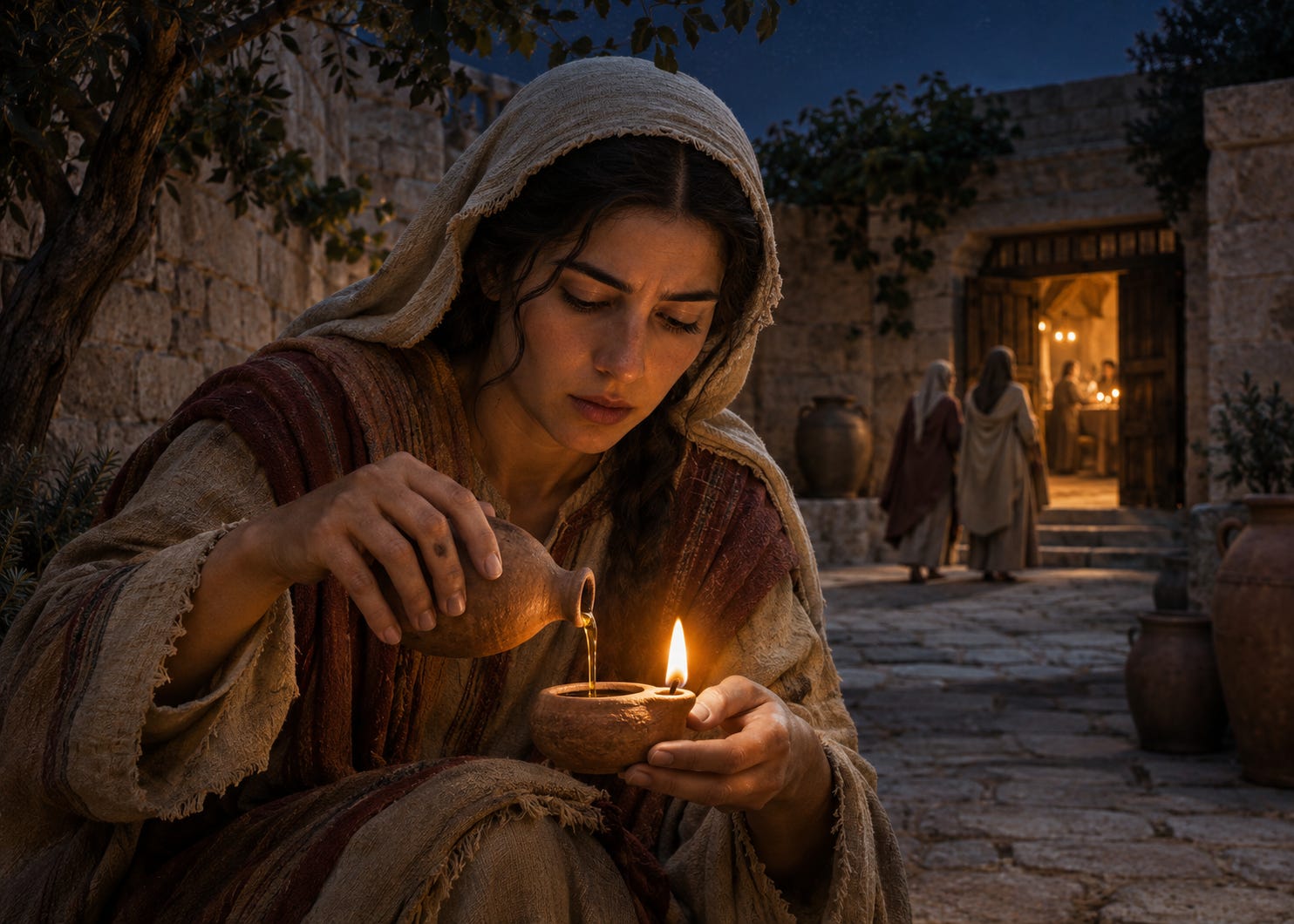
Five of them were foolish and five were wise. The foolish ones, when taking their lamps, brought no oil with them, but the wise brought flasks of oil with their lamps.
Since the bridegroom was long delayed, they all became drowsy and fell asleep.
At midnight, there was a cry, ‘Behold, the bridegroom! Come out to meet him!’
Then all those virgins got up and trimmed their lamps.
The foolish ones said to the wise, ‘Give us some of your oil, for our lamps are going out.’
But the wise ones replied, ‘No, for there may not be enough for us and you. Go instead to the merchants and buy some for yourselves.’
While they went off to buy it, the bridegroom came and those who were ready went into the wedding feast with him. Then the door was locked.
Afterwards the other virgins came and said, ‘Lord, Lord, open the door for us!’
But he said in reply, ‘Amen, I say to you, I do not know you.’
Therefore, stay awake, for you know neither the day nor the hour.”
The Homily: Through the Night
In my much younger days, I had no trouble staying up well into the night. In fact, I remember being an undergraduate and feeling that if I wasn’t still awake at three in the morning, I wasn’t really living my life.
Through my twenties and thirties, dinner invitations were scarcely made before eight.
Well… here I am at forty-two. I’m usually in bed promptly at ten-thirty. I say night prayer, and the rosary, put on a documentary, and by eleven my eyes are shut and the sound of wood being sawed can be heard floating out my chamber door. I’m sure the documentary was lovely and I learned a lot.
Occasionally, I’m invited to something that requires staying up much later. That’s where my handy-dandy espresso machine comes in, because I am not seeing that concert, that entertainer, or the ball drop without it. That much is certain.
I can still stay up late. I just have to prepare for it now.
In today’s Gospel, ten bridesmaids are waiting for the bridegroom. Five are wise, five are foolish, and as the wait stretches on, every last one of them falls asleep.
Including the wise ones.
Then Jesus ends the story by telling us to stay awake. Well, now. If staying awake were the entire test, all ten would have failed it.
Something else separates them, and at first it is easy to miss. They have all come to meet the bridegroom. They all have lamps. From a distance, you might have trouble telling them apart.
Until midnight.
A cry announces that he is coming. All ten wake up and tend their lamps. The wise have brought flasks of oil with them, but the other five discover that their lamps are going out. They ask for oil, and the wise reply that there will not be enough to go around. The five who asked go to buy more, and while they are gone, the bridegroom arrives. Those who are ready enter the wedding feast with him.
Then the door is locked.
The others return and call out, “Lord, Lord, open the door for us!” The answer comes from the other side: “Amen, I say to you, I do not know you.”
They had expected to be inside. They had come for this very purpose. Yet when the person they were waiting for finally arrived, they were elsewhere, trying to obtain what they needed to meet him.
That is a terrible ending to a story about a wedding. I would much prefer everyone getting inside and having a lovely time. But Jesus leaves five outside, calling Him Lord.
I recognize the assumption that there will be more time. I can put off changing something I know needs to change, with every intention of attending to it eventually. Eventually is wonderfully accommodating. It never asks me to do anything this afternoon.
But Jesus is talking about meeting Him, and about whether the life we are living has prepared us for that encounter. This is a parable about judgment. We will answer to God for what we have done with the life He has given us. The delay in His coming does not make that encounter any less real.
Until that encounter, we wait. In the other readings, Wisdom is sought at dawn by someone keeping vigil. The psalmist remembers God upon the bed and meditates through the night-watches. Paul writes about people who have fallen asleep in death, and the grieving community waiting for the Lord. Each reading brings us to the limits of what we can presently see.
You may know those limits from praying for someone you love while the situation remains agonizingly unchanged. After a death, you might still reach for the phone to call the person you have lost. The hope of reunion can feel terribly far away when you would give almost anything for one more ordinary conversation.
We have to live in that interval. And as it lengthens, we can begin to lose our bearings. A preacher who claims to know exactly what God is doing can become very attractive, especially if the explanation makes us feel righteous and gives us somebody else to blame.
Immediately before this parable, Jesus warns His disciples about false prophets and people claiming to be the Messiah. He also warns that the love of many will grow cold. We ought to take both warnings seriously. A religious message that teaches us to despise people can deceive us while making us feel exceptionally faithful.
But the foolishness in this parable also requires us to examine the stories we tell ourselves. Nobody has to trick us into assuming that our religious familiarity amounts to readiness. We are quite capable of arriving at that conclusion without assistance.
Matthew has already shown us the difference between a wise person and a foolish one. At the end of the Sermon on the Mount, Jesus describes two builders. Both hear His teaching. The wise one acts on it and builds on rock; the foolish one fails to act and builds on sand. When the storm comes, the consequences become visible.
Just before that, Jesus warns that saying “Lord, Lord” is insufficient, and speaks of people to whom He will declare that He never knew them. Now, outside the wedding feast, we hear those words again.
That repetition makes it difficult for me to turn this into a homily about other people’s shortcomings. I know the religious language. I can explain a passage of Scripture and still refuse to let it correct me. I can write beautifully about mercy and then find an excellent theological reason why the person I dislike should receive very little of it.
If I repeatedly excuse my own lack of mercy, I can become very good at withholding it. Eventually, I may scarcely notice what I am doing. A person who needs kindness encounters my contempt, and I go home satisfied that I have defended the faith.
There is a frightening possibility: becoming so accustomed to our own version of Christianity that we fail to recognize Christ when following Him requires us to change.
A lamp needs oil if it is going to keep burning through the wait. Matthew does not explicitly identify the oil is supposed to symbolize, but his earlier teaching gives us good reason to think about faith put into practice. We learn to return to God in prayer, including after we have failed. We allow His teaching to correct us, and another person’s need to make a claim on our time. Through such choices, we cooperate with the grace by which He forms us.
Other people can help enormously. They can teach us to pray and show us what forgiveness looks like. They can tell us the truth when we would rather not hear it. But they cannot consent to God’s work on our behalf. I cannot borrow your years of learning to love and present them as my own willingness to follow Jesus.
That is how I understand the inability to share the oil. We should be very suspicious of an interpretation that turns it into permission to abandon people. Later in this very chapter, Jesus will speak about feeding the hungry and welcoming the stranger.
And we must remember that even the wise fall asleep. Their preparation remains when their strength gives out.
If you are getting up through the night to care for someone, you already know how much effort love can require. If grief is interrupting your sleep, you do not need a priest implying that exhaustion is evidence of spiritual failure. Jesus gives us five wise people whose bodies need rest. Weariness can coexist with a life of faithful love.
The question becomes urgent when we have left that life unattended. The door closes, and the bridegroom says He does not know them. We cannot explain that away as a minor scheduling mishap. Jesus wants His disciples to hear the danger of arriving at the end of their waiting unprepared to meet Him.
But we are hearing the warning now. We still have today in which to respond. And the first reading tells us that help is already coming toward us.
Wisdom is making her rounds, seeking people out. The person who rises to look for her discovers her already sitting at the gate. Before the search has carried them very far, she has come to meet them.
We need that reading beside the locked door. God is actively seeking us through the very hours we find so difficult to understand. We can ask for wisdom, admit where we have been foolish, and allow ourselves to be taught. The grace to begin again comes from Him.
The psalmist prays through the night by remembering God’s help. Longing remains, but so does the memory of having been loved. And Paul brings the promise of Christ’s resurrection into the separation that death has caused. Those who have died in Christ will share in His life. Their loved ones can grieve with hope, because death has not put them beyond His reach.
“Therefore, console one another with these words.”
We have been given something to offer one another during the wait. A grieving person may still need to hear the name everyone else has stopped mentioning. An exhausted caregiver may need us to take a turn so they can sleep. In helping them, we practice our faith in the One who has promised that we shall be together with Him.
When I say night prayer, there is a question I can bring to God before my eyes close: where have I been putting off the love You have asked of me?
Perhaps there is a person I have been meaning to call, or someone whose forgiveness I need to ask. Perhaps I have given a resentment so much room that I scarcely remember how to pray for the person involved. I can tell God where I am, ask for His help, and take the next step while it is still possible.
Christ has died and risen to bring us into His life. The One we are preparing to meet has already loved us enough to do that. We can entrust ourselves to Him as we ask Him to change us. Wisdom is already making her rounds, and we have no reason to keep her waiting at the gate.
We have today. Let us use it to learn His love.
And Now It’s Your Turn
What has helped you remain faithful during a wait that lasted much longer than you expected?
Is there something you have been putting off that today’s Gospel makes you want to attend to? Share what you feel comfortable sharing, or keep the answer for your prayer.
If someone you love is worn down by a long wait, send them this homily and let them know you are willing to help them through it.
Let Us Pray
Lord Jesus Christ,
You know how long the night can feel
to those who are waiting for help.
Be near to those who are grieving.
Give rest to those whose care for others has exhausted them,
and move us to offer the help they need.
Show us where we have mistaken familiarity with Your words
for willingness to live them.
Give us courage to receive correction
and to begin the good we have postponed.
When we cannot see the way ahead,
help us remember Your faithfulness.
Let Your wisdom find us ready to learn,
and form us in the love by which we will recognize You.
Keep us in the hope of Your resurrection,
until we rejoice together in Your presence.
Amen.
The Collection Plate
If these Sunday reflections help you understand Scripture and live your faith, please become a supporting subscriber. Your support sustains the writing and pastoral work of Message From the Margins and helps keep nearly everything open to people who cannot pay. Thank you for reading, praying, and helping as you are able.
May Almighty God bless you, the Father, and the Son, and the Holy Spirit. Amen.