

A society begins to lose its soul the moment it can discuss a child as a burden before it can recognize that child as a neighbor.
“Even just one of these children.”
That is the phrase Pope Leo chose, and it is one of those lines that does not leave you much room to hide.
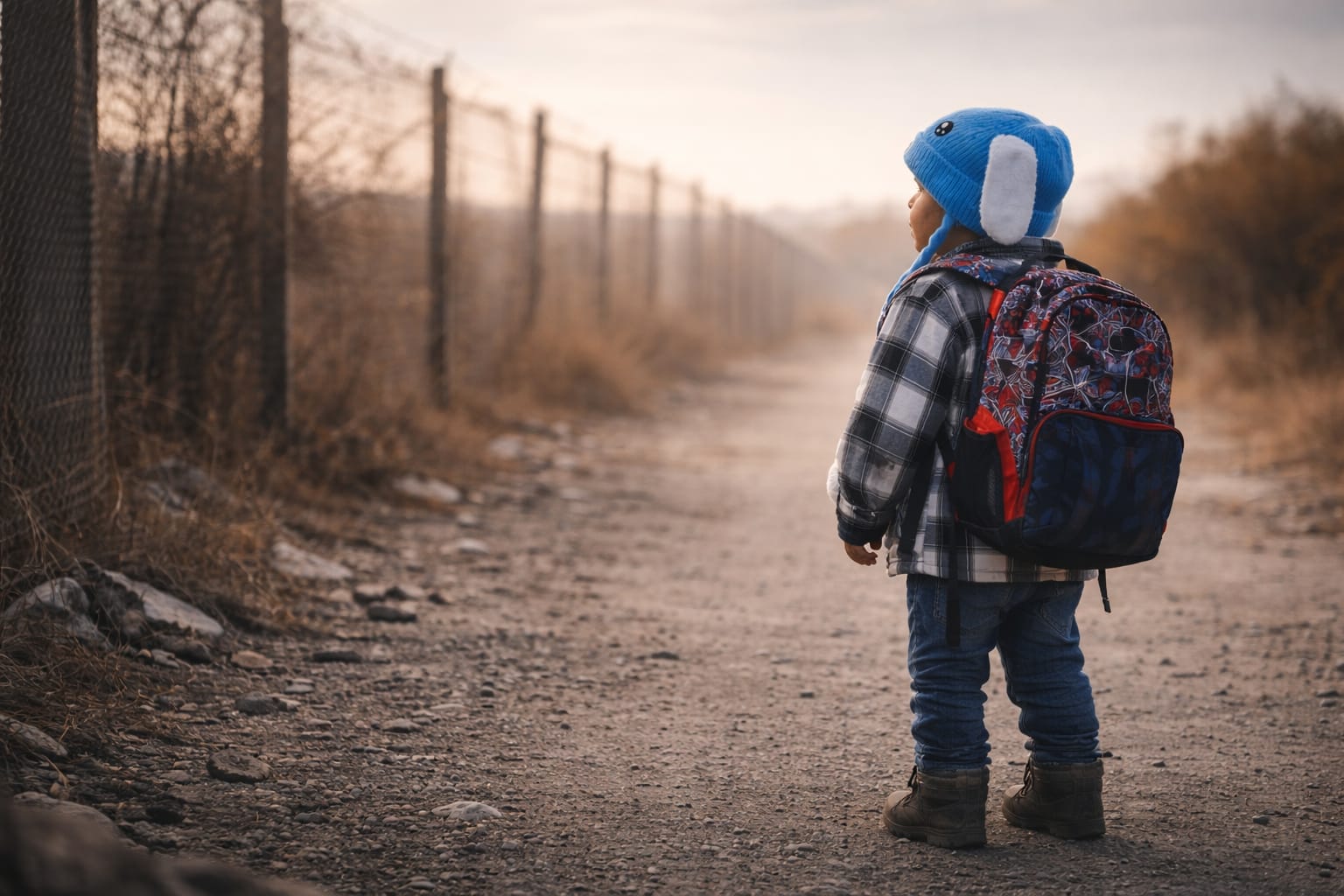
Not because it is loud. Not because it is partisan. Not because it is complicated. Quite the opposite. It is morally impactful precisely because it is so small, so plain, so difficult to wriggle away from. Even just one. One child on the move. One frightened face at a border. One backpack. One family carrying too much. One minor caught inside systems built by adults, argued over by adults, and too often defended by adults who have learned to speak about suffering in the language of efficiency.
The world you’re living in isn’t just noisy.
It’s engineered to hold your attention.
Not in a dramatic way…
but in a precise, studied one.
And over time, that shapes how you think, react, and feel.
If you’ve been feeling more scattered than you used to… there’s a reason.
In the paid Message From the Margins Substack, we’re working through how to stay grounded in the middle of that.
If you want to be part of it, you can join by selecting any paid tier here, our Journey Continues at 6:30 PM Tonight:
This year, for the 2026 World Day of Migrants and Refugees, Pope Leo chose to frame the Church’s reflection around migrant and refugee children, explicitly tying the theme to Jesus’ words in Matthew 18:5:
“And whoever welcomes one such child in my name welcomes me.”
That matters because it shifts the entire conversation. Or at least it should.
The public debate about migration is almost always designed to keep us at a comfortable distance. It deals in categories, surges, enforcement mechanisms, quotas, detention capacity, administrative burdens, border integrity, political optics. Some of those questions are real. Nations do have laws. Governments do have responsibilities. Serious people can and do argue over policy. But something spiritually corrosive happens when those arguments become a way of protecting ourselves from the human being at the center of them.
And that is what Pope Leo has just refused to allow.
He has taken one of the biggest, most politically weaponized issues in public life and collapsed it down to the scale of a child.
That is so much more than pius sentimentality. It is Christian moral reasoning.
The Vatican’s language sharpened the point even further, saying that under current migration conditions the rights and dignity of minors are threatened and that urgent, effective responses are needed. Another striking line from the Dicastery put it plainly: “even just one has the highest value.” Again, notice what that does. It strips away utilitarian logic. It tells us that the worth of a child is not determined by how many children there are, how politically inconvenient they may be, or whether their presence complicates a news cycle.
Even one has the highest value.
That is not how modern politics usually works. Modern politics prefers scale because scale is emotionally efficient. The bigger the number, the easier it is to stop seeing the person. Once people become a “flow,” a “wave,” a “problem,” a “burden,” or a “case load,” conscience begins to relax. Numbers are easier to manage than faces. Statistics are easier to control than tears. Abstractions do not look back at you.
Children do.
But there is another distortion at work as well, and it runs in the opposite direction. When scale no longer serves the argument, politics suddenly becomes very personal, very selective. A single crime, a single failure, a single broken story is lifted up and made to stand in for millions. One person becomes the explanation for an entire group. Fear is built not from reality as a whole, but from carefully chosen exceptions. The result is the same. The individual disappears, either into a faceless mass or into a stereotype shaped by suspicion.
In both cases, we stop seeing clearly. Either people are reduced to numbers, or they are reduced to symbols of threat. And in both cases, the human person, the one Christ tells us to recognize, is lost.
Pope Leo is turning both of these distortions on their head.
That, I think, is why this papal framing lands with such force right now. It suggests the Church sees something in the present moment that is getting worse, not better. Not merely migration itself, but our moral acclimation to it. Our ability to discuss the movement of vulnerable human beings, including minors, as though the central question were administrative strain rather than human dignity. Our willingness to let children disappear inside arguments about systems.
But the Gospel is terribly inconvenient that way. Jesus will not let us keep things at the level of systems alone.
“And whoever welcomes one such child in my name welcomes me.”
Not welcomes a theory. Not welcomes a category. Not welcomes an idealized version of innocence from a safe distance. Welcomes one such child. Christ places himself there, in the concrete, in the vulnerable, in the one who can be missed if we insist on staying abstract.
This is one of the reasons Christianity is so difficult when taken seriously. It keeps interrupting our preferences for scale, detachment, and self-justification. We would often rather discuss principles in the abstract. Jesus keeps introducing a person. We would rather remain at the level of policy. Jesus points to a child. We would rather ask what is practical. Jesus asks whom we are willing to recognize.
And to be clear, this does not mean every policy question has an easy answer. It does not mean borders cease to exist or governments stop governing. But it does mean that any policy, any rhetoric, any public posture that treats children as collateral, spectacle, leverage, or inconvenience has already failed a basic moral test. Before it is politically unwise, it is spiritually disordered.
That is the pressure point Pope Leo is pressing.
Because once the child is visible, certain kinds of language start sounding obscene. Talk of “deterrence” lands differently when what is being deterred includes a five-year-old. Calls for “hardening” a system land differently when a frightened minor is on the receiving end of that hardness. Appeals to “realism” begin to reveal how often realism is simply the name we give to moral surrender.
A society begins to lose its soul the moment it can discuss a child as a burden before it can recognize that child as a neighbor.
And the Church begins to lose its soul the moment it adopts the same habit.
That last part is also deeply important. Pope Leo’s message is not only aimed at states and border regimes. It is aimed at us, too. At churches that have sometimes learned to speak more comfortably about order than mercy. At Christians who are happy to defend the Holy Family in theory but uneasy when today’s displaced families appear in public life as actual claimants on our conscience. At all of us who can speak movingly about the baby in Bethlehem while growing strangely cold toward children carried across deserts, seas, checkpoints, and detention corridors.
The Christian story begins, after all, with a child under threat. It begins with political violence hovering over infancy. It begins with a family forced to flee danger. Exile is not a side note in our faith. It is braided into it. So is vulnerability. So is dependence on the mercy, or cruelty, of strangers.
That is why Matthew 25 also belongs here:
“I was a stranger and you invited me in.”
Jesus does not say, I was a stranger and you solved the geopolitical crisis. He does not say, I was a stranger and you won an argument. He says, I was a stranger and you invited me in. The moral demand is not abstract perfection. It is human recognition expressed in concrete mercy.
And if we are honest, most of us know some version of the temptation this story exposes.
No, most of us are not designing border systems. Most of us are not writing immigration law. But the moral logic is familiar. We all know how easy it is to deal with people at the level of category instead of person. We know how quickly inconvenience can harden into indifference. We know how often we speak about “those people” when what we really mean is people we do not want interrupting our comfort, our certainty, our idea of order.
The scale is different, but the habit is the same.
We do it in families, workplaces, churches, neighborhoods. We reduce someone to a problem because that is easier than facing their humanity. We hide behind broad language because broad language protects us from compassion. We pretend that complexity excuses coldness. We call ourselves practical when in truth we have simply become numb.
So this is not only a story about migrants. It is a story about what happens to the human soul when it stops seeing the vulnerable clearly.
Micah gives us the shape of the response: “To act justly and to love mercy and to walk humbly with your God.”
Notice how unshowy that is. Act justly. Love mercy. Walk humbly. Not posture. Not perform. Not reduce human beings to talking points while congratulating ourselves for being realistic. Justice, mercy, humility. Those are not soft virtues. They are the disciplines that keep power from becoming cruelty.
Pope Leo’s line is powerful because it brings all of this down to its sharpest point. Even just one of these children. Even one child is not expendable. Even one child cannot be morally buried under statistics. Even one child is enough to judge the character of a system, a politics, a church, a nation, or a heart.
And that is where the essay has to end, because that is where the conscience test begins.
Not with the number. With the child.
Not with the slogan. With the face.
Not with the management problem. With the neighbor.
Not with fear. With Christ.
If the Gospel means anything in public life, it means that no child on the move is ever just part of the background noise of history. Each one arrives carrying a claim on us. Not because they are useful. Not because they are politically convenient. But because they are human, and because Christ has already told us where he stands.
He stands there.
If this piece stayed with you, share it with someone who is trying to think faithfully about the moral demands of this moment, and tell me in the comments where this story presses on your own conscience most.
We tend to assume the world around us is neutral.
It’s not.
It is constantly shaping:
your attention
your reactions
your emotional baseline
So if you feel more anxious or reactive than you want to be…
that’s not just personal.
In the paid Message From the Margins Substack, we’re learning how to live differently within that reality.
You can join by selecting any paid tier here, our journey continues at 6:30 tonight: