

My Dear Friend,
Before we begin, I want to say thank you.
We have had a number of new readers join this community recently, both free and paid, and I do not take that lightly. Every time someone chooses to make room for this work in their inbox, their prayer life, or their week, it means something to me.
This piece was especially meaningful to write because it let me share a little bit of my own private spirituality with you.
One of the beautiful things about the Christian faith is that it becomes deeply personal over time. Yes, we share Scripture, sacraments, creeds, prayers, and the great tradition of the Church. But each of us also develops our own little rhythms with God: the phrases we return to, the devotions that steady us, the practices that help us breathe again, the small habits that may look strange from the outside but somehow keep us close to grace.
And yes, if we are being honest, maybe even a few holy superstitions along the way.
Today’s essay touches on one of mine.
That is part of why this community is so important to me. It gives us a place to explore these things honestly and safely, with seriousness but without fear. Many of us are learning how to speak about faith again, either for the first time, or for the first time in a long time.
That kind of space is rare.
If that sounds like something worth continuing, I’d invite you to consider becoming a paid subscriber. Your support gives you a real share in this ministry and helps keep this work alive, growing, and available to others.
That, and the Holy Spirit, are what keep this whole thing going.
So thank you for being here. Thank you for reading. Thank you for sharing this work. And thank you for helping build a community where wounded, searching, thoughtful people can be drawn ever nearer to the Heart of Christ.
Your Brother in Christ,

“Draw Us Ever Nearer to Your Sacred Heart”
Early in my priesthood, I started doing something a little unusual.
Granted, I do a lot of unusual things, so the bar is not exactly high.
But this one has stayed with me.
Somewhere along the way, I began adding a simple line to my prayers:
“Draw us ever nearer to your Sacred Heart.”
I honestly do not remember if I heard another priest say it, if I picked it up from some old prayer, or if it just came out of me one day and never left. At this point, I probably pray those words five to ten times a day.
Draw us ever nearer to your Sacred Heart.
It has always felt important to me, though I have never been entirely sure how to explain why. I am not claiming some great mystical insight here. Far from it. I am not walking around in a cloud of incense having visions between cups of coffee.
But the prayer feels right.
It feels steady.
It feels like one of those spiritual sentences that somehow holds more than it says.
Almost like a holy cheat code, if I can say that without getting myself reported to the theology police. As if nothing can be lost, no matter how confused or wounded or afraid we become, if we are still being drawn nearer to the Heart of Christ.
Then something unusual happened this year.
The Roman Catholic bishops in the United States announced a consecration of the country to the Sacred Heart of Jesus. We can have all the debates one wants about whether a nation, especially a nation no single church owns or governs, can or should be consecrated in that way. Those questions are not unimportant.
But debates aside, the announcement told me something.
Whatever this thing is that I have felt for years, I am clearly not the only one feeling it.
Maybe the Church, in her long memory, has been trying to give language to something many of us feel before we can articulate it: that in a brutal, anxious, overstimulated age, we do not merely need better arguments, better branding, better outrage, or better coping mechanisms.
We need to be drawn nearer to the Sacred Heart.
The Solemnity of the Most Sacred Heart of Jesus is celebrated on the Friday after Corpus Christi. That placement is more important than it might seem. After the Church has contemplated Christ giving himself to us in the Eucharist, we are led to the Heart from which that gift flows.
The Sacred Heart is not merely a religious decoration. It is more than artwork on an old holy card, though I have nothing against old holy cards. Some of them have served as a last remaining tether to God as my own faith waxed and waned at points.
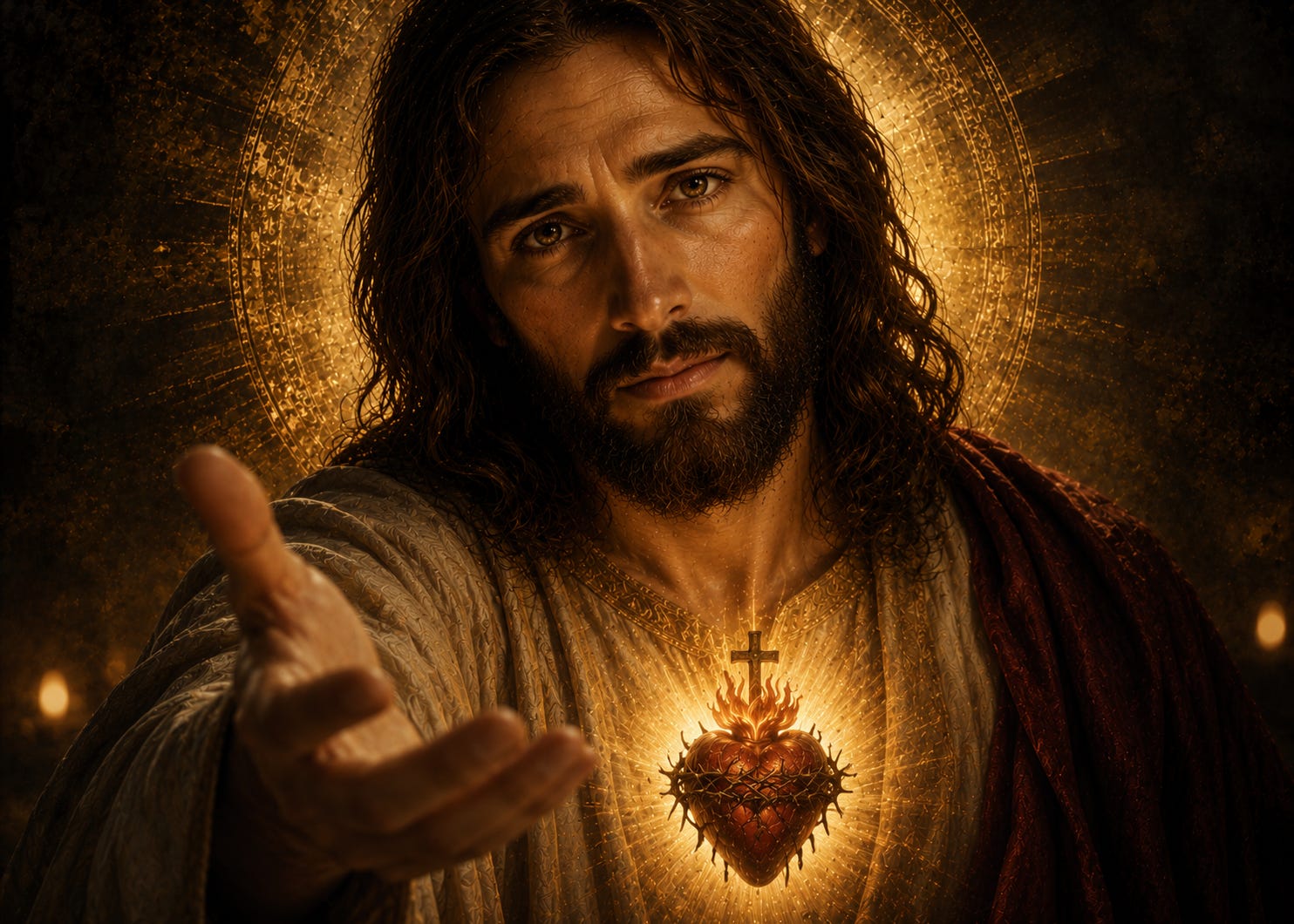
The Sacred Heart is the Church placing before us the inner life of Christ and saying: Look carefully. This is what divine love looks like when it enters a wounded world and refuses to stop loving.
The biblical image behind the devotion is the pierced side of Christ in John’s Gospel. After Jesus dies on the cross, a soldier pierces his side with a spear, and blood and water flow out.
The Church has never been able to look away from that moment.
Blood and water. Wound and gift. Death and life. The pierced body of Christ becoming the place from which mercy flows into the world.
God’s love has a body.
God’s love has wounds.
God’s love has a heart.
That is the claim at the center of this feast.
Jesus is not merely a teacher with good ideas. He is not merely a moral example. He is not the symbol we attach to whatever cause we already preferred before opening the Gospel.
He is the incarnate Son of God, whose heart burns with love for the Father and for the world.
And that love is not fragile.
Tender, yes. Merciful, yes. But not fragile. Not sentimental. Not weak. The Sacred Heart is crowned with thorns because Christ’s love enters the places where love gets wounded and still does not turn back.
That is the part we resist.
Most of us know love with limits. Love that withdraws when disappointed. Love that keeps score. Love that says, “I will come close, but only if I am certain I will not be hurt.”
So we learn to protect ourselves. We become functional. Careful. Harder to reach. We armor up and call it wisdom. We detach and call it peace.
Then the Church places before us a heart on fire.
Not a fist.
Not a weapon.
Not a shield.
A heart.
Many people today move through life feeling emotionally overclocked and spiritually numb at the same time. They wake up already bracing themselves before they even check their phones. The nervous system begins its morning liturgy before the soul has had time to pray.
News. Bills. Family tension. Political dread. Old grief. Fresh anxiety. The ache that behaves itself in public and then waits for the quiet.
Into that world, Christ says, “Come to me, all you who are weary and burdened, and I will give you rest.”
That line is quoted so often that we can forget how radical it is.
He does not say, “Come to me once you have become impressive.”
He does not say, “Come to me once your theology is tidy, your emotions are regulated, your family is functioning, and your inner life no longer looks like a junk drawer.”
He says, come to me, all you who are weary and burdened.
Come tired.
Come tangled.
Come ashamed.
Come unable to explain why you are still carrying what you are carrying.
The Sacred Heart is Christ’s answer to the exhausted soul: I know what the world has done to your heart. Bring it here.
That is why this feast feels so urgent in 2026.
Our country is not merely divided. Division sounds too clean. We are suspicious, propagandized, reactive, lonely, and increasingly trained to treat contempt as intelligence.
Public cruelty is sold as strength. Mercy is mocked as weakness. Truth is often bent into whatever shape serves the tribe. Religion itself is too often dragged into the machinery of resentment and power.
So if we are going to speak of consecrating a nation to the Sacred Heart, then we had better be clear about what that means.
It cannot mean baptizing national ego.
It cannot mean pretending Jesus has been recruited to our side.
It cannot mean placing a sacred seal over politics that do not resemble the Heart being invoked.
A heart crowned with thorns does not flatter empire.
If the Sacred Heart means anything, it means every human project, including a nation, must be brought under the cover of Christ’s love. And Christ’s love is not vague. It draws near to the poor. It tells the truth. It refuses cruelty. It forgives sinners without pretending sin is harmless. It exposes hypocrisy. It welcomes the weary. It does not confuse dominance with righteousness.
A consecration to the Sacred Heart should make us less arrogant, not more. More repentant, not more triumphal. More attentive to the vulnerable, not more comfortable with their suffering.
That is not only a national question.
It is personal.
The Sacred Heart asks each of us: What has happened to your heart?
Not your opinions.
Not your brand.
Not your ability to win an argument.
Your heart.
Has it grown numb? Has it become cynical? Has it learned to wound back before anyone gets too close? Has it confused exhaustion with wisdom? Has it become so afraid of being naive that it no longer knows how to be tender?
There is no shame in admitting the answer.
The whole feast exists because Christ knows what happens to human hearts in a hard world.
He does not despise a wounded heart.
He offers his own.
That is why I keep praying those words.
Draw us ever nearer to your Sacred Heart.
That prayer has become, for me, a way of admitting that I cannot heal my own heart by force of will. I cannot think my way into mercy. I cannot strategize my way into holiness. I cannot build a personality strong enough to protect me from every grief, disappointment, fear, or failure.
I need to be drawn.
That word matters.
Drawn.
Not shoved. Not scolded. Not dragged by shame.
Drawn.
The Sacred Heart draws us the way real love always draws: steadily, patiently, truthfully, without manipulation.
And the closer we come to that Heart, the more our own hearts begin to change.
Usually not dramatically. Most transformation is embarrassingly quiet. A little more patience where there used to be irritation. A little more courage where there used to be avoidance. A little more honesty in prayer. A little more tenderness toward someone who does not deserve it, which is annoying, because grace rarely consults our preferences.
Over time, the heart starts to learn a different rhythm.
This is where the devotion becomes more than comfort. It becomes conversion.
We are not called only to admire the Sacred Heart.
We are called to follow it.
That means refusing the cheap satisfaction of contempt. It means learning to love without pretending harm is harmless. It means staying truthful without becoming cold.
There is a kind of Christian life that knows how to be correct but has forgotten how to be tender. There is also a kind that knows how to be tender but has become afraid of truth.
The Sacred Heart gives us neither escape.
It gives us Christ, full of grace and truth, with a wounded heart still burning.
And it gives us words when we do not know what else to pray.
Draw us ever nearer to your Sacred Heart.
When the country is anxious.
Draw us ever nearer.
When the Church is wounded.
Draw us ever nearer.
When families are strained.
Draw us ever nearer.
When public life grows cruel.
Draw us ever nearer.
When we are tired of ourselves.
Draw us ever nearer.
When we do not know how to love without fear.
Draw us ever nearer.
Because if we are being drawn nearer to the Heart of Christ, then even our wounds are not the end of the story.
A burning heart in a cold age.
A wounded heart in a cruel age.
A faithful heart in an exhausted age.
Sacred Heart of Jesus, draw us ever nearer.
Practical Takeaways
-
Pray one simple line today: “Draw me ever nearer to your Sacred Heart.”
-
Sit with John 19:34, the pierced side of Christ, and notice what flows from the wound.
-
Ask honestly: where has my heart grown numb, cynical, guarded, or afraid?
-
Practice one act of non-performative tenderness.
-
Before reacting, posting, arguing, or dismissing another person, ask: “Does this resemble the Heart of Christ?”
Now it’s your turn…
I’d really love to hear from you on this one.
Is there a prayer, phrase, devotion, or image that has stayed with you over the years, even if you cannot fully explain why?
And when you hear the words “Draw us ever nearer to your Sacred Heart,” where does your own heart go? What part of your life, your family, your faith, or our country most needs to be drawn closer to the Heart of Christ right now?
Share your thoughts in the comments. I read them, and they often help shape where these reflections go next.
And if someone came to mind while you were reading this, someone tired, wounded, searching, or trying very hard to stay tender in a brutal world, please send it to them. It may be exactly the reminder they need today.
Closing Prayer
Lord Jesus Christ,
Draw us ever nearer to your Sacred Heart.
Draw us close when we are tired, guarded, ashamed, angry, or afraid. Draw us close when our hearts have grown cold from disappointment or hard from trying to survive. Teach us to trust the love that does not withdraw from our wounds.
Sacred Heart of Jesus, heal what has been broken in us. Burn away what has become false. Give us courage without cruelty, tenderness without fear, truth without pride, and mercy without pretending harm is harmless.
Where our nation is divided, draw us nearer. Where the Church is wounded, draw us nearer. Where our families ache, draw us nearer. Where we have failed to love, draw us nearer still.
Make our hearts more like yours: faithful, wounded, radiant, and alive with the love of God.
Amen.
Thank you for spending this time with me.
Writing about the Sacred Heart today felt more personal than I expected. Sometimes faith is easiest to talk about in big public language: doctrine, history, liturgy, theology. All of that matters. But underneath it, most of us are also carrying small private prayers that have kept us alive in ways we may not fully know how to explain.
“Draw us ever nearer to your Sacred Heart” has become one of those prayers for me.
If this reflection met you somewhere tender, tired, hopeful, or unfinished, I hope you will carry that line with you today.
And if this kind of work matters to you, thoughtful Christian reflection that is honest, historically grounded, emotionally real, and safe enough for people to find their way back to faith, I’d be grateful if you would consider becoming a paid subscriber.
Your support helps keep this ministry alive and growing. It helps make space for people who are searching, wounded, returning, questioning, praying, and trying to stay close to Christ in a complicated world.
That, and the Holy Spirit, are what keep this going.
Thank you for being here. And thank you for helping draw others nearer to the Heart of Christ.