

Dear Friends,
I’ve always had a particular affection for the Good Shepherd. You may think Father is getting a little carried away, but that image has helped me understand what I hope my own ministry might become, even when I’m painfully aware of how much I still have to learn.
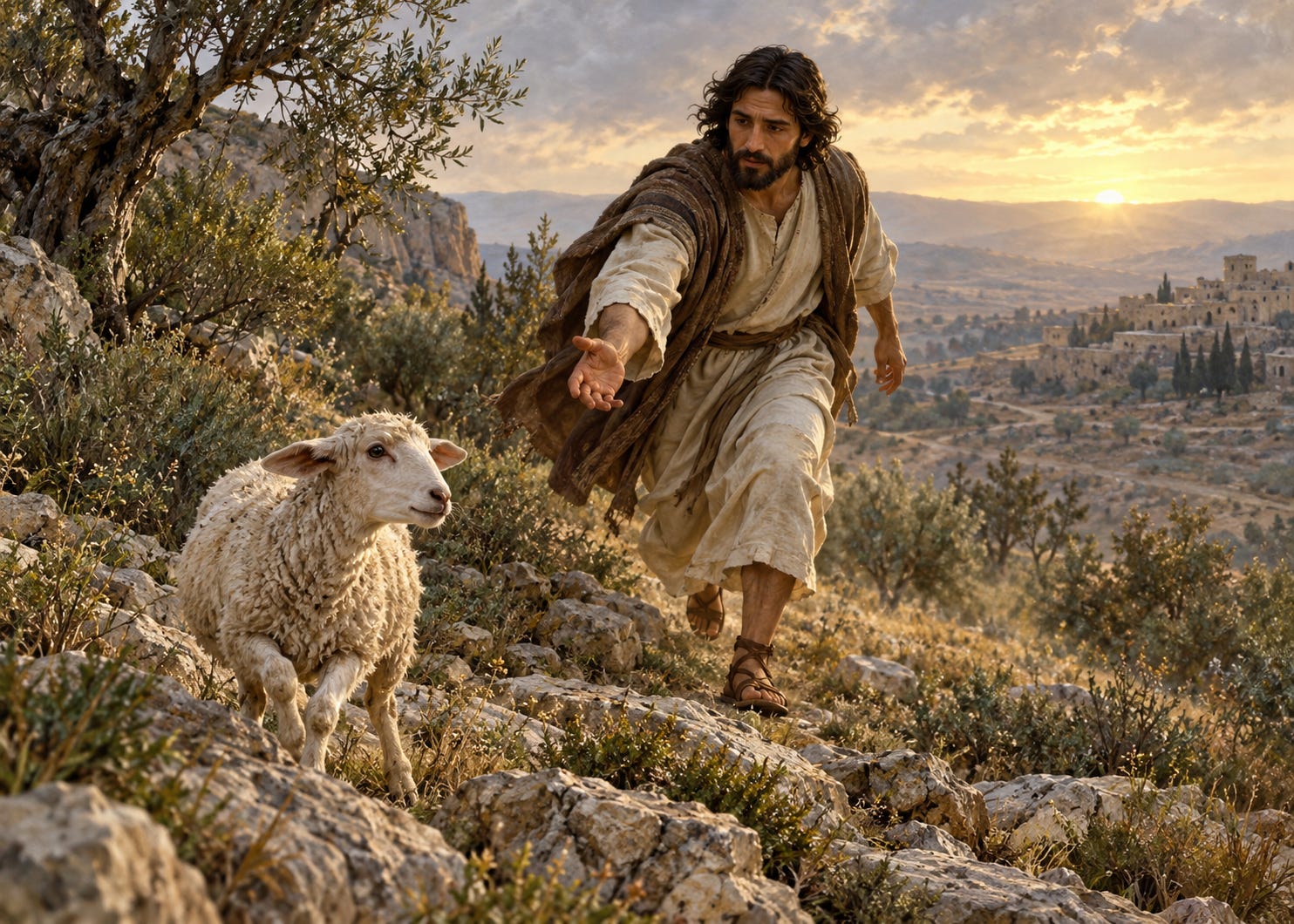
In a previous parish office, I had a beautiful watercolor of the Good Shepherd on the wall. It was pastoral and calming, the sort of image you were glad to have nearby. Lately, I’ve been eyeing a different one for my office here in New York: a frightened sheep, with Christ running toward it.
Father’s taste in pastoral art has developed a certain urgency, or so it would seem.
I love it, though. There is something about that image that feels very close to where I am in ministry right now, and the Gospel we’re exploring today has helped me understand why. I think you’re going to love where this story takes us.
Before we begin, I also want to tell you about something I sent our paid subscribers yesterday evening: a reflection on the life and miracles of Padre Pio, offered as a thank-you for helping carry this ministry. The likes, comments, and shares have been wonderful. One reader put it simply: “Oh, this was very enjoyable, thank you!”
I would love for you to read it, and I’m asking you to consider becoming a supporting member so you can.
I don’t particularly enjoy putting good work behind a paywall, but I promised you honesty, and Message From the Margins needs more readers to help carry its expenses. I’ve been involved in financially unstable ministries before. I know what that uncertainty does to the quality of the work and to the person trying to keep it going. I want us to build something dependable here, with the resources to nourish you well and bring this Gospel to more people who need to hear it.
Supporting members will receive more bonus pieces going forward, beginning with this visit with a rather extraordinary saint. Your subscription also helps keep the main work of this ministry available to readers who cannot afford to pay.
If you have room in your budget, please become a supporting member today. If money is tight, please receive today’s essay without guilt, and know that your reading, prayers, comments, and sharing are gifts to this community too.
Now, let’s spend some time with a man whose encounter with Jesus becomes far more complicated than he could possibly have expected.
Your Brother in Christ,

Have You Ever Noticed What Comes Before the Good Shepherd?
A man is healed, questioned, and thrown out. Then Jesus finds him. Reading John 9 and 10 together brings a familiar promise into focus.
When you hear Jesus call Himself the Good Shepherd, what comes to mind? I tend to see the picture that has accompanied so many of us through our lives: Jesus with a lamb resting across His shoulders, the animal looking quite content with its arrangements. It is a lovely image, and if you have ever needed to believe that someone would come looking for you when you could no longer find your own way home, there is nothing sentimental about needing it.
But I wonder whether we would picture that shepherd differently if we remembered what had happened just before He began speaking. There is a man in this story who has recently been given his sight, and by the time Jesus talks about sheep and shepherds, the people questioning him have made his life rather frightening. They have summoned his parents and challenged his honesty publicly, eventually insulting him and throwing him out, while he is still trying to understand what has happened to him and who the man who healed him might be.
I would like us to spend some time with him before we decide we know what a Good Shepherd looks like. Here is where the two stories meet. Notice the chapter break when you read it, because that little number has done a remarkable job of helping us forget that they belong together.
John 9:34–10:6 · NRSV
34 They answered him, “You were born entirely in sins, and are you trying to teach us?” And they drove him out.
35 Jesus heard that they had driven him out, and when he found him, he said, “Do you believe in the Son of Man?” 36 He answered, “And who is he, sir? Tell me, so that I may believe in him.” 37 Jesus said to him, “You have seen him, and the one speaking with you is he.” 38 He said, “Lord, I believe.” And he worshiped him.
39 Jesus said, “I came into this world for judgment so that those who do not see may see, and those who do see may become blind.” 40 Some of the Pharisees near him heard this and said to him, “Surely we are not blind, are we?” 41 Jesus said to them, “If you were blind, you would not have sin. But now that you say, ‘We see,’ your sin remains.
Chapter 10
1 “Very truly, I tell you, anyone who does not enter the sheepfold by the gate but climbs in by another way is a thief and a bandit. 2 The one who enters by the gate is the shepherd of the sheep. 3 The gatekeeper opens the gate for him, and the sheep hear his voice. He calls his own sheep by name and leads them out. 4 When he has brought out all his own, he goes ahead of them, and the sheep follow him because they know his voice. 5 They will not follow a stranger, but they will run from him because they do not know the voice of strangers.” 6 Jesus used this figure of speech with them, but they did not understand what he was saying to them.
There is no indication that Jesus has left this encounter to deliver a pleasant talk about country life out in the pastures. Some of the Pharisees have just asked whether He thinks they are blind, and His answer continues into the next chapter. The chapter divisions are later aids to finding our way through Scripture, useful things until we mistake them for instructions to stop thinking about what we have just read. Farther along, in John 10:21, people are still arguing about the opening of this man’s eyes.
That changes the question I bring to the passage. I still want to know what Jesus means by a good shepherd, but now I also want to know why He is saying it here, with this man’s expulsion still hanging over the conversation. The answer will require us to go back and meet him, which is one of the pleasures of reading Scripture carefully: sometimes a passage opens up because we have finally allowed the people in the previous paragraph to come with us.
Here at Message From the Margins, I also want us to make room for the kind of prayer Ignatius of Loyola encourages, in which we enter a Gospel scene imaginatively and spend time with the people there. John cannot tell us everything this man felt, and we should not pretend our imaginings fill in missing facts. But we can wonder what it would be like to stand beside him, or to find ourselves in his place, and see what happens to our reading when his life begins to matter to us.
Jesus sees a man who has been blind from birth. His disciples have a question about him.
John 9:1–7 · NRSV
1 As he walked along, he saw a man blind from birth. 2 His disciples asked him, “Rabbi, who sinned, this man or his parents, that he was born blind?” 3 Jesus answered, “Neither this man nor his parents sinned; he was born blind so that God’s works might be revealed in him. 4 We must work the works of him who sent me while it is day; night is coming when no one can work. 5 As long as I am in the world, I am the light of the world.” 6 When he had said this, he spat on the ground and made mud with the saliva and spread the mud on the man’s eyes, 7 saying to him, “Go, wash in the pool of Siloam” (which means Sent). Then he went and washed and came back able to see.
They want to know whose sin caused his blindness, his own or his parents’. Those are the only choices they give Jesus. Before anyone has spoken to the man, the disciples have already decided that his life requires an explanation involving somebody’s guilt.
It is an uncomfortable conversation to overhear, especially when we remember whose disciples these are. They are following Jesus, learning from Him, and see nothing troubling about asking Him to settle the question on those terms. They expect Him to know who is responsible.
I wish that way of thinking were less familiar. When we hear that someone is seriously ill, how quickly do we start asking about their habits? Sometimes we need that information because we are trying to help. But we can also find ourselves listening for a detail that reassures us: they smoked, they waited too long to see a doctor, they ignored the advice. We would have done things differently. Perhaps we can keep this from happening to us.
The disciples ask about sin, and our explanations may sound more medically informed, but we should recognize the temptation to make another person’s suffering evidence that we know how to stay safe. We can be sincerely concerned about them and still be doing that.
As a priest, I also have to reckon with the pressure to produce a religious answer. Someone asks why this happened to their child, and I am supposed to have something to say. I have the vocabulary. I can talk about providence and purpose. What requires more care is recognizing when those words would serve my need to give an answer better than they would serve the person asking.
Jesus’ answer may leave us uneasy: was this man born blind so God could make a point? Anyone who has suffered, or loved someone they could not protect from suffering, deserves more than a breezy assurance that everything happens for a reason. The Greek gives us reason to pause: the clause says “so that the works of God might be revealed in him,” without repeating “he was born blind,” words some English translations supply. Supplying them is grammatically defensible, but some interpreters connect that purpose instead to what follows: the work Jesus says they must do. That possibility does not settle the mystery of suffering, and we should hesitate before turning this encounter into an explanation for everyone’s pain. What we can follow is Jesus’ response: he rejects the blame assigned to this man and his parents, then calls his disciples into the work of God before them. We may still ache to know why suffering exists; here, Jesus gives us work to do in its presence.
Jesus makes mud, puts it on the man’s eyes, and sends him to wash in the pool of Siloam. He goes, washes, and comes back able to see. John tells this with remarkable economy. The healing is complete by verse seven; most of the chapter concerns the arguments that follow.
Those arguments will eventually bring us back to the disciples’ question. Near the end, the people interrogating the man will accuse him of having been born entirely in sins. They will use the explanation Jesus has already rejected to dismiss what the man is telling them.
Reading the beginning alongside that later exchange is one way to practice the hermeneutical circle: we let the whole story affect how we understand its individual parts, then read the story again with what those details have taught us. Here, the repeated assumption prevents us from dividing the cast comfortably into enlightened disciples and ignorant opponents. Jesus’ followers need correction before anyone else begins questioning the man.
He, meanwhile, has returned from the pool to people who remember him as a beggar. Some recognize him. Others insist he only looks like the man they knew. While they debate whether he can possibly be himself, he keeps telling them that he is.
John 9:8–23 · NRSV
8 The neighbors and those who had seen him before as a beggar began to ask, “Is this not the man who used to sit and beg?” 9 Some were saying, “It is he.” Others were saying, “No, but it is someone like him.” He kept saying, “I am the man.” 10 But they kept asking him, “Then how were your eyes opened?” 11 He answered, “The man called Jesus made mud, spread it on my eyes, and said to me, ‘Go to Siloam and wash.’ Then I went and washed and received my sight.” 12 They said to him, “Where is he?” He said, “I do not know.”
13 They brought to the Pharisees the man who had formerly been blind. 14 Now it was a sabbath day when Jesus made the mud and opened his eyes. 15 Then the Pharisees also began to ask him how he had received his sight. He said to them, “He put mud on my eyes. Then I washed, and now I see.” 16 Some of the Pharisees said, “This man is not from God, for he does not observe the sabbath.” But others said, “How can a man who is a sinner perform such signs?” And they were divided. 17 So they said again to the blind man, “What do you say about him? It was your eyes he opened.” He said, “He is a prophet.”
18 The Jews did not believe that he had been blind and had received his sight until they called the parents of the man who had received his sight 19 and asked them, “Is this your son, who you say was born blind? How then does he now see?” 20 His parents answered, “We know that this is our son, and that he was born blind; 21 but we do not know how it is that now he sees, nor do we know who opened his eyes. Ask him; he is of age. He will speak for himself.” 22 His parents said this because they were afraid of the Jews; for the Jews had already agreed that anyone who confessed Jesus to be the Messiah would be put out of the synagogue. 23 Therefore his parents said, “He is of age; ask him.”
It is also our first glimpse of how much adjustment his healing asks of everyone else. They know where he belongs in the picture because they have seen him there before. Now he is standing in front of them, and the familiar picture needs revising. We can recognize that difficulty without assuming the neighbors mean him harm. People do sometimes need time to believe good news, especially when it comes wearing a face they thought they already understood.
They bring him to the Pharisees, and we learn that Jesus made the mud and opened his eyes on the Sabbath. The Pharisees themselves disagree about what this means. Some say Jesus cannot be from God because He does not observe the Sabbath; others ask how a sinner could perform signs like these. That disagreement matters. If we turn everybody in the room into the same villain, we will have made the story easier to tell by becoming less faithful to it.
Nor is the Sabbath some absurd obstacle that enlightened people should have discarded. In Deuteronomy, its rest is bound to Israel’s memory of slavery and God’s deliverance, and extends to servants as well as those with power over them. There is mercy in the commandment. The dispute is taking place among Jews about faithfulness to the God of Israel, and Jesus, His disciples, and the man whose sight has been restored all belong within that world. I want to remember this when the argument grows ugly, because Christian readers have done terrible things with stories we first persuaded ourselves were only about somebody else’s failures.
When they ask the man what he thinks of Jesus, he calls Him a prophet. He has begun to make sense of the encounter, but he is still a long way from understanding everything we bring to it. Earlier he could give the name of the man who healed him; when asked where Jesus was, he said he did not know. I rather like that he can tell the truth about both things. He knows what happened to him, and he knows there are questions he cannot yet answer.
By the time his parents are summoned, I am hoping they can help him. He has explained what happened, answered questions about the man who healed him, and listened while people disputed whether he could possibly be the person they remember. Now someone has decided to check whether he was ever blind in the first place. His parents, at least, can settle that.
Put yourself in his situation for a moment. Something has happened to you that you are still trying to comprehend, and instead of having time to absorb it, you have been asked to defend it. Then the people who have known you all your life are called in. I think I would be relieved. Surely they can tell everyone that I have not made this up. Perhaps once they answer, somebody will finally let me enjoy being able to see.
They confirm that he is their son and that he was born blind, but when it comes to explaining the healing, they direct the questioners back to him. He is old enough to speak for himself.
Oh, I wish we knew how he heard that answer.
John tells us why they are so careful: they are afraid of being put out of the synagogue if they acknowledge Jesus as Messiah. We need to appreciate what that could mean before we decide they should have been braver. Their place among their own people is at stake, in a community where religious belonging and ordinary social life are closely connected. This is the sort of fear that makes you choose each word while wondering who will repeat it afterward.
I can understand them. But if I step back into their son’s place, understanding may do very little to ease the hurt. I might still be thinking, Please, help me here. You know me.
Some of you will know that feeling without having to imagine very much. You understood why someone was afraid to stand beside you, perhaps even told yourself you would have been afraid too, and still wished they had found a way to do it. Love does not make those situations simple. Neither does fear necessarily mean that love has disappeared.
We have no reason to decide these parents stopped loving their son or refused to take him home. What we have is their cautious answer, followed by another summons for him. Whatever he might have hoped their testimony would accomplish, the questioning is continuing.
John 9:24–34 · NRSV
24 So for the second time they called the man who had been blind, and they said to him, “Give glory to God! We know that this man is a sinner.” 25 He answered, “I do not know whether he is a sinner. One thing I do know, that though I was blind, now I see.” 26 They said to him, “What did he do to you? How did he open your eyes?” 27 He answered them, “I have told you already, and you would not listen. Why do you want to hear it again? Do you also want to become his disciples?”
28 Then they reviled him, saying, “You are his disciple, but we are disciples of Moses. 29 We know that God has spoken to Moses, but as for this man, we do not know where he comes from.”
30 The man answered, “Here is an astonishing thing! You do not know where he comes from, and yet he opened my eyes. 31 We know that God does not listen to sinners, but he does listen to one who worships him and obeys his will. 32 Never since the world began has it been heard that anyone opened the eyes of a person born blind. 33 If this man were not from God, he could do nothing.”
34 They answered him, “You were born entirely in sins, and are you trying to teach us?” And they drove him out.
This time, his interrogators begin by telling him to give glory to God, because they know Jesus is a sinner.
I keep wondering what answer could possibly get him safely through this. He has already called Jesus a prophet, and the one thing he can testify to is that Jesus opened his eyes. Now he is being pressed to agree that the person who did this for him stands condemned by people with authority in his community. We read the story knowing about Easter; he is still trying to understand who Jesus is. He has no reassuring glimpse of the last page.
I think I would be sick with fear.
His answer is careful. Whether Jesus is a sinner, he does not know; what he knows is that he was blind and now can see. When they ask him yet again how it happened, however, his patience begins to sound a little less abundant. He has already told them. They did not listen. Why do they want to hear it again? Do they want to become Jesus’ disciples too?
Now, I know something about making jokes in awful situations. Sometimes I can hear how absurd a conversation has become even while I am worried about where it is going, and my mouth contributes something that the more prudent members of the gathering might have preferred I keep to myself. I wonder whether there is something of that here. Perhaps he is frightened. Perhaps he is simply fed up. Either way, I hear his question and feel affection for him, along with an urgent desire to know how these people are going to take it.
Badly, as it happens. They answer with abuse, declaring themselves disciples of Moses and leaving him to be Jesus’ disciple if that is what he wants. They know God spoke to Moses; where Jesus comes from, they insist, they do not know.
And this man, whom we first met as the subject of somebody else’s theological question, begins reasoning with them about God. They cannot account for Jesus, yet Jesus has opened his eyes. How, he asks, could someone have done that without being from God?
I want to give him credit for that courage without assuming it came easily. A person can make the joke, offer the argument, and still be hoping desperately that somebody will listen.
Their answer is that he was born entirely in sins, and how dare he presume to teach them. Jesus has already refused the premise, but it remains useful to anyone who would rather discuss what is wrong with this man than receive what he has to say.
Then they throw him out.
Read with modern American assumptions, that can sound like a man leaving a religious building and deciding to attend somewhere else next week. He might even find better coffee. But the world of this story does not divide neatly into a religious life over here and an otherwise unaffected social life over there. The threat that frightened his parents concerned belonging among their own people. Read alongside that threat, his expulsion is much harder to reduce to an unpleasant meeting that has finally ended.
We are left to wonder how this man is supposed to walk away without worrying about his future that now contains a whole new set of problems. Who will stand beside him now? Will neighbors who knew him as a beggar receive him differently after this confrontation? Being able to see does not come with a trade, an income, or an assurance that the people whose help you have needed will still want to be seen helping you.
He has received an extraordinary gift, and telling the truth about it has brought him into conflict with people who can affect his place in the community. I would love to tell him that courage always feels like freedom. I suspect there are moments when it feels more like wondering what on earth you are going to do when you get home.
And it is here that Jesus finds him.
Go back to the passage at the beginning of this essay and notice the order. Jesus hears that they have thrown the man out, then finds him and asks whether he believes in the Son of Man. The man is willing, but needs to know who that is. Even now, after everything he has said in Jesus’ defense, there is room for a question.
I find that exchange tender in a way I might miss if I hurried toward the declaration of faith. Jesus meets him with more to reveal, and the man does not have to pretend he has already understood it. When Jesus tells him that he has seen this person and is speaking with Him, he believes and worships. The One whose whereabouts he could not give his neighbors has come to him, and the man who began by knowing what had happened to his eyes is coming to know the One who opened them.
Some of you know how different a frightening situation becomes when someone comes looking for you, even though the situation itself remains unresolved. I think of that here, where we are given no account of how the man’s practical difficulties were settled, but are told that Jesus heard what had happened and found him. Before Jesus explains what a shepherd does, we have been allowed to watch Him do it.
There is a small Greek detail that makes me want to read the two chapters together all over again. The verb John uses when they throw the man out, ekballō, appears again in John 10:4, where the shepherd brings his own sheep out and goes ahead of them. Context gives the verb a different force in each scene, but hearing it again so soon invites us to hold the actions beside each other: a man has been put outside, and now Jesus is speaking about sheep being brought out by someone who goes ahead of them and leads the way.
I wonder what “outside” sounds like after that. For the man, it may carry everything he has reason to fear. In Jesus’ account, it can also be where the shepherd is going ahead of his flock. We should be cautious about turning every rejection into proof that God has endorsed us, but this story does challenge the assumption that being inside the recognized enclosure always means being safe, or that those who put you out have the final word about where you belong.
There is an older voice beneath Jesus’ words, and hearing it makes His decision to find this man still more remarkable.
Ezekiel 34:1–24 · World English Bible Classic
1 Yahweh’s word came to me, saying, 2 “Son of man, prophesy against the shepherds of Israel. Prophesy, and tell them, even the shepherds, ‘The Lord Yahweh says: “Woe to the shepherds of Israel who feed themselves! Shouldn’t the shepherds feed the sheep? 3 You eat the fat. You clothe yourself with the wool. You kill the fatlings, but you don’t feed the sheep. 4 You haven’t strengthened the diseased. You haven’t healed that which was sick. You haven’t bound up that which was broken. You haven’t brought back that which was driven away. You haven’t sought that which was lost, but you have ruled over them with force and with rigor. 5 They were scattered, because there was no shepherd. They became food to all the animals of the field, and were scattered. 6 My sheep wandered through all the mountains and on every high hill. Yes, my sheep were scattered on all the surface of the earth. There was no one who searched or sought.”
7 “ ‘Therefore, you shepherds, hear Yahweh’s word: 8 “As I live,” says the Lord Yahweh, “surely because my sheep became a prey, and my sheep became food to all the animals of the field, because there was no shepherd, and my shepherds didn’t search for my sheep, but the shepherds fed themselves, and didn’t feed my sheep, 9 therefore, you shepherds, hear Yahweh’s word!” 10 The Lord Yahweh says: “Behold, I am against the shepherds. I will require my sheep at their hand, and cause them to cease from feeding the sheep. The shepherds won’t feed themselves any more. I will deliver my sheep from their mouth, that they may not be food for them.”
11 “ ‘For the Lord Yahweh says: “Behold, I myself, even I, will search for my sheep, and will seek them out. 12 As a shepherd seeks out his flock in the day that he is among his sheep that are scattered abroad, so I will seek out my sheep. I will deliver them out of all places where they have been scattered in the cloudy and dark day. 13 I will bring them out from the peoples, and gather them from the countries, and will bring them into their own land. I will feed them on the mountains of Israel, by the watercourses, and in all the inhabited places of the country. 14 I will feed them with good pasture, and their fold will be on the mountains of the height of Israel. There they will lie down in a good fold. They will feed on rich pasture on the mountains of Israel. 15 I myself will be the shepherd of my sheep, and I will cause them to lie down,” says the Lord Yahweh. 16 “I will seek that which was lost, and will bring back that which was driven away, and will bind up that which was broken, and will strengthen that which was sick; but I will destroy the fat and the strong. I will feed them in justice.” ’
17 “As for you, O my flock, the Lord Yahweh says: ‘Behold, I judge between sheep and sheep, the rams and the male goats. 18 Does it seem a small thing to you to have fed on the good pasture, but you must tread down with your feet the residue of your pasture? And to have drunk of the clear waters, but must you foul the residue with your feet? 19 As for my sheep, they eat that which you have trodden with your feet, and they drink that which you have fouled with your feet.’
20 “Therefore the Lord Yahweh says to them: ‘Behold, I, even I, will judge between the fat sheep and the lean sheep. 21 Because you thrust with side and with shoulder, and push all the diseased with your horns, until you have scattered them abroad, 22 therefore I will save my flock, and they will no more be a prey. I will judge between sheep and sheep.
23 I will set up one shepherd over them, and he will feed them, even my servant David. He will feed them, and he will be their shepherd. 24 I, Yahweh, will be their God, and my servant David prince among them. I, Yahweh, have spoken it.
Ezekiel addresses the shepherds of Israel, leaders who have fed themselves while failing the people entrusted to them. The weak have not been strengthened, the sick have not been healed, and those scattered from the flock have not been sought. If you have ever wondered whether God notices what happens to people under religious leadership, this is an uncomfortable chapter for those of us who exercise it. God has quite a detailed account.
One Hebrew word is especially worth our attention. In verse 4, the person the shepherds have failed to bring back is described as hanniddaḥat, someone driven away or scattered. Depending on the English translation, we may picture a stray, which can suggest an animal that simply wandered off. The Hebrew invites us to leave room for another story. The missing member of the flock may have been driven away.
The word alone does not tell us who did the driving, but Ezekiel will not let us avoid that question for long. Later in the chapter, God addresses the strong animals that push with flank and shoulder and thrust at the weak with their horns until they are scattered abroad. There are members of the flock who make it difficult for others to remain. Even the pasture and water can be spoiled by those who have already had their fill, leaving the rest to manage with what they have trampled and muddied.
I think of how readily a congregation can talk about the people who stopped coming. We may know their names and the date we last saw them, yet have very little curiosity about what being among us was like for them. Ezekiel gives us a reason to ask, and for those of us who have been hurt by a church, he offers the unsettling reminder that we can carry our own horns into the next one. Being wounded has never guaranteed that I will be gentle with everybody else.
Then God announces that He Himself will search for His sheep and care for them. The promise has an emphasis that is easy to feel even without knowing Hebrew: God is taking personal responsibility for finding those whom the shepherds have failed. Ezekiel also speaks of one shepherd, God’s servant David, who will feed them. The chapter holds together God’s own rescue and the hope of a Davidic shepherd through whom His people will be cared for.
With that promise in our ears, we return to the man in John and discover that Jesus has already begun to do what Ezekiel said God would do. He has heard about the expulsion and found the person driven out, before telling those around Him that He is the Good Shepherd.
We have moved from a detail in one encounter to the wider world of Israel’s Scriptures, and the return journey changes what we hear. Jesus’ words carry the force of God’s promise to come for His people, as well as the warning directed at shepherds who fail them. His care for this man becomes a revelation of who He is, and the scene we have been watching begins to look like the arrival of the rescue Ezekiel promised.
And this is the encounter our man has walked into, without any opportunity to prepare for it: what happens when God comes among His people, and the people charged with guarding their life together cannot agree about what they are seeing? He has had to answer questions about a gift he can scarcely have finished absorbing, while the identity of the One who gave it is being contested around him. I can admire his answers more honestly when I remember how little protection his courage offers him.
It is a relief to come back to that meeting with Jesus and remember that he has not been left to carry all of this by himself.
Which Gospel story have you always wanted to understand?
I’m building A Walk With Jesus of Nazareth, and I’d love to hear your questions. Join the Founding Community for a look at the work in progress and a chance to help shape the First Walk before we begin.
John 10:7–21 · World English Bible Classic
7 Jesus therefore said to them again, “Most certainly, I tell you, I am the sheep’s door. 8 All who came before me are thieves and robbers, but the sheep didn’t listen to them. 9 I am the door. If anyone enters in by me, he will be saved, and will go in and go out and will find pasture. 10 The thief only comes to steal, kill, and destroy. I came that they may have life, and may have it abundantly.
11 “I am the good shepherd. The good shepherd lays down his life for the sheep. 12 He who is a hired hand, and not a shepherd, who doesn’t own the sheep, sees the wolf coming, leaves the sheep, and flees. The wolf snatches the sheep and scatters them. 13 The hired hand flees because he is a hired hand and doesn’t care for the sheep.
14 I am the good shepherd. I know my own, and I’m known by my own; 15 even as the Father knows me, and I know the Father. I lay down my life for the sheep. 16 I have other sheep which are not of this fold. I must bring them also, and they will hear my voice. They will become one flock with one shepherd.
17 Therefore the Father loves me, because I lay down my life, that I may take it again. 18 No one takes it away from me, but I lay it down by myself. I have power to lay it down, and I have power to take it again. I received this commandment from my Father.”
19 Therefore a division arose again among the Jews because of these words. 20 Many of them said, “He has a demon and is insane! Why do you listen to him?” 21 Others said, “These are not the sayings of one possessed by a demon. It isn’t possible for a demon to open the eyes of the blind, is it?”
Jesus also calls Himself the gate through which the sheep enter, and the life He describes allows them to go in and out and find pasture. I like to stay with that for a while after the interrogation, because so much of the man’s encounter with authority has required him to answer the same questions again. The shepherd’s care includes room to live, nourishment to seek, and a voice the sheep come to know.
When Jesus speaks of having other sheep who do not belong to this fold, there is another detail English can obscure. The word for fold or enclosure is aulē; the word for flock is poimnē. His promise is of one flock with one shepherd. The unity He describes gathers around Him, and the distinction should make us careful about assuming that the limits of our own familiar enclosure exhaust the reach of His care.
I notice, too, that He says He has these other sheep. They do not first become His when the people already inside become comfortable with them. I am not sure I would have enjoyed hearing that if I had spent years confidently maintaining the guest list, although I would probably have found a more theological way of expressing my displeasure.
For a priest, that is a useful place to remain in prayer. I can speak warmly about welcome and still have a fairly specific person in mind when I imagine the sort of newcomer who would improve the congregation. The actual person may bring questions I cannot settle, needs that inconvenience me, or a way of telling the truth that makes the meeting rather harder to manage. I need this Gospel to reach that version of me, the one who sincerely wants to care for people and would also appreciate their cooperation in making it easier.
This is part of what interpreters mean by a fusion of horizons: the ancient text and the world we inhabit come into conversation. We have to let each retain its particularity. A modern parish disagreement is not automatically the expulsion in John 9, and I do not get to assign myself Jesus’ part because I feel strongly about it. But the story can teach me to ask better questions about the authority I exercise and the belonging I offer. Whose account do I keep asking to hear because I genuinely need to understand, and whose account do I keep asking to hear because I dislike the answer?
Jesus gives us a demanding way to recognize His care when He speaks about the wolf. The hired worker flees because the sheep are not his own; the Good Shepherd lays down His life for them. Anyone can sound solicitous while the pasture is quiet, but when danger arrives, the sheep discover whether the person responsible for them intends to remain. After what we have watched happen to this man, I find myself listening for the answer with rather more urgency.
By now, I hope the man in John 9 has made that question difficult for us to keep abstract. We have watched the pressure move toward him, watched his parents take care with their answers, and heard the insult with which the questioning ends. Jesus speaks into that story about a shepherd who accepts the cost of protecting His sheep, and the Gospel will carry those words toward the cross. He will give His life freely and take it up again. The hope He offers reaches beyond the courage of someone willing to stand beside us, into the death and risen life of the One who can keep us as His own.
I need to hear that before this becomes an essay about how much braver everybody ought to be. Some of us recognize the parents’ fear more readily than the son’s wit. Some of us remember a moment when we managed to protect ourselves and have been ashamed of the price somebody else paid ever since. There is another scene in John’s Gospel I would like to bring into the room before we finish.
John 21:15–17 · World English Bible Classic
15 So when they had eaten their breakfast, Jesus said to Simon Peter, “Simon, son of Jonah, do you love me more than these?” He said to him, “Yes, Lord; you know that I have affection for you.” He said to him, “Feed my lambs.”
16 He said to him again a second time, “Simon, son of Jonah, do you love me?” He said to him, “Yes, Lord; you know that I have affection for you.” He said to him, “Tend my sheep.”
17 He said to him the third time, “Simon, son of Jonah, do you have affection for me?” Peter was grieved because he asked him the third time, “Do you have affection for me?” He said to him, “Lord, you know everything. You know that I have affection for you.” Jesus said to him, “Feed my sheep.”
Peter has denied knowing Jesus. After the resurrection, he finds himself at a meal Jesus has provided, with bread and fish beside a charcoal fire. Then come the questions about love and the repeated charge to feed and tend Jesus’ sheep.
I find hope in the order of that encounter, too. Peter’s failure is real, and Jesus does not pretend there is nothing to address. Yet the risen Lord has already made room for him at breakfast. The conversation about the care of others takes place within the care Peter himself is receiving, which seems to me a merciful place from which to learn how to be a shepherd.
And the sheep remain Jesus’ sheep. They are not given to Peter as possessions with which to secure his importance or proof that his judgment will never need correcting. He is entrusted with people loved by the One he failed and who has come to him again. As a priest, I cannot imagine a more necessary memory to bring to ministry than that: I am being asked to care for people who belong to Christ, while depending on a mercy I have needed myself.
Perhaps that is also a place for us to pray if we have recognized ourselves somewhere uncomfortable in this story. We can ask to notice the person whose account we have dismissed, or for the courage to stand beside someone when we would rather answer cautiously and go home. We may need to apologize, listen without defending ourselves, or accept that repairing harm will take longer than admitting it. Christ’s mercy gives us somewhere to begin that work without requiring us to pretend we have never needed it.
But I want to come back, finally, to the man Jesus found. After so much discussion of what his story asks of the Church, he deserves to remain a person whom Christ loves, rather than becoming an instrument for improving the rest of us. John does not tell us how his next meal went, what his parents said when they saw him again, or how he made his way afterward. I still wonder about those things. Spending time with him has made it harder to feel that the story is finished simply because the theological questions have become clearer.
What we are given is his meeting with Jesus, his growing recognition, and the faith with which he responds. He has been found by Someone who knows more about him than the accusation that sent him out, and whose care will not end at the point where belonging becomes costly. When I return to the familiar picture of the shepherd carrying a lamb, I bring this man with me now. The tenderness of the image has acquired the weight of everything that made it necessary.
There is one more use of that Greek verb, ekballō, that I want to leave with you. Earlier, in John 6:37, Jesus promises that He will never cast out the one who comes to Him. After following this man through the questioning and out the door, I hear that promise with a gratitude I might otherwise have hurried past.
Perhaps you come to it carrying an experience of rejection. Perhaps you are tired of being asked to explain a wound to people who have already decided what it means, or you are still waiting for someone you love to find the courage to stand with you. Your story may also include suffering that has not been healed, and I would not ask you to manufacture a happy ending in order to approach Christ. The man in this Gospel is allowed to come with questions. So are we.
I think I would like to sit with him there for a little while, in the company of the One who found him, and let my own prayer be as unfinished as it needs to be.
Lord, You know what I am afraid to lose, and what I have already lost. You know whom I have failed, and the places where I do not know how to begin again. Help me hear Your voice among all the voices telling me who I am, and teach me to trust that when I come to You, You will receive me.
Before the First Walk begins, come inside the workshop.
Our thirty-day Walk with Jesus begins November 29. Before then, I’m sharing pieces as I build them and asking what you’d like us to explore. Come help bring the Gospel into conversation with the life you’re actually living.
And Now It’s Your Turn
Which part of the man’s story did you find yourself lingering over, and what did you notice when you read it alongside Jesus’ words about the shepherd? I’d love to hear what opened up for you. There’s no need to share a painful experience publicly to join the conversation.
If someone you know has struggled to believe that Christ still wants them after a painful experience of church, consider sending this essay along with a personal note.
If reading Scripture this way helps you return to a passage with fresh curiosity, I hope you’ll consider helping me keep this work going. We still need more supporting readers to meet the publication’s expenses and give the ministry a dependable future. A paid subscription helps make room for careful research, sustained writing, and the bonus reflections I’m preparing for our supporting members.
If you’re able, please become a supporting member today. And however you participate here, thank you for your company. When you read closely, offer a thoughtful comment, pray for this work, or pass it along to someone who might need it, you help this community grow.
With affection and gratitude,
Father Rich.