

Good morning, my dear friends!
Today’s reflection grew out of a sentence I could not stop turning over: to walk with Christ is not to be perfect; it is to commit ourselves to moving toward sainthood. Too many good people have been taught to confuse holiness with never struggling. Eventually, they either learn to perform a spotless version of themselves or conclude that they have failed at being Christian altogether. Scripture gives us a much more human, demanding, and hopeful way to understand the road.
Before we begin, I also want to thank you. In a little over two weeks, this community has moved Message From the Margins from 2 percent paid support to the very edge of 3 percent. That has given me real hope that we can build a ministry able to endure for years and decades. Our goal remains 10 percent, which would give us the working capital to improve the podcast and everything surrounding it, remain independent of intrusive advertising and other nonsense, and carry a Gospel so often distorted by Christian nationalism much farther.
Nearly everything here will remain free because I will not put the Gospel behind a paywall. If you have room to become a paid subscriber, I would be deeply grateful. If money is tight, please receive this without a trace of guilt. Your reading, prayer, comments, and sharing are real contributions to this work.
If you’re able to do your part in supporting our ministry, I hope you will today.
One in ten. That’s not a lot to ask, and reaching it would change what we are able to build together… and would make a considerable difference in Father’s ability to sleep at night.
Before the Marble Statues, There Was the Road
We have done the saints no favors with all that marble.
The statues are beautiful, of course. I have never been one to complain about a church containing too much beauty. But stone has a way of making holiness look unnervingly tidy. The saints stand above us with composed faces, perfectly arranged robes, and a calm that suggests none of them ever spoke too quickly, lost their temper, questioned God, or spent an evening replaying something foolish they said before lunch.
No sculptor seems interested in carving St. Peter halfway through putting his foot in his mouth.
Over time, that can smuggle a terrible idea into Christian life: saints are a different species of human, holiness belongs to people who have already conquered themselves, and the rest of us are reduced to admirers. We light candles to them, ask their prayers, and begin to conclude that whatever happened in their lives has very little to do with ours.
Scripture offers a far less polished picture.
Paul opens First Corinthians by addressing “those who are sanctified in Christ Jesus, called to be saints” (1 Corinthians 1:2). Then he spends much of the letter dealing with factions, lawsuits, sexual misconduct, status games, and Christians behaving badly at the Eucharist. Corinth had many gifts. Being easy to pastor was not among them.
Still, Paul calls them saints.
He was not saying that their failures were trivial or that they had finished becoming holy. He called them saints because they belonged to Christ and had been summoned into a new way of life. Sainthood was their vocation before it was their achievement. They had been claimed by grace; now they had to learn how to live as people who were claimed.
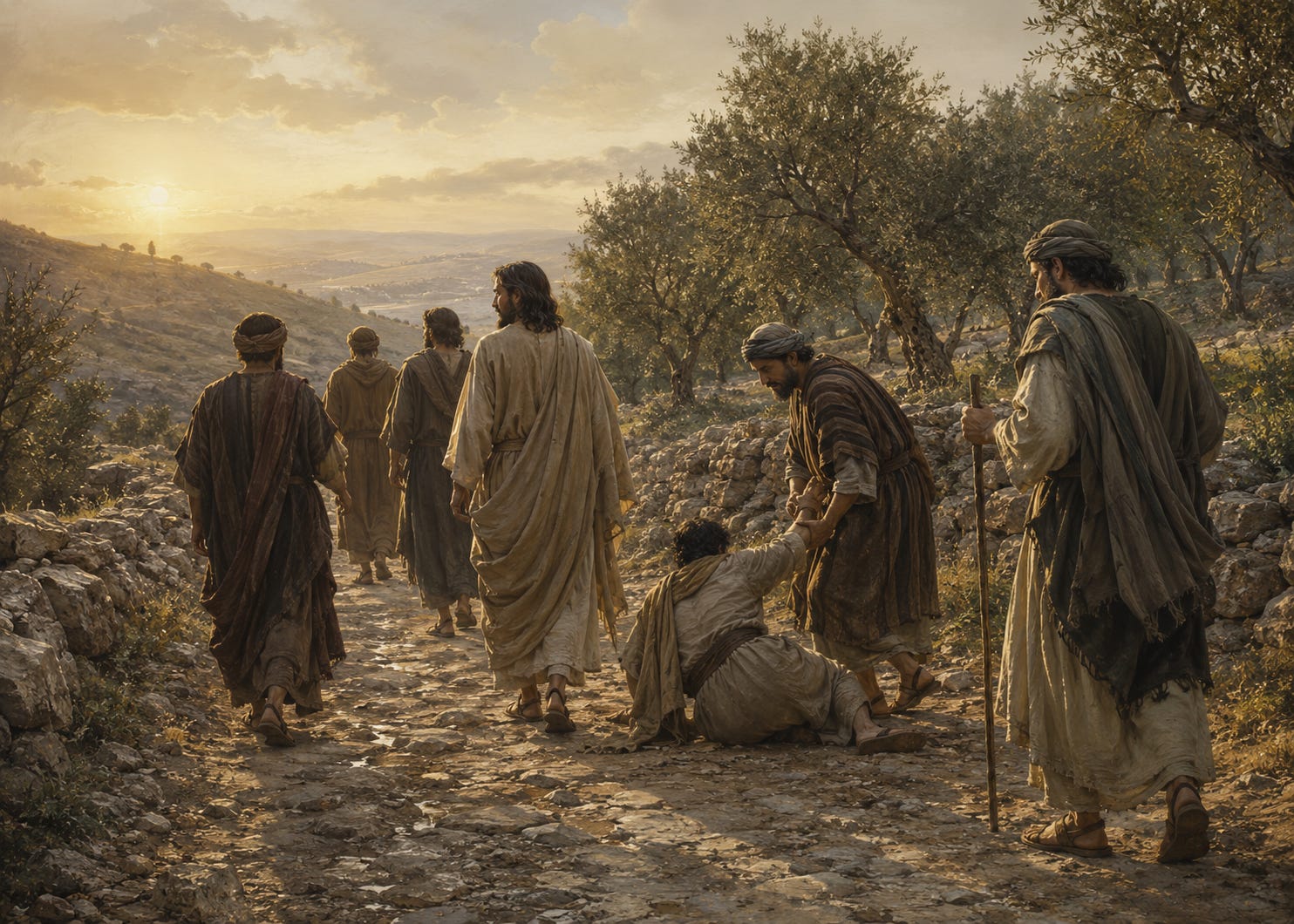
This is what it means to walk with Christ. We do not announce that we have become perfect. We commit ourselves to the direction He is leading.
Jesus’ first words to so many disciples were some form of “Follow Me.” He did not ask them to complete a moral renovation, pass an examination, and return with the paperwork. He called them from boats, roads, and tax tables. Their formation happened as they walked with Him, misunderstood Him, were corrected by Him, failed Him, and discovered that His mercy could still lead them forward.
Peter may be Christianity’s finest advertisement for this arrangement.
He is brave and impulsive, spiritually perceptive and spectacularly wrong, often within a remarkably short span of time. He steps out onto the water and then panics. He correctly confesses Jesus as the Messiah and soon afterward rebukes Him for speaking about the Cross. He promises loyalty at the Last Supper, then denies three times that he even knows Jesus.
After the Resurrection, Jesus does not pretend that the betrayal never happened. Nor does He administer a spiritual exit exam and decide Peter’s final grade. He asks him three times, “Do you love Me?” Then He gives him work to do: “Feed My sheep” (John 21:15–17).
Grace gives Peter both a way home and a responsibility. He must face what he did, receive mercy, and allow that mercy to change the way he lives. This is far more demanding than pretending he never failed; it is also far more hopeful than declaring failure the end of his story.
Paul later writes, “Not that I have already obtained this or have already reached the goal; but I press on” (Philippians 3:12). Those are the words of an apostle, not a new convert nervously finding his seat in church. Christian maturity includes the clear-eyed knowledge that Christ is still forming us.
Perfectionism and holiness can resemble each other from a distance, but they pull the soul in different directions. Perfectionism leaves us preoccupied with our spiritual self-image. We wonder whether we appear devout, whether our failures have disqualified us, and whether anyone might discover that we are still a work in progress.
Holiness turns our attention toward Christ and the person in front of us. What does love require now? Where must I repent? What harm must I repair? What part of my life am I still withholding from God?
Shame freezes us in a verdict. Repentance gives us somewhere to go.
That distinction is deeply important for anyone who was told they had to become acceptable before Christ would welcome them. Some people were handed a spiritual entrance exam with requirements Jesus never wrote. They were expected to become straight enough, certain enough, respectable enough, or sufficiently untroubled before they could imagine themselves walking beside Him.
No disciple arrived fully formed. Jesus met people in the truth of their lives and called them forward from there. He did not demand that they manufacture sainthood before entering His company. His company was where they began learning to become saints.
None of this makes sin harmless. Christ does not call us into motion so that we can spend a lifetime walking in circles around the same excuses. Grace cannot become an alibi for cruelty, dishonesty, contempt, or refusing to repair what we have damaged.
If years of religion make us harder toward vulnerable people, more willing to excuse lies from the powerful, and less able to recognize God in the stranger, our church attendance may be impeccable while our direction is wrong.
Moving toward sainthood often looks remarkably ordinary. It may mean apologizing without attaching a defense, then changing the behavior that made the apology necessary. It may mean bringing a recurring compulsion into confession, counseling, recovery, or trusted accountability instead of promising ourselves that it will eventually disappear. It may mean returning to prayer with five honest minutes when we have nothing impressive to say. It may mean speaking when our silence would protect someone else’s harm.
Sainthood is often constructed from decisions too ordinary for stained glass.
We do not manufacture holiness through clenched-teeth self-improvement. Grace begins the work, accompanies us through it, and brings it to completion. Our part is consent, return, and the next yes. Even the desire to turn back toward God is evidence that grace is already at work within us.
Some days we stride. Some days we limp. Sometimes we discover that we have taken a long and stubborn detour. Every saint had such days. What distinguished them was their willingness to turn when grace revealed the road again.
So tonight, replace the familiar question, “Was I perfect?” with a more useful examination: “When love showed me the next faithful step, did I take it? When I failed, did I return?”
You may not be where you hoped you would be by now. You may still be fighting a battle you assumed would have ended years ago. Christ is not standing at the finish line with crossed arms. He is on the road.
Take the next faithful step. If you stumble, accept the hand He sends and rise.
The marble came later. First came the road.
Next on the podcast: The Stone Which the Builders Rejected
In the next episode of the Message From the Margins podcast, we are leaving institutional history long enough to meet some of the people Scripture places at the margins.
We will enter the story of the woman who had bled for twelve years and consider what it cost her even to enter the crowd before she reached for Jesus. We will travel with the Ethiopian eunuch, whose body and identity placed him beyond familiar religious boundaries. We will also recover several women of the First Testament whose courage and complexity have too often been reduced to a sentence in somebody else’s story.
Together, these lives make a claim many Christians would prefer the Bible did not make: again and again, God places the people rejected by respectable society near the center of salvation history.
We will bring that claim directly into our own cultural hour. When empathy is dismissed as weakness and exclusion is marketed as faithfulness, the Gospel will not cooperate. I believe this may become our most pastoral episode yet, and one of our most urgent.
If you are not already subscribed to the podcast, you can find it everywhere you listen, or begin here:
Closing prayer
Lord Jesus Christ,
You called Your disciples before they understood You, loved them through their failures, and kept teaching them on the road.
Free us from the shame that keeps us hiding and the pride that pretends we have arrived. Give us courage to repent, grace to repair what we have harmed, and patience to begin again. Turn our feet toward mercy, truth, and love. Give us eyes to recognize You in the people this world pushes aside.
When we stumble, help us rise. When we wander, call us home. Keep forming our ordinary lives until they bear the likeness of Your love.
Amen.
And Now It’s Your Turn
When you hear the word sainthood, do you imagine impossible perfection, or a direction for your life? What has helped you keep following Christ after failure, and what does your next faithful step look like now?
I would be grateful to hear your story in the comments.
If someone you love believes their failures have placed them beyond Christ’s reach, please send this reflection to them. They may need a road more than a verdict.
My dear friends, if this ministry has become part of your spiritual life and you have room to help sustain it, I would be grateful if you became a paid subscriber. Every subscription protects the time, independence, and production quality required to keep doing this work well and to keep its heart open to everyone.
If giving is not possible, there is no second class in this community. Your attention, prayer, comments, and shares help carry Message From the Margins farther than you may realize. I am grateful you are here.