

Good morning, friends.
Today is the Memorial of Pope Saint Pius the Tenth, and today’s reflection began as a short explanation of the man and the society that bears his name. Somewhere along the way, it dawned on me that his legacy is one of the clearest descriptions I have found for why Message From the Margins exists. I am grateful to everyone who keeps this community alive through reading, praying, commenting, sharing, and supporting the work financially. The ministry still needs more paid readers to become sustainable. If you have room to subscribe, your support gives me the time to produce thoughtful work while keeping the heart of this ministry open to everyone. If money is tight, please stay without guilt. Your presence here is part of the ministry too.
Your Brother in Christ,
The Society of Saint Pius X I Could Have Founded
One pope, two radically different answers to what the Church’s treasures are for
Over the past several weeks, a handful of people have asked why I have not said anything about the Society of Saint Pius X and the recent excommunications involving it.
The honest answer is that I simply did not want to.
This is not my ecclesial business, I am not convinced that another hot take would nourish anybody’s spiritual life, and much of the coverage has felt like the great Catholic pastime of gossip dressed up in canon law and a Capa Magna. If you follow me, chances are very good that you are not a member of the SSPX. If you are, there is at least a fair possibility that you are only here to pelt me with rotten vegetables. I simply ask that you aim away from the collar. Please and Thank You.
Still, today is the Memorial of Pope Saint Pius X. Rather than rehearse the canonical drama, I thought we might talk about the man whose name everyone keeps invoking. Others, far better educated in canon law and the SSPX’s complicated history, have covered the dispute in detail. I would only be adding noise.
The saint himself, however, is worth knowing.
The Man Before the Initials
Giuseppe Sarto was born into a poor family in northern Italy in 1835. His path to the papacy passed through the ordinary work of parish ministry. He served rural communities, taught catechism, cared for people during a cholera epidemic, and later supported worker cooperatives as a bishop (I suspect a certain corner of American traditionalist Catholicism would begin shouting “socialism” at this juncture, but that is neither here nor there.). Even after becoming Pope Pius X in 1903, he retained the instincts of a parish priest.
He wanted Catholics to understand their faith and receive the Eucharist more frequently. He lowered the customary age of First Communion so children could approach Christ sooner. If you made your First Holy Communion as a small child, thank Saint Pius X. He also fought modernism with tremendous severity, using methods that could encourage suspicion toward scholars and ideas he considered dangerous. Sainthood does not require us to pretend that every administrative instinct came directly from the Holy Spirit’s suggestion box.
Nevertheless, one pastoral conviction runs through his life: the Church had received a treasure, and ordinary people needed access to it. Pius X guarded that treasure. He also preserved it by making certain more people could receive it.
Why the Society Chose Him
Archbishop Marcel Lefebvre founded the Society of Saint Pius X in 1970, amid conflicts surrounding the Second Vatican Council, priestly formation, and changes to the Roman liturgy. Pius X was a natural patron for the movement. He represented doctrinal firmness, resistance to modernism, disciplined priestly formation, and a serious devotion to Catholic tradition.
In July, the Society consecrated four bishops without papal authorization. The Vatican declared the bishops involved excommunicated and described SSPX clergy as being in schism. The Society disputes that judgment and argues that necessity required the consecrations.
That is our paragraph on the event. We have all survived.
The Society believes the Church’s treasure is threatened by dilution and accommodation to modernity. Its response has been preservation through inherited liturgical forms, firm boundaries, and resistance.
The Society I Might Have Founded
As I read more about Pius X, an unexpected thought occurred to me. In an alternate universe, I could easily have called this ministry the Society of Saint Pius X.
I realize that sentence has probably caused traditionalist Catholics and progressive Christians to choke on their coffee. I’ll give you a moment to recover.
I am more traditional liturgically than some of you may realize. I will be honest with you: the minute I hear a tambourine at Mass or see a liturgical dancer approaching the sanctuary, I am no longer responsible for the expression on my face.
No offense to liturgical tambourinists or dancers. To each their own. My Father’s house has many rooms, and apparently some of them have tambourines. Dance to your heart’s content. I will still happily worship beside you. I simply reserve the right to lovingly snark you in the parish hall afterward.
But I digress…
Reverence for tradition does not settle the question of what tradition is for.
Message From the Margins also begins with the conviction that the Church has received a treasure. Scripture, theology, worship, and centuries of Christian wisdom still have something essential to give us. I do not own that inheritance. I am one of its stewards.
This ministry exists to offer what has been given in a way people can actually receive today, especially those who have been spiritually exhausted, wounded by religion, or convinced that there is no room for them near Christ.
The SSPX fears that the treasure will be changed. Message From the Margins fears that people will never receive it.
Those fears produce dramatically different expressions of faithfulness. The Society responds through resistance and preservation. Here, stewardship requires translation, compassion, intellectual honesty, and the refusal to let Scripture become a weapon for nationalism, cruelty, or political idolatry. Christian language can remain technically intact while becoming almost unrecognizable as the way of Jesus.
The modern world enters the Church through more than vernacular language, folk music, and liturgical puppets. It also arrives draped in a flag, intoxicated by power, and carrying a political gospel that has very little to do with Jesus.
Pius X’s motto was Instaurare omnia in Christo, to restore all things in Christ. That goal leaves every Christian community with a searching question: Does our fidelity make Christ easier for ordinary people to encounter, or does it merely make our faction easier to identify?
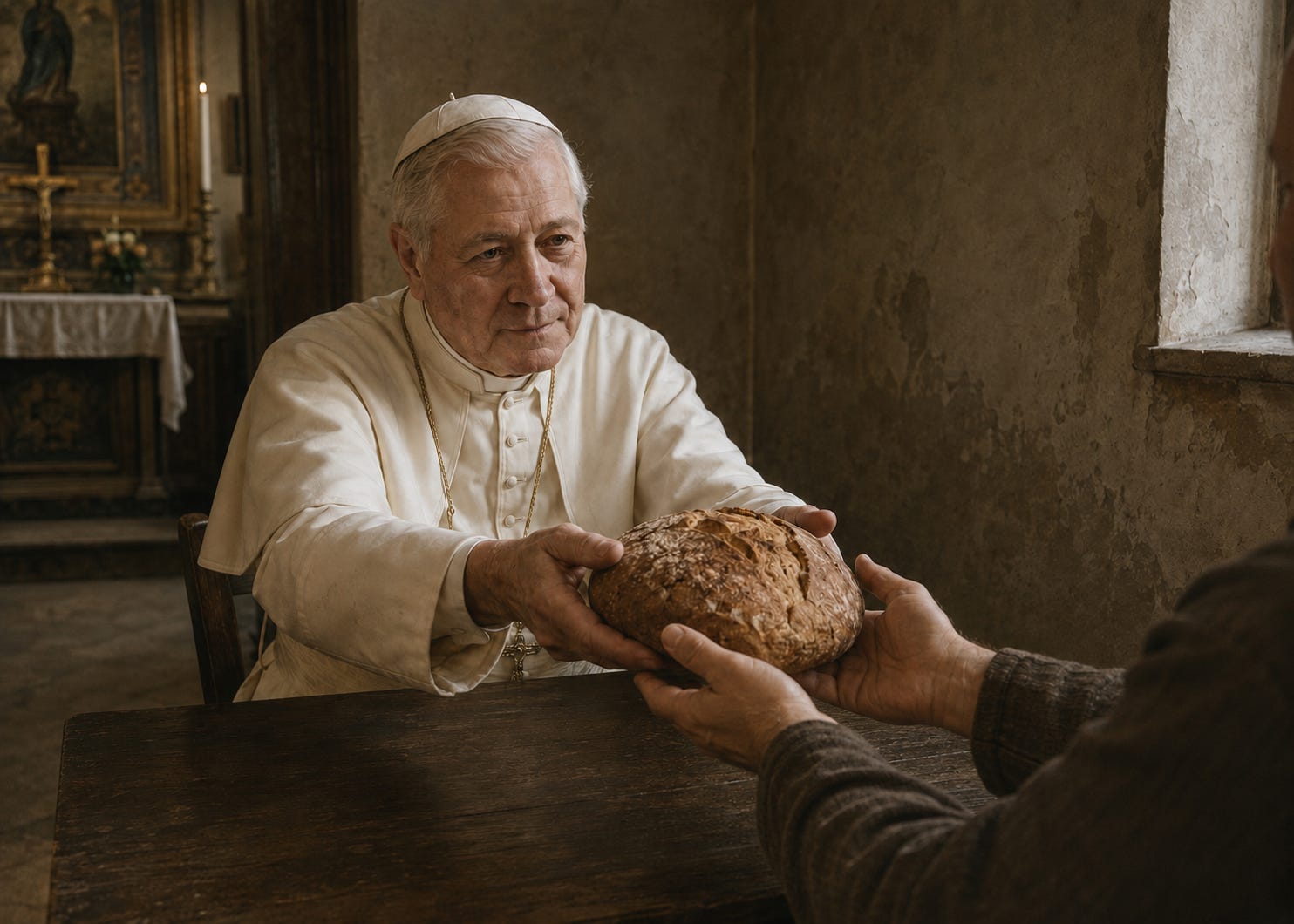
The Church’s treasure is bread. We preserve bread so that it can still be placed into hungry hands. We teach the faith so people can recognize Christ when He comes near. We protect tradition so it can continue doing the work for which it was entrusted: drawing human beings into the life of God.
I probably will not rename this ministry. The paperwork alone is enough to discourage me. But I would gladly claim Pius X’s question as our own.
Are we restoring all things in Christ?
And Now It’s Your Turn
Where have you experienced Christian tradition as something that brought you closer to Christ? Where has the way tradition was presented become an obstacle between you and Him?
If this reflection helped you understand what faithful stewardship can look like, please share it with someone who is wrestling with the place of tradition in Christian life.
Closing prayer
God of wisdom and mercy,
You have entrusted Your Church with treasures that do not belong to us alone. Keep us faithful to what we have received, and save us from confusing fidelity with fear, control, or pride.
Teach us to offer Scripture with honesty, worship with reverence, doctrine with humility, and the Eucharist with gratitude. Bring healing to those who have encountered Your gifts as weapons or barriers. Draw divided Christians toward communion in Christ, and guide every community struggling to discern what should be preserved, reformed, translated, or surrendered.
May everything we teach and build help ordinary people recognize Christ when He comes near.
Amen.
Pope Saint Pius X, pray for us.
And Did You Know?
-
Giuseppe Sarto was the firstborn of ten children. After his father’s death, his mother Margherita’s sacrifices helped keep him in seminary while the family faced serious poverty.
-
When people associated Pius X with miraculous healings, he reportedly answered with an Italian pun: “My name is Sarto, not Santo.” Santo means saint.
-
Pope Francis credited Pius X with facilitating the birth of the Pontifical Biblical Institute in Rome, an institution that has had a lasting influence on Catholic biblical scholarship.
-
Pius X died during the opening weeks of the First World War. His remains are now kept in the Chapel of the Presentation inside Saint Peter’s Basilica.
Thank you for being part of this community and for taking these questions seriously. Work like this requires research, time, and the freedom to pursue an idea beyond whatever is currently generating outrage. Paid subscriptions help sustain that work and keep it available to readers who cannot contribute financially.
If this ministry is helping you and you have room to support it, please consider becoming a paid subscriber. If you are facing financial hardship, remain with us without guilt. Reading, praying, commenting, and sharing are meaningful ways of carrying the ministry too.