

Behind the Scenes
I want to pause today and thank everyone who has stepped forward over the past several days to support Message From the Margins.
After I spoke candidly about the financial realities behind this ministry, many of you became supporting subscribers, upgraded your subscriptions, made gifts, shared the publication, or sent notes of encouragement. Your response has already made a real difference.
Among those notes was this message from Cindy:
“You guided me and prayed with me when I was struggling. You opened your heart and your ministry to help me. This ministry gives me hope to keep going, and my life is so much better with Message From the Margins.”
I’d be lying if I said I didn’t well up a little as I read those words. Cindy brought me back to why financial sustainability is so important. It is not merely about keeping a publication in business. It is about preserving the time and resources required to write, pray with people, offer pastoral care, and build a Christian community where people are treated with dignity and compassion.
This community is far more than a pleasant addition to our lives. It has become a genuine refuge where the Gospel comes to life in the ordinary, complicated lives of real people.
That said, we still have a way to go, and I do not want to pretend otherwise. But we are closer than we were a few days ago, and I am far more hopeful about what we can build together.
So, If you have the financial room to become a supporting member, your contributions would help this ministry continue serving people like Cindy, while keeping much of our work available to everyone.
If a paid subscription would place a strain on your finances, please remain here without guilt. Read, comment, pray with us, and share the work when you can. Your presence is valued.
To everyone who has already stepped forward, thank you. I am profoundly grateful that you believe this ministry deserves a future.
Oh, and please don’t forget… The Message From The Margins Podcast premiers on Monday, August 17th!!! Mark your calendars!
Your Brother in Christ,

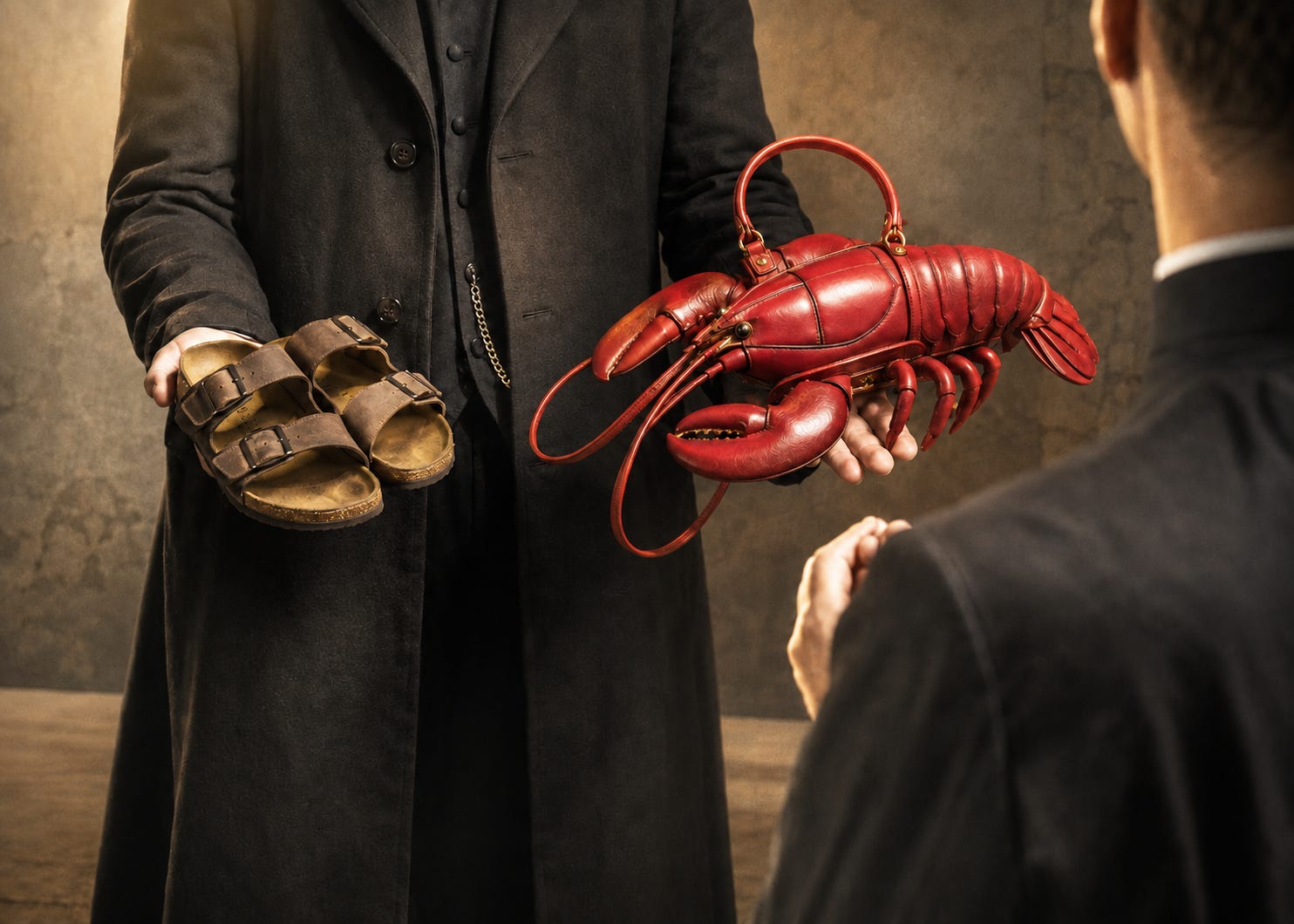
And now, on to what knockoff sandals and lobster purses can teach us about the Gospel. I promise I’m not losing my marbles…
Actually, I shouldn’t make promises I cannot keep.
My $6 Lidl Sandals, a $20,000 Lobster Purse, and Taking Joy in Material Things
What a pair of Fakenstocks taught me about enjoying what we own without asking our possessions to tell us who we are
As you can probably imagine, I do not have much fashion sense.
Do I sometimes wish I could look like the people on Instagram who teach you how to dress? Of course. I would be lying if I said otherwise. They always seem to have the right jacket, just the right shoes, and the uncanny ability to stand against a wall looking effortlessly elegant. Meanwhile, I am a clergyman. I wear essentially the same thing every day: black shirt, black pants, and a Roman collar, though more often than not my tab is casually sticking out of my pocket. The Church relieved me of most wardrobe decisions years ago, and frankly, it was an act of mercy.
For the most part, though, I am happy with me as me.
A few months ago, I ran to Lidl, which is a discount supermarket in my area. I needed to pick up some milk and a few things for my parents. And there, near the milk, was a basket filled with what I call seminarian sandals.
They are not actually called seminarian sandals. A friend informed me several years ago that they are called Birkenstocks. But they will always be seminarian sandals to me because some version of them seemed to be standard issue when I was in seminary. They were perfect for men preparing for the priesthood: comfortable, practical, so unfashionable they somehow come full circle and become fashionable again, and for some reason clergy seem to have a free pass to wear them for Mass.
They slide on and off easily, and they match all my outfits, by which I mean clerics. Same outfit, every day.
There was only one small complication. The pair in that Lidl basket were not Birkenstocks. They cost six dollars and bore no discernible connection to Germany, orthopedic science, or quality leatherwork.
I bought them immediately.
My $6 Lidlstocks™ have brought me tremendous joy.
Earlier today, however, I noticed that one sole had begun to peel away. Honestly, I am a little bummed. I love these shoes. They have served me well through grocery runs, dog walks with Figgy, errands, and long hours sitting at my computer pretending that wearing sandals counts as getting dressed-up for work.
My spiritual practice, of course, insists that I should not become attached to material possessions. I know this. Ashes to ashes, dust to dust, including my $6 Fakenstocks.
I am still going to Gorilla Glue the sole back on and stretch their earthly life a little longer.
The Lobster Enters the Story
Because I write for you, and because I need to remain at least vaguely acquainted with what is happening in the world, I spend a great deal of time online. While grieving the imminent loss of my Lidlstocks, I came across an image of a purse from a very distinguished luxury brand.
I shall not name the brand for two reasons. First, I do not want any of you looking for the purse and deciding to buy it. Second, I would very much like to avoid receiving a cease-and-desist letter from an attorney whose own shoes cost more than my car.
The purse… is shaped… like a lobster.
A lobster.
Not decorated with a tasteful little lobster charm meant to evoke a New England seashore. Not made in a vaguely lobster-inspired shade of red.
The entire purse is a literal lobster.
Claws and all.
It is a large leather crustacean that one can apparently carry in public without the fashion police becoming involved.
The lobster bag has reportedly been priced at around $20,000. I am told that it represents extraordinary craftsmanship. I am prepared to believe this. It may have been assembled by the finest leatherworkers in Europe, each of whom spent years mastering the ancient and noble art of making a handbag look as though it escaped from a seafood tower.
It is also one of the ugliest things I have ever seen.
Naturally, because I am not entirely right in the head, I began constructing a hypothetical situation.
Suppose someone approached me and said, “Father, you may have either the luxury lobster bag or a new pair of $6 Lidlstocks. Choose.”
There would need to be one rule: I could not take the lobster purse, sell it, and give the money away.
I mention this because I once did something very much like that. By coincidence, it involved the same distinguished luxury brand. I came into possession of a keychain worth about $1,000, sold it online, and used the money to buy Christmas presents for young people at risk. It remains the greatest contribution a preposterous designer keychain has ever made to the reign of God.
But in this hypothetical, resale is forbidden. I must choose one object and keep it.
I am taking the Fakenstocks without a moment’s hesitation.
What Do We Expect Our Things to Do for Us?
Now, I am not telling you this to perform virtue. There is nothing morally heroic about preferring comfortable, unstylish-but-somehow-stylish sandals to a handbag shaped like a crustacean. My choice may say less about my spiritual maturity than it does about my feet and my deep reluctance to carry a purse, let alone one with antennae.
But I am also not immune to wanting beautiful or expensive things. Those people online with the perfect clothes tend to have magnificent homes and travel to places that look considerably more interesting than the Lidl dairy aisle. Sometimes I feel the familiar tug of comparison. Their lives appear polished. Mine has Gorilla Glue on its sandals.
Over the years, I have learned that we ask material things to do all sorts of work they were never designed to do.
We ask clothes to make us desirable. We ask cars to make us appear successful. We ask houses to prove that our lives have gone according to plan. We ask labels to announce that we belong among the sort of people who can afford those labels. At some point, we may stop buying things because we enjoy them and begin buying them because we hope they will settle other people’s questions about our worth and achievement.
They never do. The question always returns, usually just in time for the next product launch.
That is part of what makes conspicuous consumption so powerful. We are not merely purchasing an object. We are purchasing the meaning attached to it, the feeling it gives us, and the message we hope it sends. The object becomes a costume for the person we hope others will see: prosperous, discerning, fashionable, important, untouched by insecurity.
The trouble is that insecurity has remarkably expensive taste.
And there is something I want to say clearly to you now. Your dignity, your inestimable worth, your preciousness, in the beautiful sense of that word rather than the smarmy one, can never come from a luxury handbag, a fancy car, a gorgeous mansion with an infinity pool, a luxury box at Citi Field (let’s go Mets), or a penthouse suite in Vegas.
Nor can it come from Fakenstocks.
Your worth comes from the beauty God has placed within you. You bear God’s own image and likeness. That makes your life sacred and your dignity inviolable. Wealth cannot increase it. Poverty cannot diminish it. No label can confer it, no financial loss can take it away, and no possession can make you more worthy of love than you already are.
You may forget that worth. Other people may fail to recognize it. Entire societies may organize themselves around denying it to certain people. None of that alters the image you bear. Before you owned anything, achieved anything, impressed anyone, or wore the right thing into the right room, you were already beloved.
This is why Jesus warns his listeners in Luke’s Gospel, “Watch out! Be on your guard against all kinds of greed; life does not consist in an abundance of possessions” (Luke 12:15, NIV).
All kinds of greed.
Greed does not always look like a miser counting gold coins in a locked room or a billionaire buying up starter homes in a residential neighborhood. It can look like comparison, endless upgrading, or the inability to enjoy something once a newer version exists. It can appear as the belief that our possessions place us above other people. It can also appear as anxiety, the fear that without the right objects we will become invisible.
Jesus does not say that possessions are incapable of giving pleasure. He says they are incapable of giving us life. His warning is about confusing the two, because Christian faith does not require us to distrust every beautiful object or apologize whenever something we own makes us happy.
Jesus attended feasts. He accepted hospitality. When a woman poured costly perfume over him, others objected to the extravagance, but Jesus recognized the love and symbolism expressed through it. Scripture does not present creation as a grim obstacle course in which enjoyment is evidence that we have failed spiritually.
Material things can carry memory, beauty, usefulness, and affection. A much-loved family Bible with gold trim, a grandmother’s ring, a well-made table, or even a ridiculous pair of supermarket sandals may become precious because of the life lived around them.
Nor is there anything automatically holy about buying the cheapest version of everything. Cheap goods may be wasteful, exploitative, environmentally damaging, and poorly made. An expensive object may be beautiful, durable, responsibly produced, and worth every dollar to the person buying it. Jesus appears to have owned at least one particularly well-made garment. St John tells us that His tunic was seamless, woven in one piece from top to bottom. The soldiers considered it worth preserving, so rather than tearing it apart, they cast lots to see who would take it. (John 19: 23-24) Price alone tells us very little about the spiritual health of a purchase. What deserves our attention is whether we remain free once possessed.
Can I enjoy this thing, use it, and care for it without needing someone else to envy it? Can I lose it without losing myself? Can I recognize when I have enough? Can I still see the person who has less as my equal, my neighbor, and someone whose needs may place a real claim upon my abundance?
Detachment does not require indifference toward anything that can be taken from us. If it did, we would also have to detach ourselves from places, animals, traditions, and people. To love anything in this temporary world is to accept that grief will eventually accompany it.
Spiritual detachment means loving without surrendering our freedom. We receive what is good with gratitude. We use what we have responsibly. We share from our abundance. We refuse to make a possession carry the unbearable burden of proving who we are.
And when the sole begins to peel away, we remember that everything we own is temporary.
Even the lobster purse.
So yes, I am going to Gorilla Glue my $6 Lidlstocks back together. They have carried me through countless errands, afternoons around the house, and more hours at this computer writing for you than I care to calculate. They have served me well, and they still bring me joy.
Someday soon though, the glue will stop holding. The sole will surrender. I will thank my Fakenstocks for their service, consign them to the dust from which all Fakenstocks came, and go rummaging through the middle aisle at Lidl for another pair.
Or maybe I will treat myself to a proper pair of Birkenstocks. I am guessing they will last a bit longer and have a better chance of being ethically made. We shall see. Maybe they will have a sale.
Either way, if someone else wants the lobster, they are welcome to it…
But if Father catches you carrying it, do not be surprised if he beans you with a $6 Lidlstock.
And now it’s your turn
What ordinary possession brings you a completely unreasonable amount of joy? And how do you know when you are enjoying something you own, rather than asking it to tell you who you are?
Share your answer in the comments. I would genuinely love to hear the stories behind the objects you treasure.
If this made you laugh, think, or glance suspiciously at something you once bought, send it to a friend and invite them into the conversation.
And Let us Pray…
A Prayer for Gratitude and Freedom
God of every good gift,
teach us to receive the things of this world with gratitude,
and to enjoy what is beautiful, useful, and lovingly made
without asking any possession to tell us who we are.
When comparison makes us restless,
return us to the dignity you placed within us.
Remind us that wealth cannot increase our worth,
poverty cannot diminish it,
and no label, home, car, garment, or bank account
can alter the image of God we bear.
Give us the freedom to enjoy what we have,
the wisdom to recognize when we have enough,
and the generosity to share
with those whose needs place a claim upon our abundance.
Keep our possessions in their proper place:
gifts to be used and appreciated,
never masters to be served.
When the things we love begin to wear out,
peel apart,
or return to dust,
help us release them with gratitude
for the joy they gave us.
May our treasure remain in you,
our identity rest securely in your love,
and our lives reveal
that every person is precious beyond price.
Amen.
See… I told you I’m not losing my marbles.
Or am I?
I’ll let you decide.
Silly or not, I suspect you took something away from all this. I just hope it wasn’t fashion advice.
Please pray for me, as I pray for you.
May God Bless You, Now and Always.
~Fr. V