

Before we begin…
What follows is a nuanced article about nuance.
A complex article about complexity.
A piece of humble writing about the need for humility.
In other words, not exactly algorithmic gold.
So that means I need to ask for your support.
You’ll notice that I’ve made the decision to keep almost everything I write available to everyone.
I simply cannot bring myself to put the Gospel behind a paywall.
Maybe that’s bad business. (I know it’s bad business)
Maybe it’s not what the consultants would recommend. (One told me this specifically)
I don’t know.
What I do know is that I cannot imagine the apostles checking tickets at the entrance to the Sermon on the Mount.
Something in my brain just refuses to process that image.
You’ll also notice that you won’t find ads here for gold and silver IRAs, post-apocalyptic survival food buckets, pharmaceuticals who’s side effects may include…, or insurance companies promising to solve all of life’s problems.
This space is intentionally simple.
It’s just me, you, and the Holy Spirit trying to make sense of life together.
That means this entire project ultimately depends on three things:
The Holy Spirit continuing to guide us.
Me continuing to show up and write.
And readers like you, if you’re able, deciding that this work is worth supporting.
A paid subscription is 9ish bucks a month, or less if you choose an annual plan.
I would love to tell you I’ve reached the spiritual maturity where I can survive on locusts and wild honey alone.
Unfortunately, my car payment remains stubbornly committed to modern economic systems.
I believe this work matters.
Not because I’m writing it.
Because thoughtful, compassionate, intellectually honest conversations about faith matter.
Especially right now.
One of our supporting members recently wrote:
“This resonated so deeply with me, Father. Thank you for all the time, research and prayer you put into such a profound piece. We’re lucky to have you!.”
I don’t know about that last part, but what I do know is that this work has established itself as important to people and I’d love to see it reach more people.
So if these reflections have helped you think more deeply, pray more honestly, or feel a little less alone in your questions, would you consider becoming a supporting subscriber today?
We need a few more complex people willing to support complex work about complexity to make this thing sustainable long term.
Will you join me today?
Your Brother In Christ,

Now, let’s begin.
The Spiritual Danger of Absolute Certainty
In an anxious world addicted to certainty, humility may be one of the most Christian things we can practice.
As most of you know, I create a lot of content for social media. In fact, that is how many of us first came to know one another.
And I genuinely love it.
Social media has allowed me to have meaningful conversations with people all over the world. I have heard from struggling families, exhausted parents, grieving people, people rebuilding their faith after spiritual harm, people who feel forgotten by the Church, and yes, even a few celebrities along the way.
I cherish all of it.
Behind every profile picture, every comment, every message, and every disagreement is an actual person carrying a story most of us will never fully know.
If you have followed my work for any length of time, you have probably noticed something else.
Most of what I post contains nuance.
Even when I am talking about a political event, a cultural controversy, or something happening in the world, I am rarely only talking about the event itself. I am usually trying to bring it back to some universal truth that has been lost, hidden, ignored, or buried beneath the shouting.
In other words, I spend a lot of time trying to demonstrate that things are complex.
And it is always funny to me how some people simply cannot abide that.
Not everyone, of course. Many people appreciate nuance. Many people are relieved by it. Many people are exhausted by the pressure to have an instant opinion about every breaking story, every scandal, every war, every court decision, every celebrity interview, every political speech, every denominational argument, and every viral clip from a person they had never heard of ten minutes earlier.
But some people cannot stand complexity.
They want the box.
They want the label.
They want the verdict.
They want the hero and the villain.
They want the righteous and the wicked.
They want the whole messy thing reduced to something that can be consumed in thirty seconds and shared in ten.
Life rarely cooperates.
A couple gets divorced, and people want to know whose fault it was. Sometimes there really is abuse, betrayal, or cruelty, and clarity is necessary. But often, a marriage collapses under years of wounds, misunderstandings, unmet needs, fear, defensiveness, family patterns, financial stress, old trauma, and words that were said too often or not said soon enough.
A company creates something useful, maybe even beautiful, and also creates consequences it does not want to admit.
A political movement advocates for something genuinely good while carrying blind spots its supporters struggle to see.
A church teaches profound truth while also being capable of institutional cowardice, arrogance, or harm.
Human beings are complicated.
Families are complicated.
Nations are complicated.
Churches are complicated.
History is complicated.
Most things worth understanding are.
When we flatten reality, we may make it easier to persuade people for or against something. We may gain followers. We may win arguments. We may feel the satisfaction of declaring ourselves right and someone else wrong.
What we seldom gain is understanding.
We do this in our personal lives.
We do this in our politics.
We do this in our churches.
And I think we do it because complexity makes us anxious.
Complexity forces us to admit that we may not have all the answers. It requires patience. It demands humility. It reminds us that we are finite creatures trying to understand a world far larger than ourselves.
That realization can feel deeply uncomfortable.
Which may explain why so many of us spend our lives running from it.
As you can imagine, I spend a ridiculous amount of time listening to online preachers.
Occupational hazard.
There are not enough grains of sand on the beach to represent the number of times I have heard someone confidently proclaim, “Scripture is clear.”
The phrase appears in sermons, podcasts, YouTube videos, social media clips, conference stages, and comment sections.
“Scripture is clear.”
What fascinates me is how often the next preacher says the exact same thing while arguing the exact opposite position.
Scripture is clear about politics.
Scripture is clear about economics.
Scripture is clear about war.
Scripture is clear about immigration.
Scripture is clear about gender.
Scripture is clear about sexuality.
Scripture is clear about who belongs.
Scripture is clear about who does not.
Everyone seems remarkably certain.
Yet somehow all of these crystal-clear conclusions rarely agree with one another.
At some point, we have to acknowledge an uncomfortable reality.
The problem may not be Scripture.
The problem may be us.
Every one of us reads Scripture through human eyes.
We bring our experiences.
We bring our fears.
We bring our upbringing.
We bring our political assumptions.
We bring our wounds.
We bring the voices of parents, pastors, teachers, professors, authors, communities, and preachers who shaped how we understand the world long before we ever opened a Bible for ourselves.
None of us approaches Scripture as a blank slate.
I certainly do not.
Neither do you.
Neither did the great saints.
Neither did the reformers.
Neither did the early Church.
Human beings have always interpreted God’s revelation through the limitations of human understanding.
The Bible itself tells us as much.
One of the things I find most comforting about the apostles is how frequently they were confused.
These were not casual observers. They were not reading secondhand theological commentary from two thousand years away. They ate with Jesus. They walked with Jesus. They listened to Him teach day after day. They watched Him heal the sick, calm storms, forgive sinners, confront religious hypocrisy, and raise the dead.
And they still misunderstood Him.
Repeatedly.
Jesus would speak about sacrifice, and they would argue about status.
Jesus would speak about serving, and they would argue about power.
Jesus would speak about the Kingdom of God, and they would imagine political victory.
Even standing in the presence of Christ Himself, they often struggled to understand what He was saying.
That should make all of us a little slower to announce that every question has an obvious answer.
A little slower to condemn.
A little slower to assume that our interpretation is identical to God’s perspective.
A little more willing to approach both Scripture and one another with humility.
There is a profound difference between saying, “I believe this is what Scripture teaches,” and saying, “Any faithful Christian must agree with me.”
One statement reflects conviction.
The other often reflects certainty that none of us has earned.
To be fair, there are a few places where I am comfortable saying, “Scripture is clear.”
Jesus was once asked about the greatest commandment, and His answer could hardly have been more direct:
“Love the Lord your God with all your heart and with all your soul and with all your mind.”
“And the second is like it: Love your neighbor as yourself.”
Then He adds something extraordinary:
“All the Law and the Prophets hang on these two commandments.”
That seems pretty clear to me.
Love God.
Love your neighbor.
Everything else must somehow fit beneath those two realities.
If I ever start confidently declaring that Scripture is crystal clear on every political controversy, every economic theory, every foreign policy debate, every cultural argument, every theological disagreement, and every complicated ethical question human beings have wrestled with for centuries, feel free to throw your breviary at me.
Preferably a small one.
What strikes me about Jesus’ answer is not merely its simplicity. It is the order He establishes.
Before doctrine becomes a weapon, there is love.
Before certainty becomes arrogance, there is love.
Before judgment becomes condemnation, there is love.
Before we begin sorting humanity into categories of worthy and unworthy, there is love.
Not sentimental love.
Not permissive love.
Not love that avoids difficult truths.
The kind of love that seeks the good of another person because they bear the image of God.
The kind of love that recognizes that every human being standing before us is infinitely more complicated than our assumptions about them.
The kind of love that leaves room for humility because we understand that our own knowledge is partial as well.
That does not solve every theological question.
It does not remove every disagreement.
It does, however, give us a place to stand when everything else feels uncertain.
And I suspect that is precisely why Jesus put these commandments first.
But I digress…
We were talking about Truth…. As Pontius Pilot Says “Quid Est Veritas?” What is truth?
You will hear preachers all the time proclaiming that what the world needs is people willing to stand for God’s Truth.
And to be fair, they’re not entirely wrong.
The world desperately needs truth.
We live in an age of manipulation, misinformation, propaganda, tribalism, and carefully curated realities. Truth matters.
Deeply.
But whenever I hear someone confidently announce that they possess God’s Truth in its fullness, my mind starts wandering in a different direction.
I have no doubt that God contains all truth.
I have no doubt that Christ revealed profound truth about God, humanity, love, justice, mercy, and the Kingdom.
I have no doubt that Sacred Scripture contains truth.
What I doubt is my ability to comprehend all of that truth perfectly.
What I doubt is my ability to untangle every mystery.
What I doubt is my ability to assign the proper weight to every verse, every command, every story, every doctrine, every tension, every paradox, and every question that has occupied theologians for two thousand years.
That isn’t a God problem.
It’s a me problem.
More accurately, it’s a human problem.
We are finite creatures attempting to understand an infinite God.
Which is why I find myself increasingly drawn toward humility rather than certainty.
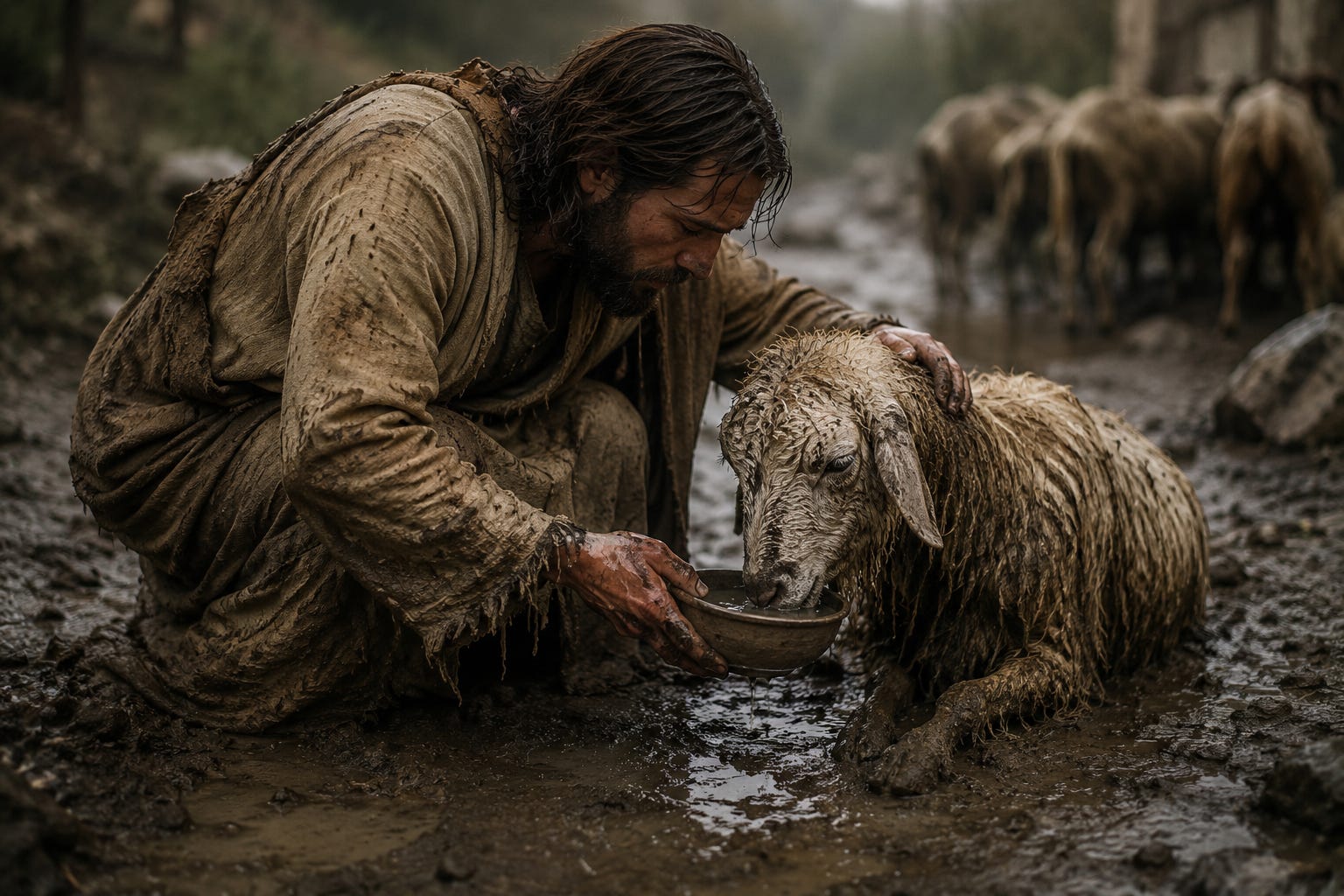
You’ll forgive me, then, if I would rather climb down into the mud and sit beside someone who is suffering than climb onto a throne and begin sorting sheep from goats.
I’ll let Christ handle that part.
My job seems much simpler.
Feed people.
Comfort people.
Love people.
Tell the truth as best I can.
Repent when I get it wrong.
And keep following Jesus.
When Christ returns, I suspect I will feel far more comfortable if He finds me feeding and watering the goats than if He finds me congratulating myself for standing with the sheep.
Perhaps that is naïve.
But I cannot shake the feeling that the heart of Christianity was never meant to be proving that we belong to the right group.
It was meant to be learning how to love as Christ loved.
The point is not that truth is unknowable.
The point is that certainty and truth are not the same thing.
History is filled with people who were absolutely certain and absolutely wrong.
Religious history is no exception.
Some of the greatest mistakes ever committed in the name of faith were carried out by people who never doubted themselves for a moment.
Humility, therefore, is not the enemy of conviction.
Humility is what keeps conviction from becoming idolatry.
Sooner or later, we all face a temptation far older than social media, politics, denominations, or culture wars.
We begin with faith in God.
Then, little by little, we place our faith in our understanding of God.
Those are not the same thing.
One posture leaves room for learning, repentance, growth, and surprise.
The other closes the door.
The Pharisees were not villains in their own minds. They believed they were defending the truth. They knew the Scriptures. They studied them. They devoted their lives to them.
Yet standing in front of the very Word made flesh, they often could not recognize Him.
That should terrify every preacher.
Including me.
It suggests that it is entirely possible to know the text, quote the text, defend the text, build an identity around the text, and still miss the heart of the One to whom the text points.
That possibility should make all of us a little less eager to pronounce judgment and a little more eager to practice humility.
After all, the goal of the Christian life is not to be right about everything.
The goal is to become more like Christ.
Those are related pursuits.
They are not identical pursuits.
One reason I think we cling so tightly to certainty is that uncertainty makes us anxious.
Human beings do not particularly enjoy ambiguity.
We want answers.
We want predictability.
We want to know who is right, who is wrong, what happens next, and where we stand.
The problem is that reality often refuses to cooperate.
Relationships are messy.
Families are complicated.
Nations are complicated.
Churches are complicated.
Human beings are complicated.
Somewhere deep inside us, there is a voice that keeps demanding a level of certainty life simply does not provide.
That tension can become exhausting.
Psychologists have long observed that uncertainty creates stress. Our brains are constantly trying to anticipate threats, outcomes, and possibilities. When we cannot predict what comes next, our anxiety often rises.
That helps explain why simplistic answers can feel so appealing.
They reduce complexity.
They provide a sense of control.
They allow us to stop wrestling and start declaring.
Unfortunately, they also tempt us to confuse confidence with wisdom.
Humility offers another path.
Humility does not eliminate uncertainty.
Humility teaches us how to live with it.
Humility allows us to say:
“I may not understand everything.”
“I may be missing something.”
“I may need to learn.”
“I may need to listen.”
“I may even be wrong.”
For many people, those statements sound terrifying.
For Christians, they should sound familiar.
Humility is not merely a personality trait.
It is a spiritual discipline.
Humility is what allows us to trust God without pretending we are God.
Humility reminds us that our salvation does not depend upon having perfect answers to every question.
It depends upon the One who holds the answers we cannot.
There is tremendous freedom in that realization.
I do not need to carry the burden of omniscience.
I do not need to resolve every mystery.
I do not need to win every argument.
I do not need to force every complicated situation into a category that makes me comfortable.
I can acknowledge complexity.
I can continue seeking truth.
I can remain open to correction.
And I can trust that God’s wisdom is infinitely larger than my own.
Ironically, the people with the deepest faith are often not the people with the highest degree of certainty.
They are the people who have learned to trust God even when certainty is unavailable.
As I have gotten older, I have become less interested in finding people who have all the answers.
I have met too many of them.
I have listened to too many sermons that promised certainty.
I have watched too many people build entire identities around being right.
What interests me now are people who possess both conviction and humility.
People who take Scripture seriously.
People who take truth seriously.
People who take discipleship seriously.
But who also understand that they are finite human beings standing before an infinite God.
Those are the people I trust.
Those are the people I want to learn from.
Those are the people who seem most at peace.
Not because they have solved every mystery.
Not because they have eliminated every doubt.
Not because they have reduced the world to a simple set of categories.
They are at peace because they have stopped demanding that life provide a level of certainty only God can provide.
I think that is part of what Jesus meant when He spoke about becoming like little children.
Children do not understand everything.
They trust.
They ask questions.
They remain curious.
They depend on someone larger than themselves.
Many of us spend our lives trying to become certain when Christ may be calling us to become trusting.
Those are not the same thing.
The world will continue demanding absolute allegiance.
Political movements will demand it.
Ideologies will demand it.
Religious factions will demand it.
Media personalities will demand it.
Entire industries profit from convincing us that every issue is simple, every opponent is evil, and every answer is obvious.
Resist that temptation.
Think deeply.
Study diligently.
Pray earnestly.
Hold your convictions.
But hold them with the humility of someone who knows that God is infinitely wiser than they are.
Love God with all your heart, soul, mind, and strength.
Love your neighbor as yourself.
Be slow to judge.
Be quick to listen.
And when you find yourself standing before one of life’s many mysteries, remember that your salvation has never depended upon understanding everything.
It has always depended upon Christ.
I find that comforting.
Because the deeper I go into the spiritual life, the more I realize that faith is not the absence of uncertainty.
Faith is trusting God in the middle of it.
A practice for this week
This week, before reacting to something online, pause long enough to ask: “What part of this might be more complicated than it first appears?”
When you read Scripture, try adding one sentence to your prayer before you begin: “Lord, help me hear You beyond my assumptions.”
When you feel the urge to judge someone quickly, ask whether you know enough of their story to do so faithfully.
Choose one conversation where your goal is not to win, correct, or persuade, but to understand.
And when anxiety rises because you cannot figure everything out, breathe slowly and remember: you were never asked to be God. You were asked to love God, love your neighbor, and follow Christ as faithfully as you can.
If this reflection gave language to something you have been carrying, I would love to hear from you in the comments. This community is at its best when we are thinking together, not performing certainty for one another.
And if someone you know is exhausted by the pressure to pick a side, defend a tribe, or have an instant answer for everything, feel free to share this with them.
Closing Prayer
Lord Jesus Christ,
Teach us to love You with all our heart, all our soul, all our mind, and all our strength.
Free us from the arrogance that confuses our understanding with Your wisdom. Free us also from the fear that makes us cling to false certainty when life becomes complicated.
Give us courage to seek truth without cruelty. Give us humility to admit when we do not know. Give us patience with those who see differently than we do, and integrity when conscience requires us to speak.
Help us resist every tribe, ideology, movement, and institution that asks for the allegiance that belongs to You alone.
When the world feels too loud, too angry, and too certain, steady us in Your love.
Make us faithful, not performative.
Make us discerning, not suspicious.
Make us humble, not passive.
And when we stand before mysteries we cannot resolve, remind us that we are held by the One who understands all things.
Amen.
One Last Thought
If you’re still reading, you’re exactly why I keep writing.
The internet rewards certainty. It rewards outrage. It rewards telling people what they already want to hear.
This community has always tried to do something different.
To ask harder questions.
To think more deeply.
To make room for both faith and intellectual honesty.
To remember that human beings are usually more complicated than the labels we place on them.
If that kind of work feels worthwhile to you, I’d be honored if you’d consider becoming a supporting subscriber.
Not because I have all the answers.
Quite the opposite.
Because I think the world needs more places where thoughtful people can wrestle with meaningful questions together.
If you’d like to help build that kind of space, I’d be grateful for your support.