

My Dear Friend,
Before we get into today’s reflection on St. Barnabas, I want to take you behind the scenes for a moment.
This week marks the one-year anniversary of Message From the Margins.
One year. Can you believe that?
I have been thinking a lot about what this little corner of the internet has become over the past year. When it began, I had a vision for more than a newsletter. I wanted to build a space where faith could feel alive again for people who were tired, bruised, curious, angry, hopeful, doubtful, and still somehow listening for God.
I wanted this to be a place where ancient Christian wisdom could meet real life without becoming shallow, sentimental, or cruel.
And because of you, that vision has started to take shape.
Every time you read, share, comment, pray along, or send a note saying, “This helped me today,” you remind me that this work is becoming bigger than one person at a keyboard. Together, we are building a ministry where lifelong Christians, spiritual seekers, and people who may never walk through the doors of a church can still find mercy, clarity, beauty, and truth.
That means more to me than I can easily put into words.
I also want to be honest with you. To keep building this well, we do need more paid subscribers.
There are no large institutions or major donors funding this work. It is sustained by the people who believe it should exist, people who have found something here worth protecting, sharing, and helping grow.
And many hands really do make light work.
If you are able to become a paid subscriber at $9.99 a month, or even less with an annual subscription, you are helping carry a small but real part of this ministry. You are helping make sure this work can continue, grow, and reach the people who need it.
I also want to update you on the podcast. It is coming soon, and I am hoping to launch it this week. I know it has taken a little longer than expected, but I want it to be right for you. I want the sound, the structure, the spirit, and the quality to match the care this community deserves.
That takes time. It also takes financial support. And let me just say, the proper camera for this kind of work was not exactly found in the clearance bin.
Paid subscriptions help make the writing, podcast, video work, livestreams, resources, and future offerings possible. They allow this ministry to grow with steadiness instead of being held together by caffeine and prayer.
If Message From the Margins has fed you, challenged you, comforted you, or helped you feel less alone in your faith, please consider becoming a paid subscriber today.
It is one of the most direct ways you can help this work continue.
And whether you are a free subscriber, a paid subscriber, a reader who shares quietly, or someone who has only recently found your way here, thank you. Truly. This first year has meant more to me than I can fully put into words.
Now, for today’s reflection.
Because St. Barnabas may be exactly the saint we need at the start of year two.
Your Brother in Christ,

Now, for today’s reflection.
Because St. Barnabas may be exactly the saint we need at the start of year two.
St. Barnabas and the Holy Risk of Second Chances
Why this first-century saint may be exactly who the Church needs now
I want you to do me a favor and call two people to mind.
First, think of someone with a past.
You know the kind of person I mean. Someone who had done real harm. Someone people warned you about. Maybe a classmate from high school. A cousin. A neighbor. The kid everyone called trouble. The one with the record, the reputation, the addiction, the anger, the history nobody wanted to get too close to. The kid who ran with a bad crowd.
Now think of the second person.
The teacher who did not give up on him.
The principal who saw leadership underneath defiance.
The counselor who noticed grief beneath the behavior.
The priest, coach, employer, neighbor, aunt, or even police officer who said, “I know what people say about him, but I do not think his story is finished.”
We know this story when we see it.
It is Sister Mary Clarence in Sister Act II, looking at a room full of students everyone has already written off and hearing a choir before they can hear it themselves.
It is Jaime Escalante in Stand and Deliver, refusing to accept that his students are incapable of greatness just because the system has already lowered its expectations.
We love those stories because they tell us something we want to believe: that a person can be more than the file, the rumor, the record, the reputation, or their worst chapter.
But St. Barnabas takes that story into more dangerous territory.
He is not simply seeing hidden talent.
He is recognizing grace in a man the Church had every reason to fear.
And that is a very different thing.
This is not a fairy tale. Some people do not change. Some keep hurting others. Some patterns remain dangerous. Some second chances require boundaries, distance, restitution, and time.
Christian mercy is not the same thing as pretending danger is not real.
But mercy does ask us to believe that conversion is possible.
The Feast of St. Barnabas, Apostle, celebrated on June 11, honors one of the earliest and most necessary figures in the Christian movement. He was not one of the Twelve, but the New Testament calls him an apostle because his work helped carry the Gospel beyond its first boundaries. He was a Jewish Levite from Cyprus, originally named Joseph. The apostles gave him the name Barnabas, usually understood as “son of encouragement” or “son of consolation.”
That name can sound gentle.
Almost safe.
It was neither.
St. Barnabas is the patron saint of the people who refuse to relegate someone to their worst moment.
The kind of man who was willing to put himself on the line to see others reach their potential.
Barnabas lived his faith near the fault lines of the early Church: fear and trust, Jewish and Gentile believers, Jerusalem and Antioch, old wounds and new mission, institutional caution and the maddening freedom of the Holy Spirit.
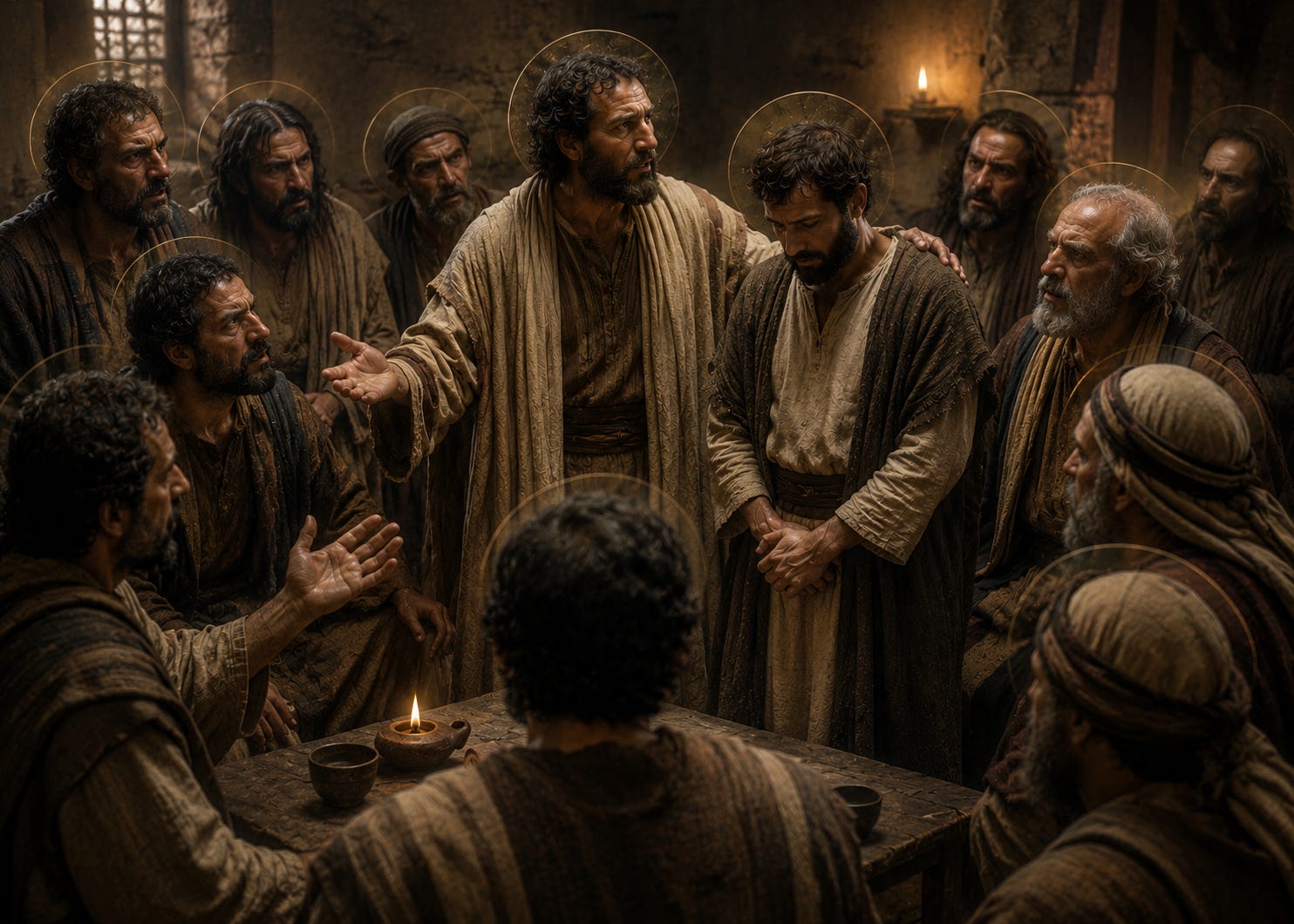
He is the one who stands beside Saul after Saul’s conversion, when the disciples are still afraid of him.
And they had every reason to be afraid.
Before Paul was St. Paul, he was Saul, the man who had instigated tremendous violence against the followers of Jesus. He had hunted the Church. He had a reputation. Reputations are not small things when people have been hurt.
Then this Saul claims he has changed.
You can almost hear the room go quiet.
Because every community eventually faces this question: what do we do when grace shows up wearing the face of someone we have learned to fear?
The Acts of the Apostles tells us that when Saul came to Jerusalem and tried to join the disciples, “they were all afraid of him, not believing that he really was a disciple.”
That fear deserves to be taken seriously. The early Christians were not being petty. They were not being unforgiving. They were trying to survive.
Then Barnabas steps forward.
Acts says Barnabas “took him and brought him to the apostles.”
That little sentence carries enormous spiritual weight.
Barnabas does not deny the past. He does not ask wounded people to pretend. He does not say, “Well, everyone makes mistakes,” as if persecution were a parking ticket.
He does something harder.
He bears witness to the possibility that Saul’s story is not finished.
That is different from cheap forgiveness. Cheap forgiveness rushes people past pain because pain makes the room uncomfortable. Barnabas is not doing that. He is practicing discernment with courage.
Barnabas is not naively endorsing a vibe.
He is discerning the fruit of the Spirit.
Saul has encountered the risen Christ. Saul has begun preaching the name he once tried to silence. Saul is placing himself before the very community he once threatened. Something has happened in him that cannot be explained by charm, manipulation, or wishful thinking.
Barnabas sees his conversion and is willing to stake his own credibility on it.
A lesser disciple would have stayed safely silent.
Barnabas steps forward.
There are moments in life when encouragement is not a mere compliment.
It is an act of public risk.
In our modern era, sometimes we turn encouragement into something decorative. A kind word. A sweet note. A quick “you’ve got this” when someone is having a rough day.
Those things are not meaningless. Sometimes a small word of kindness helps a person breathe again.
But biblical encouragement is stronger than pleasant reassurance. It is the grace-filled act of helping someone remain open to God when shame, fear, failure, or public suspicion is trying to close the door.
Barnabas does that for Paul.
Later, he does something similar for the Church in Antioch.
Word reaches Jerusalem that Gentiles are receiving the Gospel. These were not the people everyone expected to become the future of the Church. This is not a minor administrative update. This is a crisis of imagination. The movement born from Israel’s Messiah is spreading among people who do not fit the inherited expectations.
So they send Barnabas.
He arrives, looks around, and Acts says he sees “the grace of God.”
Not a problem to manage.
Not a threat to contain.
Grace.
I love that because it tells us what kind of soul Barnabas had. Some people can walk into a room where God is clearly at work and see only disorder because it does not match their preferred layout.
Barnabas had better eyes.
He could recognize the Holy Spirit outside the old center of gravity. He could see that God was not asking permission to move.
That is a dangerous gift in every age.
Especially ours.
We live in a time when suspicion often feels safer than hope.
That did not come from nowhere. Many people have been hurt. Many communities have learned, painfully, that trust without wisdom can do damage. Some doors had to be locked for survival. Some boundaries were acts of sanity.
Barnabas does not mock that caution.
He asks whether caution has become our whole imagination.
We learn to sort people quickly, sometimes because we are trying to protect ourselves, sometimes because slowing down would ask too much of us. One failure, one old association, one season of addiction, one public mistake, one complicated history, and a person becomes easier to manage as a category than to encounter as a soul.
Online, complicated human stories are easily flattened into something easier to punish or defend. In families, one person can spend decades trapped inside the role everyone assigned them. In churches, we can preach redemption while quietly keeping a list of people we are not prepared to believe have changed.
Barnabas asks a question most of us would rather avoid: do we actually believe people can be changed by grace, or do we only believe people can improve within the limits we have already approved?
That question cuts.
It cuts through churches that want mercy to remain theoretical.
It cuts through families where repentance is noticed but not trusted.
It cuts through recovery, where someone may be sober and still surrounded by people who only remember the damage.
It cuts through anyone trying to rebuild a life after prison, divorce, public failure, addiction, or a season when they were not who they now want to become.
It cuts through our own private hearts, where we sometimes keep people frozen in their worst moment because it makes the world feel simpler.
Barnabas will not let us do that comfortably.
He is not naive. He is not conflict-avoidant. He is not the patron saint of easy optimism. Barnabas belongs to the harder work of hope.
And then there is John Mark.
Later in Acts, Paul wants to continue the mission. Barnabas wants to bring Mark. Paul refuses because Mark had left them on a previous excursion. The disagreement becomes sharp enough that Paul and Barnabas separate.
Interestingly enough, the Bible just leaves the story there. No stained-glass smoothing. No tidy reconciliation scene. No narrator saying, “And everyone learned an important lesson about teamwork.” No hugging it out.
Maybe that’s Good.
Because sometimes holy people disagree sharply about what faithfulness requires.
Paul remembers the cost of unreliability. Barnabas remembers that failure is not always the end of vocation.
I do not want to flatten Paul here. Mission matters. Reliability matters. People who have been burned are allowed to remember the burn.
But I am grateful Barnabas existed.
I am grateful someone in the early Church had the instinct to stay near the one who had failed.
Because sooner or later, most of us are Mark.
We leave when we should have stayed. We falter when courage was needed. We disappoint people who had reason to expect more from us. We become inconvenient evidence that discipleship is not clean.
And if we are very fortunate, someone like Barnabas does not confuse our failure with our entire future.
Anyone who has ever helped lead a church knows this tension. Communities need reliability. Ministries need people who can be trusted. The work has to be done, the promises have to be kept, and the people depending on us cannot be treated casually.
And still, the Church cannot become so efficient that it forgets how mercy works.
That is why his feast is not quaint. It is not religious trivia. It is a needed meditation.
A Church without Barnabas may still know how to defend itself, but it will struggle to recognize resurrection when resurrection walks in limping.
And a lot of people are limping.
Many people move through life emotionally overclocked and spiritually numb. They are tired of being marketed to, judged, managed, categorized, and told to turn their pain into productivity. They do not need a Church that gives them one more burden to carry.
They need a Church with Barnabas eyes.
A Church that can say, “I see grace here.”
Not because everything is fine.
Because God is present.
That is the difference.
Barnabas does not teach us to be gullible. He teaches us to be brave enough to hope with discipline. He teaches us to make room for conversion without using conversion language to erase accountability. He teaches us that encouragement is not emotional decoration. It is spiritual labor.
It costs something to encourage well.
You may have to risk being misunderstood. You may have to advocate for someone others distrust. You may have to slow down the machinery of judgment. You may have to admit that God is working outside the lines you were taught to defend.
You may have to become less addicted to being right and more available to being faithful.
And in a culture as tired and reactive as ours, that kind of encouragement is not mild.
It is resistance.
St. Barnabas reminds us that the Church is not built only by the people who preach the sermon, write the epistle, or lead the mission. It is also built by the people who notice the first embers of grace in someone else and protect it long enough to grow.
Paul needed that.
Mark needed that.
Antioch needed that.
So do we.
The Feast of St. Barnabas asks us to examine our spiritual eyesight. Where have we mistaken grace for inconvenience? Where have we confused caution with holiness? Where have we kept someone permanently imprisoned in an old version of themselves?
It also asks the tenderer question.
Where do we need a Barnabas ourselves?
Where do we need someone to stand beside us and say, “Your worst chapter is not the whole book. God is not finished here.”
That is not sentimentality.
That is apostolic work.
And it is still the work of the Gospel.
Practical Takeaways
-
Read Acts 9:26-28 slowly. Pay attention to the fear of the disciples and the risk Barnabas takes. Do not rush past either one.
-
Think of one person you have kept frozen in an old category. You may still need boundaries, distance, or caution, but ask honestly whether you have left any room for grace.
-
Encourage one person in a specific way today. Do not flatter. Name something real: courage, steadiness, growth, honesty, tenderness, endurance.
-
Notice one place where God may be working outside the circle you expected.
-
If you are the one who has failed, bring that honestly to prayer. Ask St. Barnabas to help you trust that failure may be part of your story without becoming the title of your life.
Now it’s your turn…
Before we pray, I’d love to hear from you.
Where have you seen someone act like Barnabas, recognizing grace where others only saw a past? Or where have you needed someone to believe that God was not finished with you?
Share your thoughts in the comments.
And if this reflection brought someone to mind, consider sending it to them.
Closing Prayer
St. Barnabas, apostle of encouragement and witness to grace, pray for us.
Teach us to see as you saw. Give us courage to recognize the work of God in people and places we might too quickly dismiss. Make us wise enough to honor wounds, honest enough to remember harm, and faithful enough to believe that conversion is real.
Stand beside those who are trying to begin again. Pray for those trapped by shame, those judged only by their worst moment, and those who have forgotten that God can still call their name.
Make our churches more courageous, our hearts less suspicious, our words less careless, and our hope more disciplined. Help us become people who strengthen what is fragile, protect what is holy, and make room for grace before the world knows what to call it.
St. Barnabas, son of encouragement, walk with us into the hard places where the Gospel is still becoming visible.
Amen.
Did You Know?
-
Barnabas was originally named Joseph. The apostles gave him the name Barnabas, often understood as “son of encouragement” or “son of consolation.”
-
He was from Cyprus, which helped place him naturally between cultures as the early Church expanded beyond Jerusalem.
-
Barnabas helped introduce Saul, later Paul, to the apostles when many disciples were still afraid of him.
-
In Antioch, Barnabas recognized the grace of God among Gentile believers, and Acts says it was there that the disciples were first called Christians.
-
Barnabas and Paul eventually separated after a sharp disagreement over John Mark. Scripture does not hide the conflict, which is part of why the story feels so human.
You made it to the end. Thank you for reading.
Seriously, thank you.
Pieces like this take time. They take prayer, research, rewriting, wrestling with Scripture, and trying to say something old in a way that can still reach someone’s actual life.
That is the work I am trying to build here at Message From the Margins: thoughtful, grounded, pastorally honest Christian writing for people who are hungry for faith that does not insult their intelligence or ignore their wounds.
If this reflection gave you something to think about, pray with, or carry into the week, I hope you will consider becoming a paid subscriber.
Your support helps make this kind of work possible, the writing, the coming podcast, the videos, the livestreams, and the resources I am building for this community.
If you are able to support this ministry at $9.99 a month, or less with an annual subscription, it would mean a great deal and help make the next year possible.
And whether you become a paid subscriber today or simply keep reading, praying, and sharing, please know how grateful I am.
Okay enough, Father is ready to go watch the Knicks final. I hope you have a wonderful day. Go Knicks! (And Spurs, I shouldn’t alienate anyone when I’m asking for supporters LOL)