

Dear Sibling in Christ,
May I have a word before we begin?
As I hope you know, I read every comment posted here.
Yesterday, a reader wrote this:
“Most importantly, you have convinced me that my small life on this earth matters.”
That stopped me in my tracks.
Because beneath all the theology, psychology, Scripture, and reflection, that’s what I hope this space does.
Remind people that they matter.
Not because they are productive, though they might be.
Not because they are successful, though they might be too.
Not because they are winning arguments online.
Because they are loved by God.
It is a message I want to shout from the mountaintops, but in our modern culture it is too often lost in the noise of the day.
And that is why I need your help.
Message From the Margins remains largely free because I believe the Gospel should remain accessible.
Paid subscribers keep the doors open, the lights on, and this work moving forward.
If you’d like to support this ministry and help build a more thoughtful, compassionate Christian community online, I’d be honored to have you join us.
And if you aren’t able to at this time, I’m glad you’re here. This work is no less for you.
With gratitude,

So Many Want to Turn Over Tables…
So Few Want to Break Bread
I want to tell you a story about a man named Bill Donohue.
If you’ve somehow managed to avoid hearing of him, Donohue has spent decades serving as president of “The Catholic League,” and by any objective measure he has built an extraordinarily successful career being angry on behalf of Catholicism.
No insult against the Church is too small.
No perceived slight is too minor.
No cultural offense is too obscure.
Somewhere, at this very moment, there is probably a press release being drafted about something.
A television commercial.
A college professor.
A celebrity interview.
A hairstyle.
I’m only half joking about that last one.
Hopefully it isn’t directed at me.
For decades, Donohue has been one of American Catholicism’s most reliable table-turners. He has made quite a career out of sounding the alarm. I’m not sure he’s drawn many souls into the life of faith, but he has certainly made a lot of noise.
Now before anyone starts hammering away at their keyboards, this isn’t really about Bill Donohue.
Every tradition has its Bill Donohues.
The left has them.
The right has them.
Politics has them.
Religion has them.
Social media practically manufactures them by the dozen.
People whose entire public identity revolves around outrage. People who wake up each morning asking, “What should we be angry about today?” People who have learned that conflict gets attention, attention becomes influence, and influence can become a very comfortable business model.
And because anger is exciting, because conflict feels clarifying, because outrage gives us the intoxicating feeling of being morally certain, we often mistake it for faithfulness.
Which brings me to an uncomfortable observation.
Jesus overturned tables once.
He broke bread constantly.
Yet many Christians seem far more interested in one afternoon in the Temple than three years of shared meals and breaking down barriers.
The Gospel contains exactly one story about Jesus making a whip.
Three Gospel authors chose to ignore it all together.
But it contains dozens of stories about Jesus sitting at tables.
Tables with sinners.
Tables with doubters.
Tables with tax collectors.
Tables with people respectable religious leaders preferred to avoid.
If you judged Christianity solely by its loudest voices, you could be forgiven for thinking Christ spent most of his ministry looking for furniture to throw.
The Gospels tell a very different story.
Righteous anger is real, mind you.
I want to be very clear about that.
There are things that should make Christians angry. Abuse should anger us. Exploitation should anger us. Racism should anger us. Religious leaders who protect institutions while abandoning wounded people, especially children, should anger us. The suffering of vulnerable people should anger us.
Moral numbness is not a Christian virtue.
But neither is perpetual outrage.
Paul writes, “In your anger do not sin” (Ephesians 4:26, NIV).
Notice what he does not say.
He does not say, “Never be angry.”
He says, in effect, don’t build your home there.
Anger can be a signal.
It cannot be a compass.
It can alert us to injustice.
It cannot sustain a healthy soul.
One reason outrage is so addictive is that it gives us immediate emotional rewards. The world becomes simpler. We know who the villain is. We know who the hero is. We know which side we’re on.
Table-turning produces adrenaline.
Breaking bread produces relationship.
One can happen in thirty seconds.
The other may take thirty years.
Now, At this point, I can almost hear the objection forming.
“But Father, somebody has to defend the faith.”
Well, Maybe.
There are certainly moments when Christians must speak clearly. There are times when lies should be challenged, when injustice should be confronted, and when the Church should refuse to compromise on essential truths.
I’m not arguing for passivity.
What I am questioning is the assumption that the Gospel primarily advances through verbal combat.
Because a great deal of what passes for “defending the faith” today looks suspiciously like enjoying a good fight.
We score a satisfying dunk.
We embarrass an opponent.
We accumulate likes, shares, applause, and approving comments from people who already agree with us.
The algorithm is thrilled.
I’m less certain Jesus is.
Then we tell ourselves we’ve done evangelization.
Meanwhile, the person on the receiving end walks away more convinced than ever that Christianity has nothing to offer them except hostility.
I sometimes wonder if modern Christians have confused winning arguments with making disciples.
The early Church did not conquer the Roman Empire by controlling the Senate, dominating the media, or winning culture wars.
They cared for plague victims.
They rescued abandoned infants.
They fed the hungry.
They welcomed strangers.
They embodied the faith so convincingly that people became curious about the source of that life.
Faith needs defending on occasion.
Far more often, it needs embodying.
Just a moment of your time before we continue…
I have been informed by internet “gurus” that the proper way to grow a publication is to keep everyone angry enough to click but not angry enough to leave.
We’re trying something different.
That’s why I was so proud when one reader subscribed and wrote:
“Your provide a light in these troubled times, Thank You.”
I can’t think of a better acknowledgement of our shared work than that.
If you’d like to help build a community centered on faith, compassion, and honest reflection rather than emotional manipulation, I’d love to have you join as a paid supporter.
And so we continue our story…
The Gospels offer a wonderful example of this.
In Luke 9, Jesus is rejected by a Samaritan village. James and John are furious. They turn to Jesus and ask, “Lord, do you want us to call fire down from heaven to destroy them?”
It’s one of my favorite moments in Scripture because it is so profoundly human.
The Sons of Zebedee have been following Jesus, listening to his teachings, watching him heal people, feed crowds, and preach mercy.
And their first instinct when somebody rejects them is still:
“Let’s set them on fire!”
Jesus’ response is essentially, “Absolutely not.”
The Gospel doesn’t record a lengthy theological lecture. He simply rebukes them and moves on to the next village.
Church tradition tells us Jesus eventually gave James and John a nickname: Boanerges, “Sons of Thunder.”
I’ve always suspected there was a smile hidden somewhere in that title.
The same way a parent might affectionately nickname an impulsive child.
Jesus knew their hearts.
He knew their zeal.
He also knew that zeal without love quickly becomes destructive.
What makes the story even more fascinating is that James and John weren’t merely engaging in empty bluster. They believed it was within their power to do exactly what they were proposing. These were men who had witnessed miracles, cast out demons, and experienced God’s power at work through them.
And Jesus essentially says:
“You Guys, Please don’t.”
No fire.
No thunder.
No heavenly retribution.
Just a long walk to the next village.
Jesus never encourages their desire to call down fire and brimstone.
Instead, he spent years teaching them how to become the sort of people who could break bread with those who rejected them.
You’ll notice they never ask again.
That is a much harder miracle.
Now, I should probably confess something.
The reason I recognize this impulse so quickly is because I recognize it in myself.
Those of you who have been walking with me for a while, whether here on Substack or through my videos and livestreams, or maybe even from parish life, can probably tell when my own desire to overturn tables starts leaking through.
After all, I’m a New York Italian.
Temperance does not come naturally to me.
There are days when I read a headline, hear a politician speak, watch a powerful person exploit vulnerable people, or see religion weaponized against those already carrying heavy burdens, and my first instinct is not always charitable reflection.
Sometimes my first instinct is considerably louder.
The older I get, the more convinced I become that the Christian life is not about pretending those impulses don’t exist.
It’s about deciding what we do with them.
The life of faith is transformational.
Or at least it is supposed to be.
All of us are in some process of becoming.
Sainthood is the destination.
For most of us, it remains more aspiration than present reality.
I know that’s true for me.
One of the unexpected gifts of writing here is that you help keep me honest.
Every week I sit down and ask myself not only what I think, but whether what I think reflects Christ.
Those are not always the same thing.
My desire to show you better paths forces me to look for better paths for myself.
My desire to encourage mercy requires me to practice mercy.
My desire to invite compassion requires me to cultivate compassion.
You have become one of the guardrails God uses in my life.
That is no small thing.
So before I continue, thank you.
Thank you for reading.
Thank you for challenging me.
Thank you for walking this road with me.
We are all trying to become more faithful than we were yesterday.
But I digress….
What was I saying?
Ah yes, Bill Donohue.
Part of the reason I feel so strongly about this is because I have watched “defending the faith” become a very strange enterprise.
Too often it has looked less like speaking truth to power and more like punching down at people who already have very little power.
For much of my lifetime, enormous amounts of Christian outrage have been directed toward transgender people trying to navigate their already difficult lives, single mothers trying to raise children, grieving families wrestling with the aftermath of suicide, gay teenagers wondering whether God could possibly love them, and countless others standing somewhere near the margins.
That should trouble us.
Because when I read the Gospels, Jesus consistently seems drawn toward people standing in exactly those places.
His sharpest words are usually reserved for those with religious, political, or economic power.
His tenderness is usually directed elsewhere.
That is part of why I find myself unexpectedly hopeful these days.
Not because the world has become less complicated.
It certainly hasn’t.
But because I am seeing more Christian voices willing to challenge people with actual power.
Presidents.
Prime Ministers.
Vice Presidents.
Tech oligarchs.
Media empires.
Powerful governments.
Military leaders.
The wealthy and influential people whose decisions shape the lives of millions.
That is much closer to the pattern established by the biblical prophets.
When Isaiah thundered against injustice, he was not targeting society’s most vulnerable people.
When Amos condemned exploitation, he was not directing his anger toward those already carrying the heaviest burdens.
Neither did Jesus.
There is another Gospel story I keep returning to.
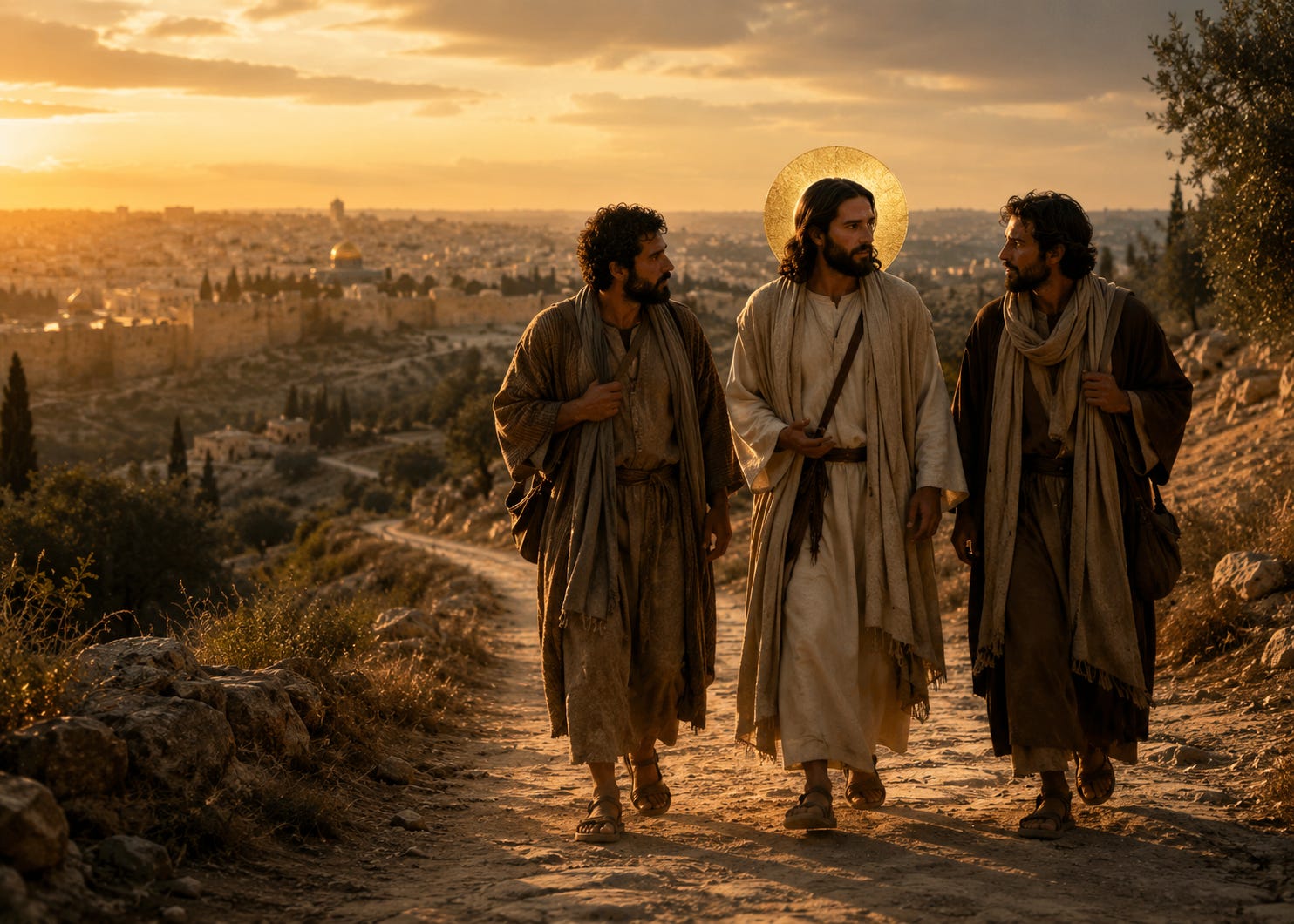
The Road to Emmaus.
Two disciples are walking away from Jerusalem after the crucifixion.
They are discouraged.
Confused.
Disappointed.
The movement they had invested themselves in appears to have collapsed.
The man they believed might change everything has been executed by the state.
As far as they can tell, they were wrong.
Church tradition suggests these were not casual observers. These were people who had sacrificed something to follow Jesus. They had invested hope, time, energy, and belief.
Now they are walking down a dusty road trying to make sense of their disappointment.
They carry the familiar blend of anger, disappointment, resentment, and doubt.
They sound a lot like many people I meet today.
People who feel let down by religion.
People who have watched church leaders fail.
People who have experienced hypocrisy.
People who have been carrying a grab bag of religious trauma and found no good place to set it down.
What fascinates me is Jesus’ response.
He does not scold them.
He does not accuse them of lacking faith.
He does not hand them a grievance-laden press release.
He walks with them.
He listens.
He lets them tell Him His own story.
He allows them to voice their disappointment.
He stays in conversation long enough for their hearts to begin catching up with the truth.
And then, Luke tells us, they recognize him in the breaking of the bread.
Of course they do.
Because that is where Jesus so often reveals himself.
Not through domination.
Not through humiliation.
Not through winning an argument.
Through presence.
Through relationship.
Through a shared table.
Imagine the story another way.
Imagine Jesus responding to their discouragement by calling them heretics.
Imagine him leaving a scathing anonymous comment on their Facebook wall.
Imagine him publishing a blistering statement about their insufficient commitment.
The idea is absurd.
Almost funny.
Because instinctively we know that is not how Christ treats wounded people.
He walks with them.
He listens.
He breaks bread.
And in that moment, their faith begins to return.
Even in an age of declining religiosity, the Church still carries extraordinary influence.
People listen.
More than we sometimes realize.
One of the things that has fascinated me about Pope Leo is watching people who would never set foot inside a church pay attention to what he says.
Not because they suddenly agree with every Roman Catholic doctrine.
Not because they have become secretly religious.
But because there is something compelling about watching a person embody the Gospel rather than argue about it.
Frankly, I find myself responding to that too.
When faith becomes embodied, people lean in.
When faith becomes primarily a vehicle for outrage, they tend to walk away.
The Church has never needed more angry defenders.
It has always needed more convincing witnesses.
The Church will always need people willing to overturn a table when the moment genuinely demands it.
The problem is that many of us have mistaken the exception for a vocation.
Jesus overturned tables once.
He broke bread constantly.
Modern Christians have spent a great deal of time emulating the exception while neglecting the habit.
The world does not need more Christians looking for someone to denounce.
It needs Christians willing to walk alongside disappointed people, listen to their stories, and break bread with them.
That’s how Jesus revealed himself at Emmaus.
It’s still how how He reveals Himself today.
A Few Practices for This Week
1. Notice what your anger is asking of you.
Before posting, sharing, or replying, ask: Is this anger moving me toward repair, courage, and truth, or is it simply giving me a rush?
2. Read Luke 9:51-56 slowly.
Pay attention to James and John. Do not mock them too quickly. Notice where you recognize yourself.
3. Delay one reaction.
When something online makes you angry, wait thirty minutes before responding. If thirty minutes feels impossible, that is useful information.
4. Pray for someone you would rather defeat.
Not performatively. Not smugly. Ask God to bless, heal, correct, and guide them. Then ask God to do the same for you.
5. Break bread on purpose.
Share coffee, a meal, or a real conversation with someone this week. Give them your attention. Do not treat every relationship as a debate waiting to happen.
Community Oriented Closing
If this reflection resonated with you, I would love to hear your thoughts in the comments.
Where have you seen outrage crowd out compassion?
Where have you seen someone choose witness over warfare?
And where do you feel Christ asking you to break bread when you would rather overturn a table?
If you know someone exhausted by the constant cycle of religious anger, political anger, or online anger, consider sharing this with them.
This community grows best when thoughtful people bring other thoughtful people to the table.
Prayer
Lord Jesus,
You knew righteous anger, yet you never allowed anger to become your identity. You confronted injustice without surrendering to hatred. You spoke truth without losing compassion. You defended the vulnerable while continuing to see the humanity of those around you.
Teach us to follow that path.
We confess that anger often feels easier than understanding. It is easier to condemn than to listen. Easier to assume the worst than to remain curious. Easier to seek enemies than to build community.
Give us wisdom to recognize when our outrage has become a substitute for discipleship.
When we encounter cruelty, grant us courage. When we face injustice, grant us conviction. When we are wounded, grant us healing. When we are tempted to dehumanize others, remind us that every person carries your image.
Help us become people who tell the truth clearly and love generously.
Make our homes, our churches, and our communities places where bread is broken more often than relationships.
And when we fail, draw us back again to your table, where mercy and transformation meet.
Amen.
Before you go, I want to thank the people who make this work possible.
Message From the Margins remains largely free because ordinary readers have chosen to support it.
Not because they agree with every word, I would be concerned if you did.
Not because they need more content.
But because they believe thoughtful, compassionate Christianity is worth preserving.
One new subscriber recently wrote:
“Most importantly, you have convinced me that my small life on this earth matters.”
That sentence captures much of what I hope this ministry offers.
If this space has helped you pray more deeply, think more clearly, or remain compassionate in difficult times, I’d be honored to have you join our paid community.
Thank you for reading.
Thank you for being here.
And thank you for helping build something steadier than outrage.