

Before we begin, I want to say something plainly.
I believe spaces like this need to exist right now.
Places where Christianity is not reduced to tribal outrage, political idolatry, culture war performance, or fear-driven manipulation. Places where people can wrestle honestly with faith, public life, morality, psychology, Scripture, and the human condition without being forced into ideological hysteria masquerading as spirituality.
That is what I am trying to build here.
And while I make many of these reflections available freely because I believe people genuinely need them, the reality is that independent Christian voices like this only survive if readers decide they are worth supporting.
So if you believe thoughtful, grounded, Christ-centered spaces must continue existing as a counterweight to Christian nationalism, public cruelty, golden calves, conspiracy-driven religion, and performative outrage, I want to ask you directly to become a supporting member today.
Not because I want to build an empire.
Because I think the Church desperately needs healthier voices still willing to speak honestly.
With Tremendous Gratitude for your presence and support,
And so we begin…
The Golden Statue and the Crisis of American Faith
Ancient idolatry still speaks to modern political life.
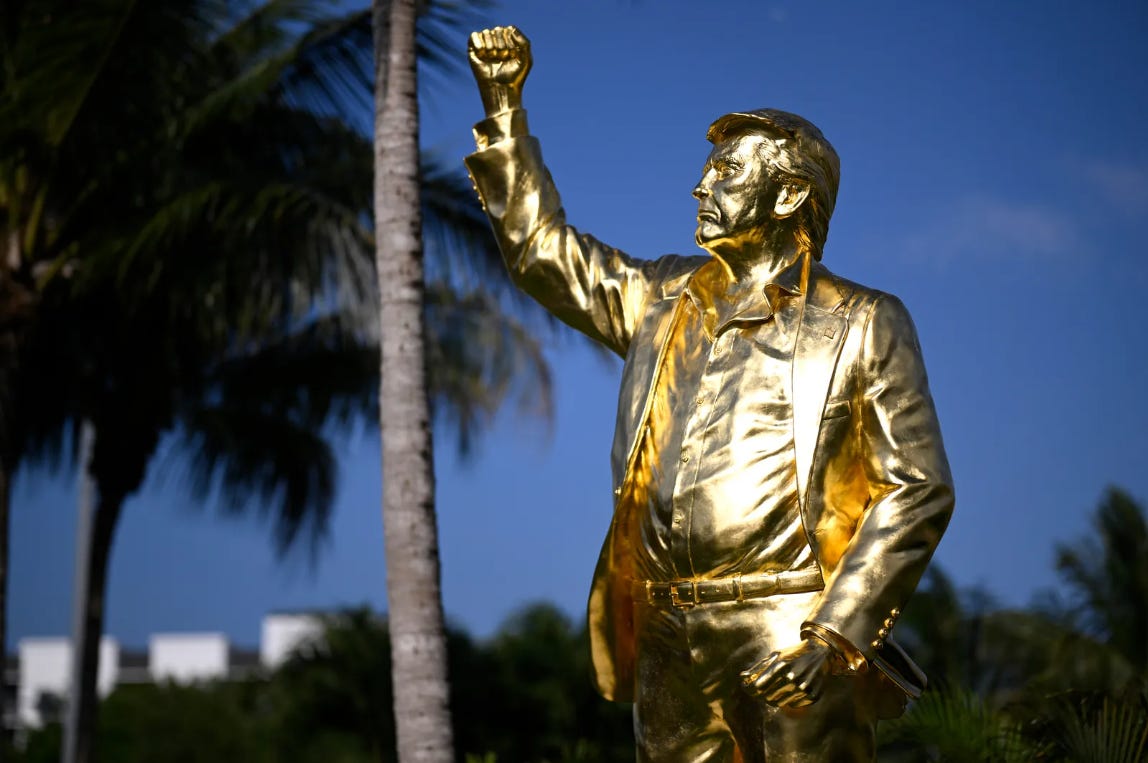
A few nights ago, I was sitting in bed scrolling through the news after Evening Prayer, half exhausted, half unable to look away from the modern American habit of turning politics into a reality show. I saw the photographs from Trump National Doral, Miami. The gold statue. The prayers. The ceremony around Donald Trump. And then the article about Rev. Mark Burns dedicating the statue with explicitly spiritual language.
I actually put my phone down for a minute.
Not because politics shocks me anymore. Honestly, after the last decade, very little does.
What stopped me was the feeling of disorientation.
The kind that settles into your chest when something crosses from ordinary political theater into something almost mythic, almost religious, almost surreal. Like watching people blur categories that should remain distinct, then acting as though the confusion itself is holy.
I suspect a lot of people feel this way lately, whether they are conservative, progressive, exhausted independents, or people who have mostly given up on public life altogether. You look around and wonder whether everyone else has become numb to things that should still trouble us.
And for Christians, there is an additional layer of grief in moments like this.
Because Scripture has very strong opinions about gold statues.
The image from Exodus is almost impossible to avoid. Moses goes up the mountain. The people grow anxious waiting. Uncertainty becomes intolerable. So they melt down their jewelry and build something visible, immediate, emotionally satisfying. A god they can point to. A god who feels strong. A god who reflects their fears and desires back to them.
“The people sat down to eat and drink and got up to indulge in revelry.” (Exodus 32:6, NIV)
The golden calf was not really about cattle.
It was about anxiety.
Human beings have always struggled with uncertainty. Neurologically, uncertainty activates threat responses in the brain. We become more impulsive, more tribal, more vulnerable to authoritarian personalities promising safety and clarity. There is good psychological research on this. Under stress, people often trade complexity for certainty because certainty feels emotionally stabilizing.
Even false certainty.
Especially false certainty.
And honestly, I understand the temptation more than I wish I did.
When the world feels chaotic, when institutions fail, when economic pressure rises, when social change moves faster than people can emotionally process, many people begin searching for strong figures who seem immovable. Somebody loud enough to drown out ambiguity. Somebody theatrical enough to feel larger than life.
Politics can become a substitute liturgy before people even realize it has happened.
I’m sorry to interrupt, can I pause here for a moment?
One of the reasons I care so deeply about this publication is because I think many Christians feel spiritually homeless right now. They love Christ, but no longer recognize the fear, rage, conspiracy thinking, political worship, and emotional manipulation that increasingly dominate parts of modern religious culture.
I want this space to remain different.
Thoughtful.
Grounded.
Spiritually serious without becoming hysterical.
Compassionate without surrendering moral clarity.
But work like this only continues if readers choose to support it. So if you believe Christianity should still sound like Jesus instead of a permanent outrage campaign, becoming a supporting member genuinely helps keep spaces like this alive.
We Continue…
You start seeing signs that look less like civic participation and more like devotional behavior. The language shifts. The emotional energy shifts. Critics become heretics. Loyalty becomes moral purity. Public figures stop being treated as flawed human beings and start being treated as vessels of destiny.
Christians are not immune to this.
We never have been.
The early Church lived surrounded by emperor worship. Rome regularly fused political power with sacred imagery. Caesars were called sons of god. Public loyalty became spiritual obligation. Refusing to participate could cost you your livelihood, your freedom, sometimes your life.
The Christians did not resist because they hated government. Saint Paul explicitly tells believers to pray for rulers. Christians have long believed public order matters.
But the Church also understood something deeply important: no political leader can carry the weight of ultimate meaning.
That burden destroys both the leader and the people projecting salvation onto him.
I think this is one reason Jesus consistently resisted becoming the kind of Messiah people wanted. They wanted spectacle. National triumph. Immediate domination over enemies. A king draped in visible power.
Instead, Christ keeps moving toward the vulnerable. The sick. The poor. The outsider. The sinner. The frightened.
And eventually toward a cross.
Which is still scandalous.
A cross is useless as propaganda branding. It does not project invincibility. It does not flatter our tribal instincts. It exposes them.
The thing that troubles me most about the golden statue is not actually the statue itself. Human beings have always built symbols. We are symbolic creatures.
What troubles me is how quickly Christians can lose their center when fear enters the bloodstream of a culture.
I see it pastorally all the time.
People become exhausted by outrage cycles and algorithmic panic. Their nervous systems stay flooded. They consume catastrophic news all day long. Every disagreement feels apocalyptic. Every election becomes the final battle between absolute good and absolute evil.
That state of chronic emotional activation changes people spiritually.
You stop praying with openness and start praying mainly for domination over enemies.
You stop listening.
You stop discerning.
You stop noticing the image of God in people you fear.
And eventually, almost without realizing it, you begin defending things you once would have recognized as deeply unhealthy because they are attached to someone or something that makes you feel protected.
I need to say something carefully here.
This is not only a conservative problem.
Liberals can build secular messiahs too. Progressives can become morally self-righteous in ways that mirror the very religious extremism they condemn. Every tribe has its idols. Every ideology is capable of demanding total emotional allegiance.
Christians are called to something harder than partisan worship.
We are called to truth.
Sometimes that truth comforts us. Sometimes it embarrasses us in front of our own political team.
The Church has survived emperors, dictators, corrupt bishops, televangelists, scandals, national collapses, wars, persecutions, and movements that once looked unstoppable. Two thousand years is a very long time. Political personalities rise like fireworks and disappear just as quickly.
Christ remains.
Not because Christians have always behaved well. God knows we have not.
Christ remains because the Gospel addresses something deeper than political identity. It addresses the human heart itself, including our appetite for idols.
And idols are not always statues.
Sometimes they are ideologies.
Sometimes they are movements.
Sometimes they are charismatic personalities onto whom we project our fear, rage, or longing for control.
Saint Augustine once wrote that the human heart is restless until it rests in God. I think modern life has intensified that restlessness. We are flooded with stimulation, outrage, advertising, dopamine manipulation, tribal sorting, and endless pressure to perform certainty online. Very few people are emotionally regulated enough anymore to sit inside ambiguity without immediately searching for someone to blame or worship.
That has spiritual consequences.
But this is also where I think Christians can offer something genuinely healing to the world right now.
You do not have to amputate your intellect to keep your faith.
You do not have to surrender moral clarity in order to reject hysteria.
You do not have to choose between caring about justice and remaining spiritually grounded.
You do not have to become emotionally numb in order to survive the news cycle.
And you do not need to treat any politician, commentator, influencer, or movement as a functional savior.
Christians should be capable of critical thought precisely because our hope is not ultimately resting on election outcomes or public personalities. That kind of spiritual grounding allows a person to remain compassionate without becoming naïve, morally serious without becoming consumed by hatred.
Frankly, some days that balance is difficult.
I feel it too.
There are moments lately when the country feels exhausted in a way I do not fully know how to describe. Everybody seems overstimulated, frightened, angry, lonely, suspicious, and chronically online all at once. Sometimes public life feels less like democracy and more like a giant nervous system having a panic attack in real time.
And then you see a golden statue receiving religious dedication language, and it feels like a scene from the Book of Kings wandered onto your phone screen between weather updates and dog videos.
It would almost be funny if it were not spiritually serious.
Still, I do not think despair is the Christian response.
Discernment is.
Steadiness is.
Prayer is.
Refusing to surrender your conscience is.
Keeping your humanity intact is.
The Gospel has survived stranger centuries than ours.
A Few Practices For This Week
-
Read Exodus 32 slowly.
Not as ammunition against political opponents, but as a mirror for the human tendency toward fear-driven idolatry. -
Limit one cycle of outrage consumption each day.
Your nervous system was not designed to absorb constant political stimulation twenty-four hours a day. -
Pray for leaders you dislike.
Not performatively. Actually pray for them. It changes the condition of your own heart. -
Spend fifteen minutes in silence without screens.
No podcasts. No scrolling. No commentary. Let your mind settle enough to hear your own thoughts again. -
Ask yourself one honest question:
“What am I tempted to trust more than God right now?”
Sit with the answer long enough for it to become real.
The comments section here has become one of the few places online where people still seem capable of thoughtful disagreement without immediately dehumanizing each other. I am deeply grateful for that.
If this reflection resonated with you, share it with someone who feels spiritually exhausted by the noise of modern public life. A lot of people are carrying more confusion and anxiety than they admit out loud.
And for those trying to keep faith while the world occasionally feels absurd beyond comprehension, I think Christ understands that feeling better than we realize.
Closing Prayer
Lord Jesus Christ,
You entered a world crowded with empires, public spectacle, religious corruption, fear, and human hunger for power. You understood how easily people mistake strength for goodness, noise for truth, and certainty for wisdom.
Keep our hearts anchored in You.
When public life becomes overwhelming, protect us from surrendering our conscience for the comfort of belonging. When fear spreads through our culture, keep us from becoming cruel. When leaders disappoint us, keep us from despair. When outrage becomes addictive, teach us how to remain awake without becoming consumed.
Give us courage to think clearly. Give us humility to recognize our own blind spots. Give us compassion for people trapped inside fear and manipulation, including ourselves.
Teach us how to pray without becoming passive, how to pursue justice without hatred, and how to remain faithful without turning politics into religion.
Help us remember that Your kingdom is not built through spectacle, domination, or golden images, but through truth, mercy, sacrifice, and love.
And when the world feels unstable and strange, steady us again in Your presence.
Amen.
Before you go, I want to say this carefully.
I think many people are exhausted by what religion is becoming in public life.
They are tired of faith being fused with domination, spectacle, manipulation, conspiracy, cruelty, and endless outrage. They are tired of watching Christianity used more often to inflame fear than to cultivate wisdom, humility, compassion, courage, or love.
Part of why this ministry exists is to resist that drift.
Not by abandoning Christianity, but by returning more fully to Christ.
To seriousness without fanaticism.
To conviction without dehumanization.
To moral clarity without idolatry.
To faith that remains thoughtful, emotionally grounded, and spiritually alive.
That kind of work requires support to continue.
So if this reflection resonated with you, if you believe thoughtful Christian spaces like this matter in the world we are living through, I want to invite you to become a supporting member today.
Not as a transaction.
As an act of stewardship for the kind of Christianity you hope still has a future.