

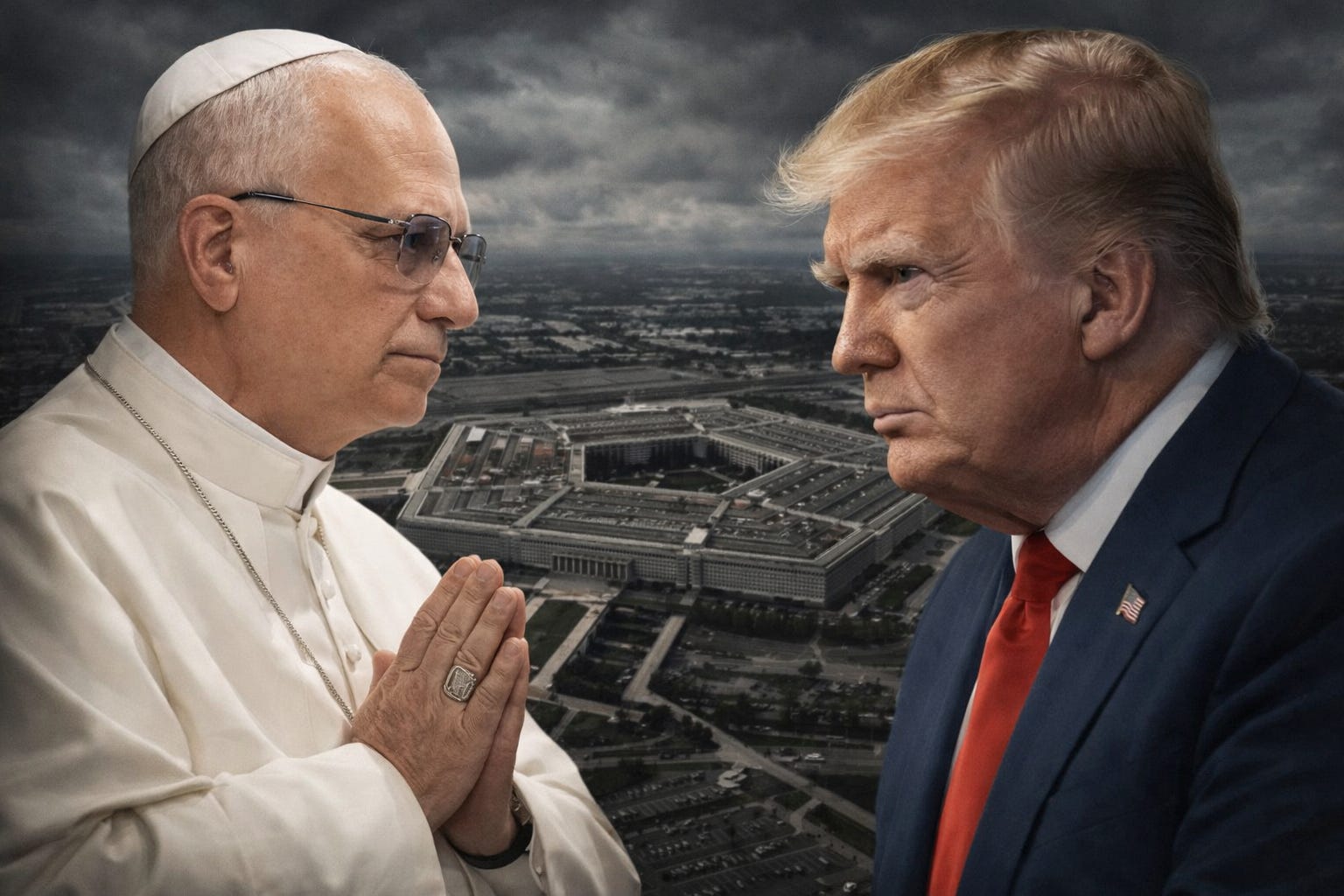
There is a reason powerful institutions get nervous when religious leaders start speaking plainly about war.
Not because the church has tanks. Not because bishops command armies. Not because popes can outmaneuver a Pentagon briefing room. They get nervous because moral clarity has a way of exposing what force tries to hide. And once that happens, the usual language of necessity, strategy, and national interest starts to sound thinner than it did a moment before.
That is why this reported story matters.
According to the account circulating in Letters from Leo, a senior U.S. defense official reportedly confronted the Vatican’s ambassador in a closed-door meeting and invoked the Avignon Papacy, that dark period when the Church was bent to political power under the French crown. The implication was hard to miss. This was not simply diplomatic disagreement. It was a warning. A reminder that empires have always preferred a Church that knows its place… and that even now, power is willing to apply pressure when the Church refuses to cooperate.
Whether every detail of that meeting is eventually confirmed or further clarified, the moral tension at the center of the story is immediately recognizable. A pope speaks against war. A military establishment, shaped by the logic of power, treats that witness not as a gift but as a problem.
And that is the real story.
The world you’re living in isn’t just noisy.
It’s carefully engineered to rob your attention.
Not in a dramatic way…
but in a precise, studied one.
Carefully created by behavioral psychologists
employed by America’s biggest companies.
employed by America’s biggest companies.
And over time, it shapes how you think, react, and feel.
That may sound like hyperbole, but it’s not.
It’s well documented publicly available information.
It’s well documented publicly available information.
If you’ve been feeling more scattered than you used to… there’s a reason.
In the paid Message From the Margins Substack, we’re working through how to stay grounded in the middle of that.
If you want to be part of it, you can join by selecting any paid tier here:
At the center of this is Pope Leo XIV’s anti-war stance, especially in a political climate where conflict with Iran and the expansion of military rhetoric have once again made it tempting for public leaders to dress violence in the language of order, protection, and even righteousness. The old temptation is always the same. Take the machinery of war, wrap it in sacred language, and hope no one notices the blood.
But Scripture notices.
“When you spread out your hands in prayer,” the prophet Isaiah says, “I hide my eyes from you… your hands are full of blood.” Those are not polite words. They are not meant to be. Isaiah understood what religious people are forever tempted to forget, that worship does not sanctify injustice. Prayer does not cleanse cruelty. Invoking God does not make violence holy.
That is why Christians need to be very careful here. The question is not simply whether one agrees with a particular pope, administration, or policy argument. The deeper question is whether the Church will remain free enough to say that not everything a nation can do is something it should do, and not everything a government calls necessary is therefore moral.
This is where the story moves beyond diplomacy and into discipleship.
Because the Church has always faced this test. Will it stand near the wounded, or near the powerful? Will it bless the sword, or will it speak for those who are cut by it? Will it obey the emotional pressures of the moment, or will it remember that Christ was killed by an alliance of political fear, public theater, and institutional self-protection?
That last part is deeply important.
We have just completed our commemoration of Christ’s Passion, and in that we are reminded that the crucifixion is not only a private spiritual event. It is also a public one… a collision between truth and power, between conscience and authority, between a man who refused to sanctify violence and a system that depended on it. It is also a public revelation of how power behaves when truth becomes inconvenient. Jesus was not executed because he was vague. He was executed because he would not let power define reality on its own terms. He kept telling the truth about God, neighbor, and the human person. He kept crossing boundaries. He kept refusing the logic that says order matters more than mercy.
So when Christians watch statesmen, generals, or political operatives grow irritated with peacemaking language, none of this should feel unfamiliar.
“Blessed are the peacemakers, for they will be called children of God.” Jesus did not say, blessed are those who make war sound respectable. He did not say, blessed are those who know how to give cruelty better branding. He blessed the peacemakers, which is far more demanding. Peacemaking is not passivity. It is not naivete. It is not surrender to evil. It is the hard, often costly work of refusing the lie that violence is always the clearest proof of seriousness.
And that lie has deep roots.
The reported reference to the Avignon Papacy is revealing for precisely that reason. History is full of moments when political authorities tried to domesticate religious witness, not always by outright persecution, often by pressure, proximity, access, and flattery. Just stay in your lane. Speak about souls, not systems. Offer comfort, not challenge. Pray over the consequences, but do not question the decisions that created them.
In every age there are Christians willing to accept that bargain.
Some do it out of fear. Some out of ambition. Some because they have so thoroughly confused their nation with the kingdom of God that they can no longer tell the difference between patriotism and idolatry. But whatever the motive, the result is the same. The Church stops sounding like the Body of Christ and starts sounding like a chaplain to empire.
And once that happens, human beings pay the price.
They always do.
Civilians in war zones pay it first. Families pay it. The poor pay it. The nameless pay it. The people whose lives are summarized later as “collateral damage” pay it with an intimacy no policy paper ever captures. This is one reason Christians must resist abstraction in stories like this. War is never merely strategic. It is always personal for someone. It tears through bodies, homes, childhoods, and futures. It leaves graves where officials once offered talking points.
That is why any attempt to pressure the Church into silence, or into softer speech, matters so much. It is not only about institutional turf. It is about whether someone will still be willing to say that the lives at the far end of our decisions are not expendable.
If we are honest, most of us know some smaller version of this temptation in our own lives.
The scale is different, of course, but the moral logic is familiar. We know what it is to soften the truth because someone important might be offended. We know what it is to stay quiet in the room where a harmful decision is being dressed up as realism. We know what it is to let proximity to power make us less brave than we meant to be. We know how easy it is to confuse access with influence, and silence with prudence.
That is why stories like this matter not only as headlines, but as examinations of conscience.
They ask whether we still believe that truth should be spoken when it is costly. They ask whether faith is merely decorative in public life, or whether it still has the strength to confront violence, hypocrisy, and moral cowardice. They ask whether we want a Church that comforts the afflicted and afflicts the comfortable, or merely one that lends sacred music to the next act of national self-justification.
The Book of Acts gives us one of the clearest lines in all of Christian Scripture: “We must obey God rather than human beings.”
That is not a slogan for defiance for its own sake. It is a reminder of order. God first. Conscience first. Human dignity first. The image of God in every person first. That has to remain true whether the pressure comes from Caesar, from a crowd, from a party, or from a defense apparatus convinced that moral resistance is a public nuisance.
The moment power feels threatened by the Church’s moral voice is the moment the Church must decide whether it still has one.
And perhaps that is the deepest spiritual question beneath this story. Not only whether the Pentagon said what it reportedly said, but whether Christians are prepared to be troubled by it. Whether we still recognize coercive power when it speaks in polished tones. Whether we still expect the Church to tell the truth when war is on the table. Whether we still believe the Gospel is something more than a ceremonial gloss for whatever the powerful were going to do anyway.
The Church does not need to win a contest of force with the state. It never could. That was never its calling.
Its calling is harder.
To remember the human face behind every policy. To say no when no is required. To refuse the seduction of relevance purchased at the expense of witness. To stand where Christ stands, which is almost never comfortably near the machinery of violence and very often near those crushed by it.
That is not weakness. That is courage.
And in an age that increasingly confuses moral clarity with disloyalty, it may be one of the few forms of Christian credibility we have left.
If this essay speaks to you, share it with someone who is wrestling with what faith asks of us in public life. And if you want more writing like this, grounded in the collision of conscience, culture, and the Gospel, subscribe and stay with me.