

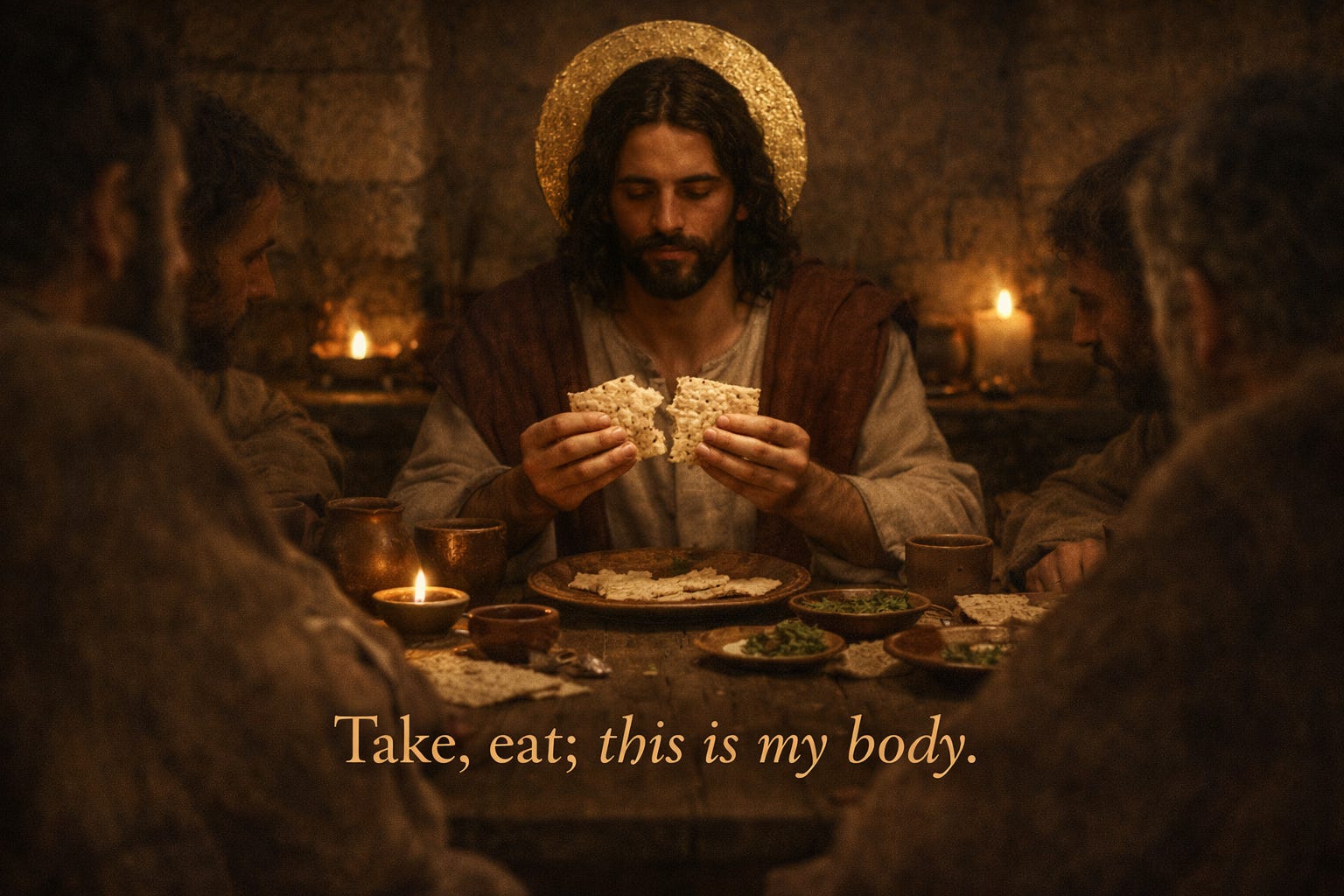
Holy Thursday is the night the Church was given her center.
Not an idea. Not a philosophy. But a real presence… offered, broken, and shared.
It is the night everything changed… quietly, almost gently… while the world outside carried on as if nothing was happening.
No crowds shouting. No public triumph.
Just a table. A towel. Bread. Wine. And a love so deliberate, so embodied, that it would carry Christ all the way to the Cross.
And if we’re honest, this is where many turn away.
Because Holy Thursday is not just something to admire. It is something that asks something of us.
The Night of the Last Supper
Holy Thursday, also called Maundy Thursday, marks the beginning of the Sacred Triduum, the three holiest days of the Christian year. The word “Maundy” comes from the Latin mandatum, meaning “commandment,” referring to Jesus’ words:
“A new command I give you: Love one another. As I have loved you, so you must love one another.” (John 13:34, NIV)
That command is not spoken in abstraction. It is enacted.
The Gospel places us in an upper room in Jerusalem during the Passover meal. Jesus gathers with his disciples, fully aware of what is coming. He knows betrayal is already in motion. He knows suffering is hours away.
And still… he chooses to stay present.
During that meal, he takes bread, blesses it, breaks it, and gives it to them:
“This is my body, given for you; do this in remembrance of me.” (Luke 22:19, NIV)
Then the cup:
“This cup is the new covenant in my blood, which is poured out for you.” (Luke 22:20, NIV)
In that moment, the Church understands that Christ institutes the Eucharist, the sacramental way he remains with his people. Not symbolically alone, but really, intimately, personally present.
This is also the night the priesthood is born. Christ entrusts his presence and this act of remembrance to the apostles, not as a performance, but as a continuation of his own self-giving.
But the night does not stop at the table.
It moves to the floor.
The Towel and the Basin
In one of the most startling moments in all of Scripture, Jesus rises from the table, removes his outer garment, wraps a towel around his waist, and begins washing the feet of his disciples.
This was the work of a servant… not a teacher, not a rabbi, certainly not the Messiah.
Peter protests, because it feels wrong.
And that’s exactly the point.
Jesus is redefining power.
“If I then, your Lord and Teacher, have washed your feet, you also should wash one another’s feet.” (John 13:14, NIV)
Holy Thursday is not only about receiving Christ. It is about becoming like him.
Not in grand gestures, but in ordinary, humbling, inconvenient love.
How the Church Has Remembered This Night
From the earliest centuries, Christians have marked this day with deep reverence.
The Eucharist is celebrated with particular solemnity. The altar is often stripped afterward, a stark visual reminder that something is about to be taken away. The consecrated Eucharist is processed to a place of repose, inviting the faithful to keep watch, echoing Jesus’ agony in the garden.
Foot washing became a powerful ritual expression of Christ’s commandment to love through service. It is not a performance, but a lived parable.
And perhaps most haunting of all… the liturgy does not end the way it usually does.
There is no final blessing.
Because the story is not finished.
The Church simply pauses… and waits.
Why Holy Thursday Still Matters Now
We live in a world obsessed with visibility, influence, and control.
We measure worth by productivity, platform, and power. Even in the Church, it can be easy to drift into a version of faith that is more about being seen than being faithful.
Holy Thursday cuts straight through that illusion.
It tells us that the center of the Christian life is not dominance… it is self-gift.
It tells us that God does not remain distant, but comes close, even to the point of placing himself in our hands… vulnerable, breakable, given.
And that is deeply important.
Because many people today are exhausted.
Exhausted by striving. Exhausted by trying to prove their worth. Exhausted by relationships that feel transactional or conditional.
Holy Thursday offers a different vision.
A God who kneels.
A God who feeds.
A God who stays.
And at the same time, it confronts us.
Because it is one thing to receive that kind of love.
It is another thing entirely to live it.
To forgive when it costs you.
To serve when no one notices.
To stay present when it would be easier to withdraw.
To love people who are, quite often, difficult to love.
This is not sentimental spirituality.
This is costly, embodied discipleship.
And yet… it is also where freedom begins.
Practical Ways to Enter Holy Thursday
Take a few minutes tonight to read John 13 slowly. Let the foot washing scene sit with you.
If you attend Mass, and I hope you do, pay attention to the small details, the silence, the movement, the stripping of the altar. Let it speak.
Identify one concrete way you can serve someone this week, quietly, without needing recognition.
Spend time in stillness, even briefly, as a way of “keeping watch” with Christ.
Carry this question with you: Where is God inviting me to love more humbly?
Closing Prayer
Lord Jesus Christ,
on this holy night you gave yourself to us, not in power,
but hidden under the appearance of bread and wine,
not in distance, but in closeness.
In Holy Communion.
You knelt before your disciples and washed their feet,
showing us that love is not about status, but about service.
We confess that we often resist this kind of love.
We prefer comfort over sacrifice, recognition over humility, control over surrender.
Yet you remain patient with us.
Teach us to receive your presence with reverence and gratitude.
Teach us to recognize you in the ordinary moments of our lives.
Teach us to love as you love, with courage, tenderness, and persistence.
Give us the strength to serve when it is inconvenient,
to forgive when it is difficult,
and to remain faithful when the path is uncertain.
Stay with us, Lord, as we walk with you into these sacred days.
Amen.
During Holy Week, it is my intention to keep the “noisier” parts of this newsletter to a minimum. That may run counter to how an algorithm-driven world works, but the spirit of this week and what we’re building here matters more.
But if this ministry is meaningful to you and you are able to help sustain it, you can find the link here: