

Palm Sunday is one of the most misunderstood days in the entire Christian calendar.
On the surface, it looks almost celebratory. People waving palms, singing “Hosanna,” a kind of spiritual parade marking Jesus’ entry into Jerusalem. It feels upbeat, almost triumphant. If you walked in halfway through, you might think this is a victory moment.
And it is… but not in the way we expect.
Because within minutes, the tone shifts. The same liturgy that begins with palms and praise quickly turns into the reading of the Passion. The crowd that cries out “Hosanna” becomes the crowd that shouts “Crucify him.” It is one of the most emotionally jarring movements in the entire Church year.
Palm Sunday doesn’t let us stay comfortable for very long. It pulls us straight into the tension at the heart of the Gospel.
The Day That Holds Two Stories at Once
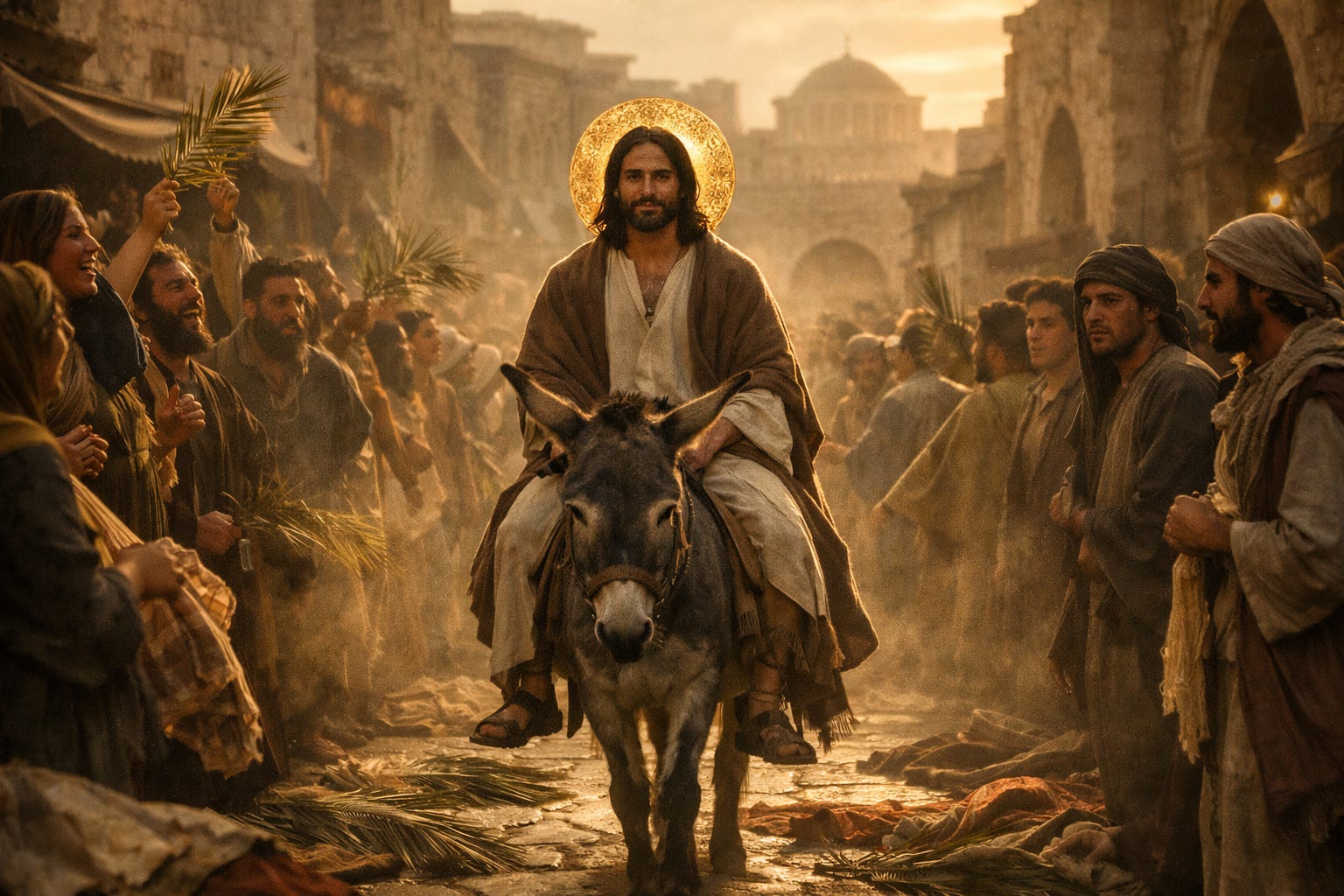
Palm Sunday marks Jesus’ entry into Jerusalem, described in all four Gospels. He rides in not on a warhorse, but on a donkey, a deliberate symbol of humility and peace. The crowds line the road, laying down cloaks and branches, shouting words drawn from Psalm 118, “Hosanna,” which means “save us.”
They are not wrong to celebrate him. They just misunderstand what kind of king he is.
Many were expecting a political liberator, someone who would overthrow Roman rule and restore national power. What they receive instead is something far more unsettling, a king who refuses violence, who speaks about suffering, who moves steadily toward the cross.
That is why the liturgy doesn’t stop at the procession. It moves immediately into the Passion narrative, usually from Matthew, Mark, or Luke depending on the year.
The Church holds both moments together on purpose. The praise and the rejection. The hope and the betrayal. The entry into Jerusalem and the path to Calvary.
Because they are not separate stories. They are the same story.
Why the Church Refuses to Separate Joy and Suffering
From the earliest centuries, Christians have marked this day as the beginning of Holy Week, the most sacred stretch of the liturgical year. It is not just a commemoration. It is an immersion.
The Church has long understood that if we only celebrate the palms, we miss the truth. And if we only focus on the cross, we miss it just as badly.
Palm Sunday teaches us something uncomfortable but deeply important. Human beings are capable of both devotion and denial, sometimes within the same breath.
Tradition teaches that the same voices that cried “Hosanna” could very well have been among those who later cried “Crucify him.” Whether or not it was literally the same individuals is almost beside the point. Theologically, it is all of us.
We welcome Christ when it suits our expectations. We resist him when he disrupts them.
That is why the Passion is read aloud with the congregation taking part. We are not spectators. We are implicated.
Palms, Crosses, and the Shape of Faith
Christians across the centuries have carried palm branches not as decorations, but as symbols of something deeper. Palms were ancient signs of victory, but in this context, they point to a different kind of triumph.
Not domination. Not force. Not control.
Faithfulness.
Over time, the Church began weaving palms into crosses, a quiet but powerful image. The symbol of celebration becomes the symbol of sacrifice. The moment of welcome becomes the path of surrender.
The Church has long understood that Palm Sunday is not about a fleeting emotional high. It is about the cost of following Christ all the way through.
Not just when it feels good. Not just when it is popular. But when it becomes difficult, inconvenient, or even costly.
Why Palm Sunday Still Cuts Close to Home
If we are honest, Palm Sunday feels uncomfortably familiar.
We live in a world of quick enthusiasm and quicker rejection. Public opinion turns overnight. Loyalty is often shallow. We celebrate people one moment and tear them down the next. It is not just cultural, it is deeply human.
And spiritually, we are not much different.
We welcome Christ when he affirms us, when he comforts us, when he aligns with what we already believe. But when he calls us deeper, when he challenges our assumptions, when he asks for surrender instead of control… we hesitate.
Sometimes we resist.
Palm Sunday asks a very direct question, quietly but persistently.
What kind of king are we willing to follow?
A king who confirms our expectations, or a king who transforms them.
A king who conquers our enemies, or a king who teaches you how to love them.
A king who stays at a distance, or a king who walks straight into suffering.
This is where the day becomes deeply personal. Because the Passion is not just something that happened then. It reveals patterns that are still alive in us now.
Our fear of commitment. Our instinct to protect ourselves. Our discomfort with anything that asks too much of us.
And yet, this is also where hope begins.
Because Jesus does not turn away from the crowd’s instability. He walks straight through it, steady, clear, and faithful. He is not surprised by human inconsistency. He absorbs it, carries it, redeems it.
That is the kind of king Palm Sunday reveals.
A Few Ways to Enter This Week Intentionally
-
Sit with the Passion narrative slowly this week. Not as a story you already know, but as something that still has the power to unsettle you.
-
Notice where you see yourself in the crowd, in the disciples, in Peter, in Pilate. Let it be honest.
-
Hold onto one phrase from the Gospel and carry it with you throughout the week.
-
Make space for quiet. Even ten minutes a day without distraction can open something deeper.
-
If possible, participate in the liturgies of Holy Week. They are not just symbolic, they are formative.
-
Ask yourself one simple question each day, where am I resisting Christ’s way right now… and what would trust look like instead?
Closing Prayer
Lord Jesus Christ,
You entered Jerusalem not with power, but with humility,
not to conquer by force, but to love without limit.
As we walk with you through this holy week,
give us the courage to see ourselves honestly,
to recognize the ways we welcome you with our words
and resist you with our lives.
Steady our hearts when faith feels costly.
Strengthen us when we are tempted to turn away.
Teach us to follow you not only in moments of celebration,
but in the quiet, hidden places where real transformation begins.
Help us to trust that your path, even when it leads through suffering,
is the path that leads to life.
Draw us closer to you,
that we may walk with you to the cross
and, in time, into the hope of resurrection.
Amen.
Palm Sunday is one of those days priests joke we get to see the whole flock… the “CAPE Catholics” show up, Christmas, Ash Wednesday, Palm Sunday, and Easter.
But there’s something beautiful about that too. Something worth paying attention to.
Do you have any Palm Sunday traditions, something you’ve carried over the years? I’d love to hear about it. Let me know in the comments.