

My Dear Friends,
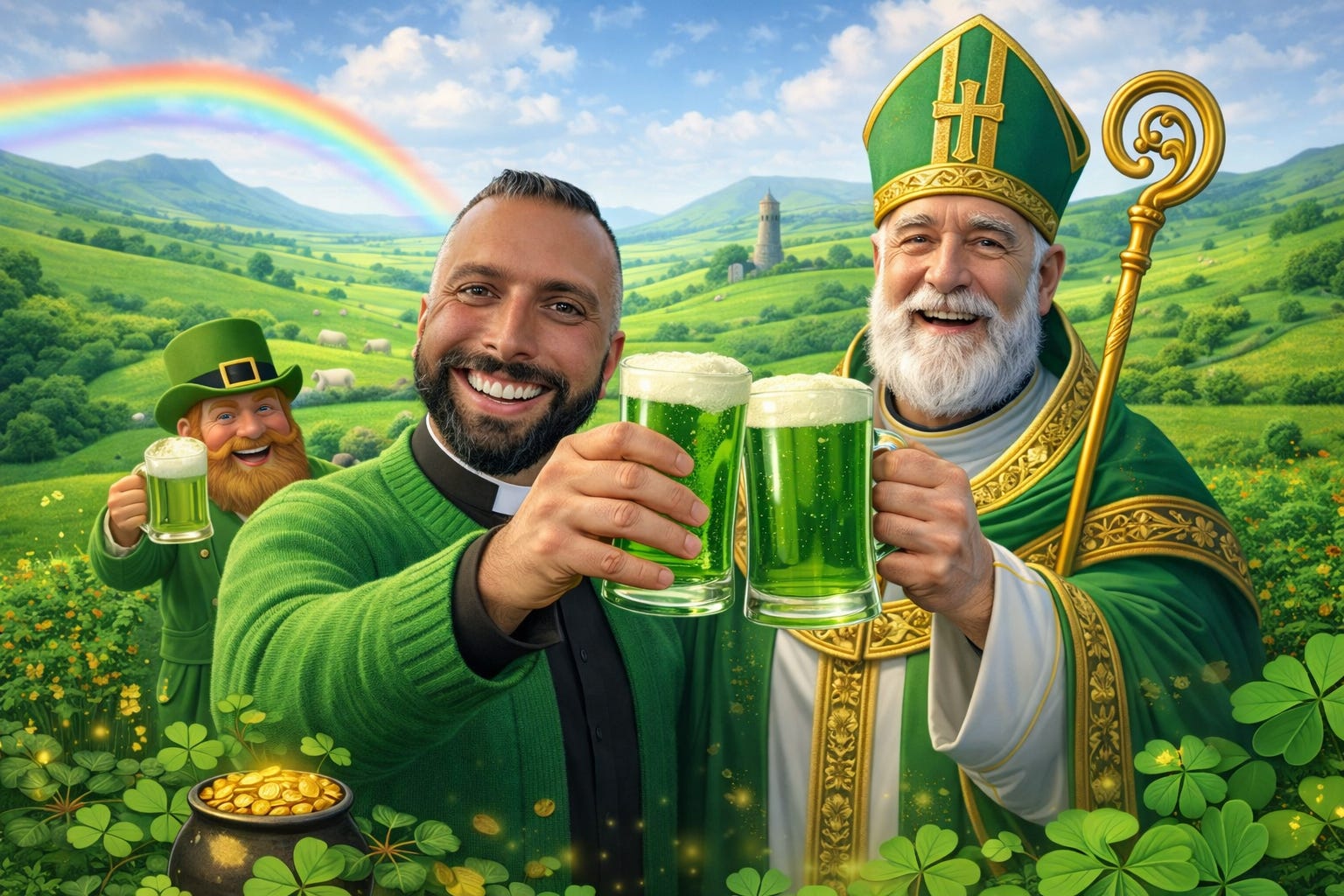
Before we get to today’s saint, I want to take a quick moment to wish you a very happy St. Patrick’s Day.
However you celebrate it, I hope the day brings you a little joy, a lot of laughter, and maybe even a bit of that famous Irish cheer. St. Patrick’s Day has a wonderful way of bringing people together. Friends gather, families reconnect, strangers become temporary companions over a shared toast, and for a day the world seems just a little more festive.
I’m grateful you’re here and part of this community. Truly. Message from the Margins only exists because thoughtful, curious people like you keep showing up, reading, reflecting, and sharing the journey of faith together.
If you’re heading out to celebrate today, enjoy it. Wear green. Raise a glass. Laugh loudly with friends. But let me offer one small pastoral reminder from your friendly neighborhood priest: part of celebrating well is taking care of one another. Make sure you have a safe ride home, look out for the people around you, and be the kind of person who helps everyone get through the night safely.
Joy and responsibility can absolutely live in the same celebration.
May the day be full of good company, good stories, and a few moments that remind you how good it is simply to be alive.
May the road rise up to meet you,

Without further ado, let’s talk about the real St. Patrick!
So, Who Was St. Patrick, Really?
Every March 17th, the world turns green.
Cities dye their rivers, people wear shamrocks, and suddenly everyone claims at least a distant Irish cousin. St. Patrick’s Day has become a global celebration. But here’s the funny part: the man at the center of it all probably wouldn’t recognize the holiday.
For one thing, Patrick wasn’t Irish.
::Pause for Groans::
And for another, the real story of his life is far more dramatic than any parade. It involves kidnapping, slavery, escape, visions, and a return to the very people who once enslaved him.
In other words, the real St. Patrick isn’t a cartoon saint waving a staff at snakes.
He’s the patron saint of second chances.
A Boy Taken Captive
Patrick was born in Roman Britain around the late fourth century, most likely somewhere in what is now England or Wales. His family was Christian, but by his own admission, he didn’t take faith very seriously as a boy.
Then everything changed.
When Patrick was about sixteen years old, Irish raiders attacked his village. They kidnapped him and carried him across the sea to Ireland, where he was sold into slavery. For six long years he worked as a shepherd, isolated in the cold countryside.
That loneliness became the turning point of his life.
In his own writings, Patrick says he began to pray constantly during those years. What had once been a casual family religion suddenly became real. Faith became the thing that sustained him through hardship and fear.
Eventually, Patrick believed he received a message in a dream telling him it was time to escape. He fled his captors and made the long journey back home to Britain.
You might think that would be the end of the story.
But it wasn’t.
The Man Who Went Back
After returning home, Patrick began studying for ministry. Over time, he became convinced that God was calling him to go back to Ireland, the place of his captivity.
Think about that for a moment.
The country where he had been enslaved.
The land that had taken his freedom.
The people who had once been his captors.
That was where Patrick believed he was meant to serve.
He returned to Ireland as a missionary bishop sometime in the fifth century. Instead of bitterness, he brought the Gospel. Instead of revenge, he brought patience and teaching.
Patrick traveled widely across Ireland, preaching, baptizing, and establishing Christian communities. He worked among tribal societies that had little connection to Roman culture, which meant he had to communicate the Christian message in ways people could actually understand.
Tradition says he used the shamrock to explain the Trinity. Whether that story is literal or symbolic, it captures something true about Patrick. He had a remarkable ability to translate the mystery of faith into language ordinary people could grasp.
By the time he died, Christianity had taken root across much of Ireland.
Miracles and Patronage
Over the centuries, many stories have grown up around St. Patrick.
The most famous is the claim that he drove all the snakes out of Ireland. Historians note that Ireland likely never had snakes after the Ice Age, so many scholars believe the story is symbolic. In Christian tradition, the “snakes” may represent the spiritual forces Patrick challenged through his preaching.
But symbolic does not mean meaningless.
Christians have long believed that Patrick’s ministry brought profound spiritual transformation to Ireland, turning a land of tribal warfare into one of the great centers of Christian learning in the early medieval world.
Patrick is now honored as the patron saint of Ireland, but his patronage extends further. He is often invoked by missionaries, converts to Christianity, and people seeking courage in difficult circumstances.
Tradition also attributes various healings and protections to his intercession. What stands out most in the stories about him is not spectacle, but spiritual authority. Patrick’s life radiated conviction, humility, and perseverance.
Why Patrick Matters Right Now
Patrick’s story lands differently when you strip away the cultural decorations.
He was a man who knew trauma.
He knew fear.
He knew displacement.
He knew what it felt like to have his life stolen from him.
And yet, the defining choice of his life was not anger.
It was forgiveness.
In a culture like ours, where outrage often feels like the default setting, Patrick reminds us that faith can take a different path. He didn’t let his worst experience define his future.
He allowed God to transform it.
Patrick also speaks to another modern struggle: identity. Today people often feel pulled between cultures, politics, and expectations about who they are supposed to be.
Patrick lived in that tension too.
He was Roman by birth, British by upbringing, and spiritually shaped by Ireland. Instead of seeing those identities as conflict, he allowed them to become bridges.
That’s how the Gospel spreads. Not through domination, but through translation.
Patrick knew how to speak across worlds.
And that might be the most important lesson he leaves us.
A Few Ways to Honor St. Patrick This Week
• Pray for the courage to forgive someone who has hurt you.
• Ask St. Patrick’s intercession for missionaries and those exploring faith.
• Spend time in quiet prayer outdoors, remembering Patrick’s years as a shepherd.
• Read Patrick’s own writings, especially The Confession of St. Patrick.
• Share the story of the real Patrick with someone who only knows the holiday version.
• And absolutely yes, have a green beer with friends or loved ones. Jesus loved gathering around tables with the people he cared about. Celebrate well, just don’t go overboard. Nobody enjoys a hangover.
A Prayer Through the Intercession of St. Patrick
Holy God,
you called St. Patrick from captivity into a life of courage and mission.
Through his witness, a nation came to know the light of Christ.
Through his intercession, grant us the grace to follow where you lead, even when the path requires courage we do not yet possess. When we carry wounds from the past, teach us the freedom of forgiveness. When fear tempts us to retreat, fill us with the quiet confidence that sustained Patrick in lonely fields and unfamiliar lands.
Strengthen our faith so that we may speak of Christ with humility, wisdom, and compassion. Help us become bridges of reconciliation in a divided world, just as Patrick became a messenger of hope among those who once held him captive.
May his example inspire us to trust that no place is beyond the reach of your grace.
We ask this through Christ our Lord.
Amen.
Fun Facts About St. Patrick
• St. Patrick left behind two authentic writings: The Confession and Letter to the Soldiers of Coroticus.
• The color originally associated with St. Patrick was blue. Green became popular much later.
• Ireland became one of the great centers of Christian learning after Patrick’s mission, preserving many classical texts during the early medieval period.
• The famous “Lorica of St. Patrick,” also called St. Patrick’s Breastplate, is an ancient prayer invoking God’s protection in every direction of life. You can find the text here, St. Patrick was… a bit long winded…
I’d love to hear from you in the comments. Do you have any St. Patrick’s Day traditions you grew up with or still keep today? A special meal, a prayer, a parade, a song, or maybe just gathering with people you love? Share it below so we can celebrate a little together.
If you have a friend who only knows St. Patrick as the patron saint of green beer, send this their way. The real story is far more interesting.