

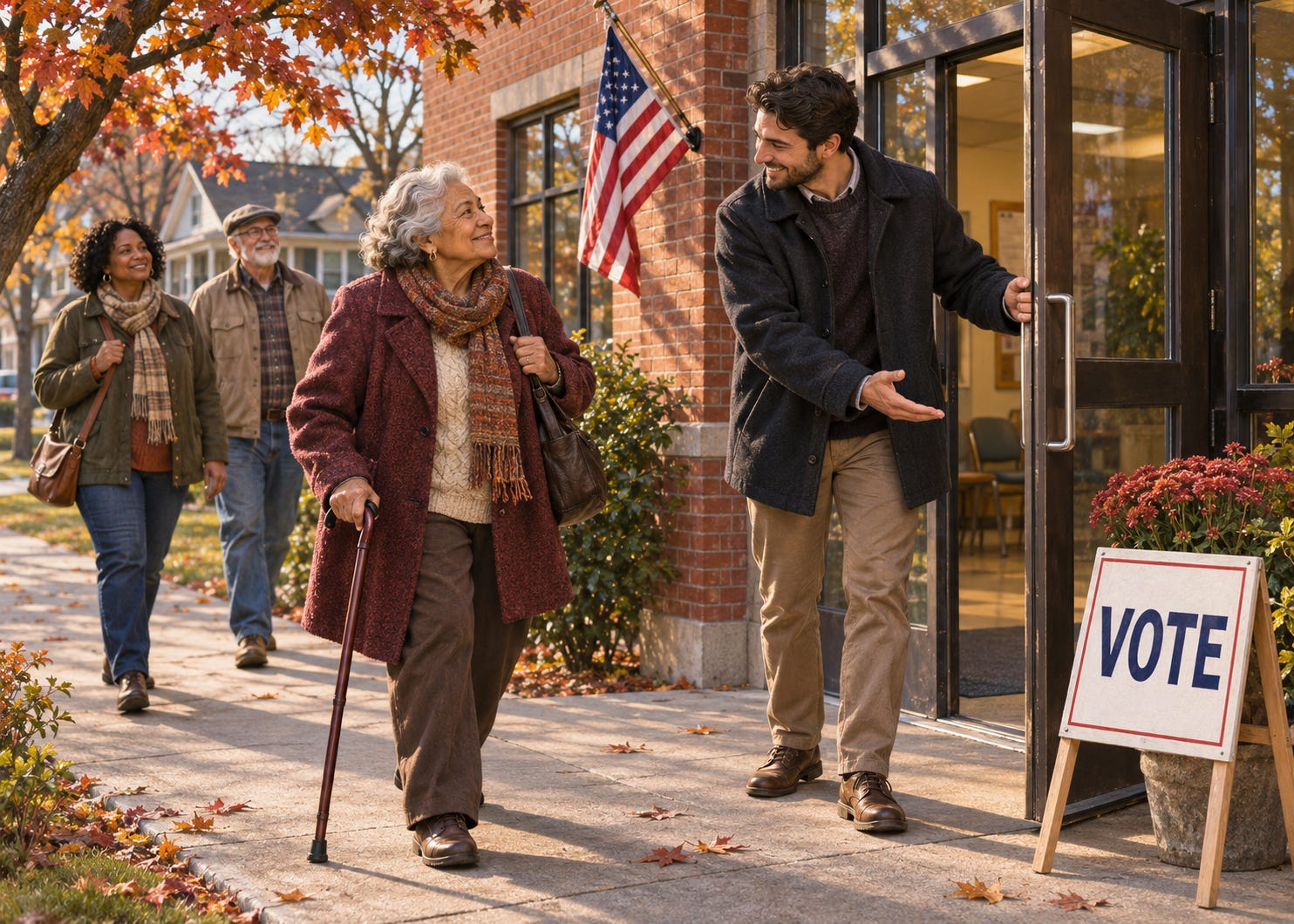
Neighbors at a polling place.
My Dear Family,
Your emails about feeling unwelcome in church over your political choices helped shape today’s letter. I know how difficult it can be to separate a religious obligation from the party allegiance attached to it, because I have felt that pressure myself.
Below, I explain the convictions that guide my decisions, including what I mean when I say that I want to respect life. I hope the letter helps you think through your own choices, and that you will return here for company when the results come. Thank you for reading and for trusting me with your questions.
Message From the Margins is 100% reader-supported and it is my full-time work, and so I do need readers who can afford it to help sustain it. Please become a supporting subscriber if you have room in your budget. Your support helps keep nearly everything here free, including pastoral letters like this one. If money is tight, please receive the work without guilt. You belong here.
With love and gratitude,
Your Neighbors Are Counting on You
A pastoral letter for anyone trying to vote faithfully in a disorienting political season.
Well, my dear friends, we have spent the past week with haunted heads, flying sorcerers, and the occasional visit to the afterlife. I hope you enjoyed our Halloween festivities, because we have now reached the frightening part: Election Day.
In retrospect, the haunted head showed admirable restraint. It never once asked us to make a contribution before midnight.
I am forty-two years old, and this has been the strangest campaign cycle of my lifetime as a political observer. AdImpact projected a record $11.6 billion in political advertising for this cycle, more than its totals for either the previous midterms or the last presidential election. After all that persuasion, a person might reasonably hope to feel more certain about the choices before them.1
Instead, many people are trying to work out whether the party they have supported for years still represents what drew them to it. Perhaps the party has changed, or their own convictions have developed. Perhaps they are finally acknowledging something they once managed to overlook. That reckoning becomes harder when questioning a party’s claim on your vote feels like questioning your place in the Church.
Father Knows Something About That
For much of my life, the message I received was that being a faithful Catholic required voting Republican, and that voting otherwise could endanger my soul. I still have an examination of conscience in my desk that makes that connection outright. Having spent some time in the Republican Party as a young man, I know how difficult it can be to untangle political belonging from religious obligation. Even then, I could see that parts of the party’s agenda were difficult to reconcile with the Church’s teaching.
Yes, the Church’s official teaching has long placed conscience and moral responsibility above party loyalty. The American Catholic bishops were making that point in their voting guidance in 2007. Yet Church leaders have also delivered messages that made the supposedly free exercise of that conscience feel perilous.2
We have watched bishops publicly challenge whether Catholic Democratic politicians, including Joe Biden and Nancy Pelosi, should receive the Holy Eucharist. In 2022, Archbishop Salvatore Cordileone instructed that Pelosi was not to be admitted to Communion because of her support for abortion rights. Bishops have themselves disagreed about these measures, while ordinary Catholics have watched access to the altar become part of a public political dispute. We cannot tell people to discern prayerfully, then treat them as suspect Catholics when their discernment produces an unwelcome answer.3
I read emails every day from people in this community who say they have felt pushed out of their churches because they did not have the appropriate yard signs on their lawns. Those people deserve more than a reminder of what an official document says. Church leaders have a responsibility to address the exclusion they describe and the fear that their belonging depends on political obedience.
So when I hear Church leaders insist that our faith is larger than any political party, I welcome it. I believe that is faithful to the Gospel. I also understand why some of you need to see that principle honored before you can trust it. You deserve pastoral guidance that helps you exercise your conscience without using your fear of losing God to secure your vote.
And when I ask you to bring your faith into the voting booth, you have a right to know what guides me when I enter it.
The Way I Vote
Although, now that I have written that heading, “the way I vote” is a bit of a misnomer. What I am describing is the way I try to order my life: around respect for human dignity and a desire for human flourishing. Every single person is made in the image and likeness of God, with an inviolable dignity bestowed by a loving Creator.4
The words “respect life” express my convictions rather well, once we disentangle them from the partisan associations that may have made some of us wince upon reading them. I want people to have the opportunity to live fully, protected from preventable injury and oppression, able to develop their gifts and participate in their communities. That includes having enough to eat, somewhere to live, and access to care when they are ill. Their dignity remains theirs through every change in health, fortune, or circumstance.
These convictions make demands on how I spend my money, whom I help, and how I treat someone who inconveniences me. They also shape what I expect of government. Public resources should serve the public, and no politician should be permitted to rob the national coffers while instructing us to resent the poor for needing assistance.
There are times, though, when respecting life involves difficult judgments about competing rights, needs, and risks. Sincere concern can lead people to different conclusions, and a policy offered with compassionate intentions can cause harm. I have to be willing to examine how I arrived at my judgment, including whether I have mistaken an old allegiance for a moral conviction. Here are the principles I return to when the answer is difficult.
Minimize violence and provide for the safety of everyone involved. I begin by asking who is in danger and what would actually protect them. Before supporting a forceful response, I want to know whether it will reduce the threat or expose people to further injury. The people at risk deserve more care than a promise to make the rest of us feel tough.
The methods matter too. A worthy purpose cannot justify cruelty, deliberate deception, or treating a person as expendable. Respect for human dignity has to govern the means we use, including when we are angry and convinced that our cause is just.5
Do not vote for dirtbags.
I won’t mince words here. If someone’s public record reveals persistent dishonesty, cruelty, corruption, or abuse of power, take that seriously before entrusting them with public office. We are deciding whether to give a person authority over other people’s lives, access to public resources, and opportunities to exercise their judgment when the rest of us cannot be there to supervise.
The argument that we have to support someone because they are our party’s candidate deserves considerably less deference than it receives. A party nomination does not absolve us of responsibility for whom we help put into office.
So the closest I will come to telling you whom to vote for today is this: you do not need to vote for dirtbags. If someone cannot be trusted with the office they seek, send them away. Your party can find someone else to run next time, and perhaps they’ll think a little harder when they do.
Character matters. We should expect integrity from the people entrusted with serving the public, and we should be prepared to withhold our votes when their conduct demonstrates that they cannot be trusted.
Believe victims. When someone tells me they have been harmed, my first responsibility is to take that person seriously and help them reach safety. Their need for care does not disappear because the person they accuse is someone I admire, or because acknowledging their suffering would embarrass an institution I love.
Fair investigation and compassionate treatment can proceed together. I want the facts pursued honestly, without subjecting the person who came forward to humiliation or retaliation. I also need to notice when my loyalty makes me quicker to search for reasons to dismiss an account than to listen to it.
Listen to the people who will live with the consequences. Before deciding what will help a community, I want to hear from the people who belong to it. They should have a meaningful part in decisions about their lives, especially when those decisions are being made by people insulated from the consequences.6
Someone trying to obtain medical care may recognize an obstacle that a person designing the system has overlooked. A parent struggling to feed a family has something to contribute to a discussion about food assistance. I can learn from their knowledge without requiring them to agree with every solution I favor.
Look at good data, and be willing to change course. I want to know what a policy does once it leaves the campaign brochure. That means looking beyond a pleasing headline to ask where the figures came from, whether the comparison is fair, and how the people affected are actually faring.
If the evidence shows that an approach I supported is failing, I need to be willing to change it. My party’s reputation cannot take precedence over the welfare of the people it promised to help. I want to know whether the politicians I like have kept their promises, and I owe them the same scrutiny I give their opponents.
Don’t expect fast results. Some problems have developed over generations, and addressing them requires sustained work across several elections. I want to give a sound approach enough time to succeed, while continuing to ask whether people are receiving help and whether their lives are improving.
Patience cannot become a reason to accept neglect. A family needs dinner while we work toward lasting solutions to hunger, and a person living in danger needs protection while we address the conditions that made them vulnerable. We can remain committed to the longer work and respond to the person who needs us today.
The Road to Jericho Runs Through Here
The person who needs us today may be someone we have learned to fear, dislike, or overlook. Helping that person means taking seriously the question a legal expert puts to Jesus in Luke’s Gospel. They have been speaking about eternal life and the commandments to love God and one’s neighbor, and the man asks, “And who is my neighbor?”7
Jesus tells him about a traveler going from Jerusalem to Jericho who is attacked by robbers. They strip and beat him, leaving him half-dead. A priest sees him and passes on the other side; a Levite comes along and does the same.
Then a Samaritan sees him. He approaches the wounded man, tends his injuries with oil and wine, and bandages him. He lifts him onto his own animal and takes him to an inn, where he cares for him. The next day, he gives the innkeeper money and promises to cover any additional expense when he returns.
The Samaritan belongs to a people regarded with hostility by many of Jesus’ Jewish contemporaries. Yet he is the one who stops. By the end of the story, Jesus is asking which traveler acted as a neighbor to the man who was attacked. The legal expert answers that it was the one who showed mercy, and Jesus tells him to do likewise.
I have no difficulty admiring the Samaritan’s generosity. I become a little less comfortable imagining the innkeeper sending the bill to me, especially if I am still hoping that the person who needs my help will be someone I already find agreeable. The Samaritan has accepted responsibility for a stranger’s continuing care. His compassion is going to cost him something after he has left.
Before I vote, I need to ask whether I am willing to support care for a person whose language I do not speak or whose religion I do not share. Will I look honestly at what a policy does to someone I have been encouraged to resent? A child’s need for dinner, a family’s need for shelter, and a sick person’s need for a doctor should trouble my conscience even when meeting those needs requires something of me.
Your neighbors are counting on you to consider them when you vote.
Take Your Conscience With You
If you are eligible and have not already voted, please vote today, unless illness, an emergency, an access barrier, or another genuine obstacle prevents you. Ask for assistance if you need it, and offer help where you can enable someone else to participate.
If your prayerful, informed judgment leads you across party lines, you are free to go. A political affiliation is not a marriage. There are no vows, and Father does not need to locate the annulment paperwork. You can vote differently today and reconsider the available choices at the next election. Your previous votes place no obligation on you to repeat a decision you can no longer defend.
You have spent years developing your faith, examining your conduct, and learning to recognize right and wrong. Trust that work enough to let it challenge a familiar allegiance. Be prepared to learn something uncomfortable, then make the most responsible judgment you can.
Some of you have substantial reasons to fear what political decisions could mean for your lives. Fear can warn us of danger, and I would never ask you to ignore it. I do ask us to question anyone who uses our fear to demand obedience or excuse cruelty. We should examine whether the promised protection will make people safer, including those whom the person making the promise would prefer us to disregard.
Before you vote, pray. Imagine explaining your choice to Jesus, including the difficulties you weighed and the people you hoped to protect. Tell Him what troubles you about the candidates and where you remain uncertain. He knows the choices are imperfect. Ask Him to help you recognize any selfishness, prejudice, or convenient excuse you have been reluctant to examine, and then act with the conscience you have worked to form.
When the Results Come
After you have done what you can today, allow yourself some rest. The results may arrive slowly, and you do not have to spend every hour of the counting frightened and alone in front of a screen. When the results come, come back here. We will give thanks where we can, speak honestly about what troubles us, and help one another face what comes next.
If a political decision leaves someone without care or places them in danger, we will still have a neighbor to help and an injustice to oppose. Our work will continue, through whatever relief or disappointment this election brings.
Christianity took root under an empire that crucified Jesus and persecuted His followers. Those who first proclaimed His Resurrection understood what political power could do to a human body. They also discovered that it could not prevent them from belonging to Christ, sharing what they had, and caring for one another.
Our first citizenship is in heaven. Wherever we live, under whatever government, we can bear witness to God’s Kingdom through the way we treat people and the injustices we refuse to accept. Today, we have an opportunity to use our votes in service of that calling.8
So please, pray and vote. And be at peace in the knowledge that you will not have to face tomorrow alone. I will be here, and we will keep doing this work together.
Somewhere along the road, a person will still be waiting for help. May they find us willing to stop.
And Let Us Pray…
Lord Jesus Christ,
You have commanded us to love our neighbors. Help us recognize them among the people whose needs are easiest for us to overlook, and give us courage to act when their safety or dignity is threatened.
Search our consciences where loyalty has made us defensive. Help us receive correction, attend to the truth, and resist the temptation to excuse cruelty because it serves our interests.
Protect voters and those serving at polling places today. Sustain people who are afraid, and bring them the practical help and companionship they need. Grant integrity to those entrusted with public office and perseverance to all who labor for justice.
As we await the results, keep us faithful to You and attentive to one another. Give us rest when our work for the day is done, and strength to serve again tomorrow.
Amen.
And Now It’s Your Turn…
What conviction most shapes the way you vote, and who helped you develop it? If your understanding has changed over the years, I would be glad to hear what prompted that change. You are welcome to share the reasoning without naming the candidate you chose.
If someone you know is trying to reconcile their faith with a difficult voting decision, please send them this letter. They are welcome to read along and subscribe for free to Message From the Margins.
A Word Before We Part…
Thank you for reading and for bringing your questions and experiences into this community. If you would like to help me continue writing, teaching, and offering this work freely to people who need it, please become a supporting subscriber. A dependable base of paid support makes it possible to plan the work ahead and give it the care it deserves. I am grateful, too, for everyone who helps through prayer, thoughtful conversation, and sharing a reflection with a friend.