

Opening
This morning I sat quietly with my usual double espresso before the sun came up, scrolling through the news as many of us now do. The world has become strangely accustomed to waking up to war updates the way previous generations woke up to the weather. If it isn’t war, it’s some other historically terrible event. Day after day, week after week.
And yet something about this moment feels particularly jarring.
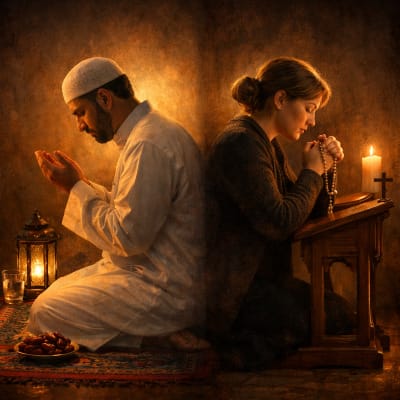
Across much of the Christian world, Lent is underway. Christians are fasting, praying, and reflecting on repentance. Churches are speaking about humility, mercy, and the path that leads to the Cross.
Across the Muslim world, Ramadan is underway. Families are rising before dawn for suhoor, a pre-dawn meal eaten before fasting begins, then fasting through the day, and gathering in the evening for iftar, a meal shared amongst family to break the fast at the end of day. The mosques are filled with prayer. People are trying, in their own way, to draw closer to God.
Two ancient religious traditions. Two seasons of spiritual seriousness.
And yet here we are, watching bombs fall.
Many people in our own country speak very confidently about living in a “Christian nation.” The language appears often. It is spoken in speeches, printed on campaign material, invoked in debates about identity and culture. To my observation, the calls for this to be a Christian Nation and the calls for this war in Iran appear to come from the same camp.
So, when a nation that claims such an identity launches military action during the very season meant for repentance and self-examination, a difficult question quietly emerges.
How seriously do we actually take the faith we claim?
Reflection
The Christian tradition has always understood Lent as a time for sober honesty.
The prophet Joel once spoke words that the Church has repeated for centuries during this season:
“Return to me with all your heart, with fasting and weeping and mourning.” (Joel 2:12)
Lent exists precisely so that we might examine ourselves. Not just as individuals, but as communities. As institutions. As nations.
It is very easy to speak of faith when it costs nothing. It is much harder when that faith begins to challenge our assumptions about power, violence, and national identity.
Jesus spoke plainly on this matter.
“Blessed are the peacemakers, for they will be called children of God.” (Matthew 5:9)
He did not say blessed are the powerful. Blessed are the victorious. Blessed are those who dominate their enemies.
He said blessed are the peacemakers.
Now to be clear, the Christian tradition has long wrestled seriously with the ethics of war. The Church Fathers, later theologians like St. Augustine and St. Thomas Aquinas, and generations of Christian thinkers developed what we now call Just War theory. The Church has never been naive about the realities of a broken world.
But even within that tradition, war is never something to celebrate. It is always considered a tragic failure of human reconciliation.
It is always meant to be approached with trembling seriousness.
One of the strange features of our modern moment is how quickly war becomes entertainment. It becomes a spectacle on television. A scoreboard on social media. A talking point in political debates.
The ancient Church would not recognize this posture.
Early Christians lived under the Roman Empire, a society far more militarized than our own (to the extent swords, shields and catapults can be compared to Patriot Missiles and the Iron Dome, but you see what I’m trying to say). Yet many of the earliest Christian writings speak about war with deep spiritual caution. They understood that taking human life, even when politically justified, scars the human soul.
Something happens to us when violence becomes casual.
Something happens to our moral imagination.
And here is where the timing of this particular moment becomes especially striking.
During Lent, Christians meditate on the suffering of Christ. On the Cross. On the reality that violence ultimately consumes the innocent.
During Ramadan, Muslims are fasting, praying, and attempting to grow in self-discipline and charity before God.
These seasons are meant to soften the human heart.
Yet the world around us often moves in the opposite direction.
If I am honest, I find myself sitting with a complicated mixture of emotions.
On the one hand, many people in Iran have suffered deeply under their government. I have friends from that part of the world who speak with quiet grief about the repression they witnessed growing up. One cannot ignore the suffering that many people there have endured.
And yet I also wonder whether violence from outside ever truly brings the healing we hope it will.
History gives us reason to be cautious.
Christians believe that Christ entered into the cycle of violence not by overpowering it, but by absorbing it. The Cross stands as a profound contradiction to the logic of domination.
The early Church did not conquer Rome with armies.
It transformed the world through witness, mercy, sacrifice, and love.
That kind of transformation moves more slowly than bombs.
But it is the only one that lasts.
Gentle Practical Integration
This week, in the middle of all the noise, perhaps we can practice a few small acts of spiritual steadiness.
1. Pray for people, not abstractions.
When you hear news about war, pause and pray for the ordinary families caught in the middle. Mothers, fathers, children, the elderly. The human heart softens when we remember that every headline contains real lives.
Pray for our service men and women. Most of them did not ask for this war. Pray for the families waiting anxiously at home.
And here is the difficult part. Pray for our enemies as well. Pray for the so-called “bad guys.” Christians do not pray only for those we like or agree with. Jesus was very clear about this: “Love your enemies and pray for those who persecute you.” (Matthew 5:44)
This is not sentimental. It is not weakness. It is one of the most radical and demanding teachings in the entire Christian faith. Never forget it.
2. Fast from war-as-entertainment.
Limit the amount of sensationalized coverage you consume. Stay informed, yes, but refuse the subtle habit of turning human suffering into spectacle.
You do not need to catch every headline the moment it is released. Unless you are in a position to meaningfully act on the information, most of us are simply absorbing anxiety that we cannot do anything about.
This is one of the quiet disciplines of Lent, learning the difference between awareness and obsession. Stay informed, but do not allow the constant churn of breaking news to colonize your mind or harden your heart.
3. Hold your own nation in prayerful honesty.
Patriotism and moral reflection are not enemies. Mature love for one’s country includes the courage to examine its actions with humility before God.
Just as we examine our own consciences during Lent, so too must we examine our national one. Nations, like individuals, are capable of both great good and grave error. Faith calls us to love our country, but never to place it beyond moral accountability.
To pray for our nation, then, is not merely to ask for victory or success. It is to ask that we might act with wisdom, restraint, justice, and mercy before God.
4. Practice small peacemaking.
Most of us will never negotiate international treaties. But we can reconcile with a neighbor, speak gently in tense conversations, or refuse the easy language of hatred.
We can buy someone a meal. Deliver clothing to someone who needs it. Let a tired parent go ahead of us in the grocery line. Offer patience where irritation would be easier.
These small acts may seem insignificant against the backdrop of global conflict. Yet the peace Christ spoke of has always begun this way, quietly, locally, one human encounter at a time.
Peacemaking always begins close to home.
Community-Oriented Closing
Moments like this remind us how complicated the world can be.
Faith does not give us simplistic answers. But it does give us a deeper compass. The life and teaching of Christ continue to challenge the easy assumptions of every age, including our own.
I would genuinely love to hear how you are processing this moment. Are you feeling conflicted? Confident? Troubled? Something else entirely?
Share your thoughts in the comments if you feel comfortable doing so. Your reflections often help others feel less alone in their own questions.
And if this reflection strengthened you today, consider sharing it with someone who might need a quiet moment of perspective.
If this reflection strengthened you, consider becoming a supporting member so we can continue walking together.
Closing Prayer
Lord of mercy and truth,
We come before you in a world that often feels restless and uncertain.
We hear the language of war, the clamor of politics, the arguments that fill our screens and our conversations. It is easy for our hearts to become hardened or confused.
In this season of repentance and reflection, draw us back to the deeper wisdom of your Son.
Teach us again what it means to be peacemakers.
Not naïve, not passive, but courageous in seeking the good of every human life you have created.
We pray for those who live in places touched by violence today.
For families who wake up not knowing if their homes will still stand tomorrow.
For children who deserve laughter and safety but instead hear the sound of fear.
We pray for leaders and nations, including our own.
Grant them humility, restraint, and wisdom.
Let power never eclipse compassion.
And we pray for our own hearts.
When anger rises within us, teach us patience.
When fear overwhelms us, grant us trust.
When we feel tempted to despair about the world, remind us that your kingdom moves quietly but faithfully through history.
Form us into people who reflect the mercy of Christ, even in turbulent times.
We ask this in hope, trusting that your grace continues to work in places we cannot yet see.
Amen.
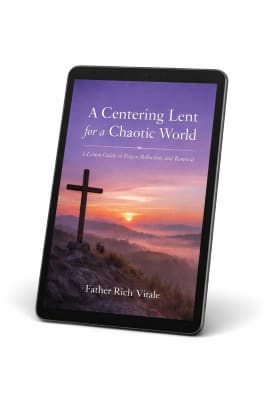
If you are looking for a little more structure for your prayer this Lent, I created a guide titled A Centering Lent in a Chaotic World. Many of you signed up specifically to receive it. It is a simple companion designed to help you slow down, pray more intentionally, and stay spiritually grounded during these turbulent times.
If you have not downloaded it yet, you can find it at the link below. I hope it serves you well on the journey.