

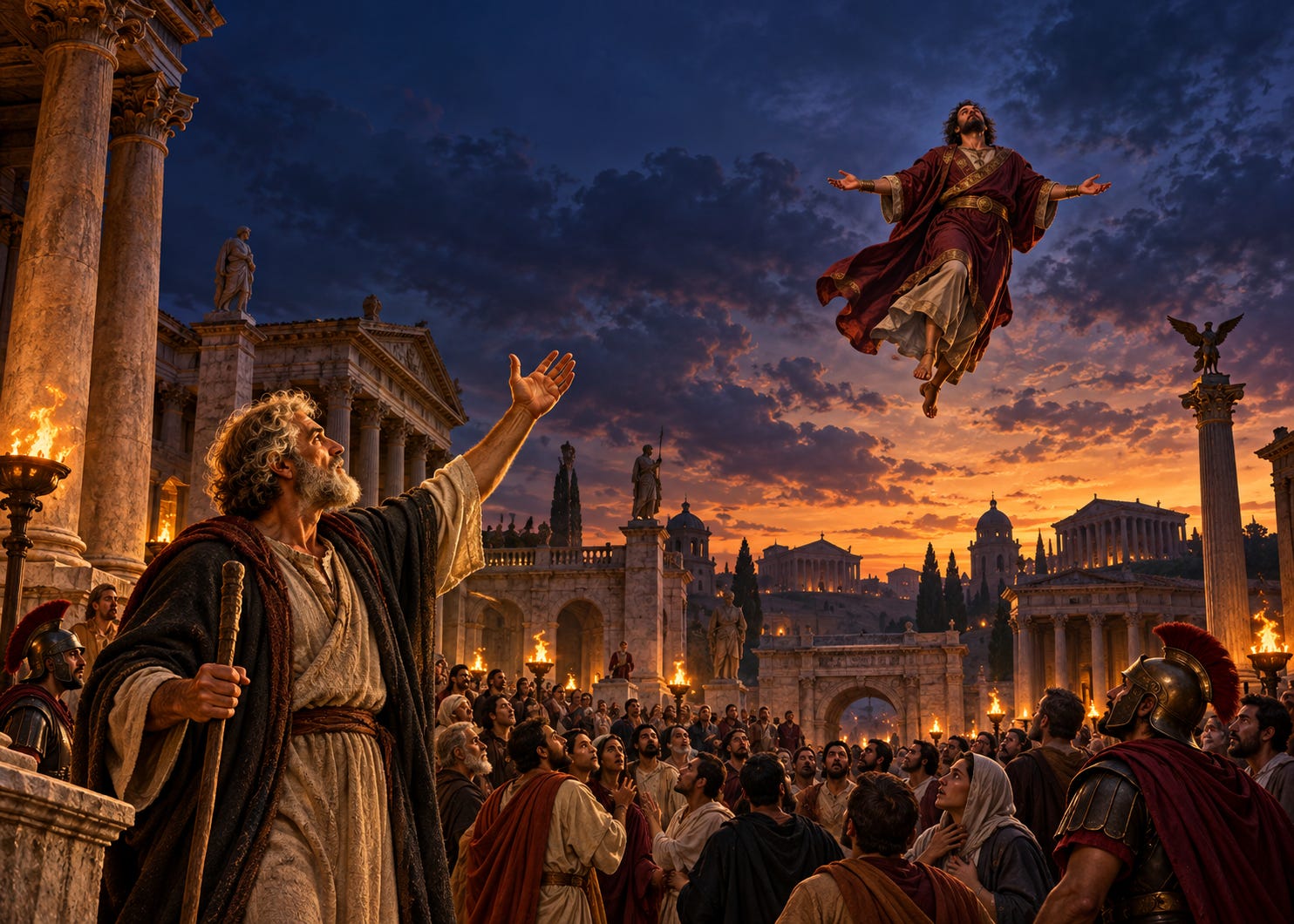
My dear friends, I had so much fun with yesterday’s story about Pope Sylvester II that I could hardly wait to tell you this one. We are going back considerably farther, into an old Christian legend in which St. Peter arrives in Rome to confront a sorcerer. I have given this one the full campfire treatment. Settle in.
Thank you for helping make this a place where we can take our faith seriously and enjoy ourselves together. Paid subscriptions help cover the work that keeps Message From the Margins going and nearly everything here available freely. If you have room to support it, I would be grateful. If money is tight, please leave that invitation for someone else and enjoy the story without a second thought.
St. Peter and the Sorcerer
A talking dog, a terrified senator, and the very public downfall of Simon Magus.
Gather close, my dear friends. The wine has begun to climb it’s way out of the cup.
It rises in a thin red thread, bending above the rim, while the man holding the cup sits very still. He had been laughing a moment ago. Now he is watching his wine coil in the air, gathering itself into something with a narrow head and a long, tapering body.
Across the room, Simon Magus twists one finger.
The serpent turns with it.
A woman draws her feet beneath her couch. Someone reaches for a servant, then thinks better of making a sudden movement. The little creature is translucent, ruby-colored in the lamplight. It opens its mouth.
Simon smiles. With a flick of his hand, he sends it gliding between the guests. They shrink away as it passes, though each is anxious to look less frightened than the person beside him. It circles the room once, then hangs above the cup from which it came. Simon closes his hand. The serpent unravels into a stream of wine, falling neatly through the narrow opening without spilling a drop.
The room breaks into applause.
At the entrance, the porter waits for his employer to notice him.
“The one called Peter is here.”
Simon’s hand closes into a tense grip around the arm of his couch.
He has given this man very particular instructions. If Peter comes, Simon is not at home. Morning or evening, today or tomorrow, it makes no difference. Simon is out.
“I told him,” the porter adds. “I told him you said to say you weren’t here.”
I have some sympathy for the porter. His employer can turn a cup of wine into a serpent, yet apparently needs help dodging visitors. That must make for a confusing place to work.
Beyond the doorway, Peter waits with a crowd pressing around him. Somewhere inside, the applause dies away. He has crossed the sea to find Simon the Sorcerer, and the people who have followed him through the streets are watching the entrance, hoping the magician will come out.
Near the entrance, a large dog strains at a heavy chain. Its claws scrape the stone as Peter approaches. He bends beside it, works the fastening loose, and lets the chain fall.
The dog stops pulling. It lifts its head toward Peter. For a moment there is only the sound of people shifting behind him, waiting for something to happen. Then a human voice comes from the animal’s mouth.
“What would you have me do?”
Peter sends it into the house with a message. Simon is to come outside. Peter is waiting.
The dog passes the porter and trots into the house. Servants stand aside. A guest draws his robe out of its path, and the animal comes to a halt before Simon’s couch.
It lifts its forepaws and delivers Peter’s summons in a voice that carries to the far end of the room.
The man with the wine cup sets it down very carefully.
Simon looks from the dog to the open doorway. The guests are looking at him. A few moments ago, he had them watching his fingers, laughing when he allowed them to laugh. Now an animal has walked in from the street and addressed him as a deceiver.
He considers his answer.
“Tell Peter I’m not here.”
The dog is standing in front of him.
I would like you to take a moment with that.
A very persuasive houseguest
Our story comes from the Acts of Peter, an early Christian collection of tales about the apostle that sits outside the New Testament. In its telling, Simon has become the talk of Rome, and a great many people have reason to regret it.
Paul, who had preached among the Roman Christians, has departed for Spain. Soon afterward, reports begin circulating about another wonder-worker. Simon Magus calls himself the great Power of God. People acclaim him as a savior, and when he promises to fly into Rome, they turn out to watch.
Christians who had listened to Paul begin following Simon. Before long, only a small group remains, praying for someone to come and help them. Among those taken in is Marcellus, a wealthy senator who had welcomed Christians and cared for people in need. He has opened his home to Simon and put up a statue honoring his remarkable guest as a new god.
Peter receives a vision of Christ sending him to Rome. By the time he reaches Italy, a Christian named Ariston is waiting for him by the sea, desperate to bring him to the city. Peter will not stop to rest. He goes straight to the people who have been scattered.
When they gather to hear him, he tells them about the night he denied Jesus.
He had been there, he says. He had known the Lord, walked beside him, witnessed his works, and still he had failed him. He speaks of his own bitter weeping, and of the compassion Jesus showed him afterward. The people who abandoned Paul’s teaching hear Peter admit that he once abandoned Jesus himself.
They ask him to confront Simon, and he goes to Marcellus’s house. By the time his messenger gets inside, Simon has had ample warning. The dog points this out.
You have had all this time to think, the animal tells him, and the best you can manage is to say you are not here? To the dog you are presently addressing?
The rebuke continues. Simon, who has been impressing people with his eloquence, cannot find an answer that will improve matters. His audience begins leaving him to follow the dog outside.
Marcellus is already at Peter’s feet.
He admits what he has done. He has welcomed Simon the Sorcerer, believed him, even turned against the Christians. Now he asks Peter to remember the mercy he preaches and pray for him.
Peter lays his hands on Marcellus and prays for him, then draws him into an embrace. The senator has scarcely stepped back when laughter comes from someone nearby.
A young man is grinning at them. His laughter grows louder, carrying on after everyone else has fallen silent. Peter addresses the spirit within him and commands it to come out without hurting him.
The young man bolts into the courtyard. Before anyone can catch him, he throws himself against a marble statue. Stone crashes onto stone. A white hand skids across the paving and stops at Marcellus’s feet.
It is a statue of Caesar.
Marcellus puts a hand to his forehead. If anyone tells the emperor, he says, they will face terrible punishment. One helpful person reporting what has happened would be quite enough. He looks down at the shattered marble, then back at Peter. The pieces do not look as though they will be of much use in explaining that this was an accident.
Peter reminds him that a moment ago he was prepared to give everything for his soul. Now he is afraid of a broken statue. He tells Marcellus to take water, pray in the name of Jesus Christ, and sprinkle it over the fragments.
Marcellus cups water in his hands. It leaks between his fingers while he prays. He asks Christ to restore the stone, to spare him punishment at Caesar’s hands, to help him believe what Peter has told him.
He scatters the water over the wreckage. Before the last drops have fallen, a fragment scrapes against the paving. Marcellus hears the deeper grind of marble turning and takes a step back. The broken hand slides away from his feet. Pieces lift and fit against one another, the shattered face takes shape, and a crack running through Caesar’s throat closes beneath the droplets of water.
The courtyard goes quiet. The statue stands where it stood before.
Marcellus looks down at his empty hands.
Outside, the dog returns to Peter and reports on its errand. It foretells the contest that is coming, then falls at the apostle’s feet and dies.
The crowd asks for another sign. Simon had performed wonders too, they say. How are they to know whom to believe?
Peter turns toward a window, where a dried fish is hanging. He takes it down and holds it before them. Its body is stiff, its mouth fixed open. Nobody would mistake it for something alive.
If they see this swimming, he asks, will they believe in the Christ he preaches?
They crowd closer as he carries it to a pool. Peter speaks the name of Jesus and throws it into the water.
It hits the surface with a slap and twists. The dry fins spread, the gills open, and its tail strikes hard enough to throw water against the edge. The fish vanishes beneath the ripples.
A child points. There it is again, turning below them, silver along the flank where the light catches it.
The crowd stays to watch. Someone feeds it bread. Other people are brought over to see the fish that had been hanging in a window and is now very much at home in the water. It keeps swimming long enough for the witnesses to satisfy themselves that they have seen something more substantial than a momentary trick.
Simon calls on Peter
Marcellus has had enough of his houseguest.
He finds Simon in the dining room and orders him out. The household joins in with considerable enthusiasm. Some of the servants have old grievances against Simon, and now that their master has withdrawn his protection, they strike him, throw things, and empty filthy vessels over his head.
It is an ugly eviction. Simon emerges beaten and furious, with very little remaining of his earlier dignity.
He makes for the house where Peter is staying. Standing at the gate, he calls for the apostle to come down and defend his belief in Jesus, the carpenter’s son.
Peter sends a woman carrying her baby.
The child is seven months old. Peter tells the mother to say nothing. She is to listen to what her infant will say.
Imagine her going down to the gate, adjusting the child against her shoulder, wondering what sort of errand this is. Simon is waiting for an argument with Peter. Instead, a woman appears with a baby who has something to tell him.
The child turns its face toward Simon. The mother feels its small body move against her arm, and then hears a voice she has never heard in her life.
It is a man’s voice, coming from the mouth of the baby she has been nursing.
It reminds Simon that a dog has already rebuked him, without lasting behavioral improvements, it would seem. Now a child must do it. He will be brought to a public contest on the coming Sabbath, the baby declares, and until then he is to leave Rome.
Then, in the name of Jesus, it commands him to be silent.
Simon draws breath to answer. His lips move. He tries again, harder, pressing a hand against his throat. The woman watches him struggle to produce a single word.
She carries the child back to Peter. Behind her, the magician stands at the gate in silence. He will leave Rome to wait for the appointed day in a stable.
A dog has answered him back, a senator has thrown him out, and an infant has deprived him of the ability to complain. I would understand if he were considering another line of work.
Before the people of Rome
On the Sabbath, the crowd fills the forum. Officials are there, with senators and people who have come to watch a confrontation that has been gathering momentum across the city.
Simon challenges Peter’s preaching. How can a man born in Judaea, a carpenter who was crucified, be God? Some in the crowd think he has made a good point.
Peter answers him from the Scriptures, then demands that Simon demonstrate his power.
The prefect Agrippa decides how they will proceed. He brings forward one of his enslaved servants. Simon is to kill him. Peter is to bring him back.
It is a dreadful proposal, delivered with the authority of a man who believes he may dispose of another person’s life to satisfy his curiosity.
Simon steps close to the servant and bends toward his ear. The young man turns slightly, trying to hear him. Whatever Simon whispers makes him stiffen. His mouth opens, but he cannot speak.
His knees give way. Someone reaches for him too late, and his body strikes the ground. He lies there with one hand turned beneath him, while Agrippa waits for Peter to begin his part of the test.
A murmur passes through the crowd. At the back, an elderly widow begins calling for Peter. Her only son is dead too, she tells him. He worked to feed her, helped her stand, carried her when she needed him. Who will reach out a hand to her now?
Peter sends men to bring her son. While they go, he turns back to Agrippa.
The prefect says the dead servant was dear to him. He had other young men he could have chosen, but wanted to make a proper trial of Peter and his God.
Peter rebukes him for putting God to the test. Then he prays over the young man lying before them and tells Agrippa to take his right hand.
Agrippa bends over the body. He takes the right hand, the fingers loose in his grip, and begins to pull.
The fingers close around his.
The prefect jerks backward. The servant draws breath, a rough, sudden sound that people at the back of the crowd strain to hear. He turns his face toward Agrippa, then gets his feet beneath him. The man who ordered his death is still holding his hand.
Before the crowd has recovered from that sight, the widow’s son arrives on a bed. Peter prays for him too. He calls the young man to get up and walk with his mother, to help her while he can.
The young man moves beneath the cloth laid over him. His mother cries out and reaches for the edge of the bed. He pushes himself upright, blinking at the faces gathered around him, and turns at the sound of her voice.
She has come through the crowd asking who will help her now that he is dead. Now she is trying to reach him, and he is leaning toward her, alive, holding out the hand she thought she had lost.
Word spreads. Another woman comes forward, pleading for her dead son. This time the young man is Nicostratus, a senator, widely known and loved. His mother has heard what Peter can do, and she begs him to help.
Peter tells the crowd that he is a man like them, a sinner who has received mercy. Whatever happens here, they are to remember whose power he is calling upon.
The mother goes to fetch her son. When the funeral procession returns, senators and women of prominent Roman households follow the bier. The young men carrying it wear the caps of freedmen. In mourning her son, his mother has granted them their freedom.
They set Nicostratus down before Peter and Simon.
Peter invites Simon to raise him. Let everyone see, he says, which of them serves the living God.
Simon hesitates. All those faces are turned toward him now. He asks the crowd for a promise. If he raises the dead man, will they drive Peter from Rome?
“We’ll burn him,” the people shout. Driving Peter from Rome will not be enough.
Simon takes his place at the head of the bier. He bends low over Nicostratus, straightens, and bends again. The people nearest him try to hear what he is saying. On the third attempt, the dead man’s head begins to lift.
His mother catches her breath.
Nicostratus opens his eyes. His neck bends toward Simon, slowly, as though something has taken hold of him beneath the skin. The linen shifts against his shoulders. He inclines a little farther, and the crowd surges forward to see.
People begin calling for wood and torches. They have seen Nicostratus move; now they mean to keep their promise. Peter raises his voice over the shouting.
Look at the man, he tells them. If he is alive, let him speak. Let him stand. Let him undo the binding around his jaw and call for his mother. Have they seen him do any of that?
“Move him away from the bier.”
Agrippa steps forward and thrusts Simon aside. Nicostratus’s head drops back. His eyes are fixed, his body limp beneath the linen. His mother makes a sound that silences the people nearest her.
Simon tries to step toward the bier again. Agrippa keeps him back.
Now the shouting changes direction. Simon should burn. He has deceived them. The same people who were calling for Peter’s death are ready to light the fire under his opponent.
Peter stretches out his hand to stop them. If that is what they intend, he says, he will not raise the young man. They have been taught to pray for their persecutors and love their enemies. Simon might yet repent. They are not to stain their hands with his blood.
Simon is still beside the bier. A few moments ago, he was bargaining for Peter’s death. Now he has to stand there and hear Peter argue for his life. The people insist they will burn him regardless, but the apostle holds his ground until they hear him through.
Then he turns to Nicostratus’s mother.
The men she has freed are watching. What will happen to them if her son returns? Peter tells her they must remain free, and that provision must continue to be made for them.
She agrees before the prefect. The goods she had intended for her son’s funeral pyre will go to them. Peter asks that what remains be shared with the widows.
Peter goes to Nicostratus. He prays to Jesus Christ, asking for the mercy he himself has received so often. Then he touches the young man’s side.
“Rise.”
The linen stirs beneath Peter’s palm. He keeps his hand there while Nicostratus draws breath, and the young man’s hands begin moving across his chest, catching in the folds. He pushes himself upright, reaches for the binding around his jaw, and pulls it loose. The people pressing behind his mother can see his mouth moving. This time there are words.
He asks for clothes.
Someone hurries to bring them. He draws his feet toward the edge of the bier and lowers them to the ground, pausing with his hands braced beside him. Peter is close enough to help, but the young man stands. His grave clothes slip down around his ankles.
He has seen Christ, he says. He wants to go to him. His mother has followed her son’s body through Rome, listened while the crowd threatened to burn one man and then the other, and promised away the things prepared for his funeral. Now Nicostratus is standing beside his own bier asking Peter to take him to Jesus.
The last performance
Simon does not accept defeat quietly.
Over the following days, he produces more wonders. People seem to be healed, then cease to be well. Figures appear in dining rooms. Peter keeps exposing the deception, and Simon’s reputation begins coming apart in public. People who once acclaimed him are laughing at him.
Finally, he announces that he will leave them.
Tomorrow, he will ascend to God. The Romans have chosen Peter; very well, Simon will return to his Father and tell him how they have treated his power on earth.
The next day, a multitude gathers along the Sacred Way.
Simon climbs to a high place. He sees Peter among the people below and calls down a challenge. If the God Peter preaches is truly God, let him show it now.
Simon spreads his arms. The edge of his robe lifts, though the air below is still. One sandal leaves the stone, then the other, and the people nearest the high place stumble back.
He rises past the rooftops.
A shout travels through the crowd. People run for a better view, pulling children after them, pointing above the temples. Simon is turning in the open air, his robe streaming around him. There is nothing beneath his feet. The sky shows through where his body has just been.
The Christians look for Peter. Some have already begun to call his name. He stands among them with his face lifted, watching the sorcerer ascend.
Peter lifts his voice to Jesus. If Simon is allowed to accomplish this, he prays, the people who have believed will be drawn away again. They are looking at the figure in the sky, waiting to see whether Peter’s Lord can reach him there.
“Let him fall,” Peter prays. “But do not let him die.”
He asks that Simon’s leg be broken in three places, that the wonder which has carried him above Rome should end before these people’s eyes.
Simon falls.
There is a change in the way his robe moves. It folds against him. His arms reach suddenly for something that is not there, and the figure above the roofs drops out of the sky.
The people below scatter. Simon strikes the ground, and the cry that comes from him is heard all along the street. His leg is broken in three places. He cannot get up.
For a moment, those who have run away stand looking back. Then someone stoops for a stone. Others follow. The crowd that gathered to watch him fly turns on him before dispersing, leaving him where he fell.
Among those who see him is Gemellus, a friend who has given Simon a great deal of money. He looks at the injured magician and asks how the Power of God can be broken like this.
Then he goes to Peter.
Simon is carried out of the city by night, lying on a bed. He is taken first to Aricia, then to Terracina. The story says he dies there after an operation by physicians. For all his promises, he leaves Rome in the hands of other men.
Gemellus, meanwhile, has found Peter. He has given Simon his money and his trust, and now he has seen the man lying injured in the street. He tells the apostle that he wants to be among those who believe in Christ.
Peter looks toward the people sitting with him. Would anyone begrudge this man a place among them?
“Come, brother,” he says. “Sit with us.”
A Quick Note About the Story You Just read.
My dear family,
Christianity has a long history, central articles of faith, and a substantial collection of legends, stories, and popular traditions. What you have just read belongs to that last collection, with some additional mischief supplied by your priest.
This is a dramatized fantasy retelling of the Acts of Peter, an early Christian work outside the New Testament. The talking dog, speaking infant, and showdown with Simon belong to the ancient story. The wine-serpent opening is my invention. I have also imagined dialogue, sensory details, and how these extraordinary events might unfold before the people witnessing them.
My source was principally chapters IV–XVI and XXIII–XXXII of the Acts of Peter, in M. R. James’s public-domain translation from 1924. If you are curious, you can read the traditional text or consult this scholarly overview and manuscript record.
If you share this with others, please make clear that Father has been having some Halloween fun with an old Christian legend. I hope it has entertained you and given you something worthwhile to think about.
Please do not announce that I have discovered a previously hidden gospel. I have enough emails to answer.
With love,
Fr. V
And Let Us Pray…
Lord Jesus Christ,
You knew Peter’s failures and still entrusted him with your people.
Remember us with that same mercy.
When admiration goes to our heads,
bring us back to the people who need our help.
When anger makes us eager to punish,
teach us to pray for those we would rather condemn.
And when someone comes looking for a place among us,
help us welcome them as a brother or sister.
Amen.
And Now It’s Your Turn
Had you ever heard this story from the Acts of Peter before? What did you make of Peter defending the man who had just bargained for his death? And yes, I am also accepting comments about the dog.
Know someone who would enjoy an apostle, a sorcerer, and a talking dog getting into a very public disagreement? Send them this story. I suspect we all know at least one person.
If you arrived here because somebody shared this story, welcome. I’m Father Rich, and Message From the Margins is where we explore faith with some curiosity, a little humor, and a concern for the people who too often get left out. You can subscribe for free and have the next piece delivered to your inbox.
To those already here, thank you for helping this community grow. We have been celebrating Unlucky 13K this Halloween week, and I would love your help getting us to 14,000 readers. A personal recommendation from you can introduce this work to someone I would never have reached on my own.