


Good morning, friends.
Today’s piece began with a report about online betting and artificial intelligence, and it brought me back to a blackjack table in Las Vegas. There will be a little humor, a list of my grievances about the Mets, and a serious conversation about how we look after one another.
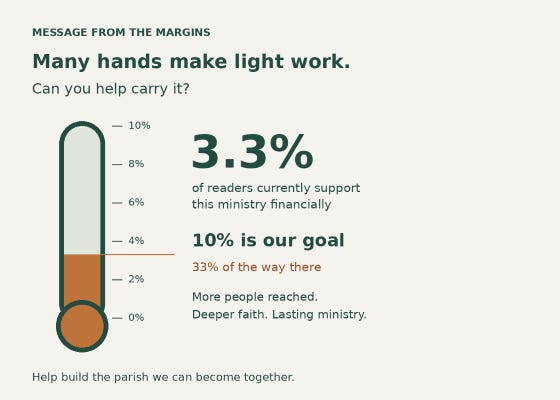
Before we begin, a word about the parish we’re building together. We currently sit at 3.3% paid support, toward our goal of 10%. Thank you to everyone who has helped carry us this far.
Reaching 10% would give this ministry room to grow and develop, bring the Good News to more people, fight the dirtbags, and bring you highly engaging, professionally produced, and hopefully enjoyable and enriching content for decades to come.
I am 100% committed to making this the best parish it can possibly be: leading you to Christ, helping you live better, and, in our own way, making this world a better place. I want this ministry to keep showing up for you, year after year, with the care, creativity, and seriousness you deserve.
But many hands make light work. Can you help carry it?
If you have room in your budget, please become a supporting subscriber today. Your subscription helps sustain the work you receive and keeps it available to someone who cannot afford to contribute. Nearly everything here remains free because I believe the Gospel cannot be placed behind a paywall.
Your Brother in Christ,

When Your Loss Is the Business Plan
I am not a gambler.
In fact, I’ve really only played beyond the novelty of it once in my life, and it was with someone else’s money. I was with a friend at a blackjack table at the Cosmo in Las Vegas when he got up to use the washroom and told me to play for him. By the time he returned, I had gotten us up to about $5,000.
I begged him to take the money and run. He insisted that I was hot, or the table was hot. I forget the lingo. He probably wasn’t telling me I was hot, now that I think about it.
And so we kept playing and lost every %#$&ing penny.
As I said before, I am not a gambler.
But for about the last year, my social media feed seems to have narrowed its interests to two things: Pope Leo’s homilies and ads for online betting. I can only assume the second has something to do with my being a sports nut and a guy in his forties. Whatever the reason, somewhere between the Holy Father explaining the Gospel and my checking on the Mets, somebody is very eager to get me to place a bet.
And it’d be weird to bet on the Bishop of Rome.
It feels like five minutes ago this stuff was illegal. Now I can hardly get away from it.
As a pastor and commissioned shepherd of God’s people, and as someone who has learned a thing or two about how the internet works over the past year, I’ve had a very bad feeling about this.
Turns out, there may be more reason for that bad feeling than I ever expected.
What are we teaching the machine to do?
Gadget Review, summarizing a New York Times investigation, reports that DraftKings developed a machine-learning model in 2023 to predict how much customers would lose after receiving bonus bets or promotional offers. The model reportedly helped determine where promotional spending would produce the greatest return for them. In other words… they figured out how to get losers to keep losing.
Former employees also alleged that a separate effort to identify customers at risk of problem gambling was shelved. DraftKings disputes the characterization of its marketing, saying it rewards sustained engagement rather than ranking customers by their losses. The company also says it monitors risky behavior and declined to deploy the proposed risk-prediction technology because it was not sufficiently evidence-based.
These are disputed allegations. But the possibility they describe deserves our attention: technology capable of learning about a person’s behavior being developed to increase revenue while a proposed protective use goes unfinished.
If that account is accurate, we have a serious moral question about the priorities of the people commissioning and deploying these systems. Someone decides what the technology should accomplish. Someone decides which results count as success. We have a responsibility to ask what happens to the human being whose losses make those results look good.
There is room for fun
Our Roman Catholic brothers and sisters give us what I believe to be a very wise and fair framework for thinking about gambling in their Catechism. Paragraph 2413 recognizes that games of chance and wagers are not inherently unjust. They become morally unacceptable when they deprive someone of what they need to provide for themselves or others. It also warns that gambling can become a form of enslavement.
And we can be fair here. With clear boundaries around the money and time involved, gambling can be part of an enjoyable evening with friends or family. A small wager can add a little excitement to watching your favorite team. I personally don’t bet on the New York Mets, but that’s a Mets problem, not a gambling problem.
There is room in life for things that are just plain fun. Even though I rarely gamble, I enjoy putting on something other than clerical attire and spending an evening with friends, martini in hand. In my head, I may also be keeping an eye out for Russian spies like James Bond, but we’ve already established that I’m not quite right in the head.
But I digress.
Some people may be called to lives of extraordinary austerity. The Gospel still leaves room for enjoyment, friendship, and a good evening out. And games of chance are hardly a modern invention. Want to know something archaeologists find from the Roman world? Dice. You can see an ancient example in the British Museum’s collection.
The moral question is what we do with that very human appetite for a little excitement. When a business can study our behavior and encourage us to spend more, its responsibility grows along with its capabilities. A person struggling to stop deserves protection, even when another bet would be profitable.
An old temptation with new tools
I had a professor in seminary who used to describe the internet as a landfill. Sure, you might find something useful in it, he would tell us, but much of it was garbage that could make you sick.
I think about that more often these days. There are the obvious dangers: obscene material, racist forums, hate groups. Then there are the videos that look like ordinary entertainment while repeatedly presenting racial minorities as stereotypes, or the endless shopping promotions that encourage us to spend beyond our means. Add betting offers to that mix, and I worry about how much of our day can become an invitation to indulge whatever impulse is easiest to sell to us.
It can feel like a conveyor belt moving us toward our worst habits, with very little time to ask where we are going. I am especially concerned about the young men growing up with all of this within reach of their phones, and about the families who may not realize what has become part of an ordinary afternoon watching sports.
Scripture has something to say about turning another person’s vulnerability into an opportunity for gain. “Hear this, you who trample upon the needy,” the prophet Amos declares. He describes merchants impatient to resume trading, manipulating measures and cheating their customers, treating people in poverty as things to be bought. Amos 8:4–6 confronts an economy in which the desire for more has swallowed any concern for the person paying the price.
Amos was speaking about dishonest commerce in his own time. The DraftKings reporting does not allege rigged wagers. But the prophet’s moral question reaches us: what are we willing to do to another person in order to gain more for ourselves?
And our answer cannot end with telling the person receiving the offer to exercise more self-control. Personal responsibility is real. So is the responsibility of a business deciding how to influence that person. Greater knowledge of someone’s habits should bring greater care about the harm we might cause.
We have a moral obligation to use the internet for good, and we have a moral obligation to develop and use artificial intelligence for good. That means making choices about what we build, what we reward, and what we refuse to profit from, even when refusing costs us something.
What helps me find my footing
One of the things I am grateful for in my own life is the grounding that spiritual discipline gives me. Prayer and examining my conscience help me recognize some of these pulls before I simply follow them. What am I allowing to shape my desires? Where is my attention going? Are my choices helping me care for the people entrusted to me?
I can feel myself moving in a better direction as I ask those questions, and a great deal of that is thanks to you. My responsibility to this community changes how I weigh my own desires. I want to be able to show up for you with a clear head, an honest heart, and something worth saying. I believe the Holy Spirit is giving me the grace I need to fulfill that responsibility well. Thanks be to God.
That doesn’t make me immune to foolishness. We have already covered the blackjack table. And someone can pray sincerely, love God deeply, and still struggle with an addiction. Seeking professional help belongs comfortably alongside a life of faith. None of us should have to interpret needing help as evidence that God has abandoned us.
In Ezekiel 34, God rebukes Israel’s leaders for feeding themselves while neglecting the flock. “You did not strengthen the weak nor heal the sick nor bind up the injured.” Later in the chapter, God promises to seek the lost, bring back the strays, and care for the injured and sick.
That is the responsibility I hear in the word “shepherd.” When we recognize that someone is vulnerable, that knowledge should move us to care for them. And there are people in your life whom you can reach in ways I never could.
Have the conversation
Now, I’ve gotten to know quite a few of you. I speak with hundreds of you regularly, and Substack gives me some demographic insights as well. For many of you, online sports betting may feel far removed from your own life. But there is something I want to ask of you: look out for your children, your grandchildren, your nephews, and the young people you love.
Have conversations. I worry that we sometimes become so afraid of intruding that we leave important things unsaid. Ask what they’re seeing online. Ask whether betting has become part of watching sports with their friends, and listen to the answer. Make sure they understand that gambling can become addictive, that betting promotions can be targeted to their behavior, and that an offer of a “free bet” is not a free bet at all.
Above all, make sure they know they can come to you if things get out of hand, even if they’re embarrassed, even if they’ve lost money, even if you’ve already had this conversation.
And make sure they know that betting on the New York Mets is an excellent way to add financial injury to the emotional damage the team already provides free of charge.
Now, I also don’t want to assume this concern belongs only to somebody else’s family. If you recognize yourself in any of this, you don’t owe us an explanation in the comments. You deserve support. In the United States, you can call or text 1-800-MY-RESET (1-800-697-3738), the National Problem Gambling Helpline, or visit 1800myreset.org. Help is free, confidential, and available 24 hours a day. You can also reach out if you’re concerned about someone you love. You do not have to wait until everything falls apart. And as always, you can email me.
I keep thinking about that blackjack table in Vegas. For all my friend’s confidence that I was “hot,” the best judgment I showed that evening was knowing when we ought to leave. I wish we had listened to it.
We all need people in our lives who care enough to say, “Come on. Let’s go.” And we need to be those people for one another, willing to risk an awkward conversation because we love the person having it with us.
If you’ve already lost more than you meant to, whether that’s money, time, or the confidence that you can stop, you still deserve someone beside you. You don’t have to win it all back before you ask for help getting up from the table.
And Let Us Pray…
A Prayer
Lord Jesus,
Draw near to those who are afraid
to tell someone how much they have lost.
Give them courage to ask for help,
and place patient, trustworthy people beside them.
Teach us to listen without humiliating,
to speak before our silence becomes neglect,
and to offer the care
we would hope to receive ourselves.
Guide those who build and use
these powerful technologies.
Give them the conscience to protect people,
even when doing so costs money.
Help us recognize what is shaping our desires,
and make us faithful in caring
for the people You have entrusted to us.
Amen.
And Now It’s Your Turn..
How can we make it easier for people we love to come to us before a problem becomes a crisis? You’re welcome to share a thought, ask for prayer, or simply read along. Please protect your own privacy and that of others. No personal story or explanation is required.
If someone came to mind while you were reading, consider sending them this reflection privately, with a word of care. It may help begin a conversation you’ve been unsure how to have.
Thank you for helping make Message From the Margins a place where faith has something useful to say about the lives we are actually living. Keeping that work dependable requires time, research, software, production resources, and the ordinary expenses of running a ministry. If you have the means, please take out a supporting subscription today. It helps me continue writing, teaching, and making these resources available to everyone. And to everyone who helps through prayer, reading, conversation, and sharing: thank you. You are part of this work.