
Before we begin today, I want to say something especially to those of you who have known the death of a child.
I know there are mothers and fathers in this community who carry that grief, and the reflection that follows speaks directly about the Blessed Mother’s sorrow at the suffering and death of her Son. We will spend time with Mary beneath the Cross, and with the Christian tradition that has remembered the wounds she carried as the Mother of Jesus.
For some of you, this may be a beautiful place to meet Mary precisely because she shares something of an experience that has marked your own life. You may find companionship here, or discover something in Our Lady of Sorrows that you have needed for a very long time.
For others, it may bring up pain that I could never fully understand.
And, of course, it may be both.
So please know that there is no spiritual obligation to read this today. You do not need to prove anything to God, to Mary, to me, or to yourself by continuing into a reflection that touches a wound you are not prepared to visit. This piece will still be here tomorrow, next month, or whenever the time is right.
And if today is simply not that day, please click away with my blessing.
For those who do continue, I want you to know what I hope to do here. I am not interested in explaining away Mary’s suffering, romanticizing the death of a child, or offering easy answers to grief. The Church does something far more tender on the Memorial of Our Lady of Sorrows. She remembers a mother who loved her Son, watched Him suffer, stood beneath His Cross, and remained with Him to the end.
We are going to remain with her for a little while.
And wherever this reflection happens to meet you today, I hope we can do that with the tenderness her sorrow deserves.
Your Brother in Christ,
The Mother Who Stood
Our Lady of Sorrows and the mystery of loving Christ when the sword comes
Stabat Mater dolorosa,
iuxta Crucem lacrimosa,
dum pendebat Filius.
At the cross her station keeping,
Stood the mournful mother weeping,
Close to Jesus to the last.
There are prayers the Church gives us because they explain something. There are others that remain with us because they know that some sorrows are too deep to be explained away.
The thirteenth-century Stabat Mater, traditionally attributed to Jacopone da Todi, is one of the Church’s great attempts to contemplate what happened to Mary at Calvary. It does not rush to make sense of her sorrow or reduce it to a lesson. It looks at a mother standing beneath the Cross of her Son, it speaks into the grief, and invites the Church to pray for the grace to remain there with her.
That may be why Christians have continued to pray it for centuries. Sooner or later, most of us discover that there are sorrows for which explanations are always inadequate. There are hospital rooms, gravesides, betrayals, diagnoses, empty bedrooms, and telephone calls after which the question “Why?” won’t leave our minds and no answer seems large enough to hold what has happened. At such times, we begin to understand the difference between an explanation and a presence.
Our Lady of Sorrows is, in a profound way, about presence. The Church places this memorial on September 15, immediately after the Feast of the Exaltation of the Holy Cross. The devotion itself is much older, developing over centuries and finding especially devoted guardians in the Servite tradition. But the present arrangement of the calendar gives us a beautiful piece of liturgical wisdom. The Church does not leave Calvary when yesterday’s feast is over. She brings us back the following morning and asks us to look again. Only now our eyes move from the Cross to the people standing beneath it, and eventually they come to rest upon His mother.
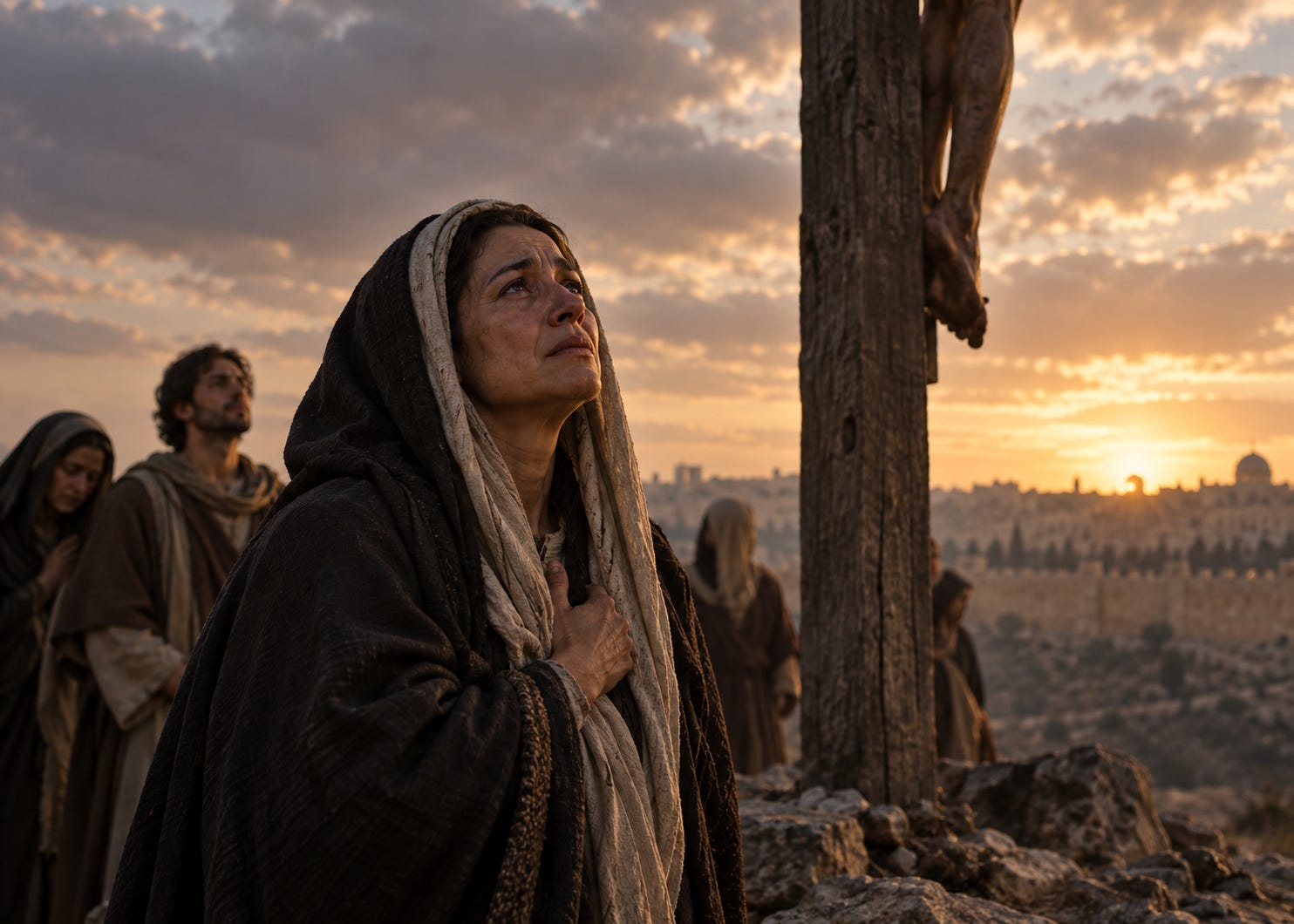
John tells us very little about what Mary does there. Perhaps very little needs to be said. “Standing by the cross of Jesus were his mother…” She is there. The woman who once carried Him within her body now stands close enough to watch His body being broken. The hands and feet she once counted, kissed, and wrapped against the cold have been pierced. The face she knew before anyone else knew it is now the face of a condemned man. She cannot take Him down. She cannot make it stop. She cannot do for her Son what every instinct of a mother must be crying out for her to do.
She can only remain, and she does.
A sword will pierce
The Church’s meditation upon Mary’s sorrow does not begin at Calvary. Luke takes us back to the Temple, when Jesus is still small enough to be carried in His mother’s arms. There, an old man named Simeon takes the Child and recognizes in Him the salvation for which Israel has waited. He blesses the family, then says something directly to Mary that must have been difficult to forget: “And you yourself a sword will pierce.”
Christian devotion eventually gathered seven moments of Mary’s suffering into what became known as the Seven Sorrows. Some come directly from the Gospel narratives; others belong to the Church’s centuries of prayerful contemplation of Mary’s participation in the Passion of her Son. They are Simeon’s prophecy; the flight into Egypt; the loss of the child Jesus in Jerusalem; Mary’s traditional encounter with Jesus on the road to Calvary; the Crucifixion; the traditional image of Mary receiving the body of Jesus after His death; and His burial.
It is easy to turn a devotion like this into a list. It is much harder to allow the list to resonate into our humanity.
A mother is warned that suffering lies ahead for her child. Soon afterward, the family must flee because someone wants her child dead. Years later, she cannot find Him and searches for Him in fear. Eventually, she watches Him become the object of public hatred. She sees Him tortured. She watches Him die. Christian art and devotion have contemplated her receiving His lifeless body into the arms that once held Him as an infant. Then comes the tomb.
These are Mary’s sorrows, but they belong to a landscape human beings still inhabit. We know mothers who have sat beside the beds of sick children. We know parents who would gladly have taken their child’s suffering into their own bodies if love had given them the choice. We know people who have buried sons and daughters, husbands and wives, parents and friends. We know the peculiar helplessness of loving someone whom we cannot save.
Perhaps some of us know it too well.
And this is where I think we need to be very careful with Mary. Christian devotion can sometimes make holy people seem almost untouched by the ordinary consequences of being human. We surround them with gold, place halos behind their heads, and slowly remove everything from their faces that looks too much like us. But the Church did not preserve the memory of Mary at Calvary because sorrow somehow failed to reach her. The ancient hymn calls her dolorosa, sorrowful, and lacrimosa, weeping.
The sword pierced her heart.
Grace did not make Mary less capable of suffering. I suspect it made her more capable of love, and therefore opened her heart more completely to everything love can cost.
Blessed among women
There is something about Mary’s suffering that Christianity cannot afford to overlook, because long before Luke tells us about Simeon’s sword, he has already told us who this woman is.
She is favored by God. She receives Gabriel’s astonishing announcement and places her life at God’s disposal: “May it be done to me according to your word.” When she visits Elizabeth, her cousin greets her with words Christians have repeated ever since: “Blessed are you among women.” Elizabeth then tells us something more about Mary’s blessedness: “Blessed are you who believed that what was spoken to you by the Lord would be fulfilled.”
Mary believed God with everything she had.
She was not spared that terrible sword.
That simple fact overturns a surprising amount of bad theology.
There are Christians who have been taught, sometimes very explicitly, that sufficient faith will bring earthly prosperity, healing, protection, or success. Many of us would reject that teaching immediately if we called it out as the prosperity gospel, yet many of us have still absorbed a quieter version of precisely the same idea. Be faithful and God will make things work out. Pray hard enough and the disease will go away. Do the right thing and God will protect your family. Give generously and God will see to your comfort.
In thirteen years of priesthood and pastoral accompaniment, I have seen enough to know that life does not unfold according to such a tidy formula. Scripture does not promise one either.
The Christian tradition certainly speaks of reward, and we should not pretend otherwise. Jesus speaks of reward. The apostles speak of reward. Christianity promises resurrection, eternal life, communion with God, and the final fulfillment of all things in Christ. These are not small promises.
But Christianity does not promise that faithfulness will spare us from the ordinary tragedies of mortal life.
In fact, the liturgy of this memorial gives us Christ Himself as the answer. One of the readings appointed for Our Lady of Sorrows comes from the Letter to the Hebrews, which speaks of Jesus offering prayers “with loud cries and tears” and learning obedience through what He suffered. The beloved Son is not spared suffering because He is faithful. His faithfulness is revealed within it.
And then there is Mary.
She believed. She obeyed. She trusted. She was blessed among women, and a sword pierced her heart.
The quieter versions of prosperity theology become especially cruel when suffering finally comes. A person already carrying more grief than seems possible is handed another burden: perhaps I did something wrong. Perhaps I did not believe enough. Perhaps God is disappointed in me. Perhaps if my faith had been stronger, the person I love would still be here.
I have heard variations of those questions more times in pastoral ministry than I care to remember.
If you are carrying one of them, I want you to look at Mary. The woman standing beneath the Cross is the woman Luke called favored. The woman whose soul was pierced is the woman Elizabeth called blessed. The woman watching her Son die is the woman who believed what God had spoken to her.
Please do not add the accusation that you failed God to the pain you are already carrying.
None of this means that suffering is inherently holy or that Christians should seek it. Christ healed the sick, fed the hungry, restored the excluded, and relieved suffering wherever He encountered it. We should do the same. We treat disease. We protect people from danger. We resist injustice. We accompany the dying. We relieve suffering wherever love gives us the power to do so.
Mary’s sorrow does not teach us that pain is good. It teaches us that suffering, however terrible, is not proof that we have been abandoned by God.
She stood
There is one word in the Stabat Mater that carries an extraordinary amount of weight.
Stabat. She stood.
John gives us the image. The hymn remains with it. And the Christian tradition noticed it long before the Stabat Mater was written. St. Ambrose, writing in the fourth century, contemplated Mary remaining at the Cross even as the disciples fled. She stood before the wounds of her Son.
But standing does not mean untouched.
Stabat Mater dolorosa.
The Mother stood sorrowful.
Iuxta Crucem lacrimosa.
Beside the Cross, weeping.
Mary’s strength at Calvary is not stoicism. We are not being asked to admire a woman who mastered her emotions so completely that she could watch her Son die with serene detachment. Pope Francis, reflecting upon Our Lady of Sorrows, described Mary at Calvary as standing there with strength and with tears. Her steadfastness and her anguish belong to the same woman.
There is something important in that for those of us who have occasionally confused faith with composure. Christians are allowed to grieve. We are allowed to be frightened. We are allowed to discover that something hurts more than we thought we could bear. None of these things constitutes a failure of faith.
Jesus Himself has made that impossible to believe.
When Lazarus died, Jesus knew what He was about to do. He knew the tomb would be opened. He knew Lazarus would walk out of it. He knew, with a certainty none of us possesses at a graveside, that death was about to surrender its prisoner.
And Jesus wept.
There is enough theology in those two words to accompany a grieving person for a lifetime. St. Augustine noticed it too. When Paul tells Christians not to grieve “like the rest, who have no hope,” Augustine understood that Paul had not forbidden Christian sorrow. Martha and Mary wept for Lazarus despite their faith, and Christ Himself wept before raising him.
Christian hope does not require us to pretend that death is anything less than terrible. Resurrection does not make the grave harmless. We believe that death will not have the final word because Christ has conquered it, but that is very different from pretending death has nothing painful to say along the way.
Mary can believe in God and still weep beneath the Cross. So can you.
He saw His mother
There is another tenderness hidden in John’s account of Calvary that I do not want us to miss.
Jesus sees His mother.
In the midst of His own agony, He sees Mary standing there. Beside her is the disciple whom John calls “the disciple whom He loved.” Jesus speaks first to Mary: “Woman, behold, your son.” Then He says to the disciple: “Behold, your mother.” John tells us that from that hour the disciple took her into his own home.
The Church has found profound theological meaning in those words, especially in contemplating Mary’s relationship to the disciples of Christ and, by extension, to the Church. But before we follow that theology upward, there is something profound happening at the foot of the Cross.
A dying Son sees His mother, and He entrusts her to someone He loves.
St. Ambrose saw in this scene an act of filial care even in the midst of Christ’s Passion. And I think there is something here for those of us who imagine that strong faith means carrying grief privately.
Even here, at Calvary, relationship remains.
There are crosses we cannot remove from one another. Most of us desperately wish we could. There are times when we would give almost anything to make someone we love whole again, and there is simply nothing left for us to fix.
But love has never been limited to fixing.
Sometimes love cooks a meal. Sometimes love sits in the waiting room. Sometimes love answers the telephone at two in the morning. Sometimes love remembers the anniversary everyone else has forgotten. Sometimes love says very little because every available sentence sounds inadequate. Sometimes love simply stays.
Jesus does not offer Mary an explanation from the Cross. He gives Mary and the beloved disciple to one another.
There are days when this may be one of the holiest things Christians can do.
Beside the Cross with you
This is finally where the Stabat Mater leads us. The hymn does not merely invite us to observe Mary’s grief from a respectful distance. It asks that her sorrow enlarge our own capacity to love Christ. The person praying it asks to stand beside her, to share her sorrow, and through that sorrow to enter more deeply into the Passion of her Son.
Our Lady of Sorrows is not a devotion to suffering for suffering’s sake. Christianity does not ask us to go looking for pain. But there is suffering we cannot prevent. There are wounds medicine cannot heal, losses apologies cannot repair, deaths we cannot reverse, and questions for which this side of eternity may never give us a satisfactory answer.
Christianity does not promise that those places will never exist.
It promises that God has entered them.
This is the love revealed at Calvary. God does not save the world by remaining safely beyond its suffering. In Christ, He enters it. He bears wounds. He knows abandonment. He weeps. He dies. And because He enters even the grave, there is finally no depth of human sorrow into which we can descend and discover that God has refused to go.
Mary stands very near that mystery.
The liturgy for this memorial says something extraordinary about her. Its Alleluia acclamation speaks of Mary as having received the martyr’s crown beneath the Cross without undergoing death. The Church recognizes something here that human beings who have suffered profound grief may understand instinctively: there are wounds that do not kill the body, but nevertheless pass through a human life like a sword.
Perhaps that is one reason suffering Christians have found their way to Our Lady of Sorrows for so many centuries. Not because Mary can offer a neat explanation for pain. Her own life does not permit one. We come to her because she knows what it is to love Christ when loving Him does not protect the heart from being broken. She knows what it is to trust without understanding, to remain when nothing can be repaired, and to weep while still belonging completely to God.
And she knows something else that perhaps we forget when grief has made the world feel terribly lonely.
Christ sees the person standing beneath the Cross.
He saw His mother. He sees you.
Yesterday, the Church lifted high the Cross and asked us to behold the love of God poured out upon it. Today, she leaves us at Calvary for one more day and asks us to stand beside Mary.
Stabat Mater dolorosa.
The sorrowful Mother stood.
There are seasons of life when faith looks like singing. There are seasons when it looks like serving, building, celebrating, teaching, or beginning again. And there are seasons when faith has been stripped of almost everything except the decision to remain near Christ while your heart is breaking.
Our Lady of Sorrows knows that kind of faith. She does not ask us to call the sorrow good. She does not ask us to understand it before we are ready. She does not ask us to stop weeping. She stands beside the Cross and shows us that a broken heart can still belong entirely to God.
And Christ, from the Cross, shows us that it is never unseen.
And Now It’s Your Turn…
I know today’s topic is heavy, and for some of you it touches something deeply personal. I hesitated to include this section at all today, but then I thought that some of you may want a place to share your stories, ask for prayer, or simply let this community know what you are carrying.
So, if there is something you would like to share, someone you would like us to remember in prayer, or some way we might help care for you, please feel welcome to let us know. I would never presume to ask you to revisit a difficult part of your life or speak about anything you would rather keep private. But neither would I want to close the door if you need somewhere to speak.
A simple request for prayer needs no explanation, and there is no obligation to leave a comment at all. You are just as welcome to remain here with us in prayer. And of course you are always welcome to email me privately.
And if you know someone who is carrying grief while also carrying the terrible fear that God is disappointed in them, please consider sending this reflection to them. Sometimes the most pastoral thing we can do is help someone put down a burden God never asked them to carry.
The Stabat Mater
At the cross her station keeping,
Stood the mournful Mother weeping,
Close to Jesus to the last.
Through her heart, His sorrow sharing,
All His bitter anguish bearing,
Now at length the sword had passed.
Oh, how sad and sore distressed
Was that Mother highly blest,
Of the sole begotten One!
Christ above in torment hangs.
She beneath beholds the pangs
Of her dying glorious Son.
Is there one who would not weep,
Whelmed in miseries so deep,
Christ’s dear Mother to behold?
Can the human heart refrain
From partaking in her pain,
In that Mother’s pain untold?
Bruised, derided, cursed, defiled,
She beheld her tender Child,
All with bloody scourges rent.
For the sins of His own nation,
Saw Him hang in desolation
Till His spirit forth He sent.
O thou Mother: fount of love!
Touch my spirit from above,
Make my heart with thine accord.
Make me feel as thou hast felt;
Make my soul to glow and melt
With the love of Christ my Lord.
Holy Mother, pierce me through;
In my heart each wound renew
Of my Savior crucified.
Let me share with thee His pain,
Who for all my sins was slain,
Who for me in torment died.
Let me mingle tears with thee,
Mourning Him who mourned for me,
All the days that I may live.
By the Cross with thee to stay;
There with thee to weep and pray,
Is all I ask of thee to give.
Virgin of all virgins best,
Listen to my fond request:
Let me share thy grief divine.
Let me to my latest breath,
In my body bear the death
Of that dying Son of thine.
Wounded with His every wound,
Steep my soul till it hath swooned
In His very blood away.
Be to me, O Virgin, nigh,
Lest in flames I burn and die,
In His awful Judgment day.
Christ, when Thou shalt call me hence,
Be Thy Mother my defense,
Be Thy Cross my victory.
While my body here decays,
May my soul Thy goodness praise,
Safe in Paradise with Thee.
Amen.
Let Us Pray…
God of infinite mercy,
You did not spare Mary from sorrow,
but You did not abandon her within it.
Stay close to those whose hearts have been pierced by grief.
Be near the parent who cannot protect a child,
the family waiting for news,
the person mourning someone they love,
the frightened patient,
the lonely caregiver,
and everyone trying simply to remain standing today.
Free us from the cruel belief that suffering proves we have failed You.
When we weep, remind us that Your Son wept.
When we need help, give us the humility to receive the people You place beside us.
When answers do not come, keep us close enough to love that we do not run from one another.
And when standing is all we can manage,
let standing be enough for today.
Amen.
Our Lady of Sorrows, Mother who stood beside the Cross,
stand beside us.
Pray for us.
Thank you for allowing me to share this reflection with you today, especially if some part of Mary’s sorrow came close to a sorrow of your own. I know that for some of you this was not simply an interesting piece of theology or a beautiful old devotion. It touched people you love, losses you still carry, and places in your life where the questions have never entirely gone away. Please know that I do not take your trust lightly.
This is the kind of work I want Message From the Margins to be able to offer: thoughtful enough to take our faith seriously, accessible enough that nobody needs a theology degree to enter the conversation, and pastoral enough to remember that the subjects we discuss are often being lived by the person reading on the other side of the screen. I also want as much of this work as possible to remain freely available, because I never want someone standing in the middle of grief, doubt, loneliness, or a search for God to discover that the rest of the conversation is waiting behind a paywall.
That is possible because some of the people who read Message From the Margins choose to support it with a paid subscription. If this ministry has become valuable to you, and you are in a position to do so, I would be deeply grateful if you would consider becoming one of them. Your subscription helps provide the time and resources required to research, write, record, teach, and offer this work freely to thousands of people who may need it but cannot necessarily afford to support it.
And if a paid subscription is not something you can manage right now, please stay. Read. Pray with us. Share these reflections when you think someone needs them. Your place in this community has never depended upon your ability to pay for it.
For those of you carrying a particular sorrow today, I hope you will be especially gentle with yourselves after reading this. And if words have finally run out, perhaps we can simply borrow the words the Church has prayed for centuries:
By the Cross with thee to stay;
There with thee to weep and pray…
Our Lady of Sorrows, pray for us.