
“Enough of the display of power! Enough of war!”
It is the kind of sentence that does not need explanation. It lands in the body before it reaches the intellect. You can almost hear it echoing through St. Peter’s Basilica, carried not as a policy argument, but as a moral cry.
And then, almost immediately, it collides with something very different.
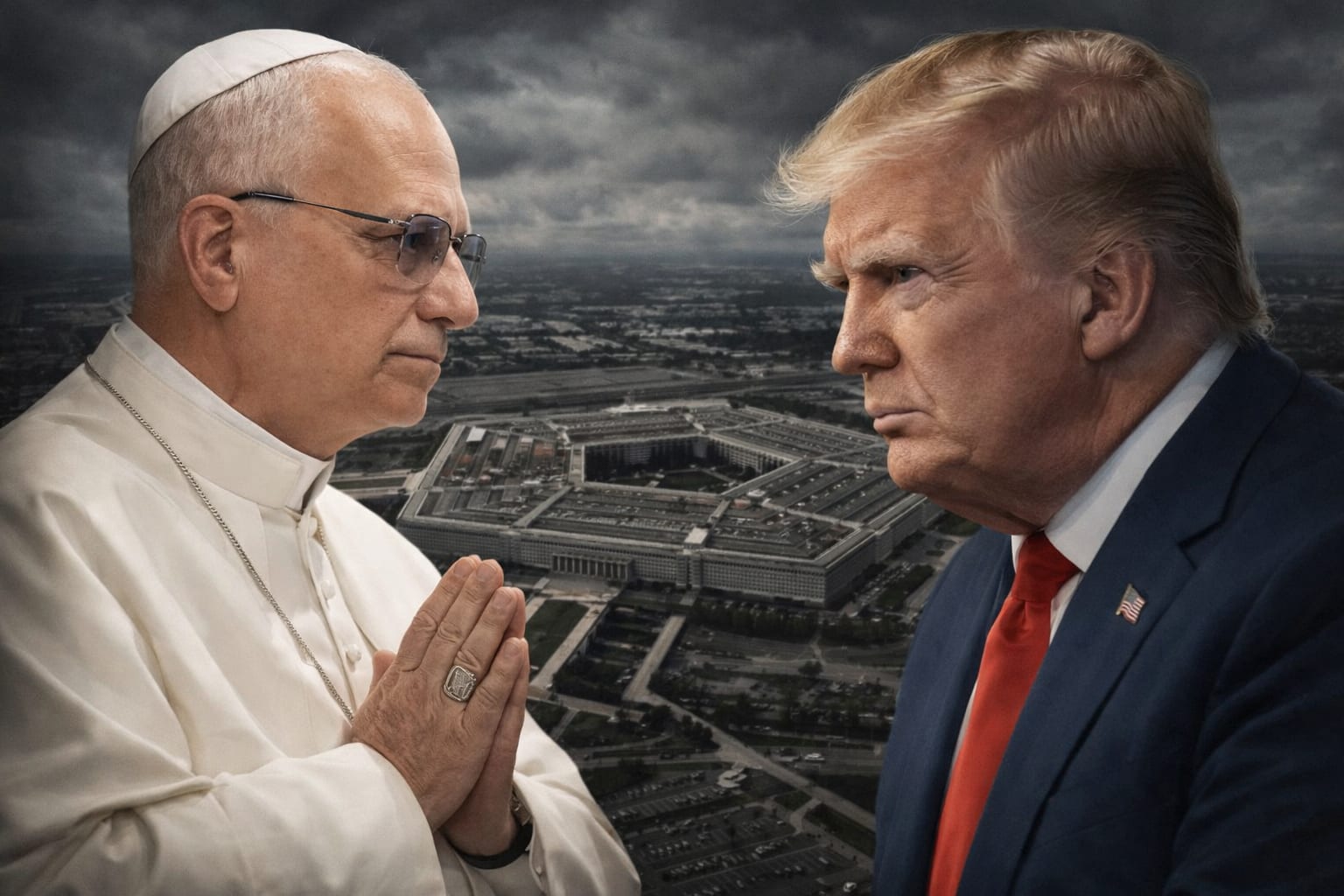
President Donald Trump responds by calling Pope Leo XIV weak, telling him to “stop catering to the Radical Left,” dismissing him outright, “I’m not a fan of Pope Leo.”
If you want to read the whole screed, you can find it here, I have neither the desire nor inclination to type it out further…
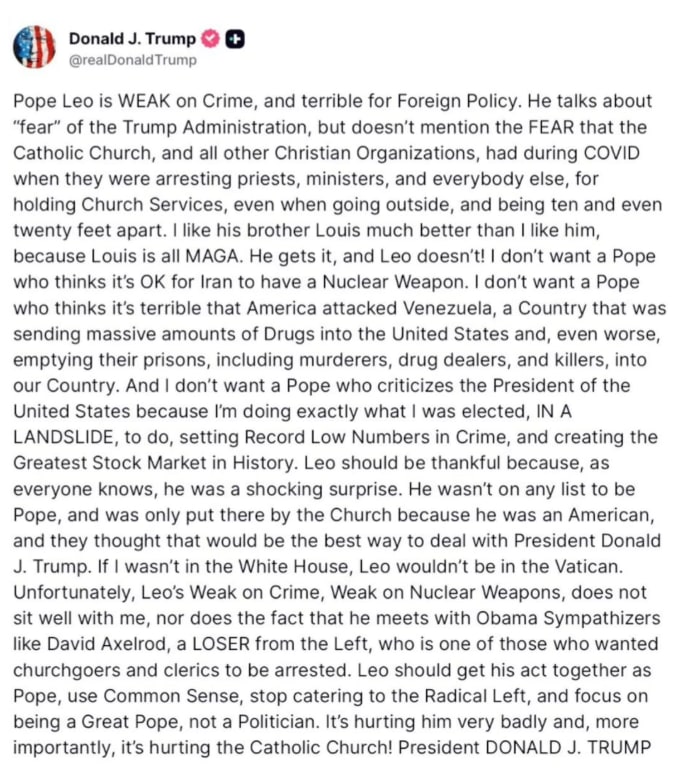
There you see the contrast, and that is the story.
Not just a feud. Not just another clash of personalities in a noisy public life. Something deeper is being exposed here, something spiritual, something uncomfortable.
When the pope pleaded for peace, power answered with mockery.
The moment itself is clear enough.
On April 12, 2026, during a peace vigil in St. Peter’s Basilica, Pope Leo XIV condemned what he called the “delusion of omnipotence” driving the escalating U.S.-Israel conflict with Iran. He warned against the moral blindness that treats war as clean, controlled, or justified by national interest. He spoke about civilians, about entire populations being threatened, about the danger of imagining that overwhelming force can ever be morally uncomplicated.
“Today… there has also been this threat against the entire people of Iran. And this is truly unacceptable!”
That is not diplomatic language. That is pastoral language. It is the voice of someone trying to name the human cost that disappears behind strategy and rhetoric.
The response from the American president was not engagement with that moral claim. It was dismissal. Insult. Reframing the conversation as weakness versus strength.
And that is where the real tension lies.
At the center of this story are not just two men, one in white, one behind a podium. It is the millions of people whose lives are bound up in decisions they do not control.
Iranian civilians. Families. Children. The kind of people who never appear in military briefings but always pay the cost in the aftermath.
The Church, at its best, insists on keeping those people visible.
Archbishop Paul Coakley, speaking from within the American context, translated the pope’s concern into language that is almost painfully direct:
“The threat of destroying a whole civilization and the intentional targeting of civilian infrastructure cannot be morally justified.”
There is no ambiguity there. No hedging.
It is a line in the sand.
And it reveals the deeper question this story is forcing us to face.
What do we do when strength begins to look like domination, and conscience begins to be dismissed as weakness?
Jesus, in the Sermon on the Mount, offers a very different definition of strength:
“Blessed are the peacemakers, for they will be called children of God.” (Matthew 5:9)
Not the conquerors. Not the ones who win at all costs. The peacemakers.
That sounds beautiful when it is safely in Scripture. It becomes much more difficult when it stands in direct tension with the language of power in the real world.
Because peacemaking is slow. It is patient. It requires restraint. It often looks, from the outside, like losing ground.
And in a culture shaped by spectacle and dominance, restraint is almost always interpreted as weakness.
Which is why the pope’s words land the way they do.
“Enough of the display of power.”
He is not just critiquing military action. He is naming a spiritual temptation, the belief that power itself is proof of righteousness.
The belief that if you can do something, you are justified in doing it.
The belief that force is clean.
James cuts through that illusion with uncomfortable clarity:
“What causes fights and quarrels among you? Don’t they come from your desires that battle within you? You desire but do not have, so you kill.” (James 4:1-2)
War, in that light, is not noble destiny. It is disordered desire at scale.
If we are honest, most of us recognize some version of this dynamic in our own lives.
Not on the scale of nations, but in smaller, quieter ways.
The instinct to win the argument rather than tell the truth.
The temptation to assert control rather than seek understanding.
The subtle satisfaction of being right, even when it costs someone else something real.
The scale is different, but the logic is familiar.
Power can become its own justification.
And conscience can start to feel inconvenient.
This is why moments like this matter so much.
Because they clarify what faith is actually for.
Faith is not here to bless whatever a nation chooses to do. It is not here to provide spiritual cover for policies or strategies or ambitions. It is not a branding tool.
At its best, faith interrupts.
It insists on the dignity of every human person, even when it complicates our narratives. It refuses to let entire populations become abstractions. It calls leaders, and all of us, back from the edge when we start to believe our own power makes us morally secure.
It tells the truth when it would be easier to stay quiet.
And that truth is not always welcomed.
Sometimes it is mocked.
Sometimes it is dismissed as naive.
Sometimes it is labeled weak.
But the deeper question is not how power responds.
The deeper question is how we respond.
Do we recognize the voice that says “Enough of war” as moral clarity, or do we instinctively filter it through the categories of politics and strength?
Do we believe that restraint can be a form of courage?
Do we still have space in our imagination for the possibility that the peacemaker is not the naive one in the room?
Isaiah offers a vision that feels almost impossibly distant in moments like this:
“They will beat their swords into plowshares and their spears into pruning hooks. Nation will not take up sword against nation, nor will they train for war anymore.” (Isaiah 2:4)
It is not just a call to stop fighting. It is a reimagining of what power is for.
That kind of vision does not come from domination. It comes from a refusal to accept that violence is inevitable or morally neutral.
It comes from people willing to say no, even when no is unpopular.
This story is not really about whether one man is right and another is wrong in a narrow sense.
It is about whether we, as people of faith, are willing to let conscience speak with authority, even when it challenges the language of power we have grown used to.
Because when faith refuses to bless violence, power often calls that weakness.
But history, and the Gospel, suggest something else.
Sometimes the most powerful words in the world are the ones that say, clearly and without apology,
Enough is Enough.
Are you Standing with Pope Leo or Donald Trump? Let me know in the comments
Hopefully you can see that this work is more important now than ever.
We are living in a moment where faith is being pulled in two directions, one that blesses power, and one that tells the truth about it. That tension is not going away. It is only getting louder.
What I am building here is not noise. It is not reaction. It is a steady, grounded voice that helps you think clearly, feel honestly, and stay rooted in something deeper than the chaos.
If you’ve been looking for that, not just headlines, but clarity… not just outrage, but moral depth… then this is exactly what this space is for.
Subscribe to Message From the Margins and be part of a community that refuses to look away, refuses easy answers, and takes faith seriously in the real world.
This work only continues with reader support. If you want clear-eyed writing that challenges the status quo and gives voice to the Gospel when it matters most, consider becoming a paying subscriber.
Thank you for reading, truly.