

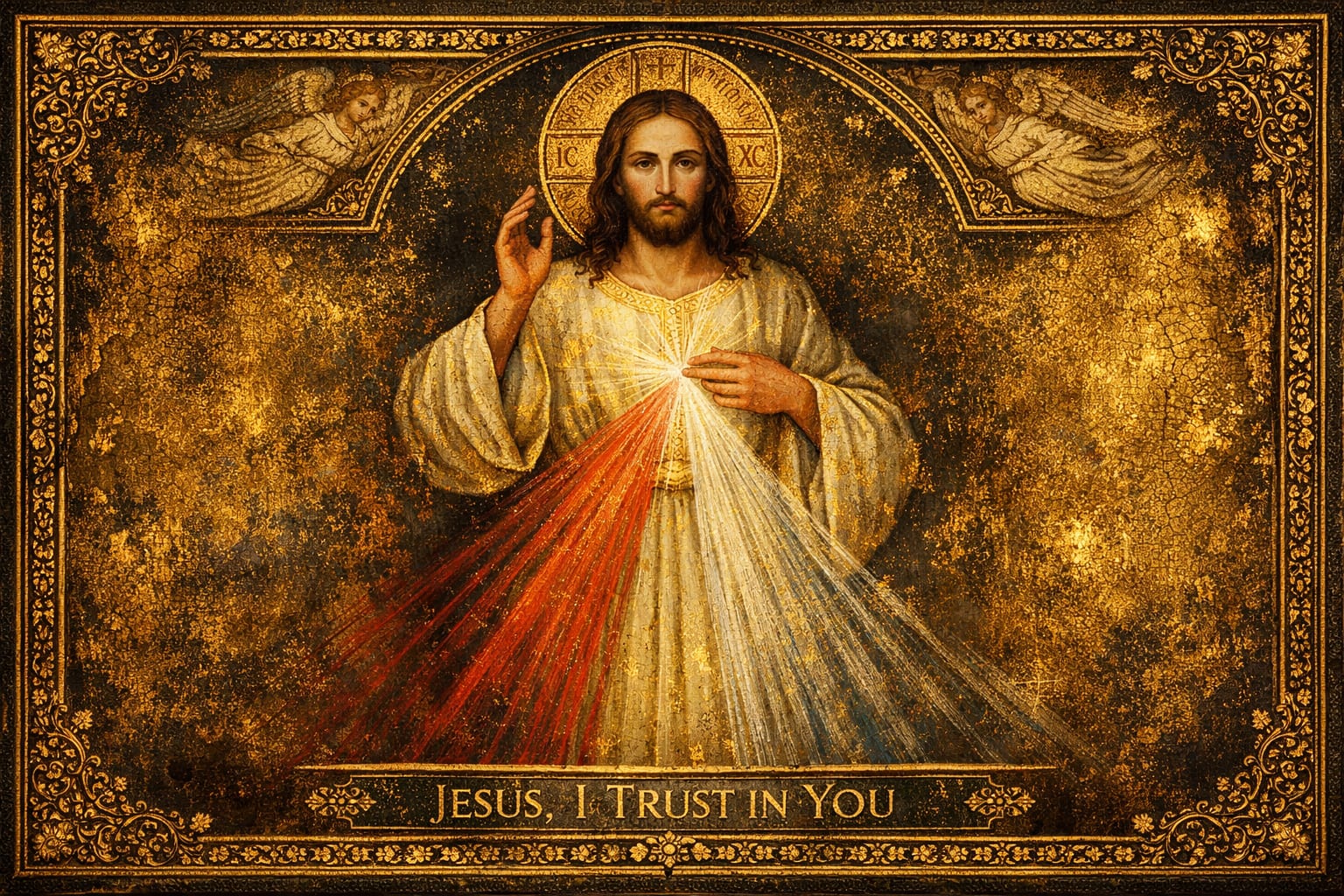
Divine Mercy Sunday is one of those days that can easily slip past us.
It comes quietly, just a week after Easter, when the alleluias are still echoing but our attention has already started to drift. And yet… I find myself thinking more and more that this might be one of the most necessary days the Church gives us.
Because what we hear in the Gospel today is something easy to overlook.
The risen Christ appears to His disciples… and the way He comes to them is not what we would expect.
There is something deeply disarming about it.
He doesn’t arrive with explanations. He doesn’t demand anything from them. He doesn’t even begin by correcting their fear or their doubt.
He simply stands among them… and shows them His wounds.
Not hidden. Not healed away. Not forgotten.
Still there… and somehow no longer a source of shame or defeat, but of peace.
And that is where Divine Mercy begins.
Not as an idea, not just as a devotion added onto the Christian life, but as a quiet, almost startling revelation… that nothing we have lived through, nothing we have done, nothing we carry, is beyond the reach of God’s love.
The Church gives us this Sunday, right in the middle of the Easter season, to sit with that truth. To let it sink in slowly.
Because most of us, if we’re honest, don’t need to be convinced that God is powerful.
We need to be convinced that God is gentle with us.
That He is patient… that He does not turn away… that even the places we are most tempted to hide are the very places He is willing to enter.
Divine Mercy Sunday is not asking us to figure all of that out.
It is simply inviting us… to come a little closer, and not be afraid.
This ministry is reader-supported.
There are no ads here. No algorithms shaping the message. No pressure to soften the truth. That freedom exists because of readers who believe in this work and choose to sustain it.
If this space has meant something to you, I want to invite you to take a moment and look honestly at your own heart… and consider becoming a paid supporter.
Your support ensures that this ministry continues, grows, and remains accessible to those who cannot afford it.
As a thank you, you’ll receive access to Father Rich’s full ebook library, along with enrollment in the course Life in the Resurrection: Living An Integrated Faith in a Chaotic World.
Here’s what people are saying about the our most recent issue of the program:
”This resonates with me in a jaw dropping way.”
”This is such a spiritual lesson which I keep trying to practice daily…I stop during the day and look for your messages to re-center myself. Thank you so much. God bless you”
There will always be meaningful free content here.
But that is only possible because of generous readers who make the choice to carry it forward.
If you’re able, I’d be grateful to have you as part of that.
Your Brother on the Path,

CLICK HERE→ I Pledge to Support This Ministry Today
The Heart of the Celebration
Divine Mercy Sunday is celebrated on the Second Sunday of Easter, just one week after the Resurrection. That timing is not accidental.
The Gospel proclaimed is the story of Thomas, the disciple who could not bring himself to believe what the others were already celebrating. While they rejoiced, he held back… wounded, uncertain, unconvinced.
And when Christ comes to him, He does not correct him harshly.
He invites him closer.
“Put your finger here… see my hands. Reach out your hand and put it into my side.”
This is Divine Mercy.
Not the erasure of wounds, but their transformation. Not the rejection of doubt, but an invitation through it.
The modern devotion is closely tied to St. Faustina Kowalska, a Polish nun in the early 20th century, who recorded a series of spiritual experiences centered on God’s mercy and the call to trust in Christ. In the year 2000, the Church formally established this Sunday for the whole world, placing it exactly where it belongs, within the light of Easter.
Because the Resurrection is not only about life after death.
It is about a love that has passed through suffering… and refuses to stop giving itself.
A Tradition Rooted in Trust
The image most associated with Divine Mercy shows Christ with rays of red and pale light flowing from His heart, with the simple words: “Jesus, I trust in You.”
That line is not decorative.
It is the entire spiritual challenge.
Christians have always believed in God’s mercy. But this devotion brings that belief into something more personal, more immediate. It asks not only whether we believe in mercy… but whether we trust it.
And trust is where many of us struggle.
Tradition also gives us the Chaplet of Divine Mercy, a simple prayer repeated on the beads of the rosary, offering Christ’s mercy for the whole world. It is quiet, steady, almost rhythmic… less about saying something new, and more about letting the truth of mercy settle into the heart.
The Church has long understood that mercy is not indulgence. It is not pretending that harm doesn’t matter.
Mercy is what makes healing possible.
Mercy is what allows a person to begin again… honestly.
Why This Matters Right Now
We are living in a time that is strangely allergic to mercy.
Public life is built on exposure, judgment, and permanent records of failure. Social media rewards outrage. Mistakes are remembered, archived, and often weaponized. There is very little room to grow, to change, to be forgiven.
And that way of living does not stay outside of us.
It becomes internal.
We grow harsh with ourselves. We replay what we regret. We carry the quiet fear that if everything were known, we would be dismissed or turned away.
Divine Mercy Sunday speaks directly into that.
It tells the truth about sin… but refuses to let sin have the final word.
It tells the truth about wounds… but insists they can become places of encounter.
It tells the truth about doubt… but shows us that doubt does not disqualify us from being loved.
But there is another side to this… and it is the harder one.
Jesus does not only invite us to receive mercy.
He calls us to become merciful.
“Blessed are the merciful, for they shall receive mercy.”
And even more, He tells us to love our enemies.
That is where this feast becomes challenging.
Because we are living in a world where injustice is real. People are hurt. Systems fail. Harm is not abstract, it is personal and often painful.
And alongside that, our instincts have become increasingly tribal. We divide quickly. We defend our side. And if we are honest, there is something in us that wants those we disagree with, even when we are right, to face the harshest consequences possible.
That instinct is human.
At times, it is even supported by legal or ethical reasoning.
But life in Christ calls us further.
The Kingdom of God is not built on getting what we deserve.
It is built on mercy.
And that turns everything upside down.
Mercy does not deny justice. It does not excuse harm. But it refuses to let punishment, resentment, or vengeance become the final word in the human story.
It asks something much more difficult of us.
To hold truth clearly… and still refuse to harden our hearts.
To name injustice… and still resist dehumanizing others.
To long for what is right… without losing the capacity to love.
That is not easy.
But it is deeply important.
Because the mercy we struggle to extend… is the very mercy we ourselves depend on.
And once we begin to see that clearly, even in small ways, it changes how we move through the world.
What You Can Do This Week
-
Spend time with John 20:24–29, and place yourself in the scene with Thomas
-
Pray slowly, “Jesus, I trust in You,” and notice where that feels difficult
-
Bring one specific regret or failure to prayer, and consciously place it in God’s mercy
-
Offer a concrete act of mercy to someone this week, especially where it feels undeserved
-
If possible, attend Mass or set aside time to mark this day intentionally
Closing Prayer
Merciful Christ,
You come to us not with condemnation, but with wounded love.
You stand before us with hands that still bear the marks of suffering,
not to shame us, but to draw us closer.
We bring You what we would rather hide,
our failures, our doubts, our regrets,
the quiet places where we feel unworthy of love.
Give us the courage to trust that Your mercy is greater than all of it.
Teach us to receive that mercy without fear,
and to extend it to others without hesitation.
Soften what has become hardened within us.
Heal what we have tried to carry alone.
And guide us into lives shaped not by shame or fear,
but by the steady, transforming power of Your grace.
We place our trust in You,
now and always.
Amen.
If this reflection stayed with you, don’t let it end here.
Leave a comment and share what struck you, I read them, and they shape what I write next. And if you know someone who needs to hear this, pass it along.
Make sure you’re subscribed so you don’t miss what’s coming.
This space grows because people like you choose to engage with it.