

Opening
We often imagine that once responsibility is owned, once truth is spoken, once the blame game stops, everything should return to normal.
But Genesis does not give us that ending.
Adam speaks.
Eve speaks.
God responds.
Consequences are named.
The ground will resist.
Childbirth will hurt.
Mortality will define their horizon.
The garden will no longer be home.
There is no apology recorded.
There is no formal absolution pronounced.
There is no rewind.
There is justice.
There is boundary.
There is prevention of further harm.
And then… something quieter.
They continue.
Life After the Garden
Genesis does not end in Eden.
After the expulsion, the narrative moves forward.
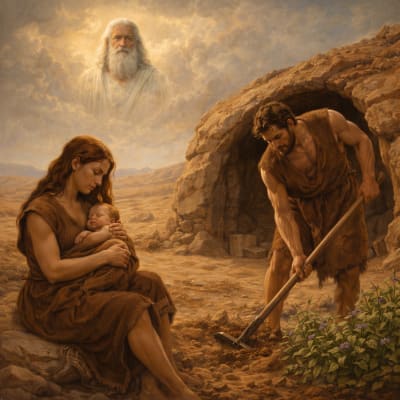
Adam knows his wife.
Eve conceives.
A child is born.
The soil is worked.
Life goes on.
It is not the life they once knew. The terrain is altered. The labor is heavier. Innocence is gone.
But it is still life.
This is important.
Confession does not suspend reality. Accountability does not rewind the world. When choices reshape the landscape, the landscape remains reshaped.
And yet, Scripture does not present this as annihilation.
Before they leave the garden, God clothes them. He covers their vulnerability. He sends them out not naked, not erased, but prepared for the new terrain.
The exile is real.
So is the future.
Accepting Consequences with Grace
Accepting consequences is not passive resignation.
It is not shrugging and saying, “Well, that’s life.”
It is the quiet decision to stop fighting reality.
Genesis does not present the exile as negotiable. There is no appeal filed. No argument offered. No counterclaim submitted.
The soil will resist.
Mortality will mark them.
The garden will be closed.
And Adam and Eve go out.
They do not storm the gates of Eden. They do not linger at the boundary demanding reinstatement. They step into the altered terrain.
This is where Saint Paul becomes unexpectedly relevant.
Writing to the Galatians, Paul says, “Do not be deceived: God cannot be mocked. A man reaps what he sows” (Galatians 6:7). That is not cruelty. It is moral realism. Actions bear fruit. Choices shape futures.
But Paul does not stop there. In the same breath he writes, “Let us not become weary in doing good, for at the proper time we will reap a harvest if we do not give up” (Galatians 6:9).
The field may be harder.
The harvest may take longer.
But sowing still matters.
Accepting consequences with grace means refusing to deny the harvest of what was sown, while also refusing to surrender hope for what can still grow.
Augustine understood this deeply.
In his Confessions, he does not minimize his past. He names it. He traces the disordered loves that shaped his choices. He does not pretend that grace erased his history. Instead, he recognizes that even his wandering became soil for humility.
God did not pretend Augustine’s past did not exist. God transformed it.
That is different from saying consequences disappear.
They remain.
But they are no longer meaningless.
There is dignity in saying:
This is now true.
I will not deny it.
I will not collapse beneath it.
I will live faithfully here.
Saint Paul himself bore consequences long after his conversion. His persecution of the Church did not vanish from memory. He carried suspicion, hardship, resistance. Yet he did not spend his life demanding that others forget who he had been.
He labored.
He endured.
And he wrote, “Forgetting what is behind and straining toward what is ahead, I press on” (Philippians 3:13–14).
He does not say the past never happened.
He refuses to live imprisoned by it.
This is the balance.
Justice is honored.
Reality is faced.
The future is not forfeited.
Where This Lands in Real Life
This is not abstract theology.
This is the terrain many people are already standing on.
Maybe you’ve gotten into trouble with the law.
Maybe addiction cost you trust, health, relationships.
Maybe your marriage fractured and ended in divorce.
Maybe a choice at work led to termination or a failed business.
Maybe financial mismanagement led to bankruptcy.
Maybe you said something you cannot unsay.
If you talk to people long enough, you learn something humbling.
These stories are not rare.
They are common.
Not because people are monsters.
Because people are human.
Consequences are not theoretical.
They are court dates.
They are custody agreements.
They are sobriety milestones.
They are job searches.
They are awkward holiday gatherings.
And here is what I have seen again and again in pastoral life:
After the dust settles, after the embarrassment fades, after the initial fear burns off… people begin to build again.
Not perfectly.
But steadily.
They get up.
They go to meetings.
They show up for their children.
They take the new job.
They pay what they owe.
They learn the lesson.
They live.
Genesis 3 is not a myth about ancient people in a garden.
It is a mirror.
And the mirror does not say, “You are finished.”
It says, “Now you work the soil.”
A Happy Enough Ending
Sometimes accepting consequences is not dramatic.
It is simply saying:
This is the terrain now.
You may not get Eden back.
But you can still build.
You can wake up.
You can work the soil.
You can love within the limits you now inhabit.
You can raise children.
You can grieve.
You can hope.
Genesis 4 does not open with despair. It opens with life unfolding in a harder world.
And that, in its own quiet way, is a happy enough ending.
Not perfect.
Not restored innocence.
But dignified, forward-moving life.
Practical Integration
If you are living in the aftermath of a hard truth:
-
Stop rehearsing alternate timelines.
-
Accept the consequence without dramatizing it.
-
Do the work in front of you.
-
Resist self-punishment. Reality is heavy enough without added shame.
-
Ask: What is the next faithful step in this new terrain?
You do not need a perfect ending.
You need a livable one.
A Gentle Word to Those Struggling Right Now
I want to say something carefully.
For some of you, this reading may not feel steady or mature. It may feel raw.
It may have brought up a lot of feelings, and I want to hold space for that.
If you are in the middle of active fallout, if the court date is still ahead of you, if sobriety is still measured in days, if the divorce papers are still fresh, if the job loss still feels humiliating… this may land heavy.
Please hear me clearly.
This is not written to scold you for not moving on fast enough.
It is not written to minimize your pain or the seriousness of your situation.
Quite the contrary.
It was written to remind you that you are not alone. We walk this road together. And when you are ready, there is hope.
Some consequences are crushing. Some are layered with other people’s sins. Some carry injustice along with justice. Life is rarely clean.
If you are struggling right now, breathe.
You are not uniquely broken. You are not disqualified from the future. You are not the only one who has ever stood outside a garden wondering how you got here and where do I go now. Your feet may even feel like lead and you can’t move.
Reach for help if you need it. A counselor. A sponsor. A priest. A trusted friend. Maturity is not isolation.
Grace often looks like support.
And even when the terrain feels harsh, the story of Scripture insists on this:
Life continues.
Not easily.
Not instantly.
But truly.
Be patient with yourself.
Community-Oriented Closing
This week we have walked through the garden together.
We asked, “Where are you?”
We named fear.
We stepped out of hiding.
We owned our part.
And now we accept what follows.
Not with despair.
Not with denial.
With steadiness.
How are you experiencing this series? What has resonated? What has challenged you? Drop a comment. I want your honest feedback.
We leave Eden.
But we do not leave life.
And that is enough.
Closing Prayer
Lord God,
You see us clearly. You do not confuse mercy with denial, nor justice with cruelty.
Give us the courage to accept what is now true.
Where we long to rewind, steady us.
Where we are tempted to self-punish, quiet us.
Where we fear that consequence means the end, remind us that life continues beyond the garden.
Teach us to work the soil before us.
Teach us to love within the limits we now inhabit.
Teach us to press forward without bitterness.
Clothe us with dignity as You clothed our first parents.
Walk with us into the harder terrain.
And help us build something faithful there.
Amen.
If this series has strengthened you, challenged you, or given you language for your own journey, I invite you to consider becoming a supporting member of this ministry.
Your sponsorship allows us to continue producing thoughtful, Scripture-rooted reflections and to reach those who may not yet know they need them.
We walk together here. Your support helps widen the circle. As always, thank you for being here.