

If You Missed Yesterday
Yesterday we began with a simple question from Genesis 3: “Where are you?”
After the fruit, after the rupture, after trust fractured, God called out to Adam, “Where are you?”
Not because He lacked information.
But because Adam needed honesty.
Adam’s reply is the first true confession in Scripture:
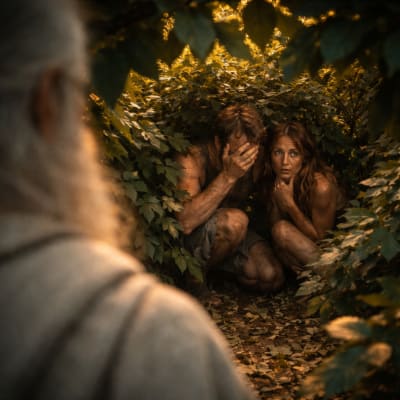
“I heard the sound of you in the garden, and I was afraid… so I hid.”
That sentence is not ancient history. It is biography.
Today, we look at the fear beneath the hiding.
The Psychology of Hiding
Most of us would never say, “I am hiding.”
We say other things.
We call it shame.
Shame is not “I did something wrong.”
Shame is “I am something wrong.”
When shame settles in, negative self-talk follows close behind.
“Of course I failed.”
“They must think I’m incompetent.”
“I always ruin things.”
“She’s probably disappointed in me.”
We begin mind-reading. We assign thoughts and judgments to other people before they have spoken a word. We replay conversations in our heads. We brace for criticism that has not yet come.
And then we withdraw.
We avoid the difficult conversation that needs to happen.
We delay the apology.
We choose silence over vulnerability.
We convince ourselves that distance equals safety.
Cognitive-behavioral therapy speaks about what it calls distortions in thinking. These are habitual patterns of interpreting reality through fear rather than fact.
Catastrophizing is when we assume the worst possible outcome without evidence. A small mistake becomes “This is a disaster.” A hard conversation becomes “This will ruin everything.”
Personalizing is when we assume we are the cause or center of situations that may have little to do with us. Someone is quiet, and we conclude they must be upset with us. A room feels tense, and we assume we are the problem.
Mind-reading is when we decide we know what others are thinking without asking. “They’re judging me.” “He thinks I’m foolish.” No conversation has happened. Fear fills in the blanks.
These are not moral failures. They are habits of fear.
But they are distortions. They do not show us reality clearly.
Left unexamined, they begin to steer our decisions. We shrink our world to avoid imagined rejection. We protect our pride at the expense of intimacy. We trade growth for safety.
Fear promises protection.
It delivers isolation.
And if these patterns are persistent, intrusive, or deeply distressing, it is not a lack of faith to seek help. Working with a therapist or a wise pastoral counselor can be an act of courage and humility. God’s grace often works through trained minds and listening hearts. There is no shame in asking for help to see more clearly.
When Fear Enters Our Spiritual Life
Fear does not stop at our relationships with one another, It often spills into our life with God.
We stop going to church.
We avoid the sacrament of reconciliation.
We refrain from receiving Communion.
We drift away from prayer.
Sometimes this happens gradually. We tell ourselves we are busy. We convince ourselves we do not need structure or sacrament. And sometimes, if we are honest, we feel unworthy. Embarrassed. Exposed.
So we stay away.
We hide.
Yet something remarkable happens in moments of crisis. When tragedy strikes, when the diagnosis comes, when the relationship collapses, when the ground gives way beneath us, a great many people reach their hand back out toward God.
I have seen it countless times.
In hospital rooms.
At gravesides.
After catastrophic mistakes.
The instinct to reach for Him remains.
What moves me most in those moments is this: beneath all our distance, beneath all our avoidance, beneath all our bravado, the heart still knows where home is. When the scaffolding falls away, when control slips through our fingers, when the illusion of self-sufficiency collapses, something ancient inside us awakens. We reach not for an idea, not for an argument, but for a Father. We may not have prayed in months or years, but the reflex is still there. That instinct is not weakness. It is memory. It is the soul remembering who loves it.
But why wait for tragedy?
Why only step out of the bushes when the storm is already overhead?
The sacraments are not rewards for the strong. They are medicine for the weak.
Reconciliation is not for the flawless. It is for the frightened.
Communion is not for the spiritually impressive. It is nourishment for those who know they are hungry.
If we only reach for God in emergency, we train our souls to associate Him with crisis instead of communion.
Our Father is not only Lord of big moments, but of Tuesday afternoons, rainy days, morning coffee, and lazy days on the couch.
Genesis tells us that God was walking in the garden.
Toward Adam.
Fear said, “Hide.”
God said, “Where are you?”
He is still walking toward us.
Small Steps Out of Hiding
If fear has been steering quietly, here are a few gentle movements toward the light:
-
Interrupt the Thought Pattern
When you catch yourself catastrophizing or mind-reading, pause and ask, “Is this fact, or is this fear?” -
Have One Honest Conversation
Choose one conversation you have been postponing. Keep it simple. Lead with humility. -
Return in One Concrete Way
If you have been distant from prayer, begin with one sentence: “Lord, I have been afraid.”
If you have been away from reconciliation, make an appointment.
If you have stayed from Communion out of shame rather than conscience, speak with a priest. -
Do Not Wait for Collapse
Do not wait for tragedy to justify your return.
Small steps count.
A Gentle Invitation
Fear is not proof that you are failing. It is proof that you are human.
The question is not whether fear visits you. The question is whether it governs you.
Sit with that this week.
If something here resonated, let it work on you quietly first. If you feel comfortable, share a thought about what helps you step forward rather than withdraw.
And if these reflections steady your faith and help you grow, consider becoming a supporting member so we can continue walking together with depth and clarity.
Closing Prayer
Lord God,
You who walked in the garden and called out to your children,
you who still seek us when we hide among the trees,
look upon us with mercy.
You know the fears we do not name.
You see the shame we carry.
You understand the distortions that cloud our judgment and shrink our courage.
Where fear has governed us, steady us.
Where shame has silenced us, free us.
Where we have withdrawn from your presence or from your Church, draw us gently back.
Teach us that your sacraments are not rewards for the strong, but healing for the weary.
Teach us that honesty is not humiliation, but the beginning of freedom.
Give us courage to step out from hiding, not because we are fearless, but because we are loved.
Walk toward us again today.
And give us the grace to answer you truthfully.
Amen.